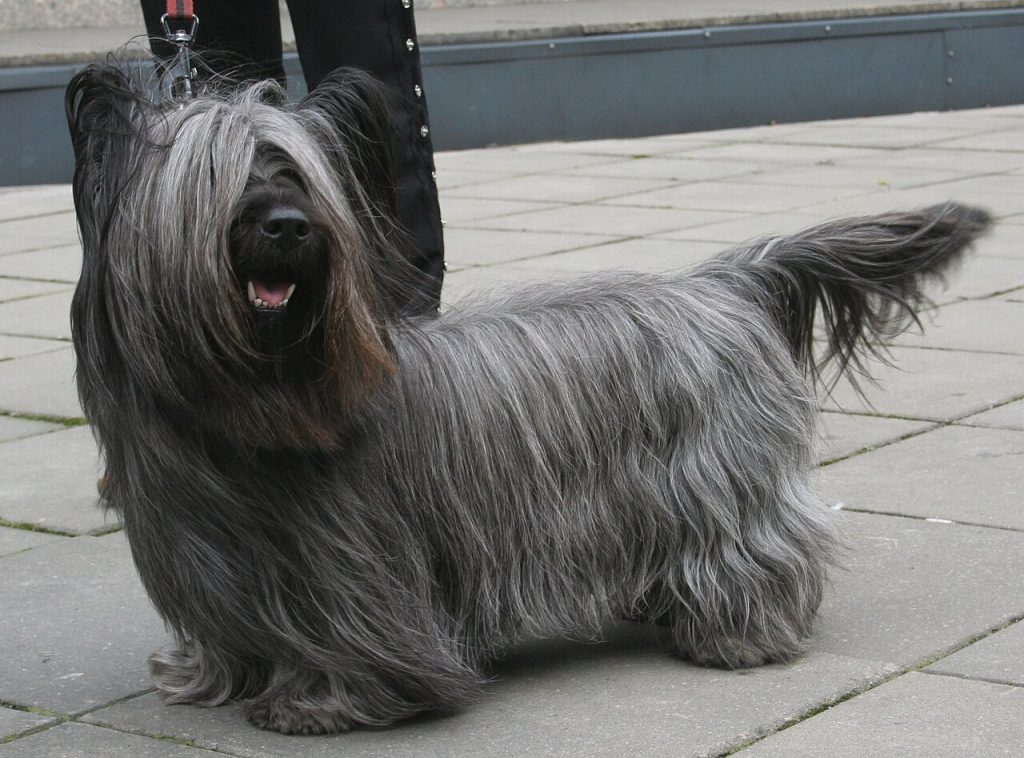
The Skye Terrier is one of Scotland’s oldest and most recognisable terriers: a long, short, short-legged dog, covered in a plump coat that gives it an elegant and somewhat haughty air. Beneath that mane is a tenacious hunter, a companion of almost legendary fidelity and, today, one of the rarest and most endangered breeds in the United Kingdom. If you are looking for a dog with a strong character, intense attachment, and unmistakable presence, the Skye Terrier deserves to be thoroughly known.
Is the Skye Terrier for you?

The Skye Terrier is not a dog for everyone. It is extremely loyal, quiet indoors and of moderate physical maintenance, but also stubborn, reserved with strangers and very apt to choose a single person as a reference.
In favour .
- Exceptional loyalty to his family, especially his reference person.
- He adapts well to life on the floor and prefers to be indoors.
- Need for moderate exercise: A good daily walk is sufficient.
- A quiet and dignified dog in the home, with presence and personality.
- Good guard of warning: alert to strangers without being scandalous by nature.
Against
- Stubborn and independent: education requires patience and constancy.
- Distrustful of strangers; needs intense early socialization.
- The long coat becomes tangled and requires brushing several times a week.
- Sensitive long back: risk of intervertebral disc problems.
- Rare and endangered breed: Finding a serious breeder puppy is difficult.
Character and temperament
Behind its majestic appearance, the Skye Terrier retains intact the mindset of the burrow hunter for whom it was bred. It is courageous, tenacious and with that stubbornness so characteristic of terriers: when it decides something, it is difficult to make it change its mind. It is not a submissive dog or especially complacent, and that is much of its charm for those who value a character with its own personality.
He is deeply affectionate and devoted to his family. It is a breed famous for its devotion, with a tendency to be one-handed dog: Chooses one person over the rest and devotes almost obsessive loyalty to him. With strangers, however, it is aloof and cautious, making it a good warning dog. He needs to feel busy and part of the family nucleus; he is not a dog to be left alone in a yard, because his balance depends on the company of his own.
Coexistence: children, other pets, flat and loneliness

The Skye Terrier fits well on a floor: it prefers home life outdoors and its low body does not claim large surfaces. With children it works best if they are older and respectful, able to understand that it is not a dog to grab or bark; its elongated back is delicate and abrupt handling can hurt it. It is not the most tolerant breed with the awkwardness of a very small child.
With other dogs it is advisable to go with caution because of their terrier temperament, brave and sometimes provocative, and with cats or small pets their latent hunting instinct may appear if they have not grown up together. As for loneliness, it is a strongly attached dog that does not like to be alone for a long time; it can accuse separation of stress. Good socialization from puppyhood softens their distrust and makes coexistence much more bearable on all fronts.
Education and training
Training a Skye Terrier is an exercise in patience. It is smart, but its independence and stubbornness make it not obey just to please: it must be motivated. Positive reinforcement, short and varied sessions and total consistency in rules work much better than imposition, which only gets it to close in on itself. Hardness is counterproductive with this breed.
The key piece is the early socialization: exposing it as a puppy to people, environments, noises and other animals to lower its natural suspicion of the unknown. Without that work, it tends to become overly reserved or defensive. Setting clear boundaries and a stable routine from the start gives this terrier the confidence it needs to show its best.
Exercise and activity
The Skye Terrier has a need for moderate exercise. A quiet daily walk with its owner and moments of exploration in a safe area are enough to keep it physically and mentally satisfied. It is not an athletic dog of endurance or long runs; it enjoys company and smelling more than pure wear.
There is an important and breed-specific caveat: during the first 8 to 10 months of life extreme exercise should be avoided, the jumps, climbing and descending obstacles and the very intense runs. Their bone development, conditioned by the short legs, is delicate; excessive straining before the growth plates close can lead to deformities, painful limping or arched legs.
Care: fur and hygiene

The coat is the Skye Terrier’s hallmark and also its main demand for care. It has two layers: a short and soft inner, and a long, smooth and hard outer that falls out of its sides. That long hair tends to tangle and flake, so it needs a regular brushing, about three times a week, to keep it healthy and knotless.
Unlike other terriers, frequent bathing does not soften the hair in a desirable way in this breed: Just an occasional bath. Special attention should be paid to the area around the eyes and mouth, where long hair retains moisture and debris and may require more frequent cleaning. Completing the routine with ear, nail and tooth checks keeps the Skye in good shape without major complications.
Foodstuffs
As a small-to-medium-sized dog with moderate activity, the Skye Terrier needs a balanced diet adjusted to its actual expenditure to avoid overweight, which in a long-backed breed is especially harmful: Each extra pound weighs on the spine and increases the risk of disc problems. A quality feed appropriate to their age and size, divided into two daily servings, is usually the simplest basis.
In the puppy stage, feeding is accompanied by a delicate bone growth, so it is advisable to use a product formulated for its phase and not overfeeding.
Health and life expectancy
The life expectancy of the Skye Terrier is around 11 to 12 years; a recent British study placed it at around 12.4 years, in line with the average of pure breeds.
The most characteristic problem is degenerative disease of the intervertebral disc, common in short-legged dogs and affecting up to 10% of Skye. A breed-specific hepatopathy has also been described (the so-called Skye Terrier hepatitis, not actually a classical hepatitis), which can cause severe liver damage and whose cause and heritability remain unclear. Causes of death include tumors such as hemangiosarcoma and breast cancer, as well as possible autoimmune or thyroid disorders. A responsible breeder, regular veterinary checks, proper weight and protection of the puppy’s back are the best prevention tools.
Physical appearance
The Skye Terrier is unmistakable: long, short and compact, with twice or more length than height. The head is long and not very wide, with a strong snout, and the short hair from the forehead falls off covering the eyes and forming a moderate beard. The neck is long and slightly arched, and the limbs, anterior and posterior, are short and muscular.
There are two varieties depending on the ears: upright(medium-sized, tall and slightly slanted outward) or falling(somewhat larger), without preferring one over the other beyond form. The long, smooth and hard coat supports lionskin, light or dark silver gray and cream; in all cases the standard asks for black spots on ears, muzzle and nose. A small white spot on the chest is acceptable. It is a small-sized dog, although its length and build give it a greater presence than its height suggests.
Origin and history
The Skye Terrier takes its name from the isle of Skye, in the Scottish Hebrides, and its origin dates back to at least the 16th century.
For a long time it was related to and confused with other Scottish terriers: In fact, Skye Terrier and Scottish Terrier were classified as one breed until 1870, when they were officially recognized as separate breeds. In the Victorian era it achieved great popularity, even in aristocratic circles. Today, however, is a critical moment: It is one of the most endangered native breeds in the UK, with birth rates so low that its continuity is seriously at stake.
Curiosities
- The Skye Terrier stars in one of the most celebrated dog loyalty stories: that of Greyfriars Bobby, the dog who, according to Edinburgh tradition, guarded his owner’s grave for years and has his own monument in the city.
- The Skye Terrier and Scottish Terrier were considered the same breed until 1870, when they were finally officially separated.
- It has a reputation for being a one-master dog, with a devotion to its reference person that the breed itself has turned into a symbol of loyalty.
- It is now the most endangered native breed in the UK – in some years just 30 puppies have been recorded in the whole country.
- Its eye-covering mantle is not only aesthetic – it derives from its original function, protecting it when entering narrow burrows.
If you are attracted to the Skye Terrier’s strong character and terrier air, you may want to compare it with other breeds with strong personalities and similar needs. Check out the Yorkshire Terrier, another long-coated British terrier; the versatile Dachshund, which shares its elongated body and short legs with its own back hazards; the intelligent and tenacious Border Collie if you’re looking for a hardworking Scottish dog; or the sleek and sociable Collie, another classic of the Scottish Highlands.
Frequently Asked Questions about the Skye Terrier
Is the Skye Terrier a good dog for beginners?
The Skye Terrier is affectionate and loyal, but also stubborn, independent, and suspicious of strangers, traits inherited from its past as a fox and badger hunter. A first-time owner can handle it well if he devotes time to early socialization and patient, constant upbringing; anyone looking for a submissive, easy-to-obey dog is likely to be frustrated.
How long does a Skye Terrier live?
The life expectancy is around 11 to 12 years. A British survey in 2024 placed the average at about 12.4 years on a small sample, in line with the average of purebred dogs. With good care, veterinary control and proper weight, many specimens exceed that figure.
Does the Skye Terrier shed a lot of hair?
It has a double coat, with a soft inner coat and a long, smooth, hard outer hair. It is not one of those that drop hair continuously in fists, but its long coat entangles easily, so it needs brushing several times a week to avoid knots and mats.
Can he live in a flat?
Yes. The Skye Terrier prefers family life indoors rather than outdoors, and its moderate activity level fits a floor whenever it receives its daily walk. Its short legs and elongated body mean it does not need large spaces, but it should be avoided from repeatedly going up and down stairs, especially as a puppy.
Is he aggressive or biting?
It is not a basic aggressive dog, but it is reserved with strangers and very protective with its reference person.
Do you get along with children and other pets?
With older children who know how to respect the dog can live well, but does not tolerate rough handling or pulling his hair, and with its elongated body it is sensitive to back injuries. With other dogs supervision is necessary for its terrier character, and with cats or small animals its hunting instinct can be activated, so coexistence depends on joint upbringing and socialization.
How much exercise does the Skye Terrier need?
A moderate daily walk and explorations in a safe area are enough to keep him in shape. The important thing in this breed is the quality, not the intensity: extreme exercise, jumping and very demanding running should be avoided during the first 8 to 10 months, because excessive exertion before the growth plates close can damage the bones.
Is it a rare or endangered breed?
The Skye Terrier is now one of the UK’s most endangered native breeds. In 2005 there were only about 30 puppies registered nationwide and in 2012 just 44, figures so low that the Kennel Club lists it as a vulnerable breed and warns that it could disappear in a few decades if the trend does not change.