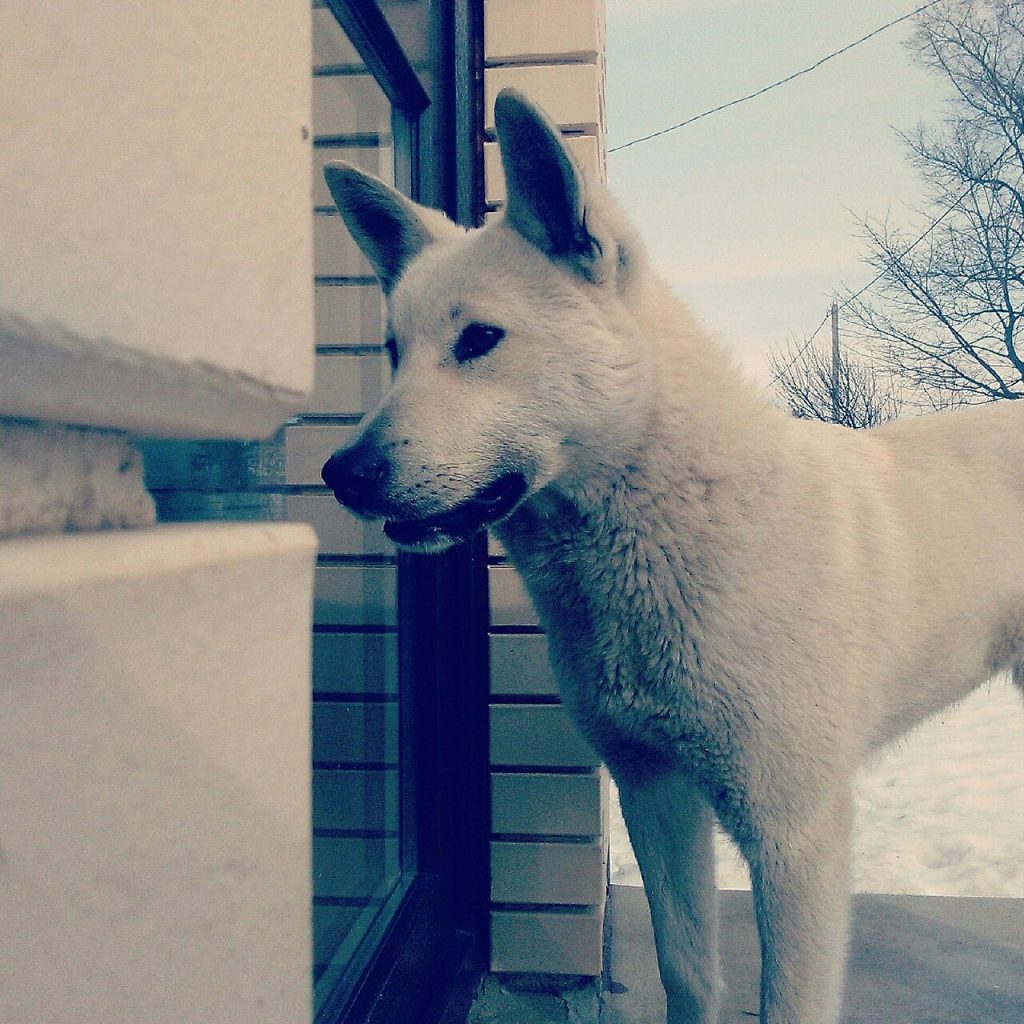
The Laika from Western Siberia is one of the oldest and most functional hunting dogs in northern Russia: a primitive spitz bred for centuries by the Mansi and Janty peoples of the Urals and the Siberian Plain to track and “bark” from squirrel to bear. If you’re looking for a rustic, tireless and deeply attached companion, the West Siberian Laika fits; if you’re looking for a couch dog that tolerates spending the day alone on a floor, almost no other breed will tell you so clearly that it doesn’t.
Is the Laika from Western Siberia for you?
This breed is neither a “fashionable” dog nor a companion stuffed animal: it is a live hunting tool, selected for its performance over generations and with very little tolerance for boredom.

In favour .
- Healthy and rustic: few hereditary flaws compared to other races.
- Outstanding intelligence and enormous ability to read its owner.
- Intense bond and loyalty to the family he grew up with.
- Excellent warning dog. Barks at strangers and wildlife.
- Resistant to extreme cold thanks to its double layer.
- A versatile hunter and tireless worker in the field.
Against
- He needs a lot of exercise and mental stimulation every day.
- High hunting instinct: unreliable loose without solid recall.
- It can be barking and “escapist” if bored or withdrawn.
- Territorial with same-sex dogs; reserved with strangers.
- Bad dog kennel or small flat with no exits.
- Rare outside Russia: difficult to find and breed well.
Character and temperament
The West Siberian Laika is primarily a loving and devoted to his master. dog. Russian sources documenting the breed describe it as an exceptionally intelligent and emotional animal, very observant of its human’s habits and mood, to the point of anticipating its intentions.
Their attitude toward strangers varies greatly from one individual to another. Most bark when someone approaches the house; some bark first and then wag their tails and accept caresses, while others keep their distance, dodging their hands and gazing suspiciously at the stranger. The standard notes that aggression toward people is not peculiar to the breed, but it is a dog with a strong territorial instinct that can become protective of its family and property. Many animals have difficulty accepting a new owner and need time to adjust to a new place.
Where it does not tolerate argument is on its hunting side: any Laika is a “barking show dog”, that is, it locates the prey and keeps it pointed at it by barking.
Coexistence: children, other pets, flat and loneliness
With his family the West Siberian Laika is affectionate and integrates well, including the children of the house, always with the supervision and mutual respect that any working dog demands.
With other animals you have to be realistic. It is a very territorial dog that can be aggressive with other intruding dogs of the same sex; in fact, breed guides recommend that an adult Laika, especially males, hunt only with dogs raised in the same household. He does, however, have a remarkable “friend or foe judgment”: naturally distinguishes wildlife from domestic animals and easily learns to leave cattle alone. Domestic cats are accepted, but a stray cat will be treated as prey.
The loneliness and the floor section is its biggest weakness. He ‘s a bad kennel dog . If left alone, locked in a small yard or enclosure, many develop the habit of barking for no apparent reason, trying to dig under the fence or jump over it, and even biting the metal fabric, damaging their teeth. It is not a breed to live in isolation or to spend the working day alone in an urban flat without long exits.

Education and training
We’re dealing with a brilliant dog, but brilliant in his own way: Think for yourself. Its intelligence and enormous sensitivity make it very receptive to a consistent owner who works with positive reinforcement and respect, and quite impervious to harsh imposition. It learns quickly what interests it – and hunting interests it above all else – so the key is to channel its instinct rather than fight it.
Two priorities in their education: the early socialization, to soften their natural distrust of the unknown, and a very solid recall, because their extraordinary interest in wildlife will make them run away chasing or “busting” an animal and stay away for a long time.
Exercise and activity
The activity need of this breed is very high. A well-exercised Western Siberian Laika, busy with hunting and with frequent contacts with other dogs, animals and people, is a happy, obedient dog and does not bark without reason.
Outside hunting season you need regular exercise in the form of long walks and hikes to stay healthy and fit. It is an excellent hiking and mountain companion for active people who walk a lot; in fact, sources describe it as a magnificent “therapy dog” for energetic people who enjoy the mountain. Of course, their interest in wildlife demands special attention in the open.
Care: fur and hygiene
The Laika from Western Siberia wears a double coat: rough and straight guard hair on the outside, and a thick and soft inner blotch. In the neck, around the head and on the shoulders the guard hair is especially long and stiff and, together with the undercoat, forms a droplet that frames the dog’s face. The tail hair is also longer and denser than the rest of the body. In winter, individuals living in cold climates develop hair between their fingers.
The quality of the coat varies with the individual and, above all, with the climate: Dogs raised in cold countries have longer and thicker coats than those that live in warm climates or spend a lot of time indoors. In terms of maintenance, it is a functional and low-maintenance coat the rest of the year, but with intense seasonal changes in which it loosens the undercoat into locks: in those weeks it needs frequent brushing. The rest of the time, a weekly brushing and bathing is all that is needed, so as not to spoil the mantle’s natural watertightness.
Foodstuffs
As a Nordic working dog, the West Siberian Laika performs best with a complete, quality diet, adjusted to its actual activity level: It doesn’t eat as much as a specimen in the middle of the hunting season traveling miles a day as the same dog in winter rest. The rule is simple: adjust the ration to the workload and monitor the body condition so that it remains fibrous and muscular, never overweight.
Split your food into two servings a day, avoid strenuous exercise just before and after eating, and always have fresh water available, especially after long outings.Any change in feed should be made gradually, and the quantities and type of diet most appropriate for your age and lifestyle should be discussed with your veterinarian.
Health and life expectancy
One of the great assets of this breed is its rusticity. Proceeding from aboriginal types selected for centuries for their function and not for their appearance, the West Siberian Laika retains healthy genetics and a low rate of hereditary diseases compared with many modern closely related breeds. Their life expectancy is usually around 10 to 14 years, in line with other medium-sized working spits.
This doesn’t mean I’m immune to anything: As with any medium-sized dog, it is advisable to monitor joints (hip dysplasia), dental health – the standard mentions how the bite may change with age – and the personal care of a hunter working in the wild (check pads, ears, eyes and parasites after exits). Choosing a serious breeder, working with functional and healthy specimens, is still the best health policy.
Physical appearance
The West Siberian Laika is a dog of spitz type medium to large size, lupine appearance and almost square proportions, with the athletic and balanced anatomy of its wild ancestors.
The head has the shape of a triangular wedge, flat above and wider between the ears; in the mantis type it is longer and in the janty type wider and with a somewhat shorter snout. eyes s are almond shaped, medium-sized, sunken and clearly oblique, brown to dark brown in color (the standard penalizes other colors). ears are always upright and pointing upwards, pointed or with the tip slightly rounded. The tail is worn high, screwed over the back, with the tip resting on the back.
On the colour, the most common are wolf gray, pale red and white. The gray can range from almost white to very dark, almost black, and mix with red to give brown and reddish tones; specimens may show white spots in varying proportions. A characteristic feature is the “zonary” pattern of the guard hair: Each hair has alternating bands of white with black, brown or red, just like the wolf’s fur.

Origin and history
The Western Siberian Laika descends from primitive dogs that accompanied humans since prehistoric times, the type that in much of the world was replaced by cultivated, specialized, dropped-eared breeds. In the vast and sparsely populated northern regions of Russia this replacement came much later, and the aboriginal lay types were preserved alongside hunters from the more remote provinces.
The very name explains it all: In Russian, layka comes from layat, “bark”, so Laika literally means “barking dog”. During the 19th century, Russian experts distinguished dozens of varieties of aboriginal laiks, each associated with an indigenous people, but none was considered pure or recorded. Deforestation and industrialization in the late 19th and early 20th centuries hastened their demise.
To save them, Russian breeders brought specimens from different provinces to cities in the European part of the country and bred them in purity. From the 1930s onwards, and especially after the Second World War, four races were established: the Karelian-Finnish, the Russian-European, the West-Siberian and the East-Siberian Laika. There was no standard or record of the Western Siberian Laika as such until 1930; the war interrupted work and systematic breeding with records resumed in 1946, when the breed began to take its modern form. Before that hunters only spoke of mansi laika and layka janty; even in the early sixties many Ural hunters preferred the old term. Of the four breeds, the West Siberian became the most popular and today is by far the most numerous Laika, far beyond its area of origin.
Curiosities
- Bear hunter and “guardian” against them. Dogs of this type have been used successfully to reduce human-bear conflicts in the U.S., Canada, and Japan.
- It barks differently depending on the prey. When a Laika barks at a bear, its voice sounds threatening, almost as if it is barking at a person, very different from the routine, repetitive tone with which it warns of a squirrel.
- It’s not a sled dog. Although it comes from the cold, the Mansi and Janti never used a good hunting dog to pull the sled: for that they used another larger dog, the “Yezdovaya Laika” or sled Laika.
- Two “types” within the race. The mansi type (longer head) and the janty type (broader head) live under the same standard and recall their two aboriginal lineages.
- Start hunting alone. Just take the puppy into the forest and let him go: because of his extraordinary hearing, they start locating squirrels between 4 and 10 months of age.
If you are attracted to this northern working spitz, you may be interested in other high-energy Nordic breeds with strong character. You can continue to explore the Husky Siberiano, Samoyedo, Akita or Chow Chow, all of them primitive, independent and with their own marked personality.
Frequently Asked Questions about the West Siberian Laika
Is the West Siberian Laika a good dog for a flat?
It’s not his ideal environment. He’s a bad kennel and locker dog: if he spends the day alone and without exercise, he usually barks for no reason, tries to escape by digging or jumping, and even bites fences.
How long does a West Siberian Laika live?
It is a rustic breed, with healthy genetics and a low rate of hereditary diseases compared to many modern breeds, thanks to its function-selected aboriginal origin.
Do you get along with other dogs and cats?
It is very territorial and can be aggressive with intruding dogs of its own sex; adults, especially males, should hunt only with dogs from their own household.
Is it hard to educate?
It’s very intelligent and sensitive, which makes it receptive to positive reinforcement, but it’s also independent and has a very high hunting instinct.
How much exercise do you need?
It needs intense daily activity: long walks, excursions and mental stimulation, especially outside the hunting season. Well exercised it is obedient and calm; without exercise it becomes barking and escapist.
Do you lose a lot of hair?
It has a double coat with thick undercoat and performs intense seasonal moults in which it loosens the undercoat in strands; in those weeks it needs frequent brushing.
Where does the West Siberian Laika come from?
From the Urals and the plain of Western Siberia, from the hunting dogs of the Mansi and Janty people. It was established as a breed with modern registration around 1930 and, after World War II, in 1946, took its current form.
Does it serve as a guard dog?
It is an excellent warning dog: most bark at strangers and the presence of wildlife, and is naturally protective against wild animals. It is not a guard dog, but its territoriality and barking make it a magnificent warner, widely used even to alert of the presence of bears.