The Nova Scotia Duck Tolling Retriever is the smallest of the collection dogs and probably the most original of all. Born on Canada’s Atlantic coast for an unusual task – to lure ducks to the hunter by imitating the movements of a fox – it combines the liveliness of a tireless working dog with the affection of a family companion. If you’re looking for a dog that’s smart, athletic, sociable and has almost endless energy, the Nova Scotia Retriever deserves your full attention.
Is the Nova Scotia Retriever for you?
The Nova Scotia Retriever is a wonderful breed, but it’s not for everyone. It’s a working dog with a racing engine tucked into a medium body, and that greatly affects the life of the person who chooses it. Before you fall in love with its beautiful copper coat, it’s best to look directly at what it asks for in return.
In favour .
- Smart and very easy to motivate for training.
- Handled size: the smallest of the collectors.
- Loving and excellent with the kids in the family.
- Athletic, healthy in general and with a good life expectancy.
- Passionate about water and any canine sport.
- Sturdy coat that doesn’t need a hairdresser.
To be taken into account
- Very high energy: needs daily exercise and stimulation.
- He gets bored and can become destructive if you leave him alone too long.
- Reserved with strangers: requires early socialization.
- Strong prey instinct towards cats and small animals.
- The “tolerant scream”, its high-pitched scream of excitement, is surprising.
- Abundant seasonal muta and predisposition to immune problems.
In short, if you lead an active lifestyle, enjoy outdoor sports, and can spend quality time doing them, it will give you years of complicity. If you spend many hours away from home or are looking for a quiet couch dog, there are breeds that will suit you better.
Character and temperament
Temperament is perhaps what best defines this breed. The Nova Scotia Retriever is an alert, curious, alert dog with an energy that doesn’t fade easily. He is affectionate, eager to please, and “busy” by nature: He’s always got something on his hands. That combination of head and motor makes it a hilarious companion for those who can channel it, and a little whirlwind for those who can’t.
He’s a workaholic from head to toe, and that means he’s happy when he’s got a job to do. It ‘s not enough for him to go for a walk . You need to think, resolve and participate. In return, he offers a huge gift, an intense connection to his family and an infectious joy. Her passion for collecting objects, her “birdiness” and her love of water are part of her essence.
With its people it is expressive and demonstrative, but with strangers it is cautious and somewhat reserved. It is not an aggressive dog or a scandalous barker; in fact, its most characteristic sound is not a barking but the so-called “toler scream”, a sharp howling that it emits when excited and that many describe as “singing”.
Coexistence: children, other pets, flat and loneliness

Living with a tolerant depends a lot on how well you meet their needs.
- With children: is an excellent family dog and gets along very well with children. His energy and playfulness make him a good playmate, always with the supervision and mutual respect that any dog demands.
- With other dogs: usually gets along well with its congeners, especially if it has been socialized since puppyhood.
- With cats and small animals: here you have to be careful. It has a marked prey instinct and can chase cats or other animals. If you live with a cat from a young age, the thing usually works; late introductions are more complicated.
- On the floor: can live in an apartment as long as it is guaranteed plenty of daily exercise and mental stimulation.
- In the face of loneliness:‘s weak point is that if he spends too much time alone or inactive, he can become destructive.
- Early exposure to new people, places, smells and situations is crucial for him to grow balanced.
Education and training
Few breeds do training as gratefully as the Nova Scotia Retriever. It’s very intelligent, has a strong drive to collect, and lives to please its guide, so it learns quickly and enjoys the process. Positive reinforcement – rewards, play, and most of all, throwing something at it to bring it in – works wonders for it.
The key is not so much in “teaching him to obey” as in giving him structure and mental work. A bored tolerator invents his own activities, and you will rarely enjoy them. Short, varied, motivating sessions yield much more than monotonous repetition.
Early socialization is another big priority. Because of their cautious nature, a poorly socialized tolerant may end up being shy, nervous, or reactive as an adult. Exposing them as puppies, positively, to all sorts of stimuli is the best investment you can make in their education.
Exercise and activity
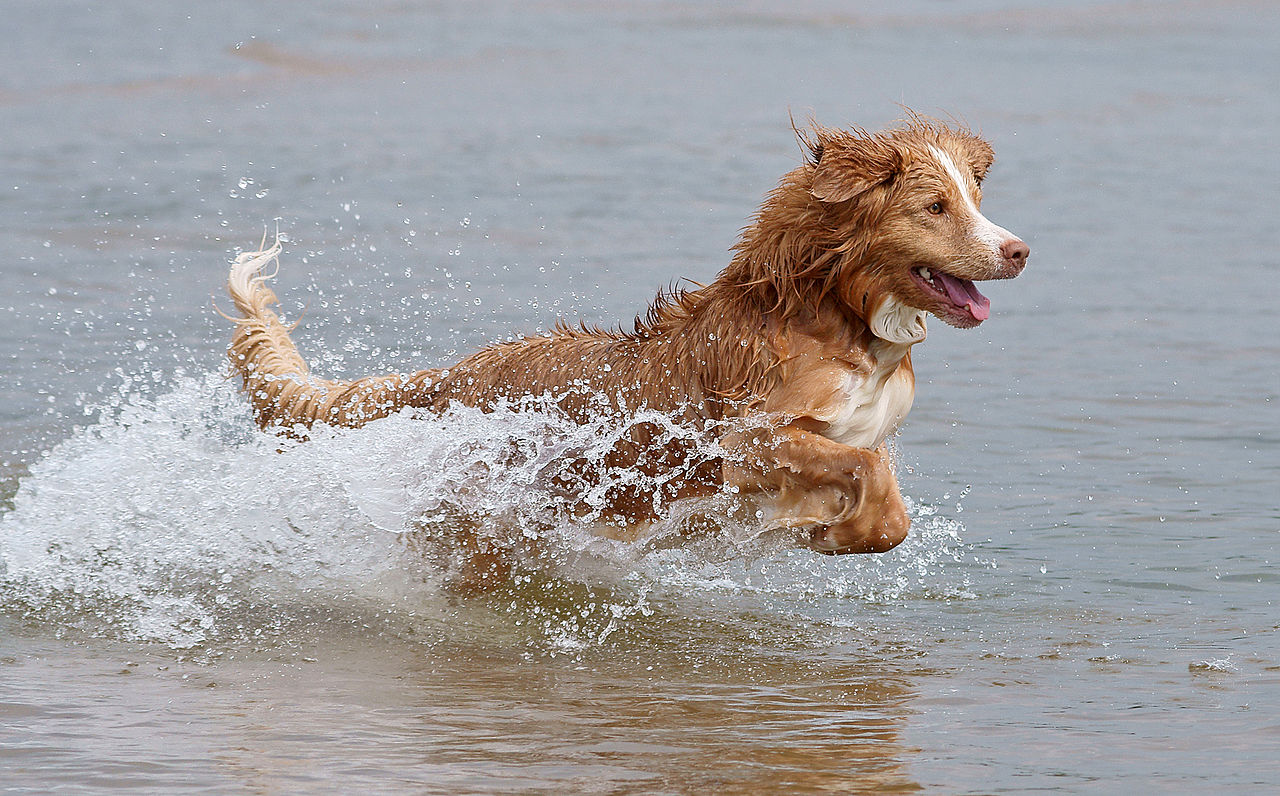
If there’s one thing that’s non-negotiable in this breed, it’s this: the Nova Scotia Retriever needs exercise every day, and not just a little. We’re talking about a dog bred to spend hours in and out of the water, with endurance and a genuine love of work. A couple of short walks aren’t enough.
The ideal is to combine physical and mental expenditure: running, collectibles, swimming, long walks and, especially, dog sports. The toller shines in agility, dock diving, obedience, flyball, disc dog, lure coursing and mantrailing.
When you don’t get enough activity or you’re left alone for too long, problems arise: distractions, anxiety, and repetitive behaviors.
Care: fur and hygiene

The maintenance of the coat is surprisingly simple for such a showy dog. The toller has a double coat, water-repellent, medium-length and soft, with a dense undercoat. It is a “working” coat, designed to dry quickly and protect from cold, not for hairdressing.
The weekly brushing is usually enough to keep it in good condition, intensifying it during the seasonal mowing, which are notable: in those times you will lose a lot of hair and you will be grateful to brush it more often.
As with any breed, it completes its routine with ear checks and cleanings, nail trimming, and regular dental hygiene, and since it loves water, it is wise to dry its ears thoroughly after bathing or bathing to prevent infection.
Foodstuffs
As a medium-sized, extremely active dog, the Nova Scotia Retriever needs a quality diet that covers its energy expenditure. The exact amount depends on its age, weight, activity level and metabolism, so it is best to adjust it by watching its body condition: you should be able to feel its ribs without over-marking them.
If you have any questions about rations, dietary changes, or supplements, your veterinarian is the best advisor. If you have any questions about rations, dietary changes, or supplements, your veterinarian is the best advisor.
Health and life expectancy
Overall, the Nova Scotia Retriever is a robust dog. A British study from 2024 placed its life expectancy at around 13 years, above the average of purebred dogs.
The most relevant problems described in the breed are:
- Immune disorders include: breed clubs point to immune system conditions as their biggest challenge, including immune-mediated rheumatic disease and corticosteroid-responsive meningitis-arteritis.
- Eye problems: highlights progressive retinal atrophy (PRA), which affects about 7% of specimens, and collie eye abnormality, of minor incidence.
- Dysplasia of the hip: present as in many medium to large dogs.
- Autoimmune thyroiditis is caused by: identified as a priority by breeders; may run with weight gain, skin and hair problems or cold intolerance.
- Addison’ s disease is characterized by: with an incidence much higher than the canine average, so it is especially monitored.
- Epilepsia and some case of a breed-specific cleft palate.
The good news is that there are genetic and health tests for several of these diseases (eyes, thyroid, a form of Addison’s and a cleft palate), which is why it is so important to go to responsible breeders who do these tests on the breeders.
Physical appearance
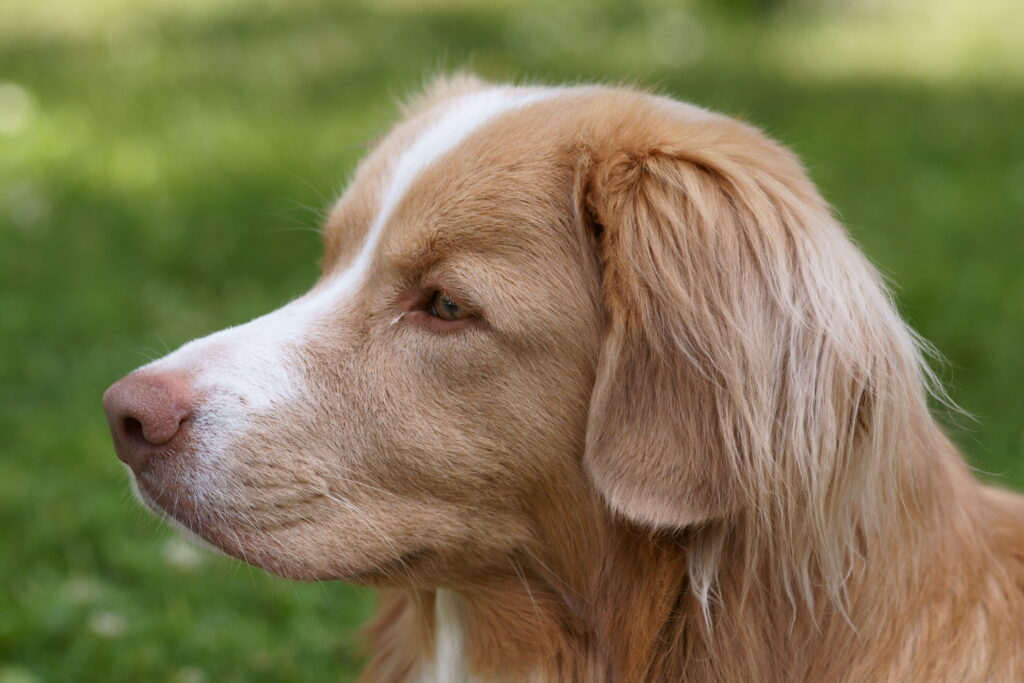
The Nova Scotia Retriever is the smallest of the collector dogs and, at first glance, resembles a miniature Golden Retriever, although it is more compact, athletic and mentally awake.
It is medium-sized, moving at an approximate height of between 43 and 53 cm at the withers (the females slightly smaller than the males) and a weight of around 17 to 23 kg. Its legs are strong and, a curious detail, palmed, which betrays its aquatic vocation.
The mantle is double and water-repellent, of medium length, straight (can wave slightly at the back) and with soft and moderate fringes. The color is always some shade of red, from golden red to dark coppery, with lighter areas on the underside of the tail and body. It is very common to have white marks on the tip of the tail, chest and feet, although their absence is not considered a defect. The head, clean and slightly concave, evokes that of a fox; the ears are triangular and of high insertion, and the expression, kind, alert and intelligent, with amber to dark brown eyes.
Origin and history
The history of this breed is as unique as its way of working. It was developed in the early 19th century in the Acadian community of Little River Harbour, in Yarmouth County, southwest of Nova Scotia, Canada. Hence their first names: “Little River Duck Dog” and “Yarmouth Toller”. Their exact origins are not entirely clear, but it seems that the mixture involved retrievers, spaniels, setters, and possibly some farm collies.
Its original function gave it the name: the “tolling”. The hunter would hide and send the dog to play on the shore, throwing a stick or a ball. With its reddish fur, lively movements, and white markings, the dog looked like a fox and aroused the curiosity of ducks and geese, who swam up to investigate. When the birds were shooting, the hunter called the dog, joined in to lift the birds, and after the shot, the toller collected the pieces, even in icy waters thanks to its double mantle.
The Canadian Kennel Club officially recognized the breed in 1945. National recognition came in 1980 and, in 1995, it was declared the provincial dog of Nova Scotia. The American Kennel Club fully admitted her to its sports group in 2003. It was on the brink of extinction and recovered thanks to the work of Canadian and Scandinavian breeders, who today remain key to preserving its genetic diversity.
Curiosities
- It attracts ducks by imitating a fox: the “tolling” is a unique hunting behavior among collectors and gives the breed its name.
- The “tolerate scream”:‘s most famous sound is not a barking, but a high-pitched howl of pure emotion that many describe as singing.
- Folded legs: an unusual trait that improves his swimming and betrays his aquatic origin.
- He’s the smallest collector: is often mistaken for a young Golden Retriever, but is more compact and active.
- Provincial dog of Nova Scotia: an official honor that very few races share with their homeland.
- Distant relative: shares a similar working method with the Dutch Kooikerhondje, another small duck claim dog.
If you are attracted to the Nova Scotia Retriever because of its collective, athletic, and family side, you may be interested in other related breeds. His affinity with lizards brings him closer to the Golden Retriever and Labrador Retriever, two classic family collectors. For those looking for a more rustic cold water charger, the Chesapeake Bay Retriever is a powerful option; and, remembering the spaniel component of its ancestry, the Cocker Spaniel is worth knowing.
Frequently Asked Questions About the Nova Scotia Retriever
Is the Nova Scotia Retriever a good family dog?
Yes, he’s affectionate, playful and gets along very well with children, which makes him a good family dog.
How much exercise does a toller need?
It is a very high-energy working dog that requires daily physical and intellectual activity: running, swimming, gambling and dog sports. Without enough exercise, it tends to get bored and develop destructive behaviors.
Why is it called a duck tolling retriever?
For its hunting method, the “tolling”: it plays on the shore imitating a fox to arouse the curiosity of the ducks and attract them to the hunter.
Is it hard to train?
Quite the opposite: he’s very intelligent, eager to please, and highly motivated to collect, so he learns quickly with positive reinforcement.
What’s the “tolerate scream”?
It is a characteristic sound of the breed: a high-pitched howl, almost a song, that the dog emits when he is very excited.
How long does a Nova Scotia Retriever live?
It is a long-lived breed for its size. A British study from 2024 estimated its life expectancy at around 13 years, above the average of purebred dogs, always with good care and veterinary checks.
Can he live in a flat?
Yes, its medium size allows it, but with one inescapable condition: it needs a lot of exercise and daily stimulation.
Do you get along with cats and other animals?
With other dogs it usually gets along well if it is socialized. With cats you have to be careful because of their strong prey instinct: if they live together from puppyhood the thing works, but late introductions are more complicated.