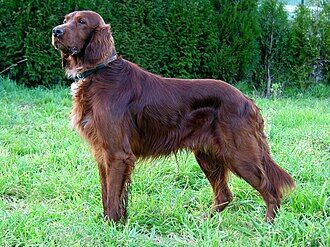
The Irish Setter is one of the most spectacular dogs in existence: a mahogany-red cloak that glows in the sun, an athletic body made to run for hours and a loving, sociable, eternally young character. Born in Ireland as a show dog for bird hunting, today he is mostly an active family companion. Before you fall in love with her mane, you should know that behind that elegance is a demanding athlete who needs movement, companionship, and patience.
Is the Irish Setter for you?
The Irish Setter is not a dog for any household. It is brilliant physically and emotionally, but it demands a level of activity and dedication that not everyone can give. Here’s the honest summary before you continue reading.
In favour .
- Loving character, cheerful and very sociable with people.
- Excellent with children when supervised for their size and energy.
- Intelligent and sensitive: learns quickly with gentle methods.
- Ideal companion for people who play sports (running, hiking, canicross).
- Pretty as hell, with that unmistakable red cape.
- A good therapy dog because of his temperament and sweetness.
To be taken into account
- He needs plenty of daily exercise; bored, he becomes destructive.
- It matures late: it keeps its puppy attitude for years.
- Fur with fringes requires frequent brushing to avoid tangling.
- Prolonged loneliness is not good for him – he suffers and is frustrated.
- Their instinct for sample and chase calls for control of the release.
- Some specimens have digestive sensitivity to gluten.
Character and temperament
If we had to define the Irish Setter in one word, it would be enthusiasm. It is a loving dog up to its marrow – the British standard goes so far as to call for it to be “demonstrably affectionate” – that lives by its family and enjoys human company like no one else. It is neither a watchdog nor a suspicious dog: its natural tendency is to greet the world by wagging its tail.
Such joy is accompanied by an overflow of energy and slow emotional maturity. While other breeds settle down by age two, the Irish Setter can behave like a naughty teenager until age three or four. He’s clueless, playful and sometimes a little “clownish”, which is charming but also exhausting if not channeled. It’s sensitive to tone of voice and conflict, so it responds much better to positive reinforcement than to harshness.
Behind the apparent frivolity is a serious working dog who inherited from his hunter ancestors a remarkable concentration when detecting a trail, enormous stamina and a fine sense of smell. That contrast – silly and sweet at home, focused and professional in the field – is part of its charm.
Coexistence: children, other pets, flat and loneliness
- With children: is one of its strong points. Tolerant, playful and peaceful, it fits very well in families with small children. The only precaution is its size and its enthusiasm: a puppy of 30 kilos can unintentionally pull a small child, so it is advisable to supervise and teach calm play by both parties.
- With other dogs: is usually very sociable and enjoys canine company, especially if it has been well socialized as a puppy.
- With cats and other pets:‘s hunting instinct comes into play here. Raised from a young age with a cat it can coexist without problems, but with small animals (rodents, birds) its chase impulse can be activated. Early and gradual introduction is key.
- On the floor: is not impossible, but it is demanding. An Irish Setter can live in an apartment as long as he receives several hours of exercise a day and company. Without that, his energy is transformed into barking, nibbling and stress. Ideally, a house with a well-fenced garden, although the garden is never a substitute for long walks.
- Soledad: is your big Achilles heel. It’s a very attached dog that doesn’t like to be alone for long hours. Prolonged loneliness causes separation anxiety, with breakdowns and vocalizations. It’s not the right breed for someone who spends all day outdoors.
Education and training
The Irish Setter is intelligent and quick to learn, but it is not the typical “obedient and helpful” dog that lives to please. It has its own agenda, is easily distracted – especially by any interesting smell or bird – and its long period of immaturity makes constancy essential. It is a perfectly trainable dog, provided you understand how its head works.
The key is the positive reinforcement: prizes, games and a lot of excitement. It is a sensitive dog that “shuts off” or gets nervous with harsh methods or yelling. The sessions should be short, dynamic and fun, taking advantage of their playful nature to keep you engaged. Early socialization – people, noises, other animals, environments – is essential for that outgoing puppy to grow into a balanced adult.
The most important command in this breed is the called(come when called). Its instinct to sample and chase makes, without a solid call, releasing it in open areas risky: it can shoot out after a trail and disregard the world. Working the call from a puppy, with very valuable reinforcements, avoids many annoyances.
Exercise and activity
Here is the heart of the breed. The Irish Setter was bred to cover large areas of ground at a gallop, searching for birds for hours without tiring. That machinery is still intact in the modern companion dog: it needs intense and daily exercise, not a walk to the block.
We talk about long walks, running and, above all, the opportunity to run loose in wide and safe spaces. It is an excellent companion for runners, cyclists and hiking enthusiasts, and shines in canine sports such as agility, canicross or field trials. A well-trained Irish Setter is a calm and happy dog at home; one that does not burn its energy becomes a destructive whirlwind. As a reference, think of a minimum of one to two hours of daily activity, combining physical and mental stimulation.
Don’t forget mental fatigue: Smell games, stuffing toys, and small obedience challenges supplement physical exercise and help to satiate that restless mind.
Care: fur and hygiene
The coat of the Irish Setter is of moderate length, silky and with fringes(the longest hair) on the ears, chest, back of the legs, belly and tail.
In winter it develops a more abundant undercoat, so the moult is remarkable. Bathing is done when necessary, with soft products, and it is advisable to dry and comb the fringes well. The drooping ears s deserve special attention: Because they are poorly ventilated, they retain moisture and are prone to infection, so they need to be checked and cleaned regularly. Complete your routine with nail trimming, dental hygiene, and checking your eyes and pads, especially if you’re out in the field.
Foodstuffs
As a large, athletic and very active dog, the Irish Setter needs a quality diet that covers its energy expenditure without going over portions. A balanced diet, adjusted to its age, weight and activity level, maintains its musculature and the shine of its coat.
There is a peculiarity of the breed: some specimens have gluten sensitivity(an enteropathy of genetic origin, which we will see in the health section). In affected dogs, a gluten-free diet completely controls the digestive symptoms.
As with all deep-chested breeds, split the food in two. is recommended instead of a single abundant one and avoid intense exercise just before and after eating, a sensible precaution against the risk of gastric torsion.
Health and life expectancy
The Irish Setter is, on the whole, a robust and long-lived dog for its size. Its life expectancy is around 12 or 13 years; a large British study from 2024 estimated an average of 12.9 years, above the purebred average.
The breed’s most characteristic condition is gluten-sensitive enteropathy, a genetically based digestive disorder (autosomal recessive inheritance) related to human celiac disease. It usually manifests in puppies, about 4-7 months, with inflammation of the small intestine, worse absorption of nutrients and diarrhea when they consume gluten. The good news is that dogs fed a gluten-free diet from the start don’t develop the symptoms. Another documented predisposition is atypical dermatitis(skin allergy), which is associated with itching and skin problems.
In addition, as a good big, deep-chested dog, it is prudent to know the signs of gastric torsion/dilatation and monitor the joints throughout its life. Acquiring the puppy from a responsible breeder, who performs health tests on the breeders, and maintaining regular veterinary checkups, good nutrition and proper weight, are the best recipe for it to reach healthy old age.
Physical appearance
The Irish Setter is elegance made of dog. Large in stature, athletic lines and aristocratic demeanor, it conveys agility and nobility in every movement. Males measure, according to the FCI standard, between 58 and 67 cm at the withers, and females between 55 and 62 cm; some exhibition line specimens reach larger sizes. The weight is approximately 29 to 34 kg for males and 25 to 29 kg for females.
Its unmistakable feature is the colour: a layer of a deep red, mahogany or brown colour, with no trace of black. The hair is medium-length, fine and silky, smooth, with those characteristic fringes on the ears, chest, legs and tail that give it its fluid silhouette. It has a deep chest and a narrow waist, a long and refined head, low and sloping insertion ears, and dark eyes of sweet expression. The medium-length tail reaches almost shoulder height and joyously accompanies its light, elastic trot. There is also a historical variety, the Irish Red and White Setter, considered a separate breed.
Origin and history
The Irish Setter – Sotar Rua, “red setter” in Irish – has its roots in 18th-century Ireland, where show dogs were selected for bird shot hunting. Those early Irish setters weren’t uniform reds: Red and white specimens, or varied shades, predominated. The preference of breeders and, later, of exhibitions for solid red gradually shaped the image we recognize today.
The breed gained fame for its canine skills throughout the 19th century. In Dublin the club dedicated to the Irish Red Setter was founded around 1882, and the modern standard was set by the Irish Red Setter Club, approved on 29 March 1886 with a scoring system that was later simplified but which, in essence, is still in force. The dog was exported in large numbers to the United States starting in the 19th century, where it became a regular of the exhibition rings.
That success in beauty came at a cost: By the mid-20th century, the Irish Setter had almost disappeared from field trials as a working dog. To recover their hunting skills, the modern, lighter and more functional working Red Setter emerged around initiatives such as those of Ned LaGrande and the National Red Setter Field Trial Club in the United States. Hence the dual identity of the race: the exposition line, luxurious and long-coated, and the field line, more compact and athletic.
Curiosities
- Its Irish name, Sotar Rua, literally means “red setter”.
- U.S. President Richard Nixon had an Irish Setter named King Timahoe, a gift from his White House team for his 56th birthday in 1969.
- Tsar Alexander II of Russia owned an Irish Setter named Milford.
- There is a sister and older variety, the Irish Red and White Setter, recognized as an independent breed.
- Thanks to its gentle and balanced temperament, it is used as therapy dog in hospitals and schools, where it helps create a calm environment.
- Its sense of smell is so fine that it can detect the trail of prey hours after it has passed.
- Although bred for dry, open country, they do not disgust the water: they have also been used in waterfowl hunting.
If you’re attracted to the Irish Setter, I’m sure you’re interested in other breeds in their world. Within the setter family you have his cousin the English Setter, spotted cape, and the sleek Gordon Setter, black and fire. If you’re looking for a sample dog that’s just as energetic and clingy, the Hungarian Vizsla is a great alternative. And for those who want a sporty family companion but something more manageable, the ever-nice Golden Retriever shares many of its virtues.
Frequently Asked Questions about the Irish Setter
Is the Irish Setter a good family dog?
Yes, it is one of his strengths. He is affectionate, sociable and very tolerant of children. The only condition is that the family is active and give him the exercise and company he needs, and that the play with small children is supervised by their size and enthusiasm.
How much exercise does an Irish Setter need?
It’s a dog bred to run for hours, so it asks for at least one or two hours a day of intense activity, with long walks and loose running in safe areas.
Does the Irish Setter shed a lot of hair?
It has a moderate coat that intensifies in winter, when it develops more undercoat. It is not one of the dogs that shed more hair, but its silky coat with fringes needs brushing several times a week to prevent knots and keep it beautiful.
Is it hard to train?
He’s smart and he learns fast, but he’s also clueless, playful and he matures late, which requires consistency. With positive reinforcement, short, fun sessions, and working very well on the call from a puppy, he responds greatly. Hard methods hurt him.
Can he live in a flat?
It can, but it’s not ideal. If you get several hours of exercise a day and company, you adapt to an apartment. What you really need is not square meters, but to go out and spend energy; without that, you will suffer in any dwelling.
How long does an Irish Setter live?
Their life expectancy is around 12 or 13 years. A British study from 2024 estimated an average of about 12.9 years, a good figure for a dog of its size.
Why can’t some Irish Setters eat gluten?
Because the breed has a genetic predisposition to gluten-sensitive enteropathy, similar to human celiac disease. Affected dogs, which usually show symptoms around 4-7 months, develop intestinal inflammation and diarrhea with gluten, but remain asymptomatic on a gluten-free diet.
Do you get along with children and other dogs?
It is peaceful and playful with children and sociable with other dogs, especially if it socializes as a puppy. With cats and small animals it is advisable to take into account its hunting instinct and make early and gradual introductions.