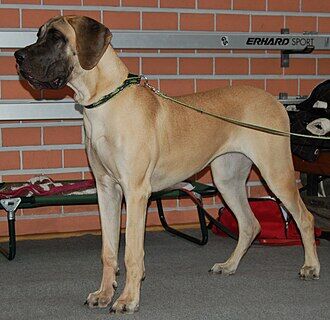
The Gran Danés is one of the most imposing dogs in the world: a German giant with a noble head, athletic body and serene gaze whom the International Canine Federation christened the “Apollo of the races”. Beneath that intimidating coat hides a quiet, affectionate companion deeply attached to his family, the so-called “gentle giant”. Before you fall in love with his image, you should know that he lives only a few years and that his size makes him a great responsibility. In this comprehensive guide we review their character, care, health and everything you need to decide if the Great Dane is your dog.
Is the Great Dane for you?
The Great Dane is not a dog for everyone. Its balanced character and affection make it wonderful in the right home, but its size drives up costs, takes up space in any corner and, above all, its short life expectancy demands an emotional maturity that not everyone is prepared to take on.
In favour .
- Sweet temperament, quiet and very affectionate: the classic “gentle giant”.
- It usually gets along well with children, people, and other pets if socialized early.
- Short hair and easy maintenance, no endless brushing.
- He barks little and is not nervous in the house; he is generally calm.
- Their mere presence is a formidable deterrent without the need for aggression.
To be taken into account
- Very short life expectancy for a dog: 8 to 10 years on average.
- Very high costs on food, veterinary, medication and XXL accessories.
- Prone to gastric torsion and heart and joint problems.
- It grows at a tremendous rate – the puppy needs measured exercise and careful diet.
- He needs space, and everything in your house happens to be within reach.
Character and temperament

Behind its colossal appearance, the Great Dane hides a surprisingly gentle nature. It is a self-confident, serene and not shy dog, which rarely shows gratuitous aggressiveness or an exaggerated prey instinct. The breed has earned the nickname “gentle giant” because it combines the physical strength of a moose with the sensitivity of a companion dog.
His most characteristic trait is attachment. The Great Dane loves to be close to his people: sits on your feet, leans those forty or fifty pounds against your leg and claims to be a part of every family moment. Not surprisingly, it is described as “the world’s largest lap dog”. He’s loyal, proud and very expressive, with an intelligent look that betrays how well he understands his surroundings.
Of course, this balance is not automatic. A poorly socialized Great Dane may become suspicious or reactive to strangers, noises, or new environments. Because of its size, any slip in behavior weighs a lot more than a small dog, so its docile character must be cultivated from puppyhood with patience and constancy.
Coexistence: children, other pets, flat and loneliness
The Great Dane is an eminently family dog and, well-behaved, fits into very different households.
- With children: is usually affectionate and patient, especially if you grow up with them. Its only “but” is the size: from a kick or a push it can throw a small child unintentionally, so it is advisable to supervise the game.
- With other pets: is generally tolerant of other dogs and pets, without a marked hunting instinct.
- On the floor:, although it seems contradictory, can live on the floor because inside the house it is very quiet and sleeps a good part of the day.
- In the face of loneliness: is a dog that is very attached to its people and does not like to spend long hours alone; it can develop anxiety.
- Space and access: remembers that its height allows it to reach countertops, tables and handles.
Education and training
With a dog of this size, education is not optional: it is a matter of safety. A Great Dane pulling the leash or jumping to greet can knock an adult down, so teaching him manners from a puppy is the absolute priority. The good news is that he is intelligent, sensitive, and wants to please, which makes the job much easier.
The key is to start early and use positive reinforcement. Hard methods are counterproductive in such an emotional race; they respond better to calm, consistency and rewards than to imposition. Prioritizing tight-tied walking, “quiet”, calling, and impulse control before the puppy reaches its full size is a good idea, since correcting a 60-pound adult is much more difficult.
Socialization deserves a separate chapter: gradual and positive exposure to people, dogs, noises, surfaces, and situations during its first few months is what turns an insecure puppy into the balanced giant everyone imagines.
Exercise and activity
The Great Dane has a need for moderate exercise, not typical of a hyperactive dog. He needs one or two good walks daily and some space to stretch his legs to stay healthy and happy. He is a dog of short bursts rather than resistance: he enjoys jogging and playing, but he also values long naps.
The great nuance is in the puppy. During growth, its bones and joints are fragile and grow at a dizzying rate, so overstrain, repeated jumps, stairs, and intense exercise on hard surfaces should be avoided until the skeleton matures. Forcing a giant breed puppy is the recipe for lifelong joint problems.
There is also a golden rule related to their health: never exercise just before or just after eating. It is recommended to leave a break of between forty minutes and an hour around meals to reduce the risk of gastric torsion, the veterinary emergency that takes the most lives in this breed.
Care: fur and hygiene
As for the coat, the Great Dane is a low-maintenance dog. Its hair is short, smooth and shiny, without woolly undercoat, so a weekly brushing with a glove or pig brush is enough to remove the dead hair and keep it shiny.
The rest of the hygiene is the usual, tailored to your size: Bathing only when really dirty, checking and cleaning the ears, regular nail trimming (which in him are big and strong) and dental care to curb tartar. Due to their anatomy, it is advisable to keep an eye on two details that are typical of molluscs: cleaning the folds of the bellies and drooling, which occurs mainly after drinking or eating. It is also important to provide large, padded beds to protect your elbows and joints from your own body weight.
Foodstuffs
Feeding a Great Dane is one of the most serious – and expensive – parts of owning one. As a good giant, it has a fast metabolism and consumes much more food than a small breed, so it needs a quality feed or diet, balanced and thought out for its size. In the puppy stage, it also requires a specific formula for large or giant breeds that controls the intake of calcium and energy and favors a slow and orderly growth: Getting fat too fast damages your joints.
Food management is also a matter of life and death because of the risk of gastric torsion. The most widespread recommendations include dividing the ration into two or more servings a day rather than one large meal, using elevated or slow-paced feeders if advised by the veterinarian, avoiding heavy drinking, and, as we have seen, respecting rest before and after meals. Adjusting the amounts to keep you thin for the rest of your life is one of the best investments in your health.
Health and life expectancy

It must be said bluntly: The Great Dane’s great Achilles heel is his health and longevity. Their life expectancy is about 8 to 10 years, and only the luckiest and best cared for individuals reach 12. A British study from 2024 placed the average age of the breed at around 10.6 years, well below the average for purebred dogs. Whoever shares his life with a Great Dane assumes that goodbye will come soon.
These are the most important health problems to be aware of and prevented:
- Gastric torsion (dilatation-volvulus or bloat): the greatest killer of the breed. The stomach fills with gas and twists, and it’s a life-threatening emergency that requires an immediate veterinarian. Prevention (meals distributed, rest) is essential.
- Dilated cardiomyopathy and heart disease: is so common that it’s been called “the race that breaks the heart”.
- It ‘s Wobbler ‘s syndrome . is a condition of the cervical vertebrae that, due to the rapid growth of the dog, compresses the marrow and causes weakness and lack of coordination in the legs.
- Dysplasia of the hip: common in large and giant breeds; should be acquired from breeders testing the parents.
- Problems associated with the merle gene: incorrect crosses between merle specimens can produce puppies with deafness, blindness or other defects.
Choosing a serious breeder who selects for health, keeping the dog at its ideal weight and being very disciplined with feeding and exercise are the levers that most lengthen and improve the life of a Great Dane.
Physical appearance

The Great Dane is, by definition, a dog of giant size. According to the FCI standard, males measure from 80 cm at the withers (not exceeding 100) and females from 72 cm (not exceeding 90). Weight ranges from 54 to 90 kg in males and 45 to 59 kg in females. Despite its size, it’s not a clumsy dog. Its construction is square, muscular and elegant, and it moves with a long and powerful stride.
Its head is long, narrow and finely chiseled, with a well-marked stop and a noble and intelligent expression. The ears are of high insertion and fall naturally – although historically they were trimmed, a practice now banned or very restricted in much of Europe. The body combines a deep chest, a short, firm back, and strong limbs that effortlessly support its massive structure.
The FCI recognizes several layers: lemonade(gold with black mask), triggered(lioned with black stripes), harlequin(white with irregular black spots), black, blue(a characteristic steel gray), the merle or jasper gray and the coat or “Boston” pattern.
Origin and history
Despite its name, the Great Dane has nothing to do with Denmark: is a German dog, and is known there as Deutsche Dogge(“German dog”). Their ancestors are hunting dogs of the Middle Ages and the Renaissance, strong and long-legged specimens, halfway between the mastiff and the hare, which the European nobility imported from England and Ireland. In Germany at the time, these dogs were called Englische Dogge, “English dog”.
For centuries its function was the big game: They were used as hunting dogs to hold the wild boar, bear or deer until the hunter arrived. The best specimens slept in the alcoves of the owners as Kammerhunde(“house dogs”), wearing ornate collars and protecting their owners from possible assaults. When firearms changed the way they hunted, the breed drifted toward a luxury companion dog.
The great turning point came in 1878, when a commission meeting in Berlin grouped the different varieties under the name Deutsche Dogge, laying the foundations for the modern breed; the first standard was set in 1880. The name “Great Dane” comes from the French Grand Danois, and in the 19th century it was also known as “German boarhound” or, for its link to Chancellor Bismarck, as Reichshund(“dog of the Empire”). From that fearsome and aggressive hunter, generations of breeders have modeled the modern Great Dane’s sweet, family-like character.
Curiosities
- The FCI nicknames him “the Apollo of races” for his harmonious and majestic demeanor.
- It is one of the two largest breeds in the world, along with the Irish Greyhound.
- Records for the tallest dog on the planet are usually held by Great Danes. Zeus, a black specimen, reached 111.8 cm at the withers; standing on its feet, a Great Dane can exceed two metres.
- The world-famous Scooby-Doo is a Great Dane, making the breed one of the most recognizable in popular culture.
- In the late 19th century they were called Reichshund for their association with German Chancellor Otto von Bismarck.
- It inherited some of the agility of the hare: despite its size, it is a surprisingly fast dog at short distances.
If you are attracted to the Great Dane because of his size and nobility, you may want to compare his character and care with those of other large, moldy breeds. Take a look at the Lebrel Irlandés, the other breed vying for the title of world ‘s largest dog; the Bóxer, which shares roots with the ancient German Bullenbeisser; the towering English Mastiff; and the sleek , guard dog Cane Corso. All of them will help you better understand what it means to share your life with a giant.
Frequently asked questions about the Great Dane
How long does a Great Dane live?
Their life expectancy is short: 8 to 10 years on average, and only the healthiest and best-kept specimens reach 12. A British study in 2024 placed the average age of the breed at around 10.6 years, one of the lowest among dogs.
How tall and how much does a Great Dane weigh?
According to the FCI, males measure from 80 cm to the cross and females from 72 cm. The weight is around 54 to 90 kg in males and 45 to 59 kg in females, which places it among the largest dogs in the world.
Is he a good family dog?
Yes, the Great Dane is affectionate, quiet and very attached to his own, the classic “gentle giant”. He usually gets along well with children and other pets whenever he socializes as a puppy; just be careful that his size does not cause accidental pushes.
How much exercise do you need?
Moderate needs: one or two good walks a day and some play are sufficient.In the puppy stage, overstrain and jumping should be avoided to protect their joints, and you should never exercise just before or after eating.
Is he an aggressive dog?
It is a balanced and unterritorial dog, without a marked prey instinct, which rarely shows gratuitous aggression. Its mere presence is already deterrent, so it does not need to be a “guardian” to impose respect.
What health problems does the Great Dane have?
The most important are gastric torsion (its leading cause of death), dilated cardiomyopathy and other heart diseases, Wobbler’s syndrome and hip dysplasia.
Can he live in a flat?
Yes, you can. Inside the house it is very quiet and sleeps most of the day, so the decisive thing is not the square meters but his daily walks and company. You will need a wide corner of your own, non-slip floors and not to stay alone for too many hours.
Does he drool and shed a lot of hair?
Its hair is short and of simple care, with a moderate moult all year round which, due to its large body surface, leaves some hair at home.