The Alaskan Malamute is North America’s great pack sled dog: a powerful, woolly, and surprisingly affectionate Nordic, bred by the Malimiut Inupiaq people of Alaska to haul weight across the Arctic. If you’re looking for an imposing, sociable, and energetic companion, this guide tells you bluntly what it’s like to live with an Alaskan Malamute who needs and truly fits.
Is the Alaskan Malamute for you?
Before you fall in love with that bonachon wolf face, be honest: the Alaskan Malamute is a large, strong and energetic working dog. It is not a difficult dog because of its bad character (on the contrary, it is one of the friendliest), but because of its needs. Here is the summary without ornaments.
In favour .
- Extremely warm and sociable with people, including strangers.
- Stable and patient, usually gets along well with children if there’s supervision.
- It barks very little; it communicates with its typical “woo woo” and howls.
- Resilient, athletic and happy outdoors and in cold weather.
- Clean and almost body odorless, she grooms herself like a cat.
- Spectacular appearance and noble demeanor that attracts attention.
Against
- He needs plenty of daily exercise; bored, he ruins the garden.
- Strong prey instinct: danger to cats and small animals.
- Independent and stubborn; bad watchdog, not protective.
- Massive hair loss twice a year (very intense hair loss).
- He suffers from heat; poor candidate for hot climates.
- Great excavator and escapist; needs a solid fence.
In short, the Alaskan Malamute shines with active owners, with space, patience, and a willingness to share outdoor adventure.
Character and temperament

The first thing that surprises those who live with an Alaskan Malamute is how affectionate it is. Despite its size and its wolf-like look, this dog loves people. It greets relatives and strangers with the same overflowing joy, making it a magnificent family dog but a pessimistic watchdog: it distrusts no one and rarely barks to warn.
He’s a pack dog to the core. He enjoys human and canine companionship and frankly resents prolonged solitude. That herd mentality has a less comfortable face: The Malamute needs a clear and consistent reference. It is not submissive or servile like a Labrador or a Border Collie; it is intelligent but independent, accustomed for centuries to making decisions by pulling the sled. That translates to a good dose of heckling.
Another trait inherited from their origins is the prey instinct. Like other northern sled dogs, many Malamutes chase what moves: cats, rabbits, squirrels and other small animals. With early socialization, they can learn to live with pets, but it is best not to trust and supervise them completely. It also tends to dominate with dogs of the same sex, so socialization from puppyhood is key. It’s funny about the vocals. It barks hardly, but it “speaks” with modulated howls and funny sounds that many owners love.
Coexistence: children, other pets, flat and loneliness
- With children: is usually tolerant, stable and affectionate. Its size and enthusiasm can throw a small child to the ground unintentionally, so always with supervision and teaching the child to respect the dog.
- With other dogs: is generally sociable, but with a tendency to mark character in front of dogs of the same sex.
- With cats and small pets: here is its weak point. The prey instinct is strong; raised as a puppy with a cat you can accept it, but bringing an adult Malamute into a house with rabbits, hamsters or cats is risky.
- On the floor: is not ideal. It can live on the floor if given a lot of exercise, but it is a large dog that needs space and long walks. A fenced garden helps, as long as it is excavation-proof.
- In the face of loneliness: bad. It is a pack dog that suffers being left alone for many hours; boredom results in wrecking, digging and howling. It needs companionship and stimulation.
Education and training
The Alaskan Malamute is intelligent, but it’s not wired to obey because it is. It was bred to work autonomously, and you can see that in training: it learns quickly what it’s interested in and it’s deaf to what it’s not. It’s not the easy student of obedience tests, and that doesn’t make it clumsy, just independent.
The key is to start early, with positive reinforcement, short and varied sessions, and a lot of consistency. Punishment and confrontation are counterproductive with this breed: they generate distrust without improving response.
Early socialization is non-negotiable: Exposing him as a puppy to people, dogs, noises and different environments makes him a balanced adult. Because of its size, strength, and tendency to pull (it was literally bred for that), teaching it to walk on a leash without crawling is a top priority. It is not the recommended breed for a first-time owner who does not have the time or desire to engage in firm and patient education.
Exercise and activity

If there’s one section that decides if this breed fits you, it’s this one. The Alaskan Malamute is a natural athlete bred to drag heavy loads for hours under extreme conditions, and that machinery needs to wear out. A Malamute without enough exercise is a frustrated dog that channels energy by smashing furniture, digging huge holes in the garden, and howling.
At a minimum, he needs one or two long, vigorous walks a day, plus time for play and activity. But the leisurely stroll is short-lived: He really enjoys it when he has a job to do. Hiking, canicross, bikejoring, skijoring and, of course, harness shooting and mushing are her star activities; so is weight pulling and head-body games.
Important: the heat is its enemy. Its double coat insulates it from the cold but makes it suffer with high temperatures, so intense exercise is advisable to reserve it for the cool hours of the day and always watch for heat strokes.
Care: fur and hygiene
The Alaskan Malamute wears a spectacular double coat: a thick, woolly inner coat that insulates it, and a rougher outer coat of guard hair that repels dirt and moisture.
In everyday life, brushing several times a week is enough to remove dead hair and avoid tangles. The story changes twice a year, when molting occurs: During those weeks the Malamute sheds hair massively, in strands, and needs to be thoroughly brushed almost daily to remove all the undercoat. Anyone who lives with this breed assumes that there will be hair all over the house in moult season.
The good news is he’s a very clean dog. He grooms himself, almost like a cat, and hardly gives off body odor, so baths should be occasional: Overwashing dries out the skin and damages the natural protection of the coat. A double-coated dog should never be shaved, because its thermoregulation is altered and the hair does not always grow back the same. Complete the routine with the usual care: Check and clean ears, cut nails and maintain dental hygiene.
Foodstuffs
As a large and very active dog, the Alaskan Malamute needs a quality diet tailored to its size, age, and activity level. Interestingly, many Malamutes eat less than would be expected for their volume: They’re metabolically efficient, a legacy of generations that had to make do with limited rations in the Arctic. It’s a good idea to watch the amount to avoid overweight, which punishes your joints.
Because of their size and deep breasts, it is wise to divide the ration into two portions and to avoid strenuous exercise just before and after eating, a sensible guideline for large breeds. A peculiarity of the breed is its tendency to have trouble absorbing zinc: some animals develop signs of deficiency (skin and coat problems) and may need supplementation under veterinary supervision. When in doubt about diet, rations or supplements, it is best to consult a veterinarian, especially in growing puppies.
Health and life expectancy
The Alaskan Malamute is a robust dog, but like any breed has predispositions that are worth knowing.
Among the health problems described in the breed are musculoskeletal, especially hip and elbow dysplasia, and hereditary cataracts. Progressive retinal atrophy, hereditary polyneuropathy, osteochondrodysplasia, cerebellar hypoplasia, congenital heart defects and skin disorders have also been documented. Hypothyroidism is the most common hormonal problem, and among Arctic breeds there is an increase in canine diabetes, which usually appears in middle age (between 5 and 7 years). As already mentioned, the difficulty in absorbing zinc is another feature of the breed.
The best prevention starts with choosing a responsible breeder who tests the health of the animals (hip, elbows, eyes, thyroid, etc.) and from there, regular veterinary checks, weight control, adequate exercise and attention to the first signs of eye or skin problems are the best recipe for a long and healthy life.
Physical appearance

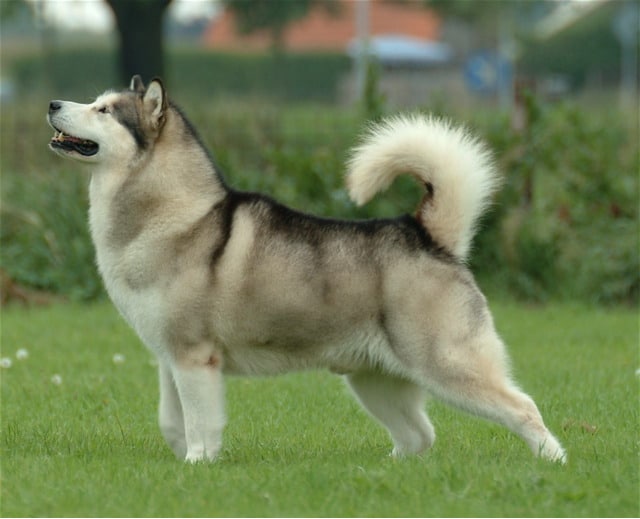
The Alaskan Malamute is a large, compact and powerful dog, built for strength and endurance rather than speed, which is precisely the key difference from the lighter and faster Siberian husky: the Malamute is the “truck” of sled dogs, with solid bones, substance and snowy racket-shaped feet.
According to the American Kennel Club standard, the desired size is about 64 cm at the cross and 39 kg in males, and about 58 cm and 34 kg in females, although it is common to see heavier specimens. The head is broad, with a deep snout, almond-brown eyes (the darker the better; purebred Malamutes never have blue eyes) and small, triangular, erect ears. The heavily populated tail is carried on its back like an undulating plume and serves to cover its snout when curled up in the snow.
The mantle is double and the usual colors are different shades of gray and white, sable and white, black and white, seal and white, red and white, or solid white. The white predominates almost always in the lower part of the body, legs and areas of the face, and facial markings such as antiface or hood are typical. The nose and gums are black, although some specimens show the so-called “snow nose”, lighter depending on the season.
Origin and history
The Alaskan Malamute is one of the oldest sled dog breeds and is considered a basal breed, predating the emergence of modern breeds in the 19th century. It owes its name to the Malimiut Inupiaq people of the Norton Sound region of Alaska, who raised it for a vital task: drag heavy loads through the snow and assist in hunting large prey such as bears and seals. In that extreme environment above the Arctic Circle, dog and human depended on each other for survival.
Genetic studies confirm its age and its kinship with other Arctic dogs: It shares a Siberian origin with the Siberian husky and is related to the Chukotka sled dogs. During the Klondike Gold Rush of 1896, the Malamute became very valuable to newly arrived prospectors and was often crossed with imported breeds, which nearly diluted the original breed.
Official recognition came in 1935, largely through the efforts of Eva B. Seeley, please. World War II almost wiped out the race: Many were lost in service and, by 1947, there were only about 30 registered dogs left, forcing me to reopen the book of origins. From that reconstruction, combining the Kotzebue, M’Loot, and Hinman lines, all present-day Malamutes descended. The breed also has a notable historical curriculum: accompanied Rear Admiral Richard Byrd on his expedition to the South Pole and served in World War II as a search and rescue and cargo dog.
Curiosities
- In 2010 the Alaskan Malamute was named official dog of the state of Alaska.
- The University of Washington husky is actually an Alaskan Malamute.
- It barely barks, but it “speaks”: its typical “woo woo” and modulated howls are its hallmark.
- An adult Malamute can pull several hundred pounds of weight, depending on its build and training.
- It is a formidable excavator: digging is a natural behavior of the breed, useful in nature for cooling or burrowing.
- It was not bred for speed racing, but for carrying heavy loads at a steady pace.
If you are drawn to the world of sled dogs, you may be interested in comparing the Malamute to its closest relatives. The siberian Husky is its lightest and fastest cousin and the confusion between the two is constant; the samoyed shares that spectacular coat and sociable character; the the Akita provides another look at the large spitz type dog, and the norwegian elkhound is another historic working Nordic. Comparing their characteristics and needs goes a long way toward making the right choice.
Frequently Asked Questions About the Alaskan Malamute
Is the Alaskan Malamute a good dog for beginners?
It is not usually recommended to first-time owners. It is affectionate, but also large, strong, independent, stubborn and very energetic. It needs an owner with time, experience or willingness to engage in firm and patient education and plenty of daily exercise.
How much exercise does an Alaskan Malamute need?
At least one or two long vigorous walks a day plus playtime, and especially enjoys shooting and endurance activities such as hiking, canicross, bikejoring or mushing.
Can the Alaskan Malamute live on a floor?
It is not ideal, but it is possible if it is guaranteed plenty of daily outings and intense exercise. It is a large, pack dog that suffers from loneliness; a home with space and a well-fenced garden does it much better.
Can the Alaskan Malamute withstand the heat?
Its double coat is designed for the arctic cold, so it suffers from high temperatures. In hot climates you have to reserve exercise for cool hours, provide shade and water and watch for heatstrokes.
Does the Alaskan Malamute shed a lot of hair?
Yes, it has a double coat and, although the rest of the year brushing several times a week is sufficient, twice a year it makes a very intense moult in which it loses hair in strands and needs to be thoroughly brushed almost daily.
What’s the difference between Alaskan Malamute and Siberian Husky?
The Malamute is larger, heavier and stronger, bred to haul heavy loads at a steady pace; the Siberian husky is lighter and faster, bred for speed.
Is the Alaskan Malamute aggressive or dangerous?
With humans it is usually the friendliest of dogs, to the point of being a poor watchdog. What it does have is a strong prey instinct towards small animals and a certain tendency to dominance with dogs of the same sex, which are handled with early socialization.
How long does an Alaskan Malamute live?
Between 10 and 14 years approximately. A UK study from 2024 placed their average life expectancy at around 11.3 years. A good breeder, controlled weight, exercise and veterinary checkups help to reach the upper band.