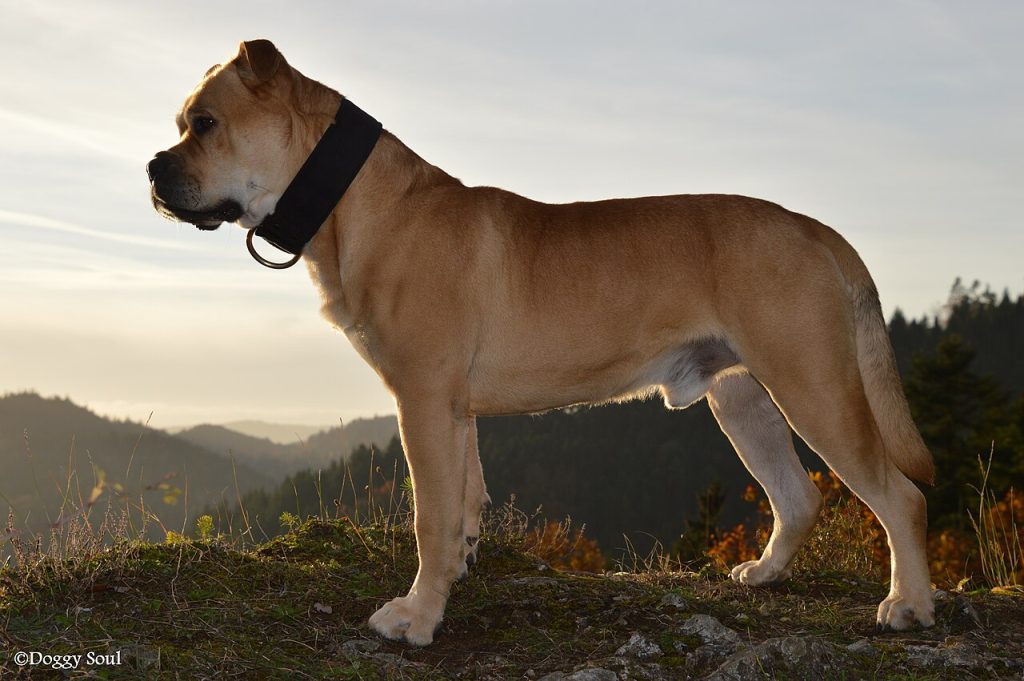
The Ca de Bou– known in Spanish as Majorcan hound or Dogo Mallorquín– is a Spanish mole originating from Mallorca: A medium-sized dog, muscular and with an imposing head, which hides behind its resounding appearance a surprisingly balanced, faithful and familiar character. A born guardian and a little barker, the Ca de Bou is a loyal companion for those who understand that behind that strength you need head, constancy and socialization.
Is the Ca de Bou for you?

The Ca de Bou is not a dog for any hand. It is calm and affectionate at home, but also strong, territorial and dominant, so it rewards the calm and constant owner and punishes improvisation. Before you fall in love with its pattern, look honestly at these two columns.
In favour .
- Exceptional guardian, deterrent and not much of a barker.
- Very loving and loyal to his family.
- A balanced and quiet character at home.
- Short coat: minimal maintenance.
- Rustic, tolerates the weather well.
- Moderate exercise needs.
To be taken into account
- Dominant tendency: requires early socialization.
- He can be conflicted with dogs of the same sex.
- Considerable strength: not suitable for weak first-time owner.
- Distrustful of strangers.
- He can’t stand prolonged loneliness.
- Rare breed: few serious breeders.
Character and temperament
The temperament of the Ca de Bou is its great surprise. Despite a hard past, today it is a gentle, balanced and extremely affectionate with his own dog. It is faithful to the bone, little barking and of a remarkable serenity: it is not a nervous dog or that reacts to anything. This calmness, added to its demeanor, makes it a formidable deterrent without needing to be aggressive.
He is, of course, a confident and naturally domineering dog. He is reserved and suspicious of strangers, and watches over his own with a strong protective instinct. Well guided, it distinguishes perfectly between a normal visit and a real threat, and does not resort to gratuitous aggression. Selection for exhibition has softened the character, maintaining the tenacity and alertness of his ancestors but making him more docile and manageable.
Coexistence: children, other pets, flat and loneliness

In everyday life the Ca de Bou is a pleasant house dog: calm, clean and not scandalous. With the children of his family he is usually patient and protective, although due to his body size it is advisable to supervise the game with the smallest to avoid involuntary pushes.
With other dogs the story changes: It can be dominant towards individuals of the same sex, so early socialization is non-negotiable. Females tend to be somewhat more manageable than males. As for the floor, its calmness allows it to live indoors without problems as long as it is taken for walks several times a day. The worst fit is the extended loneliness: He’s a dog very attached to his people and needs to be a part of family life.
Education and training
With the Ca de Bou the education begins from the first day. Being a naturally dominant breed, its socialization and training should begin as soon as possible, exposing it as a puppy to people, dogs, noises and different environments.
The key is to educate him firmly and gently at the same time. It responds to positive reinforcement, clear rules, and a consistent leader; it rejects harshness and punishment, which only breed distrust in such a strong dog. Not the ideal breed for an insecure first-timer: He needs someone who sets boundaries without yelling, with patience and perseverance. Well-behaved, he is a balanced guard; badly behaved, a powerful dog out of control.
Exercise and activity
The Ca de Bou has some exercise needs moderate. It is not a hyperactive dog or a long-distance runner: it only needs two or three daily walks, some play and, when possible, space to move in its air. It is strong and surprisingly agile for its build, and enjoys the activities it shares with its owner.
It is advisable to adapt the exercise to the climate – avoid the hours of heat, since as a mussel with a collected face it tolerates the shyness worse – and take good care of the puppy: during growth it is necessary to avoid jumps, excessive stairs and sudden efforts that can damage still immature joints.
Care: fur and hygiene
The coat of the Ca de Bou is short and rough, so a weekly brushing is enough to remove the dead hair and keep the skin healthy.
Hygiene focuses on the details: regular cleaning of ears and eyes, attention to facial folds to avoid moisture and friction, nail control and dental care.
Foodstuffs
As a 30 to 38 kg moloss, the Ca de Bou needs a high-quality diet adapted to its size, age and activity level, with a good protein intake and a correct balance of calcium and phosphorus during growth.
The main enemy is the overweight: a few extra kilos harm joints and the heart and reduce years of life. You have to ration the quantities, divide the food into two portions in the adult and, because of its deep chest morphology, avoid intense exercise just before and after eating to reduce the risk of gastric torsion.
Health and life expectancy
The Ca de Bou is, in general, a robust and rustic dog, with a life expectancy 10 to 12 years. As a good molose, the points to watch are the typical of large and broad-headed breeds: hip and elbow dysplasia, joint problems, heart conditions and some respiratory sensitivity to heat due to its brachycephalic morphology.
The best medicine is prevention: buy breeders who test for dysplasia, keep the dog at its ideal weight, provide moderate exercise, watch the diet, and go for regular veterinary checkups. It is worth remembering that it is a small breed – in 2026 it was among the Spanish breeds considered vulnerable by the Royal Canine Society of Spain – , so choosing a healthy and well-managed breeding line is even more important.
Physical appearance

The Ca de Bou is a medium-sized dog, very muscular and compact. Males measure between 55 and 58 cm at the withers and weigh 35 to 38 kg; females, between 52 and 55 cm and 30 to 34 kg. Its most striking feature is the head: bulky and massive, with a broad skull, powerful jaw and a slightly marked frontal nasopharyngeal depression. The eyes are oval, somewhat oblique and the darker the better; the ears, small, “pink” and thrown back.
The coat, short and rough, comes in three colors: triggered(the preferred, in dark tones), lemonade(in intense hues), and black.
Origin and history
The Ca de Bou – literally “bull dog” in Mallorcan – is an indigenous breed of Mallorca whose origins go back to the prey molosos who controlled the cattle on the island. The breed was forged during the period of Catalan influence on Mallorca, between the 13th and 16th centuries, from mastiff-type dogs. Its name betrays its original function: The Butcher Guild used him for to grab and hold the bull until his sacrifice.
During the British occupation of Mallorca in the 18th century, bullfighting and dog fighting were well established, and the Ca de Bou gained fame for its bravery and ferocity in these bloody shows. When such practices were banned in the 20th century, the breed lost its prominence and was on the brink of extinction. It was saved by enthusiasts from peninsular Spain who began to exhibit it; the first standard was drafted in 1932 and the The FCI finally accepted it in 1963., under the official name of Mallorcan Hound. In the 1990s, so many were exported to the United States, Russia, Poland and Japan that today many breeders are outside the Balearic Islands.
Curiosities
- Three names, one dog: Ca de Bou is the name in Mallorcan; in Spanish it is called Dog de Presa Mallorquín or Dogo Mallorquín, and in English Majorca Mastiff.
- Relative of the canary: is related to the Dogo Canario (Canarian Hound of Prey), another Spanish prey mollusk.
- Literal meaning:“Ca de Bou” means “bull dog”, in reference to his former work holding cattle.
- Vulnerable breed: in 2026 was among the Spanish breeds considered vulnerable by the Royal Canine Society of Spain.
- A little barking: imposes by presence, not by scandal; it is one of the quietest moloses.
If you are attracted to the character of the Ca de Bou, you may be interested in other moles and guard dogs of similar temperament: the Cane Corso, the Bóxer, the Rottweiler and the Bulldog Inglés, with which it shares part of its prey heritage.
Frequently asked questions about Ca de Bou
Is the Ca de Bou a dangerous or aggressive dog?
Not for free. The Ca de Bou is a guard moose with a balanced, serene and barking character, which is dissuasive to an intruder but without unjustified aggressiveness. His past in bullfighting and among dogs weighs on his reputation, but modern breeding has softened his temper. The real risk is not race, but lack of socialization and management: It’s a strong, dominant dog that needs a consistent owner.
How long does a Ca de Bou live?
With controlled weight, regular exercise, good nutrition, and regular veterinary checkups (especially of the hips, elbows, and heart), many specimens reach the upper end of that range in good shape.
Can the Ca de Bou live on one floor?
Yes, as long as you give it time and a daily walk. It is a quiet dog at home, barks little and is not nervous, so it is comfortable inside. The key is not the square footage, but the exits: it needs several walks a day and periods of activity to expend energy and not get bored. What is worse is prolonged loneliness.
Is Ca de Bou good with children?
With his family the Ca de Bou is extremely affectionate, faithful and protective, and is usually patient with the children of the house.
How much exercise does a Ca de Bou need?
It needs moderate activity: two or three walks a day, some play and, if possible, space to move. It is strong and agile, but it is not an endurance athlete or a hyperactive dog.
Does the Ca de Bou get along with other dogs?
It usually coexists well with its family and with known dogs, but can be dominant towards other dogs of the same sex. Early and continued socialization is decisive. Females tend to be somewhat more manageable than males.
How much does a Ca de Bou weigh and measure?
The males measure between 55 and 58 cm at the withers and weigh 35 to 38 kg; the females measure 52 to 55 cm and weigh 30 to 34 kg. It is a medium-sized dog, very muscular and compact, with a very characteristic voluminous head.
Does the Ca de Bou give a lot of fur work?
Very little. Its hair is short and rough, so a weekly brushing is enough to remove dead hair and keep it clean. It is advisable to check and clean ears and eyes regularly, take care of the folds of the face and watch the nails. It is a rustic dog that tolerates moderate cold and heat well.