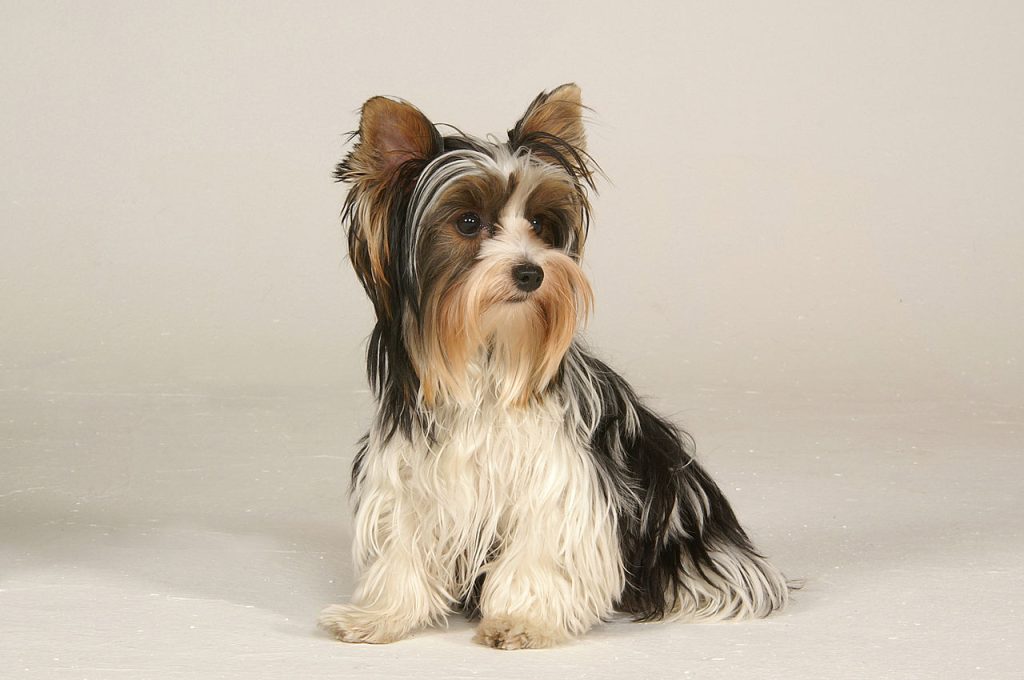
The Biewer Terrier is a toy dog of German origin, a close cousin of the Yorkshire Terrier but unmistakable by its elegant white, black and gold tricolor coat. Small, lively, and deeply attached to his family, this pocket terrier combines the beauty of a silky mane with a cheerful, sociable character that has made him one of the most coveted companions of recent decades.
Is the Biewer Terrier for you?
Before you fall in love with that tricolor face, you should know what it means to live with a Biewer Terrier. It is a dog made for close company, not for spending hours alone or for a life outdoors. Here you have, bluntly, its lights and its shadows.
In favour .
- It’s the perfect size for the floor and to carry everywhere.
- Affectionate, cheerful and very sociable, even with strangers.
- It sheds very little hair and gives off very little odor.
- Intelligent and willing to learn; enjoys pleasing.
- Enough energy to play, but without the demands of a great athlete.
To be taken into account
- Her long, silky hair requires brushing almost daily.
- Loneliness is bad for you – you may suffer from separation anxiety.
- Tendency to bark if not socialized and well-behaved.
- Fragile: not the ideal dog for very young or abrupt children.
- Predisposition to trachea, kneecap and tooth problems.
Character and temperament

The Biewer Terrier is, above all, a companion dog with capital letters. It forms intense bonds with its people and seeks to participate in everything that happens in the house: it follows you from room to room, settles in your lap and demands its ration of pampering.
Unlike other more stubborn or territorial terriers, the Biewer has a remarkably balanced and friendly temperament. It is sociable by nature, usually receives visitors with curiosity and good humor rather than suspicion, and keeps that playful spark typical of terriers alive without falling into stubbornness.
It retains, of course, a terrier heritage that should not be ignored: it is alert and warns of what is happening, so it can become an enthusiastic barker if it is not taught from a puppy when it is okay to be quiet.
Coexistence: children, other pets, flat and loneliness
With children: The Biewer Terrier is affectionate and playful, but its tiny size makes it fragile. It fits better in homes with older children who understand how to treat a small dog; with very young children there is a risk of unintentional falls or squeezes. Supervision is always required.
With other pets: usually gets along well with other dogs and, if bred with them, also with cats. Its hunting instinct is much milder than that of working terriers, although it can chase small animals for pure play.
On the floor: is almost the perfect tenant. It occupies little, does most of its exercise indoors and adapts smoothly to urban life. You just have to manage the barking to maintain good relations with neighbors.
In the face of loneliness: here is his Achilles heel. He’s such a clingy dog that it’s bad for him to be alone for long hours and he can develop separation anxiety, with barking or destructive behavior. He’s not the right breed for someone who spends the whole day outdoors without company.
Education and training
The Biewer Terrier is intelligent and highly motivated to please, a combination that makes training much easier. It responds wonderfully to positive reinforcement – rewards, play, and a cheerful voice – and is quickly extinguished by harsh methods, which are also completely unnecessary in such a sensitive dog.
There are two clear priorities. The first is early socialization: exposing him as a puppy to people, noises, other dogs and various situations prevents him from becoming fearful or barking as an adult. The second is learning to clean, which in toy breeds usually takes more time; the key is constancy, fixed routines and a lot of patience, without punishment.
The classic “little dog syndrome” should also be avoided: Because it is tiny and adorable, it is easy to indulge in behaviors that we would not tolerate in a large dog. Treating it like a real dog, with kind but firm rules and limits, results in a polite and confident companion.
Exercise and activity

It is not an athlete, but neither is it a cushion: the Biewer Terrier has the lively energy of terriers and needs to expend it daily.
As important as physical exercise is the mental stimulation. It is a smart dog that enjoys interactive toys, scent games, small obedience challenges and tricks. In fact, many Biewers excel in disciplines such as miniature agility or obedience rally, where their intelligence and willingness to collaborate shine through.
Because of its size, it is wise to avoid jumping from heights, extreme heat, and long walks too far for its paws.
Care: fur and hygiene
The coat is the Biewer Terrier’s mark of identity and also its main demand for care. It is a long, smooth, fine and silky hair, of continuous growth and without woolly undercoat, very similar to human hair. This has an advantage – it loosens very little hair – and a cost: it gets tangled easily and you have to brush it almost every day. if worn in long mane.
Many families opt for a shorter “puppy cut”maintenance cut, which drastically reduces daily work without losing grace.
The rest of the hygiene is usual for a toy breed, but with one critical point: the teeth.. Small dogs accumulate tartar easily, so frequent tooth brushing is almost mandatory.
Foodstuffs
The Biewer Terrier needs a quality food formulated for small breeds or toys, with small-sized croquette adapted to its tiny mouth.
An important point in toy puppies is the risk of hypoglycaemia(sugar lows), so as children they usually need several meals spread throughout the day to keep their energy levels stable.
If you have any questions about rations, diet or supplements, it is best to consult your veterinarian, who will adjust the guideline to your age, weight and activity level.
Health and life expectancy

Be careful, the Biewer Terrier usually enjoys a long life, around the 12 to 16 years, something typical of toy terriers.
The most relevant are tracheal collapse(weakness of the trachea causing cough, very common in small breeds, best prevented using harness), dislocation of the kneecap(knee displacement), stones in the bladder, portosystemic shunt congenital(a vascular anomaly of the liver) and hypoglycaemia, especially in puppies.
The best recipe for longevity combines responsible breeders who perform health tests, regular veterinary checkups, weight control, dental hygiene, and a harness instead of a collar to protect that delicate trachea.
Physical appearance
The Biewer Terrier is a toy dog with elegant lines and an erect build that rarely exceeds 28 cm at the withers or 3.6 kg in weight. Despite its size, it conveys safety and vivacity, with a high head and a wakeful expression framed by long facial hair.
Its distinctive trait is tricolor coat, the result of the recessive piebald gene it inherited from its Yorkshire ancestors. It comes in two combinations: white, blue and black, or white, black and gold/fire.
The hair is long, smooth and silky, and falls to both sides of the body like a shiny curtain. Unlike the traditional Yorkshire, the Biewer Terrier it keeps the whole tail, unamputated, covered by a feather of hair that tops its silhouette. The ears, small and erect, complete an unmistakable pattern.
Origin and history
The history of the Biewer Terrier is relatively recent and very concrete. In 1984, German breeders Werner and Gertrude Biewer obtained in their breeding two tricolor puppies from two Yorkshire Terriers who, without knowing it, carried the recessive piebald gene. Fascinated by this unexpected color pattern, they decided to fix it and gave rise to a new line.
A veterinary friend suggested naming the breed “Biewer Yorkshire Terrier”. Later, a pair of puppies went to German singer Margot Eskens, who is credited with the idea of adding the nickname “à la Pom Pon”, so the full name was “Biewer Yorkshire Terrier à la Pom Pon”.
Beginning in 2002, American enthusiasts began importing specimens from Germany. The breed gained followers and in 2006 the The Biewer Terrier Club of America(BTCA) was founded to promote it. The club commissioned a genetics laboratory to analyze several blood samples, which confirmed that the Biewer was a differentiated breed from the Yorkshire Terrier. That scientific backing opened the door to official recognition: entered American Kennel Club‘s foundation service in 2014 and, in 2021, became the 197th breed recognized by the AKC. In May 2024, the German Dog Federation (VDH) also accepted the breed in its country of origin.
Curiosities
- Its name means nothing in German: it is simply the surname of the Biewer family, the breeders who originated it.
- It all started on a genetic whim: the piebald gene that creates its tricolor pattern was “hidden” in two normal Yorkshires.
- A famous singer, Margot Eskens, left her mark on the official name with the addition of “à la Pom Pon”.
- It is one of the most recent additions to the American Kennel Club, which recognized it in 2021.
- Unlike the classic Yorkshire, the Biewer Terrier shows off its natural tail without amputation, something increasingly valued.
- Despite its fancy dog air, it retains the liveliness and curiosity of its terrier roots.
If you are attracted to the Biewer Terrier because of its manageable size and gentle nature, you may be interested in other related breeds. Its direct relative is Yorkshire Terrier, from which it inherits hair type and temperament. In the league of small, long-haired companions also shines the Shih Tzu, while the Chihuahua shares that floor-ideal toy format. And if you’re looking for a small, sociable, playful companion, check out the Pug as well.
Frequently Asked Questions about the Biewer Terrier
Is the Biewer Terrier the same as a Yorkshire Terrier?
Well, not exactly. The Biewer Terrier was born in 1984 from two Yorkshire Terriers who carried a recessive piebald gene, responsible for its tricolor pattern with white. For years it was considered a Yorkshire variety, but a genetic analysis commissioned by the American Club confirmed that it is a differentiated breed. It shares size and hair type with the Yorkshire, but is distinguished by its three-coloured coat and by carrying an unamputated tail.
How tall and how much does a Biewer Terrier weigh?
It is a toy dog: it weighs between 1.8 and 3.6 kg and measures approximately 18 to 28 cm at the withers.
What colors does the Biewer Terrier have?
It is always tricolor due to the piebald gene. There are two main combinations: white, blue (a bluish black) and black; or white, black and gold/fire.
Is he a good dog to live on?
Yes, it is one of the most suitable breeds for flooring. Its tiny size, moderate activity level and attachment to the family make it ideal for apartments. Of course, it needs company, daily walks and home play so as not to get bored or bark excessively.
How long does a Biewer Terrier live?
Since most toy terriers are well cared for, they typically live between 12 and 16 years, and longevity depends heavily on preventing tracheal collapse, dental care, and proper weight throughout life.
Does it need a lot of brushing?
Yes. Its hair is long, fine, smooth and silky, similar to Yorkshire, and it tangles easily. Ideally it should be brushed daily or almost daily if worn with a long mane. Many owners opt for a shorter maintenance cut, which greatly reduces daily work.
Does the Biewer Terrier shed a lot of hair?
Its coat is hairy (not woolly), continuously growing and similar to human hair, so it barely leaves hair at home.
Is it easy to educate?
It is smart and loves to please, so it learns quickly with positive reinforcement and short sessions. The two points that should be emphasized from puppyhood are socialization (so that it does not become barking or suspicious) and learning cleanliness, which in toy breeds requires more patience and routine.