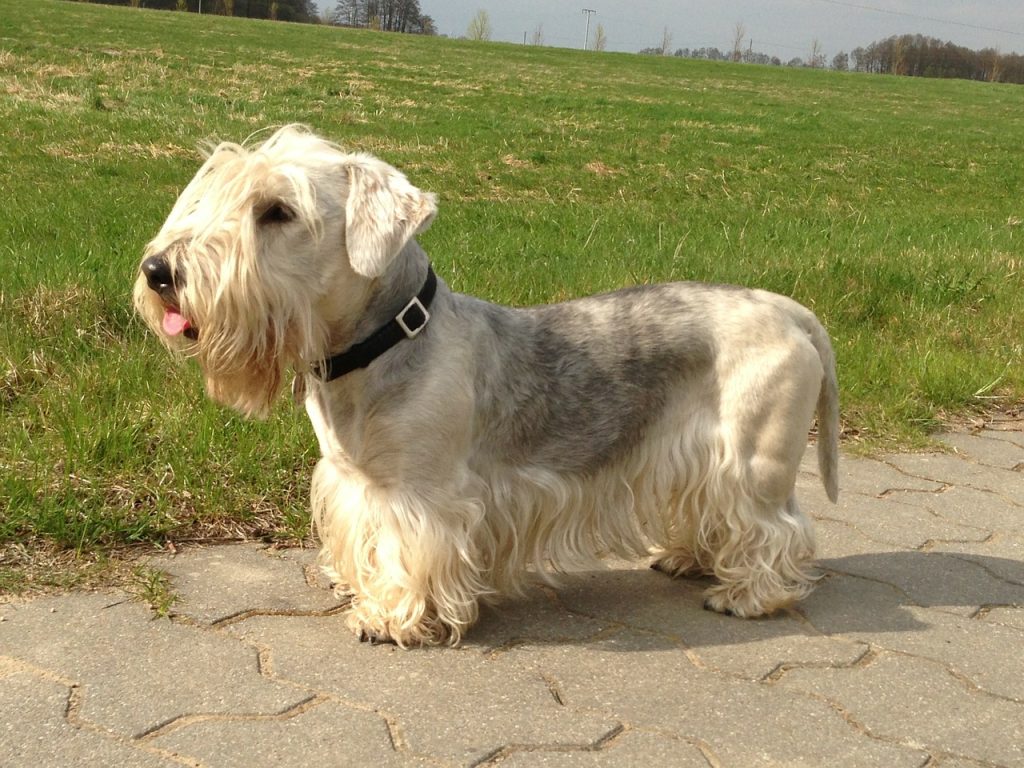
The Terrier Checo(Český teriér, also called bohemian terrier) is one of the rarest and, at the same time, easiest to live with terriers that exist: A small, short-legged, blue-gray silky-haired dog bred in the former Czechoslovakia to hunt in the forests of Bohemia. If you’re looking for a terrier temperament without the over-nervousness of many of its cousins, the Czech Terrier deserves a thorough introduction.
Is the Czech Terrier for you?
Before you fall in love with their beard and eyebrows, you should know which dog you’re up against. The Czech Terrier is an adaptable and manageable-sized companion, but it still has a hunter’s head and a mantle that demands maintenance. These are its most honest pros and cons.
In favour .
- Of the calmer and more balanced terriers, it barks and is less agitated.
- Comfortable size (6-10 kg): fits on floor and in house with garden.
- He barely changes his hair; good choice for someone who hates hair everywhere.
- Intelligent and eager to please: relatively easy to educate.
- Sociable with the family and, well presented, with other dogs.
Against
- Your hair needs machine trimming every 6-8 weeks and frequent brushing.
- It retains the hunting instinct: eye with rodents, birds and stranger cats.
- It’s rare and expensive to get; there’s usually a waiting list.
- Reserved with strangers if he doesn’t socialize soon.
- Prolonged solitude does not sit well with it: it is a companion dog.
Character and temperament

If we were to summarize the Czech Terrier in one word, that word would be peaceful .. Its creator was looking for just that: a hunting terrier with whom one could work and coexist without the typical nervous intensity of the group. The result is a dog that is alert and curious, but noticeably calmer, quieter and more manageable than most of its terrier relatives.
The FCI standard describes a cheerful, pleasant, and nonaggressive character – to the point that showing aggression is a disqualifying foul in exhibition. At home he translates into an affectionate companion, very attached to his people, who enjoys both a walk in the countryside and lying next to you on the couch.
It is still a terrier: it has initiative, it knows what it wants, and it retains that stubborn point that makes the family so fun (and so demanding).
Coexistence: children, other pets, flat and loneliness
Few terriers fit as well into a family as the Czech. Its balance and moderate size make it a good dog for homes with children, provided they learn to respect it and there is supervision with the little ones. It is not a fragile dog, but neither is it a toy.
It usually gets along well with other dogs, especially if it has been socialized since puppyhood. The point of attention are small animals: its past as a burrow hunter makes a hamster, a bird or an unknown cat can awaken its prey instinct. Coexisting from puppyhood with a house cat the thing usually works; with a loose rodent, better not to risk.
It adapts very well to the ground due to its size and low barking to be a terrier, but needs its daily dose of walking and stimulation. Where it suffers most is in solitude: it is a companion dog that wants to be with its family.
Education and training
The Czech Terrier is intelligent and, unlike other more headstrong terriers, has a marked willingness to please. This combination makes it quite easy to train for the standards of the group. It quickly learns the basic routines and responds very well to short, varied and motivating sessions.
The key tool is positive reinforcement: rewards, play and a kind voice. Harsh methods or abrupt corrections are counterproductive; with this dog they generate blockage and distrust, never obedience.
Two priorities from puppyhood: first, the socializing: exposing it early to people, dogs, noise and different environments to soften its natural reserve; second, the called: as a good terrier, it can be carried away by a trail or a movement, so it’s worth working through the “here” before releasing it into the open.
Exercise and activity
It is not a hyperactive dog, but neither is it a couch potato. The Czech Terrier has a medium energy that is well covered by a couple of good daily walks, some play and, if possible, moments of outdoor exploration where he can sniff his way through. One or two hours of activity spread out a day is a good target.
Where he really enjoys is using his head and smell. Search games, tracking tracks and earthdog tests he loves and connect with his original instinct. Mental work tires him as much or more than physical, and a mentally stimulated Czech is a calm and contented dog at home.
It is sturdy enough to accompany you on country routes and gentle hikes, and it adapts smoothly on days when you’re not walking as much.
Care: fur and hygiene

Unlike most terriers, whose coat is cut by hand (the famous stripping), the Czech Terrier’s hair is cut by machine and scissors. It is worked in the characteristic “saddle” pattern: short on the back, neck and upper legs, and long on the lower skirt, eyebrows and beard, which are its hallmark.
In practice this means a trim every six to eight weeks, whether you do it by machine or take it to a dog groomer, and a frequent brushing of the long hair – almost daily – to avoid knots in the skirt and beard.
The rest of the hygiene is the usual: checking and cleaning the fallen ears (which ventilate worse), regular tooth brushing, cutting nails when necessary and bathing only when dirty, with adequate shampoo so as not to dry that silky coat.
Foodstuffs
The Czech Terrier does not have special dietary requirements, but due to its size it is advisable to adjust the rations well: it is a small dog and it is easy to get overweight, something that punishes its joints and its elongated back.
The reasonable thing to do is to divide the food into two servings a day, measure the quantities instead of leaving the bowl always full, and deduct from the total the rewards you use in training. Watch the waistline: on such a short dog, a few grams of excess are immediately noticeable.
Clean, fresh water is always available, and if you are unsure about a particular diet, type of feed, or possible food sensitivity, it is best to consult your veterinarian before making any drastic changes.
Health and life expectancy
Overall, the Czech Terrier is a fairly healthy and long-lived breed, with a life expectancy that is usually in the 12 and 15 years old range.
The most characteristic is the Scotty Cramp(“Scottish cramp”), a mild motor disorder inherited from the Scottish Terrier that causes clumsy or stiff movements in moments of excitement; it is not painful or life-threatening for the dog. Beyond that, common health tests in the breed include hip dysplasia control, kneecap dislocation, heart abnormalities, eye problems such as primary lens dislocation (PLL) and cataracts, thyroid alterations, degenerative myelopathy, and von Willebrand disease type 3 (a bleeding disorder).
The best guarantee is to go to a responsible breeder who carries out genetic and veterinary tests for the parents, followed by the usual: regular check-ups, daily vaccination and deworming, weight control, and lifelong dental and eye care.
Physical appearance
The Czech Terrier is a small, low-legged dog with a distinctly rectangular shape: longer than tall. The height at the withers is around 29 cm in males and 27 cm in females (between 24 and 32 cm depending on the specimen), with an ideal weight of 6 to 10 kg. Despite its size, it transmits solidity and musculature, without being heavy.
The head is wedge-shaped, long and round, with crowded eyebrows and beard that give it that expression between gentle and stately so recognizable. The ears are triangular and sloping, glued to the cheek, and the tail is natural, of medium length, which can be carried hanging or in the shape of a sword.
Their great sign of identity is the cloak: long, thin, silky and slightly wavy, with a soft sheen. There are two varieties of color. The most common is the grey, in all its shades, from carbon gray to platinum, with black pigment; the other is the brown(with liver pigment), much rarer. A curious detail: puppies are born almost black and their hair gradually lighten until it reaches the adult tone around two or three years of age.
Origin and history

The Czech Terrier is a young breed created in 1948 by the Czech kennel František Horák, who crossed a Sealyham Terrier with a Scottish Terrier in search of a hunting terrier suitable for the forests of Bohemia: narrower chest to enter the burrows, manageable in a pack and with a more docile character than that of his starting breeds.
Horák was not a scientist by training, but worked for many years as a research assistant at the Czechoslovak Academy of Sciences and applied that method to his breeding program. In time, his dogs gained international fame, so much so that the flood of mail he received from abroad, in the midst of Communist Czechoslovakia, came to the attention of the secret police. Horák died in 1997.
The International Cinological Federation (FCI) recognized the breed in 1963, with the number 246 within Group 3 (Terriers). From there it made the leap into the Anglo-Saxon world: it came to the United States in the 80s and to the United Kingdom in 1989, and today it is recognized by all the major canine clubs.
Curiosities
- One of the rarest breeds in the world. The Czech Terrier regularly appears on lists of the six least common dog breeds worldwide.
- Born to two British terriers. His genetic recipe is 100% Icelandic – Sealyham plus Scottish – despite being a deeply Czech dog.
- It changes color as it grows. Puppies are almost black and lighten to adult gray: two different dogs in the same life.
- It doesn’t say goodbye, it cuts. is one of the few terriers that are groomed by machine and scissors instead of with the classic hand stripping.
- Horák’s international fame and correspondence abroad put him on the radar of the communist regime.
- It was a bohemian terrier. Its Czech name, Czech terrier, literally means “Czech terrier” or “Bohemian terrier”.
If you are attracted to the Czech Terrier because of its combination of terrier character and calm temperament, you may be interested in other breeds with a similar profile. The Teckel shares its underground hunter past and its elongated body; the Yorkshire Terrier is another small terrier with long coat and hair care; the Shih Tzu demands similar coat care thought of as a companion dog; and the Welsh Corgi Pembroke shares its low silhouette and large small-bodied personality.
Frequently Asked Questions About the Czech Terrier
Is the Czech Terrier a quiet dog?
Yes. Within the terrier world it is one of the quietest: it barks less, is less agitated and keeps its composure better than a Yorkshire or a Fox Terrier. The FCI standard itself demands a balanced character and penalizes aggression as a disqualifying fault. Yet it is still a terrier: curious, alert and with hunting instinct.
How tall and how much does a Czech Terrier weigh?
It is a small and short-legged dog. The height at the withers is around 29 cm in males and 27 cm in females (between 24 and 32 cm depending on the specimen) and the ideal weight is 6 to 10 kg. The body is clearly rectangular: longer than high.
What color is the Czech Terrier?
There are two varieties: gray (in all its shades, from coal gray to platinum, with black pigment) and brown (with liver pigment), the latter much rarer.
Do you have to cut your hair?
The coat of the Czech Terrier is not stripped by hand (stripping) as in other terriers, but is cut by machine and scissors in the characteristic “riding chair” pattern, leaving the skirt, eyebrows and beard long.
Is he good with children and other dogs?
Its balanced temperament makes it a good family companion and usually tolerates other dogs well. With children it works if there is respect and supervision. Eye with small animals (rodents, birds): its hunting origin makes it able to see them as prey.
How long does a Czech Terrier live?
Their life expectancy is usually between 12 and 15 years old. It is a fairly healthy breed; it is advisable to watch for knee dislocation, eye problems and the so-called “Scotty Cramp”, a mild motor disorder inherited from the Scottish Terrier.
Is it easy to train?
Yes, he’s awake and wants to please, which makes the job easier, responds very well to positive reinforcement and badly to harshness, the key is consistency and early socialization to soften his natural reserve with strangers.
Is he a rare dog to find?
Many. The Czech Terrier is one of the rarest breeds in the world. Outside the Czech Republic there are few breeders, so finding a puppy usually involves a waiting list and always checking the health tests of the parents.