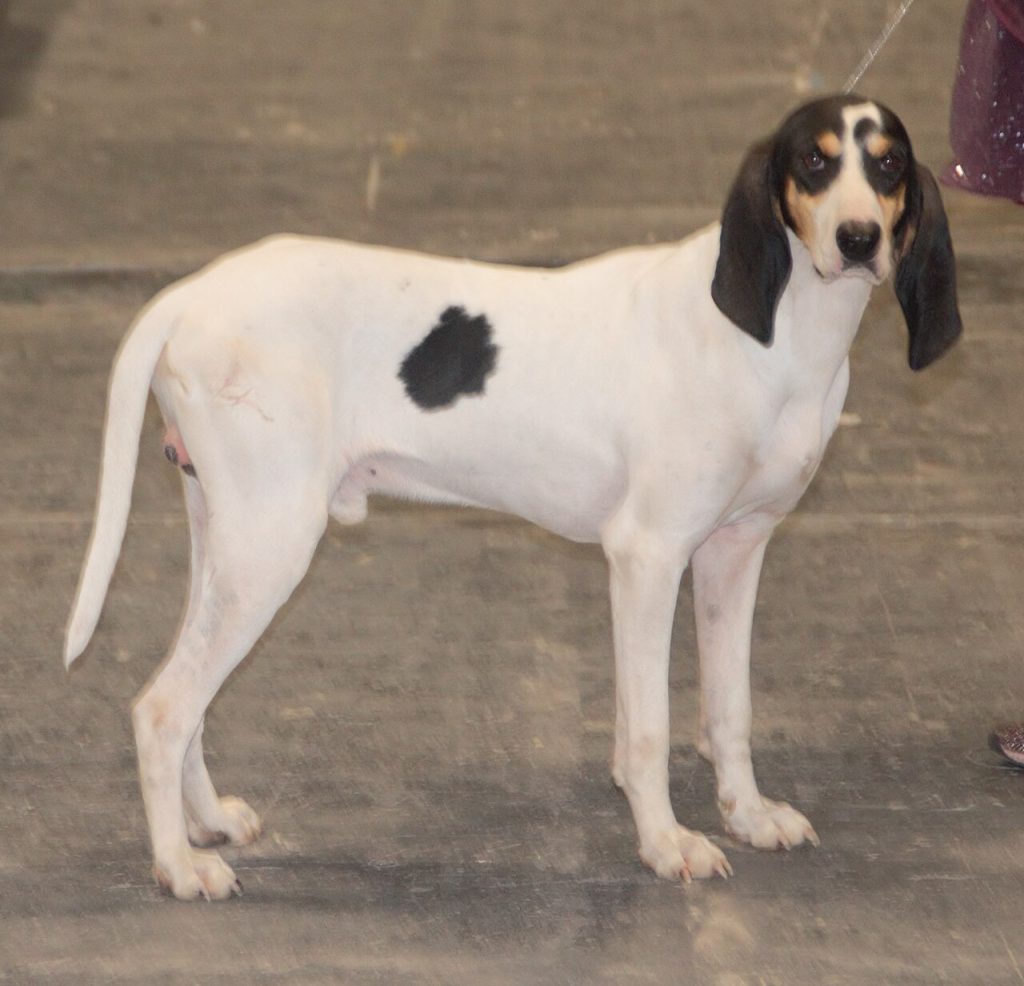
The Dog of the Ariège(in French, Ariégeois) is a medium-sized hunting dog born in the French Pyrenees, bred for generations to track the hare by voice screaming over steep terrain. Elegant, tough and sociable in character, it is still almost an unknown outside its home region: it is a hunting dog more than a couch, and understanding that is the key to knowing if it fits with you.
Is the Hound of the Ariège for you?
Before you fall in love with his image, you should be honest: The Hound of the Ariège is not a breed of dog designed for city life. He’s a skilled worker, with a nose for everything else and a need for activity that can’t be satisfied with a couple of short walks. In the right environment it is a noble and balanced companion; in the wrong, a frustrated animal that howls and runs away behind any scent.
It suits you if…
- You hunt or you play dog sport and you’re looking for a hardy hound.
- You live in the countryside or have easy access to large spaces.
- You can offer him long olfactory exercise every day.
- You want a sociable dog, a handler with other dogs.
- You don’t care about a dog giving a voice when it’s following a trail.
Think about it if…
- You live in a small apartment or in a very urban environment.
- You spend a lot of hours out and you can’t get him to do anything.
- You’re bothered by the barking or you have noise-sensitive neighbors.
- You’re looking for a dog that’s easy to keep loose without training.
- You want a common, easy-to-find breed.
Character and temperament

The Ariège hound has two faces that you should know. As a pack dog, it is deeply sociable: it carries in the genes to live with other dogs without conflicts and, in its region, it is known to be affectionate and attached to people who treat it well.
The other face is the hunter’s. It is a the nose dog, governed by smell, with remarkable determination when hooking a trail. It comes out tenacious, brave and capable of working for hours, and that same intensity translates, at home, into an animal that needs a clear outlet for its energy. Give voice when tracking: A quality sought after in the mountains but demanding for urban coexistence. He’s not a nervous door dog, but he’s not a quiet stuffed animal either. He’s a field athlete with very keen instincts.
Coexistence: children, other pets, flat and loneliness
With children.‘s friendly temperament and herding background make her generally tolerant and well disposed with children, always with the supervision and respect that any dog deserves.
With other dogs. Here shines. Accustomed to hunting in a group, usually gets along very well with other dogs and enjoys company.
With other pets. The prey instinct calls for caution. A cat that you breed with from a puppy can become part of your pack, but small animals that run (rabbits, rodents) easily activate the chase.
Flat and lonely. is its weak point. It does not adapt well to urban life or to being alone and locked up for many hours; it needs space, outings and company. In a small apartment, without a serious exercise plan, it is not a good choice.
Education and training
The Ariège Hound is intelligent and willing to collaborate, but it thinks like a hound: when the nose takes over, the rest of the world disappears. That means that training must assume from the beginning that the called and the self-control will be the big challenges, not the basic obedience.
It works much better with positive reinforcement, short sessions and tasty food than with hardness, which just blocks it. It is advisable to start early socialization and practice calling in increasingly demanding environments, always safely: In an open, unfenced area, a dog hooked on a trail can travel miles. A good long training leash and a lot of patience are worth more here than any shortcut. Don’t expect a millimeter response from a shepherd; look for a reliable dog within its limits.
Exercise and activity

This is the need that defines the breed. The Ariège Hound was bred to beat the mountain for hours on end, over rough terrain and among the thickest weeds; it is light, tough and tough but not particularly fast. All that machinery is still there even though the dog never hunts.
You need abundant daily exercise: long walks, safety races and, most of all, opportunities to use his nose, which is what really tires and satisfies him. Olfactory work (trace games, searches, mantrailing) is almost as important as physical work. A well-trained Hound of the Ariège is quiet at home; a bored one seeks his own amusement, usually barking or trying to escape. He’s not a dog who can only take a short walk around the block.
Care: fur and hygiene
In aesthetics it is a comfortable dog. Its hair is short, smooth and dense, and the skin fits the body without folds, so the maintenance is minimal: a weekly brushing to remove dead hair and little more. It does not require a hairdresser or complicated care.
The main focus is on the ears. Because they are long, thin, and slender, they are poorly ventilated and retain moisture, wax, and vegetation debris. They should be checked and cleaned regularly to prevent otitis, especially if the dog works in the field. Complete with nail trimming when necessary, dental hygiene, and checking pads and skin after mountain trips, where it’s easy to pick up ticks or spikes.
Foodstuffs
As an athletic dog of about 25-27 kg, it needs a complete and balanced diet adjusted to its actual expenditure. An example that works or exercises a lot burns a lot of energy and thanks a quality food with a good protein contribution; one with a quieter life needs measured rations not to get fat, something to watch out for in the non-active seasons.
The wise thing to do is divide food into two portions a day, avoid strenuous exercise just before and after eating, and always keep fresh water available. When in doubt about quantities, type of diet or stage of life (puppy, adult, senior dog), it is best to adjust with the veterinarian according to the body condition, which should allow you to intuit the waist and feel the ribs without marking them excessively.
Health and life expectancy
The Ariège Hound is a rustic dog, the result of a functional breeding oriented to work and not to aesthetic exaggeration, which is usually associated with a solid and healthy constitution. As it is a small breed and very much linked to hunting, there are no large population studies on its diseases; for its type and size, it is reasonable to place its life expectancy around 12-14 years, a usual estimate for medium hounds rather than a closed data.
Without pathologies declared as characteristic of the breed, prevention focuses on what is reasonable for any active hound: care of drooping ears to prevent otitis, weight monitoring, dental health, and careful checkup after field trips (ticks, spikes, small wounds on pads). Regular veterinary visits, vaccination and daily deworming complete the picture.
Physical appearance

The Ariège Hound is reminiscent of its Gascon cousins, the Great Blue Hound of Gascony and the Great Gascon-Saintongeois, but in a more light and stylized version, somewhat lower and with finer bones.
The coat is its hallmark: short and dense hair, white or mottled white on the background, with black spots with well-defined edges, fire-coloured marks on the face and two fire points over the eyes. The skin fits without wrinkles and the mucous membranes are black. The head is thin and elongated, with soft, sloping ears, long enough to almost reach the truffle. The neck is slender and slightly arched. The feet are elongated oval-shaped, “hare-like”, with black pads and nails and no spurs. The tail is wearing a slight curve. The ensemble conveys lightness, nobility and function.
Origin and history
The Ariège Hound is a traditional breed of Mediodía-Pirineos and, very specifically, of the department of Ariège, from which it takes its name.It was born with a practical objective: the hunters in the area wanted a hound that was lighter, more agile and more manageable than the large Gascon cage dogs, able to move through broken terrain and to hunt the hare effectively.
To achieve this, large pack hounds such as the Gascony blue hound and the Gascony-Saintongeois hound were crossed with local, smaller and live briquettes(artesian hounds). From this mixture came a dog that retained the smell and voice of the Gascon, but with a more athletic body. The breed became officially recognized in France in 1912 and was definitively accepted by the International Cinological Federation (FCI) in 1954, within Group 6 of hounds. Despite this, it never became popular outside its corner of the Pyrenees, and even today it remains a rare breed, kept mainly by hunters.
Curiosities
- A dog from his land. Few breeds are so bound to a territory: the Ariège is not only its name, it is its raison d’être, and outside the Pyrenees it is hardly known.
- He’s an all-terrain hunter. Although its star prey is the hare, it is also used to track deer and wild boar, working both alone and in packs.
- It’s like rabbit feet. Its elongated, oval feet, similar to those of the hare itself, give it grip and endurance on rough terrain.
- She sings while she hunts. gives voice when following the trail: that melodious howl allows the hunter to locate it at a distance among the brush.
- It’s a matter of balance. is light and tough, able to withstand a lot, although it does not stand out for speed: it wins by consistency, not by starting.
If you are attracted to this French hound, you may be interested in other tracking and hunting breeds with which it shares a family air: the popular Beagle, the unmistakable Basset Hound, the tireless Bloodhound and the versatile Dachshund, all of which are governed dogs, such as the Ariège Hound, by the power of their nose.
Frequently asked questions about the Ariège hound
Is the Ariège Hound a good companion dog?
It is primarily a hunting dog. In its region of origin it has a reputation for affable character and attachment to people, but its tracking instinct, its need for exercise and its tendency to bark following a smell make it unsuitable for urban or sedentary life.
How tall and how much does an Ariège hound weigh?
The males measure between 52 and 58 cm at the withers and the females about two centimeters less. The weight is around 25-27 kg. It is a medium-sized hound, lighter and less tall than its relatives the Great Blue Hound of Gascony or the Great Gascon-Saintongeois.
Do you need a lot of exercise?
Yes. It is bred to work for hours on end in difficult terrain, so it asks for long walks, sniffing and, if possible, space to run in safety. A short walk a day is not enough: an Ariège hound without physical or mental expense gets bored and frustrated.
Does he get along with other dogs and children?
Due to its pack origin, it is usually very sociable with other dogs and tolerant of children. With small prey animals (cats, rabbits) you have to be careful, because its hunting instinct is very alive and a fast movement can trigger the pursuit.
Does he bark a lot?
It’s a hound that howls and barks when it follows a trail, a trait sought after in hunting but which can be a problem in a neighborhood.
What kind of skin care do you need?
Their hair is short, dense, and smooth; a weekly brushing and a thorough checkup of the fallen ears are all that is needed, since long ears hold moisture and dirt and can become infected if not cleaned.
Is it an easy breed to find?
No. Outside southwestern France it is a rare breed, raised mainly by hunters. It is very uncommon to see it as a domestic dog, and getting a puppy usually involves contacting breeders specializing in French hounds.
Where does the Hound of the Ariège come from?
From the department of Ariège, in the region of Midi-Pyrénées, in southern France. It was born from the crossing of large Gascon hounds with lighter local briquets (artesian hounds). It was officially recognized in France in 1912 and the FCI accepted it definitively in 1954.