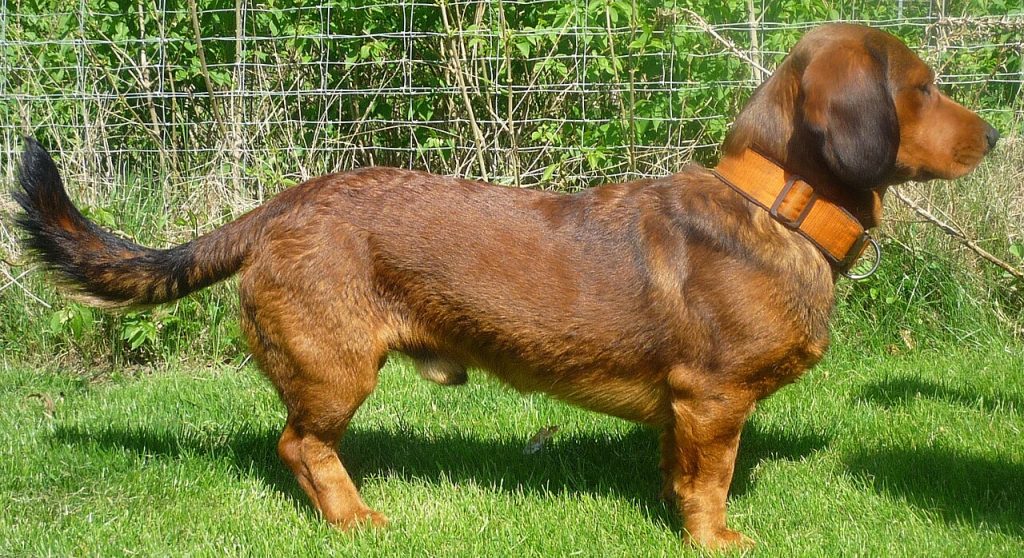
The Dachsbracke of the Alps(Alpenländische Dachsbracke) is a small but massive Austrian hound, bred for a very specific task: Follow the trail of blood from the wounded hunt down the mountain, at high altitude and even though the rainbow is already cold. With its long body, short legs, and infallible nose, it resembles a grown and strengthened Teckel, but it is a working dog in its own right: Robust, brave, sociable and much more resilient than he looks. This is the complete guide to the Dachsbracke of the Alps to see if it fits you.
Is the Dachsbracke of the Alps for you?
Before you fall in love with its good-natured dog face, be honest: the Alpine Dachsbracke is a specialized hunter in a compact body. It shines with active owners, lovers of the countryside and, above all, with people who value (and know how to manage) the work of smell. As a pure city and sofa pet, it is short of stimuli and its character pays for it.
In favour .
- Rustic, healthy and very resistant; little complaining.
- Friendly and balanced: good with children and other dogs.
- Manageable size and very short maintenance hair, easy to care for.
- Smart and hardworking; a crack at nose and trace games.
- Very close to his family, not aggressive.
To be taken into account
- Very strong prey and tracking instinct: the nose can do it.
- Unreliable call; be careful not to release it without a fence.
- He barks and howls like a good hound.
- He needs exercise and real daily mental stimulation.
- Long back: you have to take care of it and watch your weight.
Character and temperament

The Alpine Dachsbracke has a temperament that surprises those who expect a dog nervous because of its resemblance to the Teckel. It is, first of all, brave, friendly and intelligent. At home he is calm and affectionate, very close to his people, without the reactive spark of many small dogs. That serenity is just what you ask of a bloodhound: You have to work focused for hours, without getting distracted or collapsing in hostile terrain.
But don’t be fooled by her domestic calm. Inside, it carries a very high-octane olfactory motor. When it catches a scent, it goes into “trace mode” and the rest of the world disappears: Neither your voice nor your awards can compete with a good roar. This functional independence – thinking for oneself following the track – is a virtue in the mountains and a challenge in the day to day. Understanding that dual nature, a gentle house dog and an obsessive tracker, is the key to getting along with it.
It is a sensitive dog and not a dominant one. It responds badly to yelling and harshness, and very well to gentle treatment and play. It is not a serious watchdog – it warns with barking, but its calling card is the nose, not the teeth – so it is expected company and work, not protection.
Coexistence: children, other pets, flat and loneliness
With children: is usually excellent. It is patient, sociable and resistant to drag, which makes it a good family companion. As always, it is advisable to teach the little ones to respect their rest and meal times.
With other dogs: well, in general. It is a breed used to working and living with other dogs, so canine sociability takes it seriously. With dogs of the opposite sex and good socialization, coexistence is usually easy.
With other pets:‘s strong prey instinct, typical of hounds, can be activated with cats, rabbits or birds, especially if it has not grown up with them.
On the floor: is viable for its size, as long as you cover its need for exercise and smell. Two important drawbacks: it’s vocal (scream and howl) and it doesn’t do any good to be alone for long hours. If you work out all day and have neighbors hanging around, this is not the most comfortable dog.
Education and training

Training an Alpine Dachsbracke is an exercise in patience and cunning, not coercion. It’s smart and wants to please, but it drags on the selective stubbornness of the hound: it obeys delightfully… until its nose finds something better to do. The good news is that, well-motivated, it learns fast.
The keys that work with this breed:
- Positive reinforcement always. Awards, play and cheerful voice.
- Better five minutes of fun than half an hour of boring.
- The call, as a priority. is your Achilles heel, work it from a puppy, with prizes of the highest value, and be realistic: in an unfenced area, better with a long leash.
- Duct the nose. Smell games, searches and home tracks are not an extra: they are their language.
- Early socialization. People, dogs, noises and varied environments during the first few months for their natural balance to shrink.
Exercise and activity
Don’t be fooled by its short paws: this dog was bred to move around the mountain for hours, on slopes and at high altitudes. It needs much more exercise than its size suggests.. A couple of laps around the block is not enough for it.
The ideal plan combines quantity and head: several long daily walks that you can walk and, most of all, smell at your own pace, plus some nasal activity that makes you think. He loves country walks, quiet hiking and any game that involves searching and tracking. That physical and mental outlet is what keeps at bay their tendency to bark, dig, and “self-employ” themselves by following scents. Of course, respect his long back: Avoid large jumps and abrupt descents, especially from a puppy.
Care: fur and hygiene
In terms of maintenance, the Dachsbracke of the Alps is one of the easiest. Its the mantle is short, dense and very thick., with an abundant undercoat that insulates it from the cold and moisture of the mountain. It does not require hairdressing or large pamperings: with a weekly brushing is enough to remove the dead hair and distribute the natural fat, increasing the frequency during the spring and autumn mowing.
The ears is the place where you should be on top. Because it is long and falling, it retains moisture and dirt and is a candidate for otitis, especially after working in the field; check and clean it often. Complete with the usual basics: short nails (their are black and hard), well-groomed teeth and a bath only when you really need it, so as not to dry your skin.
Foodstuffs
It has no special dietary requirements, but its morphology demands control. A complete and quality diet, adjusted to its age, weight and actual activity level, is sufficient. The golden rule with this breed is don’t let him get fat.: with a long body and short legs, each extra kilo punishes the spine and joints.
Split the food into two servings a day, measure the rations, and use some of the feed in their olfactory games (great idea for a dog with such a nose). Water always fresh and available, and beware of excess rewards when you’re working on education: it’s easy to get carried away with a dog so gluttonous and motivated by food.
Health and life expectancy

One of the great assets of the Alpine Dachsbracke is its rusticity. By remaining a working dog selected for functionality, and being a breed few in number and nothing subject to fashions, it has remained fairly healthy and free of many of the hereditary problems that drag more popular breeds.
The point to watch is the obvious: your long back. The combination of an elongated trunk and short legs makes it prudent to protect the spine – avoiding jumping and overexertion, controlling weight – to reduce the risk of disc problems, as in any chondroid dog. Fallen ears (otitis) also deserve attention because of their tendency to accumulate moisture. With regular veterinary checkups, vaccination, deworming and weight control, it is usually a long-lived dog.
As for the life expectancy, the figure that is usually handled is around the 12 – 14 years.
Physical appearance
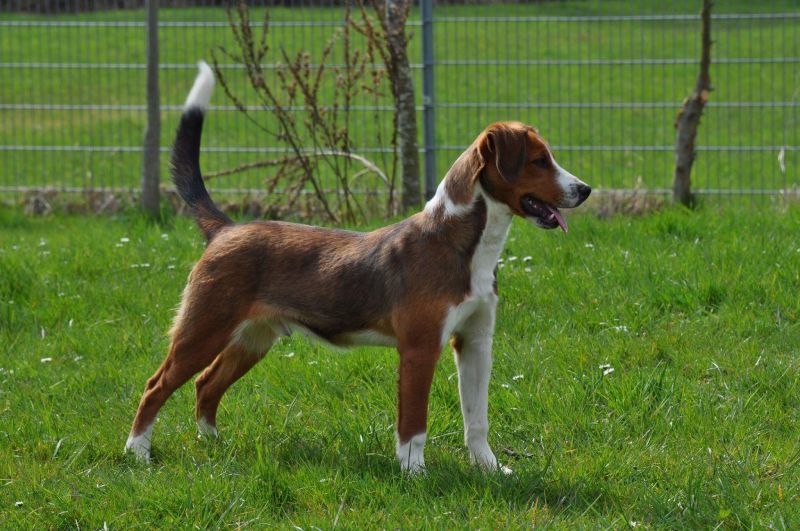
The Alpine Dachsbracke is a small but surprisingly massive dog. Its silhouette is unmistakable: long and robust body on short legs (though somewhat longer and stronger than those of a Teckel), broad chest and a heavy bone structure that conveys solidity.
- Height at the cross: between 34 and 42 cm; ideal in males is 37 – 38 cm and in females 36 – 37 cm.
- Peso: of 15 to 18 kg, a lot for its lift, which confirms its corpulence.
- Cabeza: hound, with round eyes of vivid expression and long, drooping ears.
- Manto: short, dense and very bumpy, longer in tail and neck, with abundant undercoat.
- Color: dark red deer (with or without intermixed black hairs) or black with fire-red-brown markings; a small white star on the chest is allowed.
Exhibition judges look for strong limbs and feet, black nails, tight fingers, elastic skin, and a loose, efficient trot – traits of a dog designed to last on the ground.
Origin and history
The Alpine Dachsbracke has its roots in the Austria in the mid-19th century. Like other Bracken(Central European Dachshunds), it was fixed by lowering the size of larger tracking dogs by crossing with Teckels (Dachshunds).
During the 1880s, Crown Prince Rudolf of Habsburg took Dachsbracke specimens from the Alps on his hunting trips to Egypt and Turkey, a detail that gives an idea of the prestige the breed achieved in his time.
Today the Federación Cinológica Internacional (FCI) recognizes it in Group 6 (tracking dogs or hounds and similar breeds), Section 2, along with the Bavarian Mountain Hound and the Hanover Hound, its blood-tracking relatives. Outside Europe, the American United Kennel Club also admits it, using the FCI standard.
Curiosities
- His name says it all.“Dachs” is badger and “Bracke” is dachshund in German: literally, an alpine “badger dachshund”, a name that betrays its origin and its kinship with the Teckel.
- Dog of princes. Accompanied the Habsburg court on hunts as exotic as those in Egypt and Turkey in the 19th century.
- Specialist in cold leads. is famous for tracking blood even when it’s already cooled, a skill that makes it invaluable for recovering wounded pieces ethically.
- The High-level worker. is designed to hunt in high mountains and steep terrain, where larger dogs have a harder time.
- Three musketeers on the trail. shares section in the FCI with the Bavarian Mountain Hound and the Hanoverian Hound, the classic trio of Central European bloodhounds.
If you are attracted to this short, snooty hound, you may be interested in other related breeds because of their tracking instinct or morphology: the Teckel (Dachshund), a direct relative of the one from which it inherited its short legs; the Basset Hound, another hound with a long body and sloping ears; the tireless Beagle; and the king of the trail, the Bloodhound or St. Hubert hound.
Frequently asked questions about the Alpine Dachsbracke
Is the Alpine Dachsbracke a good family dog?
Yes, within its profile. It is a friendly, well-balanced and very attached to its people hound, which usually gets along well with children and other dogs. Now, it is primarily a hunting dog with a powerful tracking instinct: it enjoys family life, but it needs exercise, olfactory stimulation and owners who understand that its nose is in charge. It is not a decorative sofa dog.
Does it look like Teckel?
They are similar because they share blood: the Alpine Dachsbracke was established by crossing mountain hounds with Teckels to lower the elevation.
How much exercise do you need?
It is a working dog bred to trawl for hours on rough terrain and at high altitude, so it copes poorly with a couple of short walks. Ideally several long daily outings, with time to sniff, more nose games or trails that occupy its head. A bored Dachsbracke becomes stubborn and barking.
Is it easy to educate?
It is intelligent and collaborative, but has the independence typical of hounds: when it catches a smell, it disconnects. It responds very well to positive reinforcement, short sessions and olfactory work, and badly to harshness.
Can he live in a flat?
It can, if you give it the exercise and mental outlet it needs. It’s not big and tolerates indoors well as long as it gets out enough. Two warnings: it tends to use the voice (it barks and howls like a good hound) and it doesn’t take long solitude well, so in a flat with neighbors and long days out of the house it can give problems.
What colours is the Alpine Dachsbracke?
The reference color is intense deer red, with or without some intermixed black hairs. Black is also allowed with red-brown (fire) markings on the head, chest, legs, feet and tail, and even a small white star on the chest.
Is he a healthy dog? How long does he live?
It is a rustic and robust breed, without the list of problems of many fashionable breeds, partly because it is still a work dog selected for functionality.
Where did it originate and what was it used for?
It was used – and is still used – as a tracking and bloodhound: it locates by smell the wounded piece (deer, wild boar, hare, fox) and follows the reaper even when the trail is already cold.