Omega-3s, chondroprotectors, and other supplements – which are worthwhile?
You walk into any pet store and you’re greeted with whole shelves of boats promising new joints, shiny hair and perfect digestion. The supplements for dogs market moves billions a year, but the scientific evidence behind each product varies widely: Some have serious studios behind them and others live almost exclusively on marketing. In this guide we separate the wheat from the chaff: what the science says about omega-3s, chondroprotectors, probiotics and company, when it makes sense to supplement and when you’re throwing money away.
If your dog has a health problem, the correct order is diagnosis first, supplement later (and only if appropriate).
Supplements for dogs: when they make sense and when they don’t?
Let’s start with what almost no one tells you in the store: a healthy dog that eats a complete and balanced feed does not need supplements. Commercial foods labeled “complete” are formulated to cover all the essential vitamins, minerals, and nutrients. Adding a multivitamin “just in case” doesn’t improve anything and in some cases can be harmful: excess vitamin A or D, for example, is toxic and accumulates in the body.
That said, there are situations in which supplementation does make sense:
- Diagnosed diseases: osteoarthritis, atopic dermatitis, kidney or heart disease, where certain nutrients in therapeutic doses act as treatment support.
- Home-made diets: almost no home diet covers all micronutrients without supplementation formulated by a veterinary nutritionist.
- Specific stages: gestation and lactation, sport or geriatric dogs, always under professional guidance.
- Digestive stressful situations: treatment with antibiotics, dietary changes, travel or residency.
With this clear framework, we go with the three big protagonists.
Omega-3 (EPA and DHA): the supplement with the most scientific evidence
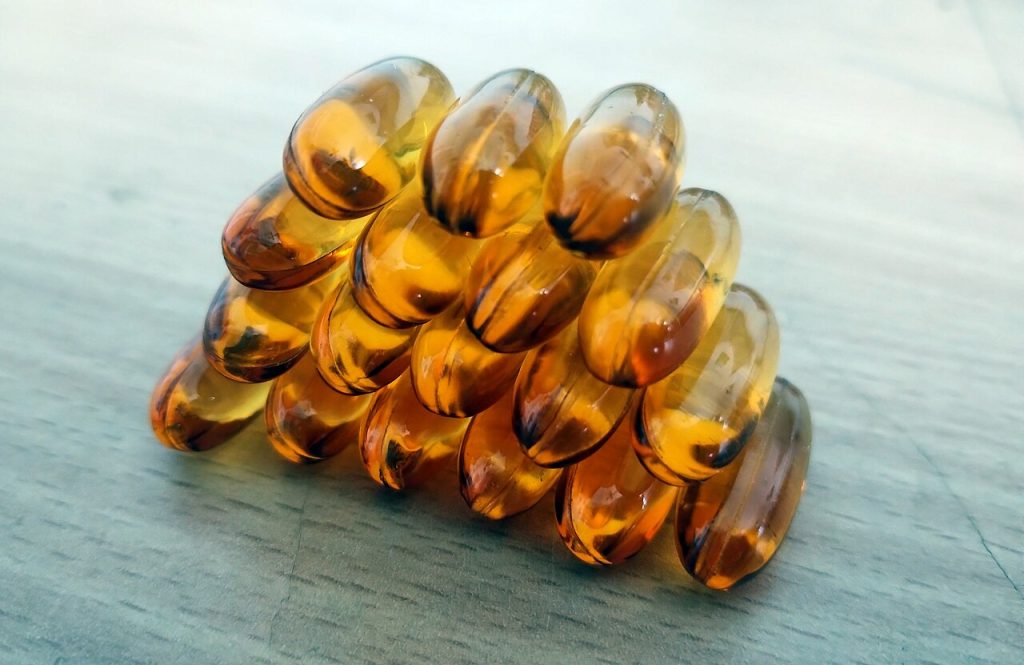
If you could only keep one extra from the entire shelf, it would be this one. The long-chain omega-3 fatty acids, EPA and DHA, from fish oil are among the few supplements with randomised and double-blind clinical trials in dogs that show real benefit, especially in osteoarthritis: In multicenter studies, supplemented dogs had significant improvements in joint pain, lameness and inflammation compared to placebo, with improvements visible from 6-8 weeks onwards.
Why do they work? EPA and DHA are incorporated into cell membranes and displace arachidonic acid, reducing the production of inflammatory mediators.
- Arthrosis and joint health: as support in older dogs and in breeds with predisposition to hip and elbow dysplasia, such as Labrador Retriever, Golden Retriever or Pastor Alemán.
- Skin and hair: improves the skin barrier and reduces itching in atopic dermatitis; interesting in breeds with sensitive skin such as the Bulldog Francés or Shar Pei.
- Renal and cardiac support: as an adjuvant in chronic renal disease and certain cardiac diseases, always prescribed by the veterinarian.
Dosage and how to get it right
Veterinary reference tables handle guideline ranges of 50 to 100 mg/kg by weight per day of combined EPA+DHA for general support, and higher doses (guided by the veterinarian) in osteoarthritis.
- What counts is the sum of EPA + DHA., not the total milligrams of “fish oil”. One product can have 1,000 mg of oil and only 300 mg of EPA+DHA.
- Start with a fraction of the dose. and increases gradually over one to two weeks: the most common side effects are soft stools, and are avoided with a gradual introduction.
A nuance that saves discomfort: the omega-3 of plant origin (flax seeds, chia) is ALA, and dogs turn it very badly into EPA and DHA.. For therapeutic effect, you need fish, krill or seaweed oil, not flax oil. And keep the bottle in the fridge: omega-3 oxidizes easily and a stale oil loses its effect.
Chondroprotectors (glucosamine and chondroitin): the uncomfortable truth
Let’s be honest here, because it’s probably the best-selling supplement for dogs and also one of the most questioned. Glucosamine and chondroitin sulfate have been recommended for osteoarthritis for decades, and their safety profile is excellent. The problem is efficiency: studies in dogs show conflicting results.. Some trials found some improvement in pain; others, well-designed and with placebo, found no significant differences. A recent meta-analysis was even more conclusive and concluded that the effect of the glucosamine-chondroitin combination is as low as should no longer be recommended as the main analgesic in dogs with osteoarthritis.
Do you mean throw them away? Not exactly.
- If you’re on a tight budget, prioritize what works.: weight control, adapted exercise and omega-3s. Overweight is the great enemy of joints, and slimming a dog with osteoarthritis improves their limping more than any chondroprotector.
- If your vet prescribes them as part of a multimodal plan, there’s nothing wrong with using them: they’re safe, and some dogs seem to benefit, although we can’t guarantee that.
- Be wary of any product that promises to “regenerate cartilage”.
This is especially important in breeds doomed to watch their joints all their lives: giants like the Bernese Boyer, or breeds with delicate backs like the Teckel, where real prevention comes from weight, musculature and checks, not a miracle boat.
Probiotics: Useful, but at specific times
Probiotics are living microorganisms that, in appropriate strains and doses, provide a digestive benefit.
- Diarrhoea associated with antibiotics: dogs given probiotics alongside the antibiotic have less diarrhoea, vomiting and loss of appetite.
- Non-specific acute diarrhoea: they can shorten their duration by one or two days.
- Diarrhoea due to stress: changes of home, travel, canine residences.
Outside of those contexts, giving probiotics daily to a healthy dog with normal digestion has no proven benefit. Two pieces of advice if you use them: Choose products with strains studied in dogs(human yogurts are not good: the majority of its bacteria do not survive canine digestive transit and many carry sugar or sweeteners) and checks that the label indicates the number of colony-forming units (CCU) guaranteed up to the expiry date, not just “at the time of manufacture”.
Other supplements: which are worthwhile and which are not
Honest summary of the rest of the shelf:
| Supplement | Evidence in dogs | When should I consider it? |
|---|---|---|
| Omega-3 (EPA/DHA) | High: clinical trials with placebo | Osteoarthritis, atopic skin, renal or cardiac support |
| Glucosamine + chondroitin | Low/contradictory | Only within a multimodal plan, no high expectations |
| Probióticos | Average: good for specific diarrhoea | Antibiotics, acute diarrhea, and digestive stress. |
| Colágeno UC-II | Low-average: weak effect in studies | Alternative joint to evaluate with your veterinarian |
| Multivitamínicos | Unnecessary with complete diet | Only on home diets, guided by a nutritionist |
| Cúrcuma, “superalimentos” | Very low: no solid tests in dogs | For no apparent reason; they do not replace anything |
| Calcium in puppies | Counterproductive | Never on your own: Excess damages the growing skeleton |
It is worth emphasising on calcium: in puppies of large and giant breeds, such as the Gran Danés, excess calcium during growth is associated with serious orthopedic problems.
How to choose a quality supplement: checklist
The supplement industry is much less regulated than the pharmaceutical industry, and independent analyses often find products that do not contain what the label says.
- Specific quantities by dose: mg of EPA and DHA, UFC of probiotics… runs away from proprietary blends without numbers.
- Manufacturer identifiable with quality controls and, where appropriate, published own studies.
- Specific product for dogs: human supplements may contain xylitol (toxic to dogs), added vitamin D or other dangerous ingredients.
- Batch number and expiry date visible, and correct storage (the omega-3, cold and protected from light).
- Realistic Promises: “supports joint function” is acceptable; “cures dysplasia” is a scam.
- Consistent price: calculates the cost per mg of active substance, not per bottle.
Common Mistakes When Supplementing Your Dog
- Supplementing without diagnosis. If your dog limps, the first thing is not glucosamine, it’s finding out why he limps. It could be osteoarthritis, but it could also be a torn ligament or something worse.
- Doses designed for 70 kilos, xylitol, vitamin D… a potentially dangerous combination.
- Expect results in a week. Omega-3s take six to eight weeks to incorporate into cell membranes.
- Double it both ways. Many “senior” or “joint care” feeds already contain omega-3s and chondroprotectors.
- Use the supplement as an excuse. No omega-3 compensates for a dog with osteoarthritis remaining 5 kg overweight.
- Don’t call the vet. Omega-3s at high doses affect clotting; they should be discontinued before surgery and communicated at all times, especially if your dog is taking medication.
Frequently Asked Questions
Can I give my dog my human omega-3 capsules?
Sometimes yes, but only if the product contains only fish oil (without added vitamin D, xylitol or flavourings) and your veterinarian adjusts the dose to the dog’s weight.
How long does omega-3 take to take effect?
Fatty acids take time to incorporate into cell membranes, so don’t expect visible changes before two months.
Does glucosamine have any side effects?
It’s one of the safest supplements: at best, mild digestive upset at first. The problem is not the risk, but the limited efficacy that studies show. Talk to your vet if your dog is diabetic, because it’s good to monitor glucose.
Does my large breed puppy need extra calcium?
No, and it’s also dangerous. excess during growth is associated with deformities and orthopedic problems, especially in giant breeds.
Can supplements replace medication for osteoarthritis?
No. In painful osteoarthritis, anti-inflammatory and pain relievers prescribed by the veterinarian are the treatment; supplements such as omega-3 are a support that can help reduce long-term doses, never a substitute.
Does a healthy, young dog benefit from taking “preventive” supplements?
The best joint and general prevention is to keep your dog lean, exercised and with regular veterinary check-ups.