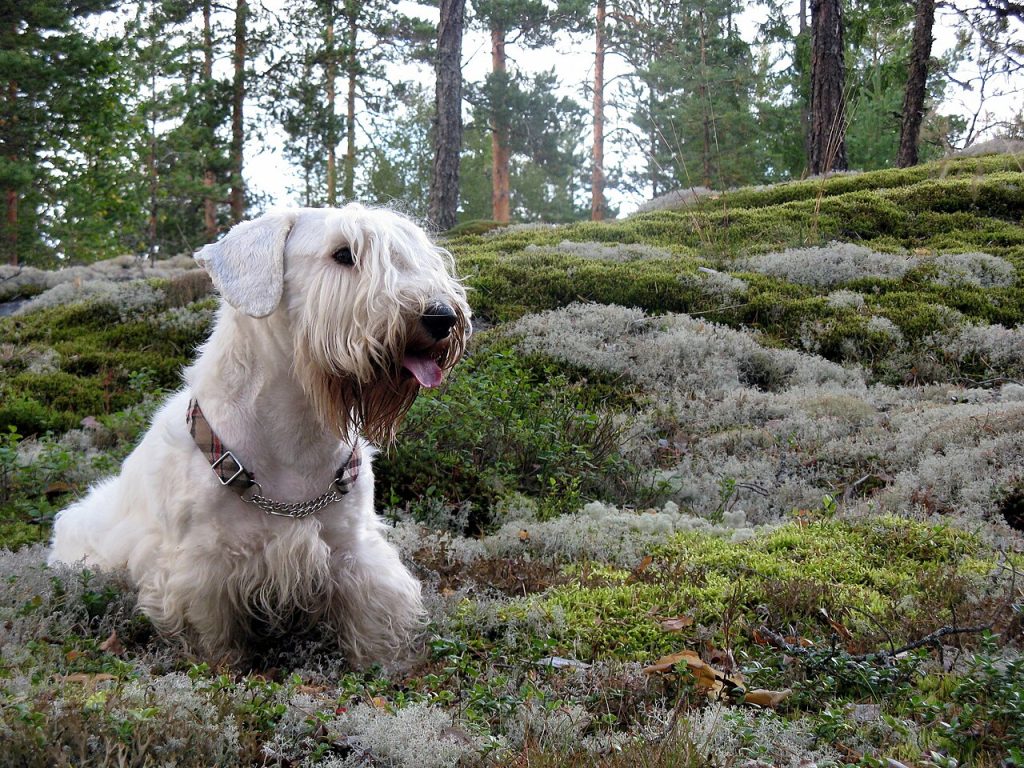
The Sealyham Terrier is one of the rarest and most unique terriers in existence: a small, white, almost gentlemanly-looking Welsh dog, with a longer than tall body, unmistakable eyebrows and beard, and a character that combines typical terrier bravery with surprising calmness. Raised in the 19th century to pull badgers and rats out of their burrows, today it is mainly a family companion with a lot of personality. It is listed by the British Kennel Club as a vulnerable native breed, so owning a Sealyham Terrier is also participating in the conservation of a breed that was on the brink of extinction.

Is the Sealyham Terrier for you?
Before you get carried away by that adorable, crowded eyebrow face, let’s be honest: The Sealyham Terrier is a working terrier with centuries of hunting instinct inside a small body. It’s affectionate, quiet indoors and very adaptable, but it can also be stubborn and barking if not groomed with judgment. Here’s a quick check to see if it fits you.
In favour .
- Small size (about 8-9 kg) that adapts well to flats and city life.
- Calmer and less hyperactive than most terriers.
- It’s okay to stay home alone if you’re used to it.
- Coat that barely loosens hair, good choice for someone who hates the mute.
- Loyal, brave and with a very funny personality; excellent companion.
- Healthy, long-lived breed with few hereditary problems and DNA testing available.
To be taken into account
- He can be stubborn and strong-willed – not an “easily obedient” dog.
- Bark if you’re bored or watch your territory; you have to work the warning.
- Strong hunting instinct for rodents and small prey.
- The hard white coat requires periodic stripping or hairdressing.
- It’s a rare breed: finding puppies from a serious breeder can take months.
- He loves to scratch and get dirty; his white feet and beard give him work.
Character and temperament
If I had to sum up the Sealyham Terrier in one sentence it would be this: A terrier with the volume down. He shares with the rest of the group his audacity, his tenacity and that mischievous spark, but he does so with a composure and a calmness that surprises anyone expecting a nervous puppy. Inside the house it is a serene companion, attached to its people and with an “almost magical” way of connecting with its owners, as described by those who live with the breed.
That doesn’t mean I’m a submissive stuffed animal. The Sealyham Terrier is lively, fearless and very sure of himself, and can be stubborn when he doesn’t feel like it. He’s also a vocal dog: It warns, barks and “comments” on what is happening around it, a direct inheritance of its role as a working and alert dog. Well channeled, that character makes him a discreet guardian and an enormously expressive companion; mismanaged, a headstrong barker.
First and foremost, he is a loyal, sympathetic family dog who goes to great lengths to please those who treat him with respect, and his courage – the same courage that drove him to stand up to an underground badger – is now translated into a strong character wrapped in a small, endearing wrapper.
Coexistence: children, other pets, flat and loneliness
The Sealyham Terrier is an adaptable dog that performs just as well in the countryside as in the city, making it a reasonable candidate for the living on the floor as long as its exercise and mental stimulation are covered.
With children it is usually a robust and playful companion, especially if it grows up with them. As with any terrier, it is advisable to teach the youngest to respect their time and rest, and supervise play: it is not a fragile dog, but it does not tolerate being treated like a stuffed animal either.

With other pets there are nuances. The Sealyham can learn from puppyhood to get along with other animals, including cats and birds, if socialization is early and positive. However, it should not be forgotten that it was bred as a scavenger: towards rodents, rabbits or other small prey it retains a very vivid instinct, so a hamster loose in the hall is tempting luck.
As for the loneliness, it is one of its great advantages. Although it enjoys company, it tolerates staying home alone well if you gradually get used to it. It is not a dog that collapses from anxiety easily, but, like any breed, it needs routines, enough outings and not spend the whole day locked up and boring, because then the barking and mischief will appear.
Education and training
Training a Sealyham Terrier is an exercise in good humor and patience. He is intelligent and able to learn a lot – even to take prey if trained – but his independent and stubborn nature means that he will do things when you convince him that they are worthwhile, not out of blind submission. positive training, with prizes, short sessions and a lot of consistency, is the only way that really works with this breed.
Two fronts deserve special attention. The first is the barking: Being a vocal dog, it’s best to work from puppyhood on the order of silence and not reinforce the barking by asking for attention. The second is the early socialization with people, dogs, and other animals, essential to softening their headdress and hunting instinct. A well-socialized Sealyham is a balanced and sociable dog; one that has not left the house can become suspicious and barking.
The good news is that his eagerness to please, when he connects with you, makes him very receptive. Those who work with the breed say that “they will do anything to please” once they have earned your trust. The key is respect, perseverance and not getting into the pulses of force that a terrier will always be willing to fight.
Exercise and activity
The Sealyham Terrier has moderate energy: it needs less exercise than most long-legged terriers, but much more than a lap dog. A couple of good-quality daily walks, with time for sniffing and research, plus some playing time, are usually enough to keep it fit and balanced.
Where it really shines is on the mental stimulation. It’s a thinking dog, with centuries of tracking and blood-searching work, so it appreciates scent games, stuffed toys, “searching” exercises, and any activity that puts its nose to work. A mentally stimulated Sealyham is a quiet dog at home; a bored one digs, barks, and seeks its own amusement.
Being a short and long-bodied dog, it is advisable to watch out for sudden jumps and excessive stairs, especially as a puppy and in old age, to protect its back. No high-impact sports: it does better walking, tracking, intelligence games and, if you feel like getting back to its roots, activities such as the earthdog where it can use its instinct in a controlled way.
Care: fur and hygiene
The coat is the Sealyham Terrier’s hallmark and also its main maintenance job. It has a double coat: a dense inner coat and a hard, rough, weather-resistant outer coat, with a texture reminiscent of a breakdown.

The traditional technique is the stripping or hand-peeling: the dead hair is plucked by hand (or with a stripping blade) once or twice a year so that the outer layer retains its hardness and colour. If the dog does not go to exhibitions, many owners opt for cutting hair by machine, more comfortable, although over time the coat becomes softer and loses some texture. In any case, regular brushing with a metal comb avoids knots and tangles.
The white color requires extra hygiene. The areas around the eyes and muzzle must be cleaned frequently to avoid the purplish spots of tears and saliva, and pay attention to the paws and beard, which get very dirty because it is a short dog that loves to burrow in the mud.
Foodstuffs
As a small, moderately energetic dog, the Sealyham Terrier does not need large amounts of food, but does need a complete and balanced diet suitable for its size, age and activity level. Good quality feed, a moist diet formulated or home feeding supervised by a veterinarian are valid options; the important thing is that it provides the necessary nutrients without excess.
The critical point is the weight control. Like many compact dogs, it tends to gain weight if overfed or if you abuse rewards, and overweight is especially harmful in a dog with a long body and short legs, because it burdens the back and joints. Divide the daily ration into two portions, measure the quantities, discount the treats from the total, and adjust according to your body condition. Fresh water always available and veterinary checks to adapt the diet to each stage of your life.
Health and life expectancy
The Sealyham Terrier is, as a whole, a resistant and long-lived breed, with relatively few specific health problems. A British study from 2024 placed its life expectancy around 13 years old, above the average of both purebred and mixed breed dogs; traditional sources speak of an approximate average of 12-13 years.
The two hereditary problems most highlighted by breed clubs are:
- Dislocation of the lens: an eye condition in which the lens shifts from its position due to weakening of the ligament that holds it. The Sealyham is one of the most predisposed breeds, by a mutation in the ADAMTS17 gene. If left untreated, it blocks the drainage of the eye, causes a painful rise in blood pressure (glaucoma), and can lead to blindness. There is a dNA test that identifies carriers and allows for responsible crossing planning.
- Myelopathy of the spine: a degeneration of the spinal cord that occurs in older dogs and can gradually cause them to lose the use of their hind legs.
In addition, the breed shows some predisposition to atypical dermatitis(skin allergies). On the other hand, with such a small population, one of the biggest challenges is not a specific disease but genetic diversity: the low number of stallions makes it important to breed with the head to avoid the founder effect and the abuse of few stallions. Buying from a reputable breeder who performs appropriate DNA testing is the best guarantee of starting from a healthy puppy.
Physical appearance
The Sealyham Terrier has an unmistakable silhouette: a longer than high body, without becoming square, robust and surprisingly compact, which brings together a lot of dog in a very small volume.
According to the British standard, its height should not exceed 31 cm at the cross (about 30 cm in average), and its weight is around 8 kg in females and 9 kg in males. It has a broad skull, a long, square-shaped snout, a strong, thick neck, and powerful, muscular limbs despite being short. The ears fall to the sides of the head and, along with the plump eyebrows and beard, give it that characteristic expression.
The coat is predominantly white, with a long, hard outer layer and a dense inner one. Color marks on the head and ears – lemon, black, brown, blue or badger – are allowed, while extensive body stains are penalized. The target is not random: It was deliberately selected so that the hunter could distinguish the dog from the prey in the middle of work.
Origin and history
The Sealyham Terrier owes its name to Sealyham House, an estate near Wolfscastle in the Welsh county of Pembrokeshire, where the captain John Edwardes developed the breed between 1850 and 1891. Edwardes was looking for a small, white dog with a strong jaw and hard hair, able to crawl into burrows to extract badgers, otters and alligators. He left no record of their crosses, but it is believed that the Welsh Corgi, the hard-haired Fox Terrier and the now extinct White English Terrier were involved in the mixture. He chose without consideration, raising only the strongest specimens.
After Edwardes’ death in 1891, other breeders continued his work. The breed was first shown in 1903, the Sealyham Terrier Club was founded in 1908 and the Kennel Club officially recognized it in 1911; in its early days it became known as the “Welsh Border Terrier” or “Terrier Cowley”. In 1913 the American Breed Club was born. In the 1920s and 1930s, Sir Jocelyn Lucas used Sealyhams to hunt badgers, otters and squirrels, and by crossing them with the Norfolk Terrier gave rise to the unrecognized “Lucas Terrier”.
After the First World War he lived his the golden age: It became fashionable among Hollywood stars and British royalty. Since then, however, their numbers have plummeted. In 2008 it hit bottom, with barely 43 puppies registered in the UK, which left it among the most endangered native breeds. The rise of designer dogs, the loss of their function as working dogs, and the ban on tail trimming contributed to the decline. The Kennel Club included it on their vulnerable native breeds list, and campaigns such as the “SOS: Save our Sealyhams” from Country Life magazine in 2011 sought to revive interest in preserving it.
Curiosities
- The white coat is not an aesthetic whim: it was purposefully selected for the hunter to distinguish the dog from the prey during underground work.
- They had Sealyham Terriers stars such as Humphrey Bogart, Bette Davis, Elizabeth Taylor or Tallulah Bankhead, and the writer Agatha Christie.
- Cary Grant had one he named Archie Leach… which was his own real birth name.
- Alfred Hitchcock was a lover of the breed: he is shown riding two of his Sealyhams in his famous cameo at the start of The birds(1963).
- The british royal family also loved them: King George V had one named Jack, and Princess Margaret had two, Pippin and Johnny, who took him to the bedroom along with the breakfast tray.
- In 2009, Sealyham “Charmin” won the Best in Show by Crufts, although his victory was not televised because the BBC had stopped broadcasting the contest that year.
- The Welsh name for the breed is Daeargi Sealyham.
If you are attracted to this strong-willed little Welshman, you may be interested in other terrier and companion breeds with strong personalities. You can continue to explore the Yorkshire Terrier, another terrier often full of courage; the elegant Poodle or Poodle, also with barely shaved hair and very intelligent; the charismatic Dachshund or Teckel, with that long, short body so similar to the Sealyham; or the sociable Shih Tzu, another little flatmate.
Frequently Asked Questions about the Sealyham Terrier
Does the Sealyham Terrier shed a lot of hair?
Like most terriers, it has a coat that barely changes, so it sheds very little hair around the house, but that dead hair has to be removed manually by stripping or periodically cutting, in addition to regular brushing.
Is he a good dog to live on?
Yes, it is one of its great advantages. Its small size, its tranquility inside the house and its ability to adapt to both the city and the countryside make it suitable for flooring, as long as you cover its daily walks and its mental stimulation.
How long does a Sealyham Terrier live?
It is a long-lived breed. A British study from 2024 placed its life expectancy at around 13 years, above average, and other sources speak of an approximate average of 12 to 13 years.
Do you get along with children and other pets?
With children it is usually a robust and playful companion, especially if it grows up with them and games are supervised. With other dogs and cats it can get along well if socialized from a puppy, but it maintains a strong hunting instinct towards rodents and small prey, so it is not a good idea to leave it loose with hamsters or small birds.
Is it hard to educate?
It’s intelligent but independent and stubborn, so it requires patience. It doesn’t respond well to imposition: it works with positive reinforcement, short sessions, consistency and respect. Once it connects with you, it becomes very receptive and “does anything to please”. Early socialization is essential.
What health problems does the breed have?
It is a resistant breed. The two main hereditary problems are lens dislocation (eye disease with DNA testing available, as the breed is predisposed) and canine degenerative myelopathy in older dogs, also with DNA testing. It shows some tendency to atopic dermatitis.
Why is it such a strange breed?
After their heyday in classic Hollywood and among royalty, their numbers dropped dramatically to a low of only 43 puppies registered in the UK in 2008.
Does the Sealyham Terrier bark a lot?
It can be quite vocal: it warns, barks and “comments” on what is happening, inheriting its role as a working and alert dog. With education from puppyhood (order to be silent, not to reinforce attentional barking) and enough exercise and mental stimulation, the barking is kept under control.