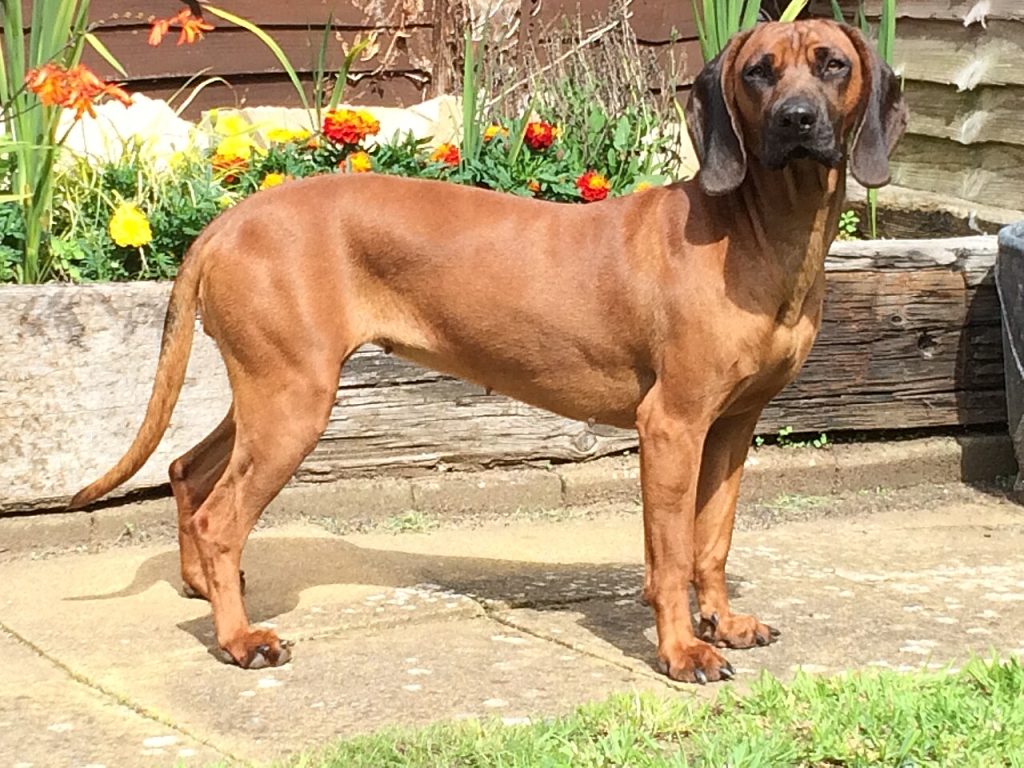
The Bavarian Mountain Hound(in German Bayerischer Gebirgsschweißhund) is one of the finest trackers in the canine world: a mountain dog bred in Bavaria to follow, for hours and over the most broken terrain, the blood trail of the wounded larger hunter.
Is the Bavarian Mountain Hound for you?
Before you fall in love with their noble look, be honest: this is a working dog, not a sitting dog. It shines in the hands of big game hunters, rangers and people who live in the countryside and can give it a purpose. If you’re looking for a quiet companion for an urban flat, almost any other breed will fit better. These boxes summarize who does and who doesn’t.
It’s a good fit if…
- You live in a rural or mountain environment, with space.
- You hunt big game or you want a bloodhound.
- You can give him several hours a day of exercise and sniffing.
- You value a quiet dog at home and devoted to his family.
- You have patience for an independent character.
Think about it if…
- You live in a small apartment or you don’t get out much.
- It’s your first dog and you’re looking for something easy to handle.
- You can’t spend time with her every day.
- You have small pets (their hunting instinct is strong).
- You want a dog that’s very sociable with strangers.
Character and temperament

The Bavarian Mountain Hound has a temperament that seems to be split in two. In everyday life, with his family, he is a serene, balanced and deeply attached dog. He is neither noisy nor nervous; he likes to be close to his own and is calm at home. With strangers he is reserved and cautious, without falling into aggressiveness: he simply keeps his distance until he gains confidence.
The other face appears as soon as you put your nose on a trail. Then he turns into a hard, determined and obsessively persistent. dog . That concentration, which makes him an elite tracker, is also what makes him a dog of strong, independent character. He’s stubborn not out of disobedience, but because his brain is wired to follow a goal to the end. Those who live with it learn to respect that nature and to channel it, not to fight it.
It is, in short, a dog of one very stable emotional record: balanced, loyal and sensitive to its people. It is not the typical extroverted dog that jumps to greet everyone, and precisely because of that it conveys that image of noble and centered hound that characterizes it.
Coexistence: children, other pets, flat and loneliness

With children: is patient, but also robust and energetic, so it is advisable to teach the little ones to respect their moments of calm.
With other pets: with dogs usually get along well, especially if they grow up together. The problem is small animals: cats, rabbits or rodents can awaken their powerful hunting instinct. Coexistence is not impossible, but requires early socialization and a lot of head.
On the floor: is not his thing. He is a dog made for the mountains and the open space; locked in a floor without enough exercise he gets bored and frustrated. He can live in the city only if his family compensates with hours of daily activity, but his natural habitat is the countryside.
Soledad:, being so close to his family, has a hard time with prolonged loneliness. If he spends too many hours alone and without stimuli, he can become destructive or howling. He needs to be part of the life of the house, not parked in a garden.
Education and training
This is where the Bavarian Mountain Hound shows its double face. For its job – blood tracing – it’s a brilliant student: no one has to teach it to use its nose, just to channel that talent. For daily obedience, however, you have to arm yourself with patience.
It is a smart but independent dog, used to making decisions on its own while following a trail. This means that it does not obey “because it does”: it needs a consistent, calm and constant guide who earns its respect without harshness. Positive reinforcement, short and motivating sessions and a good bond give much better results than imposition.
Two keys are nonnegotiable. The first, the early socialization: The sooner he gets to know people, environments, noises and other animals, the more balanced he will be as an adult. The second, the call and dam control: With such a powerful sense of smell and such a strong instinct, a Bavarian Mountain Hound that catches a trail can disconnect from the world. Working the call from a puppy and being cautious with the loose in areas with wildlife is essential. It’s not the ideal breed for an absolute beginner.
Exercise and activity
If there’s one thing that defines this hound, it’s its resistance. It was bred to go around the mountain for hours following a trail, and that machinery needs fuel. It doesn’t just take a short walk to the block: it requires intense physical exercise and, above all, olfactory mental work.
The ideal plan combines long walks, running, nature exploration, and sniffing or tracking games that put his nose to work. For him, following a trail is as satisfying as it is exhausting: half an hour of search tires him more than an hour’s walk. Disciplines like mantrailing or sport tracking are perfect for channeling his talent if not used for hunting.
A well-trained Bavarian Mountain Hound is a calm and pleasant dog at home. A bored and unemployed one is a sure source of trouble: barking, wrecking, and running behaviors in search of something to track.
Care: fur and hygiene

In terms of maintenance, it is a very unpretentious dog. Its hair is short, dense, shiny and attached to the body, designed to withstand the mountain weather.
The point that requires the most attention are the ears: When they fall and hit their heads, they breathe poorly and accumulate moisture, especially after going out into the countryside or water. They should be checked and cleaned regularly to prevent otitis. Complete the routine with the basic care of any dog: check pads and nails after exits (very important in a dog that treads hard ground), dental hygiene and baths only when really needed.
Foodstuffs
As a medium-sized, very active, high-endurance dog, the Bavarian Mountain Hound needs a complete and of high quality feed, adjusted to its very high energy expenditure. A working specimen that spends the day crawling in the mountains has very different needs than a dog that lives a quiet day: the ration must be adapted to age, weight, physical condition and, above all, actual daily activity.
It is advisable to divide food into two daily servings instead of one, a recommended practice in deep-breasted dogs to reduce the risk of digestive problems, and avoid strenuous exercise just before and after eating. Always keep an eye on his condition: You need to stay athletic and fibrous, never overweight, something that would punish your joints and your performance. Fresh water at discretion, essential for a dog that works outdoors.
Health and life expectancy
The Bavarian Mountain Hound is reputed to be a rustic and healthy breed . Having always been raised with criteria of functionality and work, and not aesthetic fashion, it has retained a good genetics. A 2009 study found the breed to have a inbreeding coefficient of just 4.5%, the lowest of the three tracker hounds analyzed, which is a good sign of genetic diversity and population health.
It doesn’t carry a long list of characteristic hereditary diseases. Even so, as with any medium-sized, active dog, sensible veterinary follow-up is warranted: care for the joint health(avoiding overweight and over exertion in the growing puppy), monitor the ears for their droopy ears and keep up to date with deworming and vaccinations, especially important in a dog that lives and works in the wild, exposed to ticks and other parasites. With proper care, their life expectancy is estimated to be around 10 to 14 years.
Physical appearance
It is a of medium size hound, harmonious, light and muscular, built for agility on rough terrain rather than for brute strength. The males measure between 47 and 52 cm to the cross and the females between 44 and 48 cm, with a weight around the 20 to 30 kg. The body is somewhat longer than tall and rises slightly towards the group, giving it that silhouette ready for the mountain.
The head is strong and elongated, with a broad and slightly bulbous skull, marked stop and dark truffle with broad ears. The ears, of high insertion and medium length, are broad at the base, rounded at the tip and hang glued to the head.
The coat is short, thick and shiny, thin on the head and ears and rougher on the rest. As for the color, it features a beautiful range of tones: deer red and reddish, lion with black mask and fresh or chilled, sometimes with a small white mark on the chest.
Origin and history
The story of the Bavarian Mountain Hound is that of a dog born of a very specific need: track wounded game in the mountains. For centuries, European hunters used bloodhounds (the Schweißhunde) to find escaping big game animals injured after a shot. The great specialist was the Hound of Hanover(Hannoverscher Schweißhund), heavy and slow-paced, ideal for the flat forest but impractical in the high mountain.
In the 19th century, hunters in the Bavarian Alps searched for a lighter and more agile dog, capable of moving through steep passes and slopes without losing its extraordinary tracking ability. To achieve this they crossed the Hanoverian Hound with native mountain hounds, such as the Tyrol hound, and other hunting dogs. The result was this mountain hound, smaller, athletic and hardy, perfect for working on broken terrain.
In 1912 the Club for Bayrische Gebirgsschweißhunde(Bavarian Mountain Dog Club) was founded in Munich, which set the standard and ensured the purity of the breed. From Bavaria, his reputation as an infallible tracker spread to Austria, Hungary and, gradually, to the rest of Europe, always linked to the world of big game hunting and forestry. Today it is recognized by the FCI within Group 6(sows and similar breeds), in the section of blood tracking dogs.
Curiosities
- He specializes in blood. Its German name, Schweißhund, does not come from “sweat” but from Schweiß, the hunting term for blood that loses a wounded piece.
- He has an extraordinary olfactory memory. is able to follow a trail several hours old – sometimes an entire day old – distinguishing the wounded piece from those of other healthy animals.
- More of a worker than a pet. Unlike almost any popular breed, most specimens remain working dogs in the hands of hunters and rangers, not urban companion dogs.
- Very controlled upbringing. Breed clubs are notorious for requiring work tests to breed, which has kept their skills intact and their genetic health enviable.
- Unlike its heavier relatives, the The most agile of the hounds. was designed specifically for speed and agility in the mountains.
If you are attracted to this noble and hardworking hound, you may be interested in other breeds with a prodigious sense of smell or a strong tracking and hunting instinct. Check out the Bloodhound, the undisputed tracking king; the unmistakable Basset Hound; the tireless Beagle; or the sleek Arm of Weimar, another great versatile hunting dog.
Frequently asked questions about the Bavarian Mountain Hound
Is the Bavarian Mountain Hound a good dog to live on the floor?
It is not its ideal environment. It is a working dog bred to track for hours in the mountains, with a lot of energy and need for space. In a flat it can adapt only if you guarantee it several hours a day of intense exercise and olfactory stimulation; otherwise it becomes frustrated and develops undesirable behaviors. It fits much better in a house with land in a rural or mountain environment.
Do you get along with the kids?
Yes. It is calm, balanced, and very attached to its family, and usually gets along well with children if it has been socialized. Nevertheless, it is a robust dog with a hunting instinct, so it is advisable to supervise play with the youngest and teach children to respect their rest times.
Is it easy to educate?
It is intelligent and quick to learn, but also independent and stubborn when following a trail. It is not the easiest dog for an inexperienced person: it needs a patient, constant guide who works positively. For tracking it is brilliant; for urban obedience you have to insist more.
How much exercise do you need a day?
We’re talking about a minimum of a couple of hours a day between long walks, running and, above all, olfactory work. He’s a distance runner designed to follow blood trails over rough terrain: if he doesn’t burn that physical and mental energy, you’ll feel it at home.
What is the Bavarian Mountain Hound used for?
It is a blood-tracking dog (Schweißhund).[citation needed] Its specialty is to follow the trail of a wounded big game animal – deer, roe deer, wild boar – from the drops of blood it leaves, even hours after the shot.
Do you lose a lot of hair? How much care does your coat need?
No, her hair is short, dense, and attached to her body, very easy to maintain. A weekly brushing is enough to remove the dead hair and keep it shiny.
How long do you live and enjoy good health?
It is estimated to have a life expectancy of around 10-14 years. It is a rustic breed with little consanguinity by canine standards, with few documented hereditary problems. As with any medium and active dog, it is advisable to monitor joints, ears and maintain a correct weight.
Is he a good companion dog or just a working dog?
It is traditionally a working dog, and most are still in the hands of professional hunters. As a companion it is affectionate and loyal, but it will only be happy – and manageable – if its family can give it the exercise and olfactory work its nature demands.