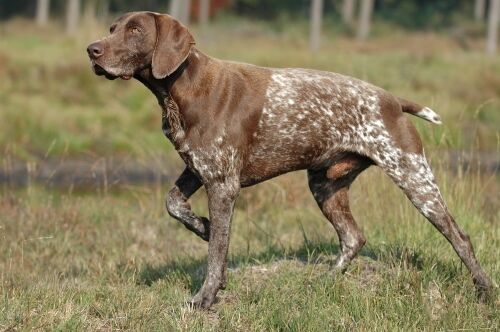
The German Shorthaired Pointer(Deutsch Kurzhaar) is one of the most complete and versatile hunting dogs in the world, and at the same time a loyal and energetic family companion. Athletic, intelligent and always willing to work, it needs an active life to show its best face.
Is the German Shorthair Braco for you?
Before you fall in love with its elegant appearance, be honest: this is not a dog for a sedentary life. The German Shorthaired Pointer was created to spend the whole day in the countryside and that passion for work remains intact. It is ideal for active people or families, but it can be a challenge for anyone looking for a quiet couch dog.
In favour .
- Incredibly versatile and hardworking.
- Very smart and easy to train.
- Loyal, affectionate and devoted to his family.
- She’s great with kids.
- Very low-maintenance fur.
- Perfect sport dog for running, swimming or dog sports.
To be taken into account
- He needs a lot of daily exercise.
- He has a hard time dealing with loneliness. He may suffer from anxiety.
- Strong hunting instinct with small animals.
- It’s not the best choice for a small apartment.
- If he gets bored, he can become destructive.
- Its energy requires a time-consuming and consistent owner.
Character and temperament

The German Shorthaired Pointer combines two souls in one dog: that of a tireless hunter and that of a loving and loving companion. In the field it is determined, courageous and of admirable concentration; at home it is calm, patient and deeply connected to its people. It is a dog that wants to be with you, participate in what you do and feel part of the group.
It stands out for a remarkable intelligence, superior to that of many breeds, which translates into a great capacity for learning and resolution. That awake head is a double-edged sword: a stimulated Braco is a dream, but a bored one will seek its own amusement, usually with undesirable results for your furniture or your garden.
He is sensitive and emotionally connected to his family. He is rarely aggressive with people; on the contrary, he is usually friendly and sociable. This same sensitivity explains why he does not tolerate either prolonged loneliness or harsh parenting methods well.
Coexistence: children, other pets, flat and loneliness
- With children: is one of its great virtues. Patient, tolerant and playful, it becomes a faithful companion for the little ones. As with any large and energetic dog, it is advisable to supervise play with very young children to avoid involuntary pushes.
- With other dogs: generally does well, especially if it has been socialized since puppyhood.
- With small pets: caution. Their powerful hunting instinct can cause them to chase cats, rabbits, birds or rodents. Coexistence is viable, especially if they grow together, but requires gradual introductions and supervision.
- On the floor: is not your ideal environment. It can adapt if you get several hours daily of real exercise, but it is much better in a house with a garden and an active family.
- In the face of loneliness: is his weak point. He needs company and has trouble spending many hours alone. Lack of activity and contact can lead to separation anxiety and destructive behaviors.
Education and training
Here shines the German Shorthaired Pointer. Its intelligence and eagerness to please make it one of the most grateful breeds to educate. It quickly learns basic commands and can go far in advanced obedience, tracking or field trials. In fact, in its home country the registration of the breed is linked to passing work tests.
The formula that works best is positive reinforcement: rewards, play and praise. It is a sensitive dog that is turned off or stressed by harshness and screaming. The sessions should be short, varied and motivating to keep its attention. Early socialization, exposing it to people, dogs, noises and different environments, is essential for it to develop its full balance.
Don’t forget the mental component: this dog needs to think as much as it needs to run. Smell games, challenges, collection jobs, and obedience routines help channel its energy and avoid boredom, which is the root of almost all of its behavior problems.
Exercise and activity

If you remember just one thing from this article, let it be this: the German Shorthaired Pointer needs a far above-average amount of exercise. It was bred for generations to run miles of country through bushes, hillsides and water without losing its bellows, and that engine is still there.
It is reasonable to offer him between one and two hours a day of intense activity, not simple walks. He loves to run in freedom, accompany his owner on a bicycle or running, swimming (he is an enthusiastic swimmer) and practicing canine sports such as agility, dock diving or obedience.
A well-trained Braco is a calm and balanced dog at home. One that doesn’t burn its energy turns into a nervous, barking and destructive animal. That’s why this breed fits so well with outdoor sportsmen, hunters and families, and so badly with those looking for a low-demand dog.
Care: fur and hygiene
In contrast with their exercise demands, the German Shorthaired Pointer’s coat is one of the simplest to care for. Its hair is short, dense, and rough, with a undercoat that makes it water-resistant and provides shelter in cold climates. A weekly brushing with a firm pork glove or brush is enough to keep it clean and shiny and to control mildew, which is moderate and constant throughout the year.
She doesn’t need a hairdresser or cuts, and the bathrooms have to be spaced so as not to dry out her skin: with bathing him when he’s really dirty is enough. The rest of the hygiene is routine for any dog: checking and cleaning your droopy ears (more likely to accumulate moisture and wax, especially if you swim frequently), trimming your nails when necessary, and maintaining dental hygiene with regular brushing.
Foodstuffs
As an athletic, active and medium to large-sized dog, the Shorthaired German Shepherd needs a high-quality, protein-rich diet that supports its musculature and energy expenditure. The amount should be adjusted to its age, weight, activity level and metabolism: a dog that hunts or trains daily consumes much more than one with a more moderate life.
As a deep-chested dog, you should take precautions against gastric dilation-torsion: Split food into two portions instead of one and avoid strenuous exercise just before and after meals. Keep fresh water available at all times, monitor your weight so that you do not gain weight during periods of reduced activity, and consult your veterinarian about the most appropriate regimen for each stage of your life.
Health and life expectancy
The German Shorthaired Pointer is, as a whole, a robust and healthy dog. Its life expectancy is around 12 to 14 years; a study conducted in the United Kingdom in 2024 calculated a median longevity of 13.4 years for the breed, slightly above the average of all dogs.
Like all breeds, it has a predisposition to some inherited disorders that you should know about:
- Dysplasia of the hip: joint malformation common in medium and large breeds.
- Progressive retinal atrophy and cataracts: hereditary eye problems.
- Hipotiroidismo: is a relatively common hormonal disorder.
- He was diagnosed with Von Willebrand disease. is an inherited bleeding disorder.
- Epilepsy, hereditary lupus dermatitis, some neurological conditions and certain nasal and oropharyngeal tumours have been described with Otros:.
Acquiring the puppy from a responsible breeder who performs health tests on the breeders, maintains veterinary checks and good weight control and exercise are the best guarantees of a long and healthy life.
Physical appearance

The German Shorthaired Pointer is a medium to large sized dog, with harmonious lines that convey power and elegance to equal parts. Males measure between 62 and 66 cm at the withers and females from 58 to 63 cm, with an approximate weight of 25 to 32 kg in them and 20 to 27 kg in them. Its constitution is elongated and athletic, with strong legs and a clear dog musculature made for endurance.
The head is of moderate size, with a slightly convex profile and a long, wide and strong snout, designed to carry hunting pieces. The eyes are brown and the expression, alert and intelligent. The ears are wide, of high insertion and fall attached to the head. The tail, traditionally amputated at half-length where the law permits, is carried horizontally in motion and hanging at rest.
The coat is short, dense and rough to the touch. It admits several color patterns: solid (liver or black), white with head and spots of color, and ruano, both dark and light.
Origin and history
The story of the German Shorthaired Pointer is written in 19th century Germany. European show dogs are descended from the ancient Spanish braco, now extinct, which spread through France and the Netherlands to German-speaking territories, where it was first used in hunting with nets and hawks and, later, with firearms. To this base were added sample dogs brought from England and specimens of the Braco type from Burgos.
From this mixture, which at first did not even have a specific name, the German breeders looked for something very ambitious: a single versatile dog to suit all hunting modalities, rather than a specialized breed for each task. In 1878 it was agreed to set the standards of the German breeds, and in 1879 the Deutsch Kurzhaar (short-haired) and the Deutsch Langhaar (long-haired) were introduced. The first book on the origins of Kurzhaar was published in 1897.
The breed was definitively accepted by the International Kennel Federation (FCI) in 1954, and recognized by the American Kennel Club as early as 1930. Since then it has not stopped gaining followers: it is one of the most registered and appreciated hunting breeds in the world, valued both by hunters and sports families.
Curiosities
- Its German name, Deutsch Kurzhaar, literally means “short-haired German”.
- It’s a truly multifaceted dog: it tracks, samples, snakes on land and in water, and tracks blood from wounded pieces.
- It has close relatives in the German Longhaired Braco and the German Hardhaired Braco, fruit of the same German kennel school.
- Its versatility and smell have taken it beyond hunting: it is used in security bodies for detection tasks, such as the search for illicit substances.
- In 2016 a specimen of the breed was proclaimed “Best in Show” at the prestigious Westminster Kennel Club dog show.
- He is a natural swimmer: water, far from holding him back, is one of his favorite elements.
If you are attracted to the character of the Shorthaired Pointer but want to compare before deciding, take a look at other sample and game breeds with a similar profile: the Weimaraner, another stylish and athletic German hound; the Vizsla, a Hungarian cousin of similar energy and attachment; the classic English Pointer; and the English Setter, another show dog of great nobility. They all share this combination of instinct, intelligence and the need to move.
Frequently asked questions about the German Shorthaired Pointer
Is the Shorthaired German Shepherd a good family dog?
Yes. It is an extraordinarily loyal, sociable and affectionate dog that binds strongly to the whole family. It lives very well with children and enjoys human companionship. The condition is to satisfy its enormous need for exercise and companionship: a Braco who is bored or spends many hours can only become destructive or anxious.
How much exercise does a German Shorthair need?
We’re talking about a high-energy, high-endurance sporting dog. It needs at least one to two hours of intense activity a day: running, cycling, swimming, collectibles or dog sports. Quiet walks are not enough; without physical and mental outlet, it becomes frustrated.
Is the German Shorthaired Braco easy to train?
It is one of the easiest breeds to train thanks to its above-average intelligence and its eagerness to please. It learns quickly with positive reinforcement, short and varied sessions. Its sensitivity causes it to respond poorly to harsh methods; the key is constancy, early socialization and giving it tasks that occupy its mind.
Can the German Shorthair live in a flat?
It is not ideal. It can adapt to a flat only if the owner guarantees it several hours a day of real exercise outside the house. It is much better in a house with a garden and, above all, with an active family. What it really needs are not square meters, but activity and company.
How long does a German Shorthair live?
Its life expectancy is around 12 to 14 years. A British study from 2024 placed the median longevity of the breed at 13.4 years, slightly above the canine average. It is a robust and healthy dog, and proper care helps it reach the maximum of its range.
Does the German Shorthair drop a lot of hair?
Its short coat is of very low maintenance: a weekly brushing is enough. It loosens hair moderately and constantly throughout the year, with peaks in the seasonal changes. It does not require hairdressing or cuts, which makes it a very comfortable breed in terms of coat hygiene.
Do you get along with other dogs and pets?
With other dogs it usually coexists well, especially if it socializes from a puppy. With small pets you have to be careful: it retains a strong hunting instinct and can chase cats, birds or rodents. Coexistence is possible with gradual introductions and supervision, better if they grow together.
How tall and how much does a German Shorthair Braco weigh?
The males measure between 62 and 66 cm at the withers and the females from 58 to 63 cm. The approximate weight ranges from 25 to 32 kg in males and from 20 to 27 kg in females.