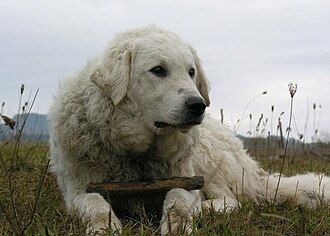
The Kuvasz is a large, white and imposing Hungarian cattle guard dog, bred for centuries to defend herds and farms without the need for anyone to give him orders. Behind his dignified demeanor and snowy fur is a brave, independent protector deeply loyal to his family. It’s not a dog for just anyone: The Kuvasz needs space, serene leadership and early socialization to show their best. In this comprehensive guide we review their character, their care and everything you should value before sharing your life with one.
Is the Kuvasz for you?

The Kuvasz is a wonderful breed, but also demanding. Before letting yourself be carried away by its beauty, you should be honest about what it means to live with a guard dog of large size and independent mindset. These are its lights and shadows.
In favour .
- Exceptional guardian, brave and deterrent by nature.
- Unwavering loyalty to his family.
- Smart and capable of making decisions for himself.
- Rustic and resistant: it withstands the cold and the weather without problems.
- Affectionate and, beneath his serious demeanor, surprisingly playful.
- Simple coat care in spite of her white mane.
To be taken into account
- Very territorial and suspicious of strangers.
- Independent and stubborn – not a “book” obedient dog.
- It needs space; it doesn’t fit well in small floors.
- It tends to bark as a warning and can be noisy.
- Very abundant seasonal mold.
- Not recommended for first-time owners with no experience.
Character and temperament
The temperament of the Kuvasz is that of a classic guardian: confident, brave and serene, with a marked independence that comes from centuries of working alone protecting herds. These dogs were selected to watch the cattle away from the shepherd, which means they are programmed to assess situations and decide for themselves when to intervene. That autonomy is precisely what makes him so effective as a protector and, at the same time, so different from blind obedience races.
With his family, the Kuvasz is deeply affectionate and loyal. He is strongly attached to his people and develops a natural protective instinct towards his own, especially towards the smallest of the household.
With strangers, however, he is aloof, watchful, and often openly suspicious. It is not gratuitous aggression, but prudence: The Kuvasz needs time to accept someone new and will always remain alert to any signal it interprets as a threat. This combination of calm courage and distrust makes early socialization absolutely imperative.
Coexistence: children, other pets, flat and loneliness
- With children: is usually a patient and protective dog with the children of his own family, to the point of acting as their guardian.
- With other pets:, bred among animals, can get along well with other dogs and with the livestock it is used to protecting.
- On the floor: is not their ideal environment. The Kuvasz is a large dog that needs space and preferably a garden or fenced terrain to patrol.
- Soledad: tolerates loneliness better than many companion breeds due to its independent nature, but it should not spend the entire day isolated.
Education and training

Educating a Kuvasz requires patience and perseverance. It is a dog with a strong and independent personality that will put its guide to the test, so education should begin very early, ideally from a puppy. Do not expect the immediate submission of a hardworking shepherd: the Kuvasz thinks for itself and will obey when it understands the meaning of what you ask and trusts the one who asks it.
It works much better with calm, consistent leadership based on positive reinforcement than with hard methods, which only get you in a band. The key is to set clear standards from the start and keep them firmly in kind. Socialization is the most important part of their education: The more you expose the puppy to people, noises, environments and other animals in a controlled manner, the more balanced the adult will be.
Due to its guarding nature and size, it is not the most suitable breed for someone facing dog breeding for the first time. A poorly socialized and unguided Kuvasz can become too territorial.
Exercise and activity
The Kuvasz has moderate energy but needs enough daily activity to stay healthy in body and mind. It is not a hyperactive athlete like a border collie, but it is a large and robust dog that enjoys long walks, exploration and the possibility of patrolling its own terrain.
It is advisable to be careful with intense exercise during the growth phase: being a large breed with a tendency to bone problems in its development, puppies should not be subjected to repeated jumps or excessive exertion until their joints have matured.
Mental stimulation is as important as physical stimulation. A bored or aimless Kuvasz tends to look for occupations on his own, not always desirable. Giving him a “function” – watching the farm, accompanying you in your routines – keeps him satisfied and focused.
Care: fur and hygiene
Despite its spectacular white coat, the Kuvasz is surprisingly easy to maintain in everyday life. Its coat is long, rough and wavy, with a softer inner layer, and has some natural resistance to dirt. Regular brushing, a couple of times a week, is enough to keep it clean and untangled most of the year.
The exception is the seasonal moods, in which it loses a significant amount of hair. During these periods it is necessary to brush it daily to remove the dead undercoat and prevent the house from being filled with hair. Bathing should be occasional: bathing it excessively takes away natural protection to its mantle.
The rest of the hygiene is the usual for any large dog: checking and cleaning the ears, watching the nails and maintaining good dental hygiene. It is also advisable to inspect the pads and skin, especially if you live outdoors.
Foodstuffs
As a large dog, the Kuvasz needs a quality diet adapted to its size and activity level. The most important thing is to adjust the amount to its age, weight and wear to avoid both thinness and overweight, which would overload already sensitive joints in large breeds.
In the puppy stage, a specific feed for large breeds is appropriate, formulated to promote controlled growth and protect bone and joint development.
Because of its size and deep chest, it is advisable to divide food into two daily servings instead of one, and avoid vigorous exercise just before and after eating as a precautionary measure against digestive problems.
Health and life expectancy

The Kuvasz is, in general, a healthy and robust dog, the result of centuries of natural selection for hard work outdoors. Its life expectancy is around 12 to 14 years, a notable figure for a dog of its size.
The main ones are the developmental bone problems: being a dog of considerable growth, it is prone to joint and bone disorders during its growth stage, including hip dysplasia, common in large breeds.
To minimize risks, it is best to go to responsible breeders who perform health tests on breeders, keep the dog at its ideal weight throughout its life, and follow a regular veterinary check-up schedule.
Physical appearance
The Kuvasz is a large, solidly built and unmistakably dignified dog. The males measure around 71 to 76 cm at the cross and weigh between 48 and 62 kg, while the females are somewhat smaller, with about 66 to 70 cm and a weight of 37 to 50 kg. It is therefore an imposing but agile dog, never heavy.
Its most characteristic feature is the white fur– pure white or ivory white – long, rough and wavy, with a softer inner layer.
The head is wedge-shaped, with a slightly arched skull and a snout that is not too long. The ears, small and V-shaped, hang on the sides. The body is somewhat elongated and muscular, with robust and not overly long extremities, and the tail is long and slightly curved at the end.
Origin and history
The Kuvasz is one of the native breeds of Hungary and a dog with a very long history linked to the Carpathian Basin. Its exact origin is lost in time: Some associate it with the peoples who came to Hungary during the great migrations, from Asia and the area of Turkey. Its own name seems to derive from an ancient Turkish word, often translated as “safe guardian”, which fits perfectly with its millenary function.
In the 15th century, he achieved great prestige at court: it is believed that King Matthias Corvinus kept numerous Kuvasz as guard, hunting and even war dogs.
Selective breeding of the breed with a defined standard began in the late 19th century. The International Cinological Federation recognized it in 1934, with final acceptance in 1954. However, the Kuvasz was on the verge of disappearing: The two world wars severely decimated it, and by the end of World War II, there were very few copies left in Hungary – according to sources, less than thirty, and even only a dozen. Thanks to the efforts of dedicated breeders, the breed recovered, although that genetic bottleneck left its mark on the current population.
Curiosities
- Its name comes, according to the most widespread theory, from an ancient Turkish word related to the idea of “safe guardian”.
- It was a dog of the Hungarian aristocracy: King Matthias Corvinus especially appreciated it and kept numerous specimens at his court.
- It was on the brink of extinction after World War II; it was its reputation for protecting families that led many to be persecuted.
- It’s such a rustic dog that it can withstand the harshest weather conditions without moving.
- In Hungary he has also been employed as a police and army aide.
- It should not be confused with the Komondor, the other large Hungarian white dog: the Kuvasz has smooth, wavy hair, while the Komondor wears the characteristic rasters or strings.
If you are attracted to the Kuvasz because of its guarding nature and stately demeanor, you may be interested in other protective and mountain breeds with a similar profile. Check out the Gran Pirineo, another large white cattle guard; the Komondor, the unmistakable cordoned-haired Hungarian dog; the agile Puli, also from Hungary; or the imposing Mastín Tibetano, another large-sized millennial guard dog.
Frequently asked questions about the Kuvasz
Is the Kuvasz a good family dog?
Yes, he is loyal, affectionate, and protective to his family, and he is usually patient with the children in his household. However, his size, independence, and strong guardian instincts make him a better fit in experienced families that can offer him space, early socialization, and calm leadership.
How long does a Kuvasz live?
With proper nutrition, moderate exercise, and regular veterinary checkups, you can enjoy a long, active life.
Is the Kuvasz aggressive?
It is not aggressive in a gratuitous way, but it is very territorial and distrustful of strangers. Its behavior is that of a guardian who evaluates situations and protects his own. Proper socialization from puppyhood is key to channeling that instinct in a balanced way.
Can he live in a flat?
The Kuvasz is a large dog that needs space and, preferably, a fenced area to patrol. Its tendency to bark to warn does not facilitate coexistence in a neighborhood community either. It adapts much better to a house with a garden.
Do you lose a lot of hair?
In day-to-day life, its coat is easy to maintain with a couple of weekly brushes, but during seasonal mowing it loses a large amount of hair.
Is it hard to educate?
It has a strong and independent personality, so it is not the simplest breed. It responds well to positive reinforcement, consistency and calm leadership, but will test the patience of its guide.
How is it different from the Komondor?
Both are large white guard dogs of Hungarian origin, but their coat is totally different: the Kuvasz has smooth, long and wavy hair, while the Komondor has the characteristic mantle in the form of stripes or ropes.
How tall and how much does a Kuvasz weigh?
Males measure between 71 and 76 cm at the withers and weigh 48 to 62 kg; females measure between 66 and 70 cm and weigh 37 to 50 kg. It is a large and powerful dog, but retains agility and is never heavy.