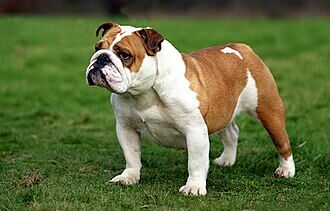
The Bulldog Inglés is one of the most recognizable dogs in the world: wide head, massive shoulders, flat nose and that serious expression that hides a quiet companion very attached to his family. Born in England for a tough job, today he is first and foremost a house dog, affectionate and surprisingly comfortable. Before you fall in love with their face, you should understand that they are a breed with very specific health and care needs. In this guide, you’ve got everything that’s important, sorted from what’s going to condition you the most to what’s going to condition you the least.
Is the English Bulldog for you?
The English Bulldog fits perfectly with those who are looking for a quiet, homey and very affectionate dog, and who is willing to take care of their health. It is not a breed for those who want a sports companion or for those who live in a very hot climate without means to cool it. Before deciding, weigh these two columns sincerely.
In favour .
- A gentle character, affectionate and very attached to his people.
- Excellent with children and tolerant of other dogs and pets.
- It needs little exercise – ideal for quiet, flat living.
- Short hair and minimal brushing maintenance.
- It barks little; it is not a nervous or hyperactive dog.
To be taken into account
- Delicate health: brachycephaly, respiratory and joint problems.
- Very sensitive to heat; real risk of heat stroke.
- Shorter life expectancy than the average canine.
- Tendency to gain weight and skin problems in the folds.
- Difficult breeding: most are born by C-section.
Character and temperament

The great paradox of the English Bulldog is that its tough appearance has nothing to do with its character. The breed standard describes it as a fair and kind, resolute and brave, never vicious or aggressive dog, with a peaceful and dignified attitude.
It is an affectionate dog that forms very strong bonds with its people, especially with children. It likes to be close, lie next to you and participate in domestic life without making a fuss. It is not noisy or restless: it spends much of the day resting and is active in short intervals.
In day-to-day life, it is a stable, fearless dog with slow and predictable reactions, and this serenity makes it a pleasant companion for almost any household, as long as its rhythm is respected and it does not require a level of activity that its body cannot provide.
Coexistence: children, other pets, flat and loneliness
The English Bulldog is one of the dogs best adapted to family life and confined spaces.
- With children: is one of its great virtues. Patient, tolerant and not abrupt, it usually creates very close bonds with the little ones in the house. As with any dog, it is advisable to supervise play and teach children to respect their rest times.
- With other pets: generally gets along well with other dogs and cats, especially if socialized as a puppy.
- On the floor: is almost the perfect apartment dog. It needs little space and little exercise, barks little and spends many quiet hours. You just have to monitor the temperature: in summer it needs cool rooms.
- In the face of loneliness: is very attached, so he prefers company. He tolerates moments only reasonably well if he’s used to it, but he’s not a dog designed to spend the whole day without anyone.
Education and training
Educating an English Bulldog is an exercise in patience and perseverance rather than demanding. It is a smart but stubborn dog: it understands perfectly what you ask of it, it is another thing if it wants to do it. That is why it responds fatally to pressure and punishment, and very well to positive reinforcement, to short sessions and to routine.
The early socialization is the best investment: exposing the puppy to people, other dogs, noise and a variety of environments as a puppy strengthens its balanced character and prevents fears.
A key detail: never push him too hard or make him work too hard. Always work in cool hours with breaks. Rewarding him with food works very well, but you have to measure the rations because he gets fat easily.
Exercise and activity

The English Bulldog is a low need for exercise dog, and that’s good and bad at the same time. Well, because it fits into quiet lives; bad, because its anatomy prevents it from doing much even if it wants to. Its flat snout limits breathing and, combined with heat sensitivity, makes it quickly fatigued.
The recommended guideline is simple: 20 to 30 minutes daily walk at a medium pace (no jogging), spread out and always in the cool hours of the day. In summer, best early in the morning or at dusk, and avoiding hot asphalt. A Bulldog panting excessively, with a purple tongue or sitting and does not want to continue, is asking you to stop immediately.
Keeping your body physically active is not optional. Moderate and constant exercise is the main tool for controlling your weight and relieving the load on already weakened joints.
Care: fur and hygiene
The English Bulldog’s hair is short, smooth and fine, low maintenance: with a brushed every two or three days it is enough to keep it clean and distribute the natural fat.
- Facial wrinkles: the folds of the face and nose accumulate moisture and dirt, and are an easy ground for dermatitis.
- It’s important to dry it thoroughly, especially between the creases.
- Nails and ears: periodic checking and trimming of nails, and cleaning of ears to prevent infections.
- Cola:‘s short and sometimes “corked” tail can form a fold that is also convenient to keep clean and dry.
- Ojos: monitor the area for potential problems (entropy, ectropion) requiring veterinary attention.
Foodstuffs
The feeding of the English Bulldog revolves around one word: weight control. It is a gluttonous dog with a clear tendency to gain weight, and each extra kilo worsens its respiratory and joint problems.
Their brachycephalic conformation also affects digestion: they swallow air when eating and are prone to gas and digestive discomfort. It helps to divide the food into several intakes, use feeders that slow down the rate of ingestion and, very importantly, leave a space between eating and exercising to reduce risks.
Health and life expectancy

Here is the most important and delicate point of the race. Selection for an extreme appearance has made the English Bulldog a dog with considerable health predispositions, and the adopter should know this beforehand. British studios put their life expectancy at low numbers: A study in 2022 estimated it at around 7.4 years and another in 2024 at about 9.8 years, below the average for purebred dogs. In practice, the average life expectancy is usually between 8 and 10 years with good care.
The most characteristic problems are:
- If you have any other medical conditions, please inform your doctor. the short snout deforms the airways and causes snoring, noisy breathing and fatigue.
- Since Sensitivity to heat: cannot cool themselves properly by panting, they are at high risk of heat stroke and hyperthermia.
- The Dysplasia of the hip: breed has one of the highest rates, aggravated by overweight.
- Skin problems: fold dermatitis and increased incidence of demodicosis.
- Ojos: entropy and ectropion, which sometimes require surgery.
- Reproducción: is commonly used in artificial insemination, and more than 80% of litters are born by caesarean section due to the large size of the head of the pups.
- Corazón: cardiac causes are among the leading causes of mortality in the breed.
None of this makes the Bulldog a bad dog, but it does require a real commitment: frequent veterinary checkups (ideally every six months), strict weight control, avoiding heat, and choosing responsible breeders who prioritize health over appearance.
Physical appearance
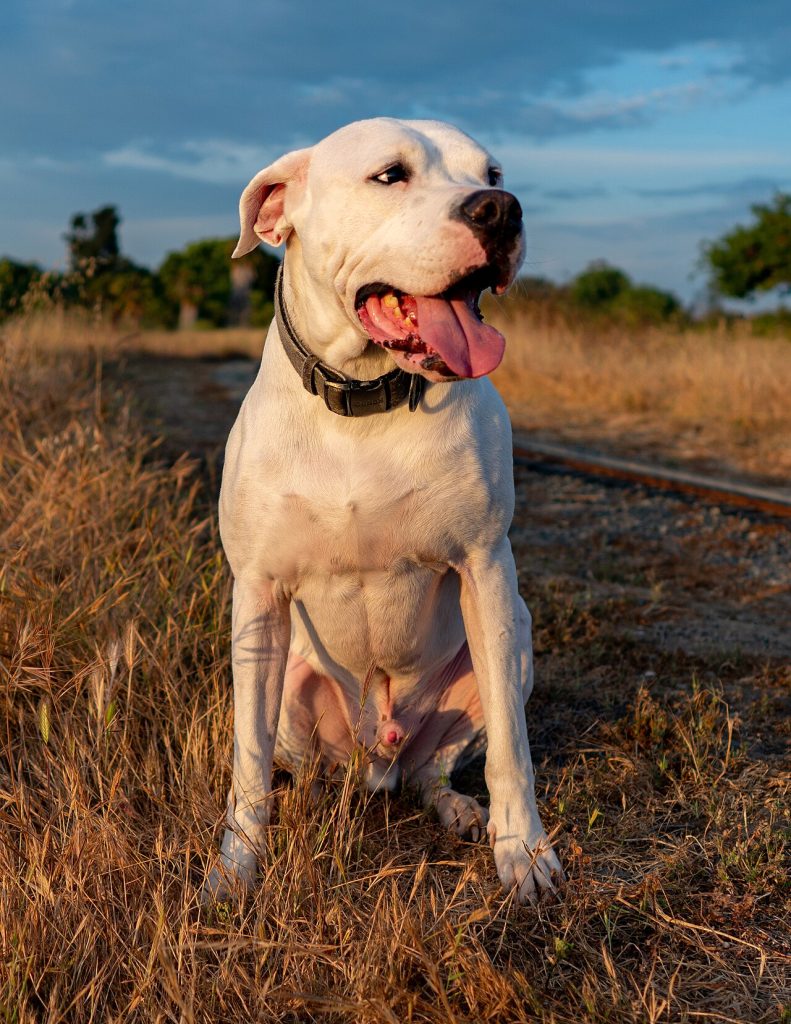
The English Bulldog is a medium-sized, compact and very muscular dog, with a low center of gravity that gives it that characteristic, heavy and balanced gait.
It has a hanging paw under the neck, drooping lips, and a prominent lower jaw (prognatism) that leaves the upper teeth behind the lower ones. The the tail is naturally short, straight or corkscrew shaped; a long, erect tail is considered a defect. The coat is short, smooth and thin, in colors such as red, lionside, white, atigrade and combinations of these (pie); black as the predominant color is not accepted.
In terms of size, males weigh about 25 kg and females about 23 kg according to the standard of their country of origin, with slightly lower weights in the American standard (around 22 kg males and 18 kg females).
Origin and history
The English Bulldog originated from Inglaterra and its name says it all: “bull dog”. Its ancestor, the Old English Bulldog, was an athletic and combative dog, lighter than the current one, employed in the bull-baiting, a cruel “sport” in which the dog had to grab a tied bull by the muzzle.
Everything changed when the The Cruelty to Animals Act of 1835 banned bull-baiting in England. The dog lost its function and could have disappeared, but a group of enthusiasts decided to convert it back into an exhibition and companion dog. In the process, it crossed with other breeds – including the pugs, from which it inherited part of its flat snout and chubby silhouette – and selected a heavier, calmer, and friendlier animal.
The hobby was soon organized: breed clubs were founded in the second half of the 19th century – the Bulldog Club, still in existence, is the oldest monoracial club in the world – and the first standards were drawn up. The American Kennel Club officially recognized the breed in 1886. Since then, the Bulldog has become a symbol of England and one of the most popular companion dogs on the planet.
Curiosities
- It is a british national icon, associated with tenacity and courage.
- It’s one of the most widely used sports and college mascots in the world, from “Handsome Dan” at Yale to “Chesty”, the mascot of the U.S. Marine Corps.
- Its short tail is natural, uncut: the Bulldog is one of the few breeds to be born with the tail like this.
- The modern Bulldog cannot perform the function for which it was born – it cannot withstand running or strenuous effort, and its short snout prevents it from biting and holding as it once did.
- It served as the basis for creating other breeds, such as the bullmastiff, the boxer and the bull terrier.
- Its popularity is enormous: in 2013 it was listed as the twelfth most registered breed in the world.
If you are attracted to the English Bulldog but want to compare before deciding, take a look at other breeds in the same moluscous, flat-faced family: the smaller and still more homely Bulldog Francés; the larger, athletic and temperamental American Bulldog; the miniature brachycephalic cousin Pug (Carlino); and the more sporty Bóxer, a descendant of the older bulldog.
Frequently Asked Questions About the English Bulldog
Is the English Bulldog aggressive?
Despite its tough appearance and its past as a fighting dog, today’s English Bulldog is kind, calm, and good-natured.
How long does an English Bulldog live?
Their life expectancy is shorter than that of the average canine.British studies place it between 7.4 and 9.8 years; in practice it is usually spoken of 8 to 10 years with good care, weight control and frequent veterinary care.
How much exercise do you need?
Little: about 20 to 30 minutes a day of walking at a leisurely pace, always in the cool hours of the day and without jogging.
Is the English Bulldog good with children?
Yes, it is one of its greatest virtues. It is patient, tolerant and forms very strong bonds with children. As always, it is advisable to supervise the game and teach the little ones to respect the rest of the dog.
Why is he snoring and breathing so loud?
For brachycephaly: its short snout deforms the respiratory tract and causes snoring, noisy breathing and fatigue.
Does it need a lot of hygiene?
The hair is easy (brushed every two or three days), but the folds of the skin do require attention: they must be cleaned and dried regularly to avoid dermatitis, in addition to bathing every three or four weeks and cutting nails.
Can he live in a flat?
Yes, it is almost the ideal floor dog: it needs little space and little exercise, barks little and spends many quiet hours. The only important care is to keep it in cool rooms during the heat.
Why are Bulldogs born by C-section?
Because the head of the chicks is very large relative to the mother’s birth canal, more than 80% of the litters are obtained by cesarean section, and reproduction is usually based on artificial insemination because of the difficulty of natural mounting.