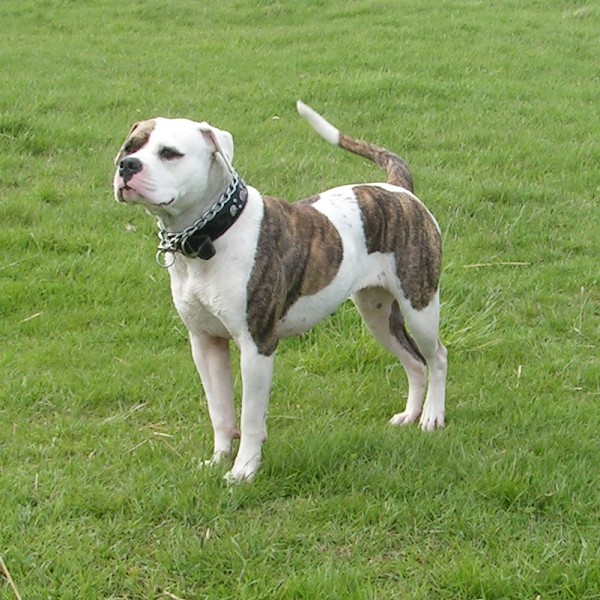
The Bulldog Americano is a large, athletic and muscular dog, a direct descendant of the ancient farm bulldogs that settlers brought to the southern United States. Raised for generations to work, hold livestock and protect property, he combines remarkable strength with absolute devotion to his family. It’s not a dog for everyone, but in the right hands, it’s one of the most loyal and balanced companions there is.
Is the American Bulldog for you?
Before you fall in love with its imposing build, be honest: the American Bulldog is a dog of strong character, with a lot of energy and need for guidance. It shines with active and constant owners, and can overwhelm those looking for a quiet and low-maintenance pet. These are its lights and shadows at a glance.
In favour .
- Unwavering loyalty and a strong bond with his family.
- Excellent watchdog and protector, very deterrent.
- Loving and tolerant of the children in the house.
- Intelligent and highly capable of learning.
- Short coat that barely needs grooming.
- Robust, athletic and tough for work and sport.
To be taken into account
- It needs an experienced owner and a firm but kind hand.
- He can be dominant with other dogs if he doesn’t socialize.
- Their strength requires early socialization and education.
- It demands abundant daily exercise; it is easily bored.
- It tends to drool more than other breeds.
- In some countries it is subject to potentially dangerous dog regulations.
Character and temperament

The American Bulldog is, above all, a family dog with a guardian soul. It is self-confident, courageous and deeply attached to the people with whom it lives. Despite its rough appearance, it is usually surprisingly affectionate at home: it seeks contact, enjoys company and considers itself another member of the human herd, often larger than it believes.
That trust has its counterpart. It is a determined dog with a tendency to dominance, especially in front of other dogs of the same sex. It is not by nature aggressive toward people (a good specimen is stable and balanced), but its protective instinct makes it an excellent watchdog that warns and defends its territory without hesitation. That ‘s why the key to his temperament lies in early socialization: A puppy that knows people, dogs, noises and various situations grows into a calm and reliable adult.
It is also a very intelligent dog that learns quickly, both good and bad. It immediately grasps the routines, norms and limits of the house, but if it detects inconsistency or lack of leadership, it will take the reins. With a consistent owner, the result is a noble, balanced and loyal companion difficult to match.
Coexistence: children, other pets, flat and loneliness
- With children: is one of its strong points. The American Bulldog is usually affectionate, patient and protective of the children in its family. However, due to its size and strength, it is always advisable to supervise the game with the youngest to avoid accidental pushes or falls.
- With other dogs: can be dominant or intolerant of unfamiliar dogs, especially of the same sex. Constant socialization from puppyhood and well-managed introductions make the difference.
- With other pets:, if raised with cats or other domestic animals, can learn to live together without problems. It retains some prey instinct, so introductions must be gradual and supervised.
- Life on the floor: is not the ideal breed for a small apartment. It can adapt if it gets more than enough daily exercise, but enjoys a house with a garden or space to move around much more.
- Soledad: is a very attached dog and does not do well with prolonged loneliness. If it spends too many hours it can only get bored, frustrated and develop destructive behaviors or barking. It needs to be part of the family day to day.
Education and training
Raising an American Bulldog is rewarding because it learns quickly, but it demands judgment. It responds phenomenally to positive reinforcement: rewards, play, voice, and caresses work much better than harshness, which only generates distrust or stubbornness in a dog of this temperament.
Socialization is the most important subject in its education. From puppyhood it must be exposed in a controlled manner to people of all kinds, other balanced dogs, urban environments, noises and new experiences. A well-socialized American Bulldog is an open and confident dog; one that is not can become reactive or overly suspicious.
It is advisable to start early with basic obedience (sitting, standing still, calling and walking without pulling on the leash), because handling an adult over 40 kilos who does not respect the leash is very different from correcting a puppy.
Exercise and activity

Behind its massive appearance is an athlete. The American Bulldog was bred to work long hours on the farm, chase cattle, and deal with wild animals, so it needs to expend that energy daily. A couple of long walks are not enough: it requires real activity, combining physical exercise and mental stimulation.
He marvels at vigorous walks, controlled races, pick-up and drop-off games, and hiking. It is a breed that excels in strength and control dog sports such as weight pulling(weight dragging), adapted agility or obedience and sport bite exercises. These activities not only keep him fit, but also strengthen the bond and channel his work instinct.
An American Bulldog that gets enough exercise is a calm and balanced dog at home, but one that is bored will seek out entertainment on its own: digging, chewing, or barking. Of course, you should avoid overworking the puppy while its joints are still developing, and moderate the intensity on hot days.
Care: fur and hygiene
In terms of maintenance, it is a very grateful breed. Its coat is short, smooth and attached to the body, so it hardly requires work: a weekly brushing is enough to remove the dead hair and keep the skin healthy.
Bathing is only necessary every few weeks or when you get really dirty; washing it too much dries your skin. Since you have a predisposition to skin problems, it is advisable to check your skin regularly for redness, irritation or hairless areas. Other basic care: cleaning your ears to prevent infection, cutting your nails when they are too big and maintaining good dental hygiene by brushing frequently.
A very peculiar feature of the breed: the American Bulldog tends to drool more than other dogs, especially the heavier types with shorter noses.
Foodstuffs
Being a large, very muscular and active dog, the American Bulldog needs a quality food, rich in animal protein to maintain its muscle mass and with the energy adequate to its activity level.
Control of weight is essential. Its powerful structure should not be loaded with extra kilos, because excess weight punishes its joints and favours health problems. It is preferable to divide the food into two daily intakes instead of one, a practice recommended in large breeds and deep-chested.
During the puppy stage, it is advisable to use a specific feed for large breeds, which regulates growth and protects the development of bones and joints.
Health and life expectancy
The American Bulldog is, in general, a robust and resistant dog, the result of generations selected for its working capacity and not only for its appearance.
Still, the breed has some predispositions that are worth knowing. In dermatological terms, it is prone to allergic skin diseases, ichthyosis, solar dermatosis and squamous cell carcinoma, in addition to having a higher incidence of demodicosis (demodedic scabies) of juvenile appearance. Neuronal ceroid lipofuscinosis (NCL), an inherited neurological disease for which genetic testing is available, has also been identified in some individuals.
As with almost all large breeds, the joints (hip and elbows) must also be monitored.The best prevention is to choose a responsible breeder who tests the health of the breeders, keeps the dog at its ideal weight, takes care of the skin and follows veterinary checks and the schedule of vaccinations and deworming.
Physical appearance

The American Bulldog is a large and powerful dog, with robust but athletic lines. It gives an impression of compact strength without losing agility: wide head, powerful jaws, muscular neck and a well-armed body on strong limbs.
In size, males measure between 55 and 70 cm at the withers and females between 52 and 65 cm. Weight ranges approximately between 32 and 54 kg in males and between 27 and 45 kg in females, with notable variations depending on type and bloodline.
The cloak is short, smooth and attached to the body. The most classic color is white, often combined with red, brown, brindle, or lionskin spots; modern layers support many patterns. Traditionally black pigmentation is preferred in the truffle and eye contour. Within the breed, two historical morphologies coexist: the standard or Scott type, lighter, athletic and long-nosed, designed for running and holding, and the like Bully or Johnson., larger, heavier and shorter-nosed, guard-oriented. Many current specimens are a combination of both, what is known as hybrid type.
Origin and history
The history of the American Bulldog begins with the old working bulldogs of England and Spain, functional dogs used on farms to hold livestock, as butcher dogs and as guards. These bulldogs traveled with European settlers to the British colonies in North America, where they found a home on small farms and ranches in the southern United States as all-terrain dogs.
While in the United Kingdom the prohibition of the bull baiting in 1835 was softening the bulldog to become the compact pet we know today (the English bulldog), in America those dogs maintained their utilitarian character. They were not a pedigree breed, but local strains selected for their usefulness: The European Union has a responsibility to protect the environment, to protect the environment and to protect the environment. The bulldog was often the farmers’ only resource for controlling them.
After World War II, this type of dog was on the brink of extinction. Her recovery is largely due to two men: John D. Johnson, a veteran who scoured the South looking for the best specimens and began keeping records and pedigrees, and Alan Scott, who joined his effort. Over time, their views diverged and gave rise to the two types of race: Scott’s most athletic and Johnson’s heaviest. The breed came to be registered as American Pit Bulldog in 1970, a name later changed to American Bulldog to avoid confusion with the American Pit Bull Terrier. The United Kennel Club officially recognized it on January 1, 1999, and in 2019 the American Kennel Club incorporated it into its Foundation Stock Service. It’s not recognized by the FCI.
Curiosities
- Over time the American Bulldog has been given very descriptive names such as Southern White, Old Southern White Bulldog, Hill Bulldog or Country Bulldog, reflecting its rural origin in the southern United States .
- The logo of the video game company Zynga is the silhouette of an American Bulldog: the company owes its name to “Zinga”, the dog of founder Mark Pincus.
- Chance, one of the three protagonists of the 1993 film Homeward Bound: the incredible adventure, is an American Bulldog.
- The breed has also appeared in film, such as in Tucker and Dale against evil(2010) and in the film Joe(2013).
- It should not be confused with the American Bully, a distinct and more recent breed arising from the crossing of the American Pit Bull Terrier with bulldogs.
- Paradoxically, much of the breed’s survival is owed to wild pigs – they were the main “task” that kept these working bulldogs alive for decades.
If you are attracted to the American Bulldog, you may want to compare its character and needs with other breeds in the same family or similar profile. You can take a look at the English Bulldog, its closest relative and of common origin; the American Pit Bull Terrier and the American Staffordshire Terrier, dogs with which it shares roots and is often confused; or moldy oversized keepers such as the Cane Corso and the Bullmastiff.
Frequently Asked Questions About the American Bulldog
Is the American Bulldog a dangerous dog?
It is not aggressive by nature; a well-bred and socialized specimen is stable and balanced. However, its strength, size and protective instinct make early socialization and education essential. In some countries it is included in the regulations of potentially dangerous dogs, so it is advisable to inform the local legislation.
Is he good with kids?
It is usually affectionate, patient and very protective of the children in its family, one of its great strengths.
How long does an American Bulldog live?
Their life expectancy is usually around 10 to 15 years, a very good figure for a dog of their size, provided they maintain their ideal weight and receive proper veterinary care.
How much exercise do you need?
It is an athletic dog bred to work, so it needs plenty of daily exercise combining physical activity (long walks, running, games) and mental stimulation.
Can you have it on one floor?
It’s not the ideal choice for a small flat, but it can be adapted if you get more than enough daily exercise and company.
Does he get along with other dogs?
With constant socialization from puppyhood and well-managed introductions, many get along with other pets without problems.
How much does it cost to keep her fur?
Very little. It has short, smooth hair that only needs a weekly brushing and occasional baths. Its maintenance is one of the simplest; what is convenient is to check the skin frequently for its tendency to skin problems.
What’s the difference between the Johnson guy and the Scott guy?
The Bully or Johnson type is larger, heavier and shorter-nosed, guard-oriented. The Standard or Scott type is lighter, athletic and long-nosed, designed for running and holding.