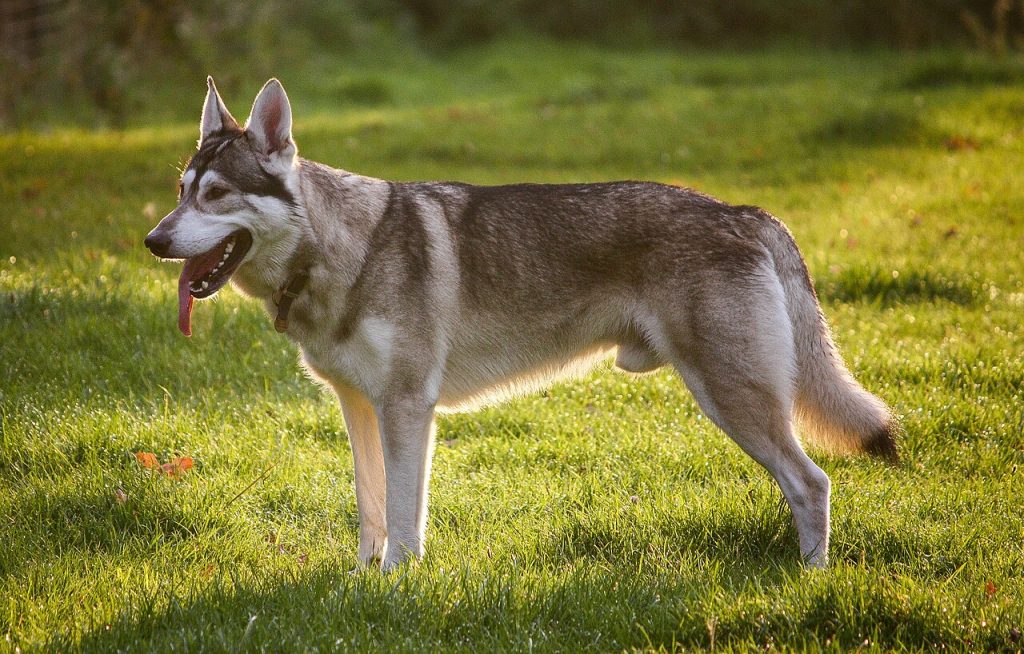
The Northern Inuit Dog(Northern Inuit Dog) is a modern British breed bred to look like a wild wolf but behave like a loyal and sociable companion dog. Tall, athletic and piercing-eyed, he became world-famous for his portrayal of the Game of Thrones werewolves. Behind that cinematic image is a loving, intelligent, family-loving dog who needs exercise, companionship, and patient training. Here’s everything you need to know about the Northern Inuit Dog before you share your life with one.
Is the Northern Inuit Dog for you?

The Northern Inuit dog falls in love at first sight for its wolf-like appearance, but it’s not a dog for everyone. It’s large, very active, and deeply dependent on its family: it shines in a home with time, space, and a desire to share outdoor activity, and it suffers in a home where it spends many hours alone.
It suits you if…
- You’re looking for a loving, sociable, family companion, not a guard dog.
- You lead an active life: hiking, running, dog sports, long walks.
- You can give him daily company and avoid leaving him alone for many hours.
- You have the patience to train an intelligent but independent dog.
- You don’t care about the hair: you accept abundant mowing and frequent brushing.
Think about it if…
- You spend a lot of time away from home: you tend to have separation anxiety.
- You want a guard or defense dog: he’s too friendly for that.
- You’re a first-timer and you seek immediate and easy obedience.
- You don’t tolerate hair at home and you don’t have time for daily exercise.
- You live in a very small space with no possibility of long exits.
Character and temperament
If anything defines the Northern Inuit Dog, it is the contrast between its wild appearance and its sweet character. He was selected from day one to be kind, balanced and sociable, and that goal is noticeable: It is an affectionate, people-oriented dog that greatly enjoys human company. It lacks the guarding instinct of other large breeds; in fact, its natural tendency is to greet strangers with curiosity rather than distrust.
It is a smart and sensitive dog, with an independent vein inherited from its Norse ancestors. He thinks for himself, evaluates what you ask of him and decides if it pays to cooperate, so don’t expect mechanical obedience from a German Shepherd. That mixture of cunning and stubbornness makes it fascinating, but it demands consistent guidance. It is also notably attached: He has a strong bond with his family, and he has a hard time dealing with loneliness, which is something to keep in mind before adopting.
Coexistence: children, other pets, flat and loneliness

With children: is usually an excellent family dog, tolerant and playful. Its size and energy advise monitoring play with young children to avoid accidental pushes, but its friendly temperament makes it a good companion for homes with minors.
With other pets:, due to its Nordic origin and herd-like character, coexists well with other dogs and appreciates canine companionship, which also helps to alleviate its fear of solitude.
On the floor: can live in an apartment if its exercise and companionship needs are met, although it is a large dog and appreciates space. Soledad: is its big weakness. The Northern Inuit Dog is not built to spend the day alone; separation anxiety, howling, and destructive behavior are common in bored or neglected dogs. A second dog or a routine that avoids long absences helps a lot.
Education and training
Training a Northern Inuit Dog is an exercise in patience and perseverance. It is smart and learns quickly, but its independence makes it need real motivation to obey: it works much better with positive reinforcement (rewards, play, praise) than with harsh imposition or correction, which only get it to close in on the band.
The early socialization is non-negotiable: The more you expose the puppy to different people, dogs, noises and environments, the safer and more balanced he will be as an adult. It’s a good idea to work from the beginning on the tolerance to being alone for short and progressive periods, to prevent separation anxiety. Sessions should be short, varied, and fun; a bored Northern Inuit dog disconnects. With a consistent guide she responds very well to training and enjoys challenges such as trail running, agility or canicross.
Exercise and activity
We’re dealing with a medium to high energy dog with work and sleigh genes, and it needs a lot more than a ride around the block, it thinks about one or two hours a day of physical activity combined with mental stimulation, long walks, running, hiking and sniffing games to keep it happy and balanced.
It is a dog that enjoy your run. and that excels in canine sports such as canicross, bikejöring, recreational mushing or agility, direct inheritance of its Nordic ancestors. Without an adequate outlet for that energy, boredom results in digging, biting furniture, and howling. Shared activity not only tires him: Strengthens the bond with your family, which is just what this dog values most.
Care: fur and hygiene

The Northern Inuit Dog wears a double coat, with a sturdy outer coat and dense undercoat that insulates it from cold and heat.
It is not advisable to bathe it excessively in order not to damage the natural protection of the mantle; with punctual baths when it is really dirty it is enough. The rest of the hygiene is that of any large dog: checking and cleaning ears, cutting nails when needed, and maintaining a good dental routine with brushing or specific products. Also watch the pads behind hard or snow-covered exits.
Foodstuffs
As a large and active dog, the Northern Inuit Dog needs a complete and balanced diet, adapted to its age, weight and activity level. A quality feed with good protein intake, or a well-formulated diet under veterinary supervision, covers its needs without problems.
watch your weight is suitable for large breeds: Being overweight hurts the joints and increases the risk of dysplasia. It adjusts the amounts to its actual expenditure (an athletic dog eats more than a sedentary one) and avoids strenuous exercise just before or after eating to reduce the risk of gastric torsion, typical of deep-chested dogs. Fresh water always available, especially after exercise.
Health and life expectancy
Overall, the Northern Inuit Dog is a fairly healthy dog, the result in part of a broad genetic base and a breed oriented to functionality rather than extreme traits.
Still, there are points to watch. As with all large breeds, hypoplasia of the hip is the primary joint risk, so serious breeders screen breeders. In related lines of this breed family, specific cases of epilepsy, carriers of degenerative myelopathy and, in males, some incidence of cryptorchidism(non-descended testicle) have been described. Choosing a responsible breeder who performs health tests, maintains the dog’s weight, and goes for regular veterinary checkups are the best guarantees for a long and healthy life.
Physical appearance
The Northern Inuit Dog is a large, athletic and with harmonic lines dog, designed to evoke the silhouette of a wolf without reaching the mass of a Malamute. The males are usually larger and more robust than the females, with a wider head and heavier bone; the females show a finer and more stylized expression.
The head is lupine in appearance, with erect ears, elongated snout and some almond eyes ranging from yellow to amber and brown; light eyes are rare and blue or disparate are not considered desirable. The double coat comes in various shades of wolf gray, sabre and cream, with layers of black, white and gouge (each hair with colored bands along). The tail is stubby and straight, and the whole conveys that characteristic mix of wild dog and balanced companion.
Origin and history
The Northern Inuit Dog is a young and British breed. Its history begins in the United Kingdom in the 1980s, when several dogs of Nordic type – of largely unknown ancestry – were imported from the United States with the idea of creating a dog that look like a wolf but behave like a domestic dog. Those specimens were crossed with Alaskan Malamutes, Siberian Huskys, German Shepherds and, according to some sources, Samoyed.
The result was a dog of lupine phenotype and good character that was gaining followers. During its development, the project was branched out into several related races: In addition to the Northern Inuit Dog itself, the Utonagan, the British Timber Dog and, later, the Tamaskan emerged when some breeders sought genetic diversity by adding working dogs of Finnish origin. Today the breed is managed by its own societies, such as the Northern Inuit Society, which acts as the governing body and maintains the standard and records. It has no recognition from the FCI or the big traditional clubs.
Curiosities
- The hobo from Game of Thrones. Specimens of this breed gave life to the Stark family werewolves in the series, which shot up its worldwide popularity… and also the impulsive adoptions of people who just wanted “the show dog”.
- False wolf, the real dog. despite its imprint, does not bear documented wolf blood: all its lupine resemblance was achieved by selecting domestic breeds of Nordic type.
- Large family. shares a family tree with the Utonagan, British Timber Dog and Tamaskan, all born from the same drive to recreate the wolf as a pet.
- The Outlander series has used dogs of this breed to play Rollo, the “wolf dog” of young Ian.
- An ancestral trait in his DNA. Genetic studies have identified in many of these dogs a colour variant linked to one of the oldest mutations described in domestic dogs, detected in samples thousands of years old.
If you’re attracted to the Northern Inuit’s wild air but want to compare yourself to other wolf-looking or Nordic-rooted breeds, check out the Husky Siberiano, Samoyedo, the versatile Pastor Alemán, or the noble Akita.
Frequently Asked Questions About the Northern Inuit Dog
Is the Northern Inuit Dog dangerous or aggressive?
No. Despite its wolf-like appearance, the Northern Inuit Dog was selected precisely to have a kind, sociable, and balanced character. It is not a naturally aggressive dog or a guardian by instinct; it is usually too friendly to serve as a defense dog.
Is the Northern Inuit Dog a wolf or does it carry wolf blood?
It was created in the United Kingdom in the 1980s by crossing Nordic type dogs (Siberian Husky, Alaskan Malamute and German Shepherd, among others) with the aim of achieving the physical resemblance of a wolf but with the temperament of a domestic dog.
Is it recognized by the FCI?
No. The Northern Inuit Dog is not recognized by the Fédération Cynologique Internationale or by the major traditional clubs. It is a modern breed managed by its own societies, such as the Northern Inuit Society in the United Kingdom, which have their own registers and standards.
Does the Northern Inuit Dog appear in Game of Thrones?
Specimens of this breed were used in the filming of the series Game of Thrones to bring to life the Stark children’s werewolves.
How much exercise do you need a day?
It is a medium-high energy dog. As an orientation, it is advisable to offer him around one or two hours a day spread over long walks, play and mental activity. He loves to run, explore and participate in canine sports; a poorly stimulated dog may get bored and develop destructive behaviors or vocalize excessively.
Can you have an Inuit Northern Dog in a flat?
It can adapt to a floor as long as it receives enough daily exercise and is not left alone for too many hours. It is a large dog and very attached to its family; it does not tolerate prolonged loneliness and tends to separation anxiety, so a garden helps but does not replace company or outings.
Do you lose a lot of hair?
It has a dense, double coat that changes abundantly, with two major seasonal moults in which it loses the undercoat in strands. It needs frequent brushing throughout the year and daily during moult to control loose hair at home.
How long does a Northern Inuit Dog live?
As it is a large dog with relatively healthy lines, its life expectancy is usually around 12-14 years. As with all large breeds, hip dysplasia is a risk to watch out for, and specific cases of epilepsy and degenerative myelopathy have been described in related lines.