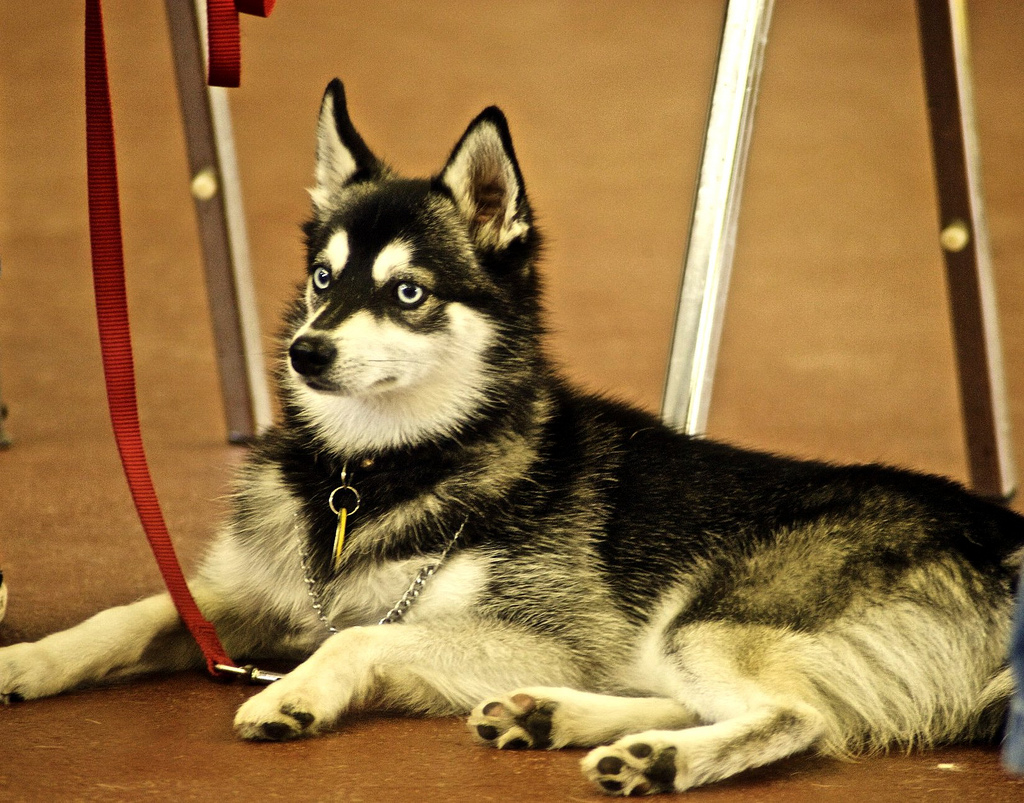
The Alaskan Klee Kai is a Nordic pocket dog: It has the unmistakable appearance of a Husky – face mask, upraised ears, and plumed tail – but concentrated in a small, agile, lively body. Created in Alaska in the 1970s as a companion dog, the Alaskan Klee Kai combines the wild northern elegance with an alert character, wary of strangers and deeply attached to his family. It’s not just a miniature Husky. It’s a breed with its own personality that demands commitment, activity and respect.
Is the Alaskan Klee Kai for you?
The Alaskan Klee Kai is a fascinating but demanding dog: it needs activity, mental stimulation, a patient owner and socializing time. Here are its lights and shadows at a glance.
In favour .
- Small size: adapts to floors if exercised well.
- It’s a spectacular Husky in miniature.
- Very smart and athletic: brilliant at agility and games.
- Extraordinarily clean, almost no dog smell.
- Loyal and affectionate to his family; excellent warning dog.
- Long-lived and, on the whole, quite healthy.
Against
- Distrustful and reserved with strangers; needs early socialization.
- Energetic and mentally restless: easily bored.
- Independent and stubborn; he does not obey “because he does”.
- Vocal: warning, howling and “parlotea”.
- Intense moves twice a year.
- Hunting instinct with small animals; rare and expensive breed.
Character and temperament

The temperament of the Alaskan Klee Kai can be summed up in four words: Curious, nimble, intelligent and reserved. Inside the house he is a lively, expressive and very attached companion to his own, who follows his people from room to room and participates in everything that happens. This devotion to family contrasts with his attitude toward strangers: Unlike the Siberian Husky, which is usually sociable with everyone, the Alaskan Klee Kai is aloof and wary of strangers, making it an excellent warning dog despite its size.
He’s a tremendously smart dog, to the point that his intelligence can play tricks on him: He learns at his own pace, analyzes situations, and if it doesn’t pay off, he decides to ignore the order. That stubbornness, considered an undesirable trait in the standard, is actually the other side of a mind that needs work. Bored, the Alaskan Klee Kai becomes restless, vocal, or destructive; stimulated, it is a brilliant companion. An important detail of his character: does not tolerate harsh treatment or punishment, and responds much better to patience and trust than to imposition.
Coexistence: children, other pets, flat and loneliness
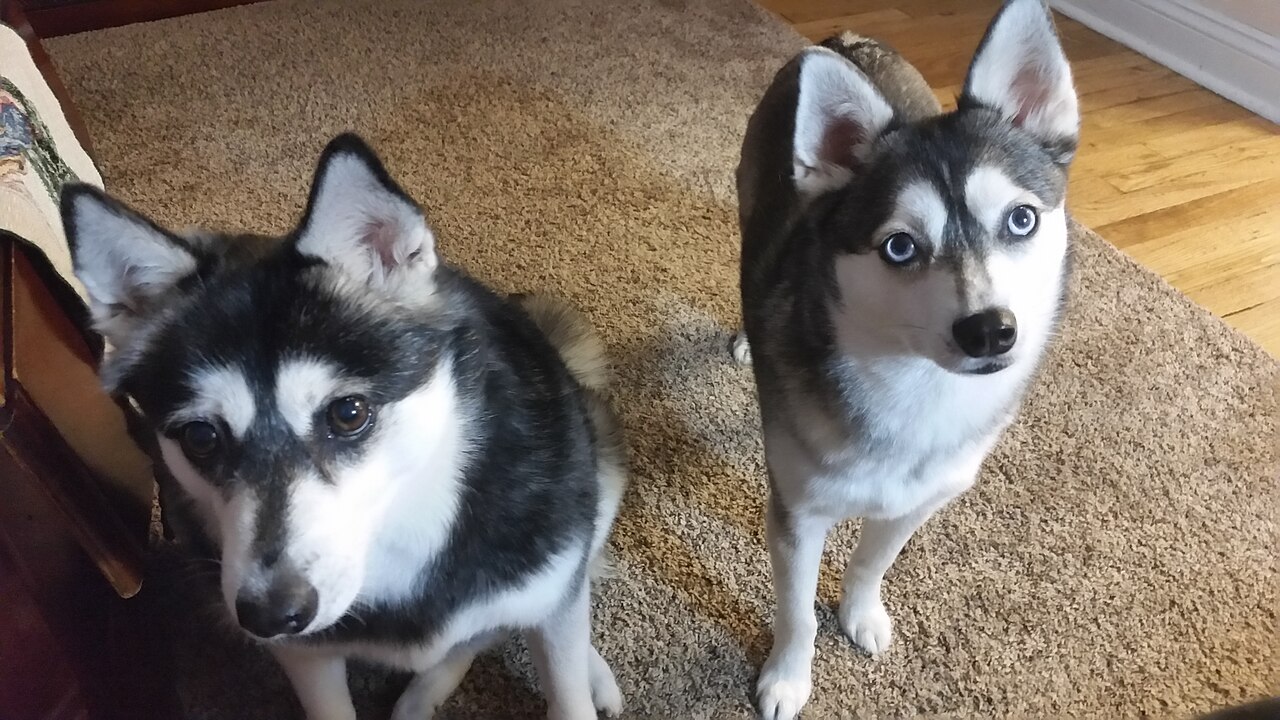
Well socialized, the Alaskan Klee Kai integrates as one more member of the family. With the children in the house who respect it, it is usually a great playmate, although it is advisable to teach the little ones to treat it carefully, because it is a dog that does not tolerate touching or pulling. With strangers– also with other children – it is prudent, so presentations should be done calmly.
With known other dogs he usually gets along well, but he inherits a marked prey instinct from his Norse ancestors: cats, rabbits, rodents or small birds may awaken their hunting instinct, so coexistence requires gradual introductions and supervision. As for the floor, its small size makes it compatible with apartment living as long as its high exercise needs are met; yes, its tendency to vocalize can be a point to watch with neighbors. As for the loneliness, he ‘s a very close-knit family dog who ‘s had a hard time with prolonged isolation: spending too many hours just creates anxiety, barking and destructive behavior, so it’s not the best option if no one’s going to be home all day.
Education and training
Training an Alaskan Klee Kai is an exercise in mutual intelligence. He grasps concepts at high speed, but his independence leads him to ask, “What’s in it for me?” before he obeys. The key is in the positive reinforcement: Rewards, play, and a gentle voice work; harshness, yelling, or physical punishment block it and erode trust. The sessions should be short, varied and funny to sustain your attention and keep you from getting bored.
Two pillars are non-negotiable. The first, the early socialization: exposing him to people, sounds, environments and other animals as a puppy reduces his natural suspicion and prevents fear or reactivity problems as an adult. The second is to manage the vocalization and the call from the beginning, because a Scandinavian with little self-control and a lot of instinct can become a noisy dog or difficult to recover loose. Working the “call” in safe environments and reinforcing it is always crucial, as your instinct to pursue can take you far.
Exercise and activity
Just because he’s small doesn’t mean he’s sedentary. The Alaskan Klee Kai is a energetic, fast and athletic dog that needs to burn body and mind daily. Long walks, controlled racing, find-and-bring games, smart toys and, most especially, dog sports are their fuel. Highlights from agility: Despite its size it is a dog with strong bones capable of high jumps, and its agility and lightness make it move with remarkable ease on the circuits.
As a guideline, a healthy adult appreciates at least one long hour of physical activity throughout the day, supplemented with mental stimulation. An Alaskan Klee Kai that doesn’t expend energy is a frustrated dog, and frustration in this breed translates into barking, digging, running and wrecking. Attention also to heat: With its double coat, it tolerates the cold well, but intense exercise should be avoided in the hottest hours.
Care: fur and hygiene
Here the Alaskan Klee Kai surprises for good. He has a dense double coat, but is an extraordinarily clean and self-sufficient in its grooming dog, with almost feline habits: She grooms herself, rarely needs a bath and practically doesn’t smell like a dog. The big chapter in its maintenance is the moved: It changes the hair intensely twice a year, and in those periods it loses a lot of undercoat and it is advisable to brush it daily to remove the dead coat and aerate the skin. The rest of the year, just a weekly brush.
Important: you must not shave. has its double coat, because it acts as a thermal insulator from both cold and heat and its recovery can be irregular.
Foodstuffs
The Alaskan Klee Kai does not have exotic dietary demands, but its small size and high activity sets the focus. It needs a complete and quality food, adjusted to its weight, age and exercise level, divided into one or two daily intakes. Being a small breed dog tends to eat a small amount, so the primary quality over volume; it is advisable to measure the rations and not get carried away by its face.
The weight control is key: overweight punishes its joints and reduces agility in a dog that lives on movement. It measures well the rewards used in training – they count as calories – and keeps fresh water always available. When in doubt about quantities, allergies or specific diets, it is wise to consult with the veterinarian, who will adjust the guideline to each specimen.
Health and life expectancy
Overall, the Alaskan Klee Kai is considered a relatively healthy breed, with a life expectancy around 13 to 16 years, typical of small dogs and spitz lines.
Among the problems described in the breed are:
- Juvenile cataracts and other eye conditions.
- Factor VII deficiency, a blood clotting disorder.
- Heart problems.
- Hepatic disorders(of the liver).
- Thyroid problems.
- Kneecap dislocation and dental problems, common in small breeds, are also cited.
The best prevention is to go to responsible breeders who perform health tests on the breeders (eyes, heart, clotting), by periodic veterinary checks and by a good management of diet and exercise.
Physical appearance
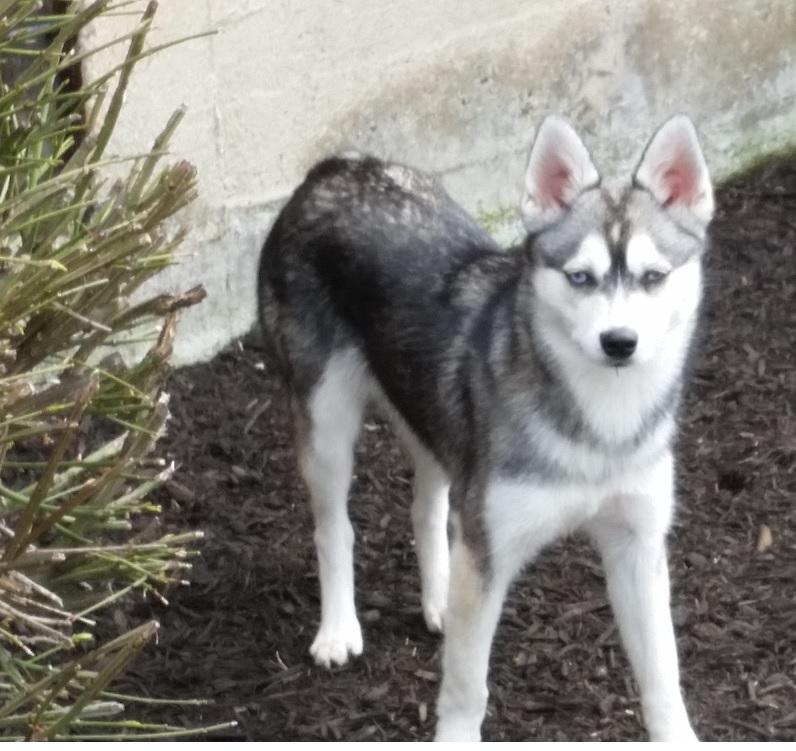
The Alaskan Klee Kai is a dog of the spitz type that looks like a reduced-scale Husky, but with its own details. It has upright, triangular ears – proportionally larger than those of the Husky – expressive eyes that can be blue, brown, amber or different color (heterochromia), a well-marked face masks characteristic and a feathered tail that curls over the back, higher than that of the Husky. Its snout is somewhat shorter, which reinforces that alert expression and a cunning point.
It breeds on three sizes:
- Toy: up to about 33 cm at the withers and less than 4,5 kg.
- Miniatura: between 33 and 38 cm, 4.5 to 6.8 kg.
- Estándar: from 38 to 43 cm, from 6.8 to 9 kg.
As for color, the standard supports three combinations, always with white: black and white, grey and white and red and white, with contrasts ranging from very marked to diluted in grayish or cinnamon tones.
Origin and history
The Alaskan Klee Kai is a modern and distinctly american breed. Its story begins in Wasilla, Alaska, in the mid-1970’s, when Linda S. Spurlin became trapped as a result of an accidental crossing between an Alaskan Husky and an unknown small dog.
The name “Klee Kai” comes from the language spanish and means “small dog”. Spurlin bred these dogs privately for years and did not introduce the breed to the public until 1988.
Its recognition came through the American associations: the This Regulation shall enter into force on the day following that of its publication in the Official Journal of the European Union. recognized it in 1995 and the United Kennel Club (UKC) on January 1, 1997.
Curiosities
- “Klee Kai” means “little dog” in the Atabascan language, native to Alaska.
- Despite its appearance as a sled dog, it was never meant to be a shooting dog. was born exclusively as a companion dog.
- It is a uncommon and relatively expensive breed, with a limited census of serious breeders worldwide.
- Many specimens have different colored eyes(heterochromia) or intense blues, a highly prized trait inherited from their husky relative.
- Its almost cat grooming and sparse smell make it strikingly comfortable to have at home for a two-coat dog.
- The motto with which Linda Spurlin guided the selection was reportedly “breed the best and discard the rest”.
If you are attracted to the Alaskan Klee Kai because of its Nordic, intelligent, and active dog profile, you will surely be interested in other breeds in the same family or with a similar character. Check out the Husky Siberiano, its larger relative; the Samoyedo, another sociable Nordic spitz; the Akita, independent and loyal spitz; or the Welsh Corgi Pembroke, another small one of great intelligence and energy.
Frequently Asked Questions about the Alaskan Klee Kai
The Alaskan Klee Kai is a miniature Husky?
In a way, yes, although it’s good to make it more nuanced. The breed was born precisely to get a small-sized Nordic dog with the appearance of the Husky, but it is not a shrunken Siberian Husky: In their creation, the Alaskan Husky, a small proportion of the Siberian Husky, the American Eskimo Dog and the Schipperke, intervened precisely to reduce the size without resorting to dwarfism. The result is a breed of its own, with a shorter snout, larger ears, and a longer tail than the Husky.
How tall and how much does an Alaskan Klee Kai weigh?
There are three varieties of size: the Toy is up to about 33 cm at the withers and weighs less than 4.5 kg; the Miniature is between 33 and 38 cm and weighs 4.5 to 6.8 kg; and the Standard is 38 to 43 cm and weighs between 6.8 and 9 kg.
Is that a dog that barks a lot?
It is vocal and very alert: it warns of everything that happens and can emit howling, growling and the typical ‘talking’ of Nordic breeds. It is not a compulsive barker by nature, but its watchful instinct and its distrust of strangers make it a good warning dog.
Do you get along with children and other pets?
With good socialization, it usually coexists well within its family nucleus, including children who respect it, as it is a dog that does not tolerate rough treatment.
How much exercise do you need?
It is an energetic, fast and athletic dog, which enjoys long walks, search games and, above all, canine sports: it stands out in agility thanks to its agility and its surprisingly robust structure.
Do you lose a lot of hair?
It has a double coat and moults intensely twice a year; in those moults it loosens abundant undercoat and it is convenient to brush it daily. The rest of the year the loss is moderate.
Is it easy to educate?
It’s very intelligent and it learns fast, but that same intelligence makes it independent and sometimes stubborn. It responds greatly to positive reinforcement, to short, varied sessions, and to consistent guidance; instead, it closes in on harshness. It’s not the ideal breed for someone who seeks blind obedience without spending time.
How long does the Alaskan Klee Kai live?
Its life expectancy is around 13 to 16 years, a high longevity typical of small breeds and spitz lines.