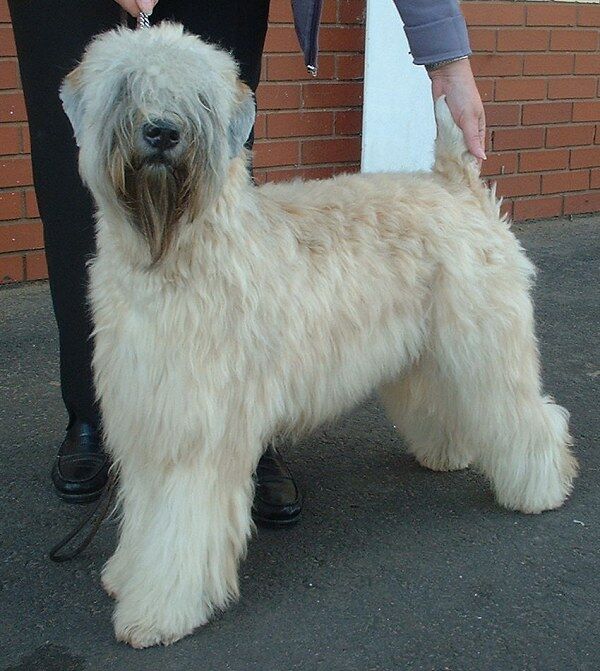
The Soft Coated Wheaten Terrier is a medium-sized, cheerful and sociable Irish terrier, famous for its smooth, wheat-colored silky coat from which it takes its name. Raised for centuries as an all-terrain farm dog, today he is mostly a charismatic family companion who loves people. If you’re looking for an active, affectionate dog that barely sheds hair, the Soft Coated Wheaten Terrier deserves your full attention. In this guide, you’ll find everything you need to know before you share your life with one.
Is the Soft Coated Wheaten Terrier for you?
The Soft Coated Wheaten Terrier is a dog of character balanced between the sparkle of the terrier and the sweetness of the family dog. It is not the ideal breed for everyone: its energy and the maintenance of its hair require an involved owner. Before taking the step, it sincerely weighs its strengths and its demands.
Points in favour
- Affectionate, sociable and very close to his family.
- Very little hair: discreet at home.
- Excellent with children and, if socialized, with other dogs.
- Smart and versatile for dog sports.
- Medium size and manageable, long-lived breed.
- Large alert dog that warns but is rarely aggressive.
Points to Consider
- Hair needs almost daily brushing and periodic haircuts.
- High energy: It requires real daily exercise.
- Terrier stubbornness; does not tolerate harsh methods.
- Strong hunting instinct: watch out for cats and small animals.
- He may bark excessively if he’s bored or not polite.
- Predisposition to a couple of serious hereditary diseases.
Character and temperament
If we had to sum up the Soft Coated Wheaten Terrier in one word, it would be enthusiasm. It is a lively, playful and deeply human-oriented dog, to the point that its greeting has earned a name for itself among aficionados: The “Wheaten greetin”, that ritual of jumping to lick the face of whoever comes home. Behind this effusivity is a good-bottomed terrier, less quarrelsome and “quarrelsome” than many of its cousins, but with its point of independent character.
It’s an intelligent and curious dog, attentive to everything that happens around it. That same curiosity drives him to explore and, if left alone in a garden, to find a way to escape. He is loyal and protective of his family: It barks to warn of the presence of strangers, but its instinct is not to attack, but to welcome. That is why it is said to be a magnificent warning dog and a terrible defense dog, an important distinction for anyone seeking royal protection.
It is worth remembering that it is still a terrier bred to hunt vermin. That prey instinct is alive and explains why it can shoot after a cat or a rodent if it has not grown up living with them. Well socialized since puppyhood, however, it is a stable companion, sociable and not nervous.
Coexistence: children, other pets, flat and loneliness
The Soft Coated Wheaten Terrier is an eminently family dog that adapts well to different households as long as their needs are met.
- With children: is one of its great virtues. Patient, playful and affectionate, usually adores children.
- With other dogs: is generally friendly if socialized, enjoys canine company and dog parks.
- With cats and small animals: here is the delicate point. Its hunting instinct is remarkable; it can coexist with a cat if it grows up with it, but introductions with small animals should be done with caution.
- On the floor: can live perfectly in an apartment as long as it is taken out for daily exercise. It is not a garden dog that entertains itself; it wants to be with its people.
- In the face of loneliness: is very attached and does not like to spend many hours alone. Boredom and lack of company can lead to barking and destructive behavior.
- Clima: tolerates the cold well, but heats up easily. In summer you should avoid exercise in the hottest hours.
Education and training
The Wheaten is intelligent and learns quickly, but carries the stubbornness characteristic of terriers. The key to its education is in the positive reinforcement: rewards, play and praise get from it much more than any severe correction. Hard methods are counterproductive and can generate fear or, worse, defensive aggressive reactions in a dog that is not by nature.
Begin socialization and education as a puppy, with short, varied and fun sessions to keep their attention. He prioritizes calling (his curiosity and hunting instinct can take him far), controlling jumps when greeting, and tolerating being left alone gradually. It is a dog that enjoys learning tricks and responds wonderfully when training is presented as a shared game.
Exercise and activity
Don’t be fooled by its stuffed air: the Soft Coated Wheaten Terrier is a active dog that needs to expend energy every day. A long hour of activity combining walks, play and, if possible, loose running in a safe area, keeps it balanced and happy.
Beyond walking, it shines in dog sports. It competes fluently in obedience, agility and tracking, and the breed was admitted to herding trials in the United States in the 1990s, a nod to its farm past. Stimulating its mind with olfactory and intelligence games is as important as physical exercise.
Care: fur and hygiene
Hair is the Wheaten’s hallmark and, at the same time, its main demand for care. It is a unique, soft and silky coat, which is not renewed by moulds like that of most dogs, but rather it grows continuously. in the style of poodle or human hair. That’s why it sheds so little hair, but instead it tends to get tangled: need to be brushed and combed almost daily to prevent knots, especially in areas of friction such as the armpits, behind the ears and beard.
In addition, regular haircuts are made every few weeks to maintain the figure and hygiene. Do not neglect the ears (cleaning to prevent infections), nails and the area of the beard and mustache, which get dirty when eating and drinking. Bathing with soft shampoos should always be accompanied by a good drying and brushing. Those who do not want to spend this time at home should have regular visits to the dog hairdresser.
Foodstuffs
The Soft Coated Wheaten Terrier needs a complete and quality diet, adjusted to its age, weight and activity level. Being a medium and active dog, it appreciates an adequate intake of protein of good origin.
There is an important nuance in this breed: Because of their predisposition to protein loss diseases (PLN and PLE, which you will see in the health section), any changes in diet or digestive symptoms should be discussed with your veterinarian. In diagnosed dogs, dietary management is a key part of treatment. Always have fresh water available and avoid excessive rewards during training.
Health and life expectancy
Overall, the Wheaten is a robust dog and long-lived: a 2024 British study placed its average life expectancy at around 13.7 years, above the average of purebred dogs.
The two most characteristic are disorders that cause protein loss: protein-losing nephropathy(PLN), in which the kidney releases proteins, and protein-losing enteropathy(PLE), in which the intestine does not absorb them well. Both can be serious, but detected early are managed with strict changes in diet and medication. They are more common in females and often appear together. Other conditions described in the breed are renal dysplasia, inflammatory bowel disease, Addison’s disease and cancer, in addition to food or environmental allergies and atopic dermatitis.
The best prevention starts with the breeder: always choose one that performs the recommended health tests and is transparent with the line’s background.
Physical appearance
The Soft Coated Wheaten Terrier is a medium-sized dog, with a well-proportioned, square structure, neither too thin nor too heavy. The males measure about 43 to 51 cm at the cross and weigh between 14 and 20 kg approximately, with the females somewhat lighter.
Her unmistakable trait is her hair: soft, silky and wheat-colored, hence its name (“wheaten” means “wheat color” in English). There are two variants of the mantle: the irish type, thinner and wavy, and the american or heavy type, denser and more abundant. Interestingly, puppies are born with dark hair – reddish, brown, mahogany, or white – and often with a dark snout and ears; that color gradually lighten to almost white before turning to the definitive gray hue by three years of age. The adult coat may retain some black or darker guard hairs.
Origin and history
The Soft Coated Wheaten Terrier originated from Irlanda, where it was bred for over two hundred years as a versatile farm dog. Its Gaelic name, An Brocaire Buí, literally means “yellow terrier”. On the farms, he did everything: He drove and watched the cattle, guarded property and hunted game. It shares ancestry with the Kerry Blue Terrier and the Irish Terrier, with which it forms the group of Irish terriers.
Unlike the aristocratic breeds, the Wheaten was the dog of humble country people. In fact, in Ireland he was known as the “Poor Man’s Wolfhound”: Since the law forbade peasants from owning hunting dogs of the nobility, they bred this versatile terrier that served as both shepherd, guard and hunter. It was also customary to cut off their tails in their day to avoid taxes.
Despite its long history, official recognition was slow to come: The Irish Kennel Club did not admit it as a breed until 1937 and the British Kennel Club did so in 1943. The first specimens arrived in the United States in the 1940s, but serious interest took a decade to take hold; the American Kennel Club was founded in 1962 and the American Kennel Club recognized it in 1973. The FCI classification is Grupo 3 (terriers). Today, it is primarily a companion dog that also excels in obedience, agility, tracking, and even animal-assisted therapy.
Curiosities
- Its name accurately describes its hair: wheaten means “wheat color”, the light golden hue characteristic of the adult.
- The cubs are born dark and take up to about three years to turn a definite wheat color.
- The typical jumper salute of the breed has a name of its own among amateurs: the “Wheaten greetin”.
- It was nicknamed the “poor man’s hare” because it was the all-terrain dog of the Irish peasants.
- Their hair does not shed, but it grows continuously, like poodle hair or human hair.
- There is a trace of its past in art: it is reflected in works documenting rural Irish life more than a century ago.
If you are attracted to the character of Irish terriers, you will be interested to know their closest relatives: the Kerry Blue Terrier and the Irish Terrier, with whom they share ancestry, as well as other abundant-haired working terriers such as the Airedale Terrier and the Lakeland Terrier.
Frequently Asked Questions about the Soft Coated Wheaten Terrier
Does the Soft Coated Wheaten Terrier shed a lot of hair?
Unlike most dogs, it has a unique, smooth, silky coat of “hair” rather than “fur”: it grows continuously, similar to poodle or human hair, and sheds very little. Instead, that texture requires almost daily brushing and periodic trimming to prevent it from getting stuck in knots.
Is the Wheaten Terrier hypoallergenic?
No dog is 100% hypoallergenic, but because it sheds very little hair and dandruff, many people with mild allergies tolerate it better than other breeds.
Do you get along with children and other dogs?
Yes. It is a friendly and playful breed that usually gets along very well with children and other dogs when it is well socialized. For its energy it is advisable to supervise the game with small children so that their enthusiastic jumps do not knock them down. With cats you have to be careful: it retains a strong hunting instinct due to its mouse origin.
How much exercise do you need?
It is an active terrier: it needs at least one hour of activity a day divided into walks, play and, if possible, loose moments in a safe area. It enjoys agility, tracking and obedience.
How long does a Soft Coated Wheaten Terrier live?
It is a long-lived breed. A British study from 2024 calculated an average life expectancy of about 13.7 years, above the average for purebred dogs. With good genetics, proper feeding and veterinary checks, many exceed that figure.
What health problems does the breed have?
It’s pretty healthy, but it’s notable for two diseases that cause protein loss: protein-losing nephropathy (PLN) from the kidney and protein-losing enteropathy (PLE) from the intestine. Both are serious but manageable if detected early. Renal dysplasia, inflammatory bowel disease, Addison’ s disease, allergies and atopic dermatitis may also occur. It’s a good idea to buy from breeders who do health checks.
Is he a good guard dog?
It is an excellent warning dog and a bad defense dog. It warns by barking at a stranger, but rarely becomes aggressive: its instinct is to greet, not attack. It serves to warn that something is happening, not to intimidate.
Is it easy to educate?
It is intelligent and learns quickly, but has the typical headstrongness of a terrier. It responds very well to positive reinforcement and very poorly to harsh methods, which generate fear or stubbornness. With short, fun and constant sessions from puppyhood you get a very obedient companion.