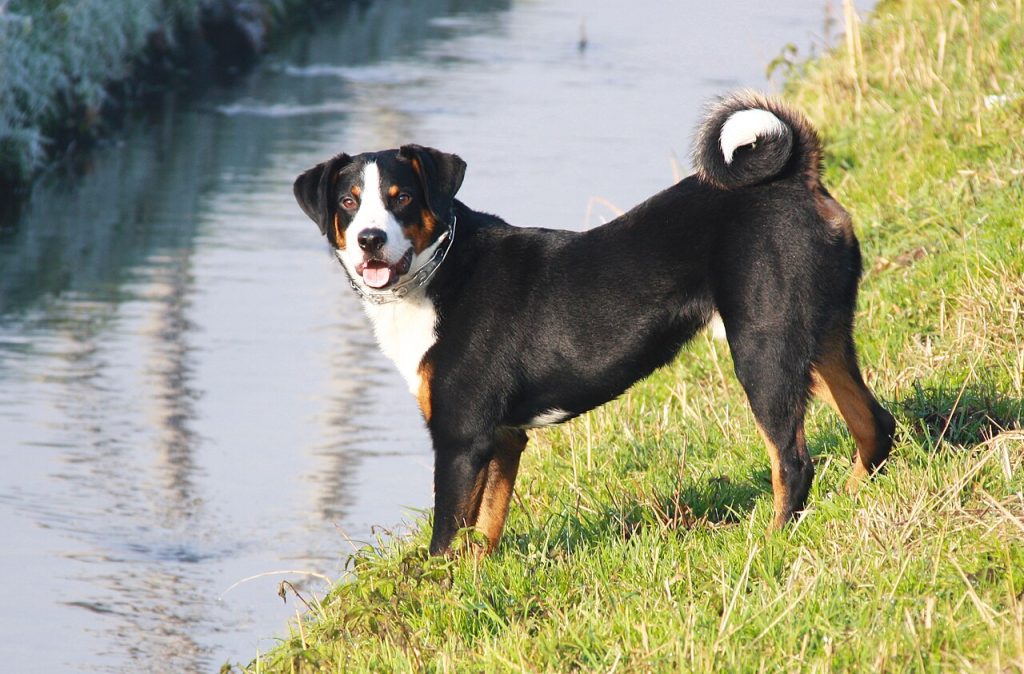
The Boyer of Appenzell(Appenzeller Sennenhund) is one of those dogs that seems to carry a motor inside: nervous, intelligent and loyal to his family. Born in the pastures of northeastern Switzerland to drive cows and watch the farm, it is still a working dog from head to toe today, although more and more homes are discovering it as a companion. If you’re looking for a quiet couch dog, this isn’t your dog; if you want a partner who’s tireless, alert and characterful, Appenzell’s Boyero deserves more reading.
Is the Boyero of Appenzell for you?
Before you fall in love with her gaze and her tricolor cloak, be honest about what she asks in return. The Appenzell Boyero is a farm dog with all the consequences: He needs to wear his head and body out on a daily basis, he has guard instinct and he doesn’t take well to boredom. In the right hands, it’s a brilliant companion; in the wrong, a frustrated dog that barks, watches too closely, and invents its own work.
In favour .
- Very smart and quick to learn.
- Intense and loyal bond with his family.
- Resilient, healthy and long-lived.
- Excellent natural guardian, attentive to all things.
- Easy coat to maintain, no cuts.
- Multipurpose: herding, dog sport, active company.
Against
- Very high energy: not a passive floor dog.
- He tends to bark and overwatch if he gets bored.
- Distrustful of strangers: requires early socialization.
- Stubborn and lively; does not forgive inconsistent education.
- Rare breed: difficult to find and breed well.
- Bad companion for someone who spends the day away from home.
Character and temperament

The breed standard sums it up in a few words: lively, fiery, athletic and suspicious of strangers. Anyone who lives with a Boyero from Appenzell confirms it every day. It’s a dog that’s always “on”, aware of what’s going on around it, ready to act. That spark that made him irreplaceable on the mountain is the same spark that can overwhelm a family that doesn’t give him a clear job.
With his own, he’s affectionate, expressive and very close. It usually chooses its people and follows them from room to room; it is not an independent dog like a Nordic. In return, he expects participation: He wants to accompany, decide and feel useful. With strangers he is reserved and alert, barking to warn before accepting them. It is not gratuitous aggression, but the legacy of the dog that guarded the farm, but it is best to channel it from puppyhood so that mistrust does not turn into reactivity.
It is also a sensitive and intuitive dog. It reads its family’s moods very well and responds better to cooperation than to imposition. Treated with respect and consistency, it returns a loyalty difficult to match.
Coexistence: children, other pets, flat and loneliness
With children: Well socialized, the Appenzell Boyero is an enthusiastic and protective playmate. You have to keep in mind his herding instinct, which sometimes translates into pushing or trying to “lead” the little ones; with supervision and clear rules, coexistence is excellent, especially with older children who understand how to treat such an active dog.
If With other pets: grows up with other dogs or cats, it usually accepts them without problem, although its dominant and territorial character can clash with dogs of the same sex.
On the floor: is not impossible, but it starts with a disadvantage. An Appenzell Boyero in an apartment demands a firm commitment to daily exercise and stimulation, in addition to a serious control of the barking, which is its natural way of warning.
Soledad: here is its Achilles heel. It’s a dog that needs companionship and purpose; leaving it alone for many hours is the recipe for boredom, barking and destructive behavior. It’s not a breed for someone who spends full days out of the house.
Education and training

Few breeds learn as fast as this one, and that’s exactly the problem: it learns good and bad at the same speed. The Appenzell Boyero captures a sequence in a few repetitions, so the consistency of the guide is decisive. If you let him get on the couch one day and you forbid him another, he’ll take note of the incoherence and use it to his advantage.
Early socialization is not optional. Between 8 and 16 weeks it is advisable to positively expose them to people, dogs, noises, surfaces and situations, so that their natural distrust does not lead to fear or adult reactivity.
It works wonderfully with positive reinforcement, short, varied sessions, and mental challenges. He is bored with mechanical repetition, so it is best to view training as a meaningful game. Punishing or forcing such a sensitive dog is counterproductive: It either shuts down or rebels. Set firm but fair boundaries, be predictable, and give him real tasks: It’s glowing here. It’s an excellent candidate for obedience, agility, tracking or sports herding.
Exercise and activity
We are talking about a natural athlete. An adult Appenzell Boyero needs at least one or two long hours of intense physical activity a day, and is grateful for much more. We are talking about racing, demanding hikes in the mountains, pick-up and drop-off games, bicycle alongside him or dog sports. A quiet walk around the block does not make him tickle.
But exercise is only half the equation. Equally or more important is mental work: intelligence toys, obedience exercises, scent-finding or any activity that forces you to think. An Appenzell Boyero who just runs, but doesn’t think, is still a dissatisfied dog. It is the combination of tired body and tired head that results in a balanced and calm dog at home.
It is important to dose exercise during growth: in puppies and young dogs, repeated jumping and intense joint exertion should be avoided until the skeleton matures.
Care: fur and hygiene

Good news for anyone who’s afraid of canine barbers: The cloak of the Boyero of Appenzell is easy to maintain. It has double hair, with a short, thick, smooth and shiny outer coat, and a woolly inner coat. No cuts or scissors are needed, just regular brushing – once or twice a week – intensified during spring and autumn mowing, when more undercoat is released.
The bath is reserved for when you get really dirty; washing it too much dries out your skin and ruins the natural shine of your hair. The rest of the hygiene is routine: checking and cleaning the ears, which retain moisture when dropped and should be kept dry; cutting nails when they do not wear out on their own; and maintaining dental hygiene with frequent brushing. Take advantage of brushing sessions to check your skin, pads and ears: Detecting a problem early is always cheaper.
Foodstuffs
As a medium-sized, very active and muscular dog, the Appenzell Boyero needs a complete and quality diet, adjusted to its actual activity level. A sporty specimen who works or mounts spends far more than one who lives a quieter life, and the ration should reflect this. A good reference is a medium-high-end feed or a balanced diet formulated by a professional, with an adequate intake of protein to maintain your muscle mass.
It is advisable to divide the food into two daily servings instead of one, to monitor the weight regularly and to avoid overweight, which punishes the joints of any active dog. Sweets are a great tool for training, but they must be discounted from the daily ration. And, as with any deep-chested dog with a gluttonous temperament, it is wise to avoid strenuous exercise just before and after eating. Fresh water always available, especially after activity.
Health and life expectancy
The Appenzell Boyero is, as a whole, a rustic and healthy dog, the result of generations selected for its working capacity rather than for its appearance.
That said, you’re not risk-free. As a small breed with a small genetic pool, responsible breeding is key to avoiding a concentration of hereditary problems. Conditions to watch for include hip and elbow dysplasia – common in working dogs – some eye problems and, because of their predisposition to otitis, ear infections resulting from their droopy ears. Buying from a reputable breeder who performs the health tests relevant to breeders greatly reduces these risks.
The rest is up to you: regular veterinary checks, daily vaccination and deworming, weight control, dental hygiene and, above all, an active lifestyle.
Physical appearance
The Appenzell Boyero is a medium-sized, almost square, compact and well-muscled dog, with a general image of agile strength rather than sheer bulk. Males measure about 52 to 56 cm at the withers and females a couple of centimeters shorter, within a general range of about 47 to 58 cm. Weighs about 22 to 32 kg. It is the third largest of the four Swiss boyars, behind the Grand Swiss Boyer and the Berner Boyer, and ahead of the small Entlebuch Boyer.
The coat can be black base or a brown called “Havana”, always with symmetrical white markings on the chest, face, legs and tail tip, and with areas of fire (red-brown) between the base color and white.
The tail is one of its most characteristic features: Born tall, he carries it tightly coiled on his back when he moves. The ears, also of high implantation, are small and triangular, and hang attached to the cheeks at rest, rising and turning forward when the dog is attentive. The look, vivid and expressive, completes an unmistakable picture. The standard is strict: a gazeous eye, a tail with a knot, single-coated hair or a cloak other than a tricolour disqualify the specimen.
Origin and history
The name says it all. Sennenhund means “dog of the Senn”, the cowboys and milkmen of the Alps, and Appenzell is the region of northeastern Switzerland where this breed was forged. For centuries it was the all-terrain dog of the Alpine farms: it drove the cattle, watched over the property and helped out when needed, with no pedigree other than its usefulness.
The first known written description was signed by the naturalist Friedrich von Tschudi in 1853, in his work on the animal life of the Alpine world. At the end of the 19th century, a forest ranger named Max Sieber, who had seen these dogs at cattle fairs in eastern Switzerland, asked the Swiss Canine Society to recognize the breed. A commission was created with funding from the canton of St. Gallen, and the Boyero of Appenzell was recognized around 1896-1898. In 1898, eight specimens were exhibited at the Winterthur International Dog Show, in a new class created for boyars.
The definitive impetus came in 1906, with the founding of the breed club at the instigation of cynologist Albert Heim, a key figure in the recovery of the Swiss boyars. Heim drafted in 1914 the first complete standard, and the International Cinological Federation (FCI) accepted the breed definitively in 1954, classifying it in Group 2, within the section of mountain type dogs and Swiss boyars.
Curiosities
- A rarity even in his own land. Although it is the most registered breed in the canton of Appenzell itself – where it accounts for about 19% of registrations – it represents only 1% of registered dogs in Switzerland as a whole.
- Heritage in the making. is the only Swiss dog breed considered “endangered” by the ProSpecieRara foundation, dedicated to conserving native breeds and varieties.
- Four mountain brothers. is part of the quartet of Swiss boyars alongside the Grand Boyer of Switzerland, the Boyer of Bern and the Boyer of Entlebuch, all recognizable by their tricolor cloak.
- The tail that betrays his spirit. That coiled tail over the back is not an aesthetic whim: it is one of the traits that distinguishes it at first glance from its sloping-tail relatives, such as the Bernese Boyer.
- Discreetly international recognition. The American Kennel Club lists it in its breed development service and the Canadian Kennel Club ranks it among herding dogs, a sign of its slow but steady expansion outside Switzerland.
If you are attracted to the Appenzell Boyer’s profile – energy, intelligence, and work ethic – you may be interested in other air-breeds with which it shares a spark. Take a look at the San Bernardo, another giant of the Swiss Alps; the Rottweiler, the quintessential cattle driver; the industrious Welsh Pembroke Corgi, a miniature cowboy; or the versatile Pastor Australiano, another workaholic who needs busy body and mind.
Frequently asked questions about the Appenzell Boyero
Is the Appenzell Boyero a good dog for beginners?
It is not the best first breed. Its very high energy, intelligence and guarding instinct demand an active owner, with time and constancy, able to give it exercise, mental stimulation and a coherent education. For someone committed and athletic it can be wonderful; for a quiet and inexperienced home, it is usually too much dog.
How much exercise do you need a day?
At least one or two hours of vigorous daily physical activity – running, hunting, game play or dog sport – plus mental work.
Can he live in a flat?
If you live in a flat, you need to compensate with plenty of daily exercise, mental stimulation, and firm control of your barking, which is your natural way of warning.
Does he get along with children and other dogs?
Yes, if it is well socialized. With children it is an enthusiastic companion, although it is advisable to monitor its herding instinct, which leads it to push or “drive”. With other dogs it usually coexists well if it grows up with them, although its dominant character can clash with dogs of the same sex.
Does he bark a lot?
It tends to bark: it is a born guardian that warns of anything it considers out of the ordinary. With socialization and education it can be managed, but if it is bored or spends too much time alone, excessive barking is one of its most common problems.
How tall and how much does an Appenzell Boyero weigh?
It is a medium-sized dog: the males measure about 52-56 cm at the cross and the females a little less, within a general range of 47 to 58 cm. The weight is around 22 to 32 kg, with a compact and very muscular constitution.
How long do you live and what health problems do you have?
Its life expectancy is about 12 to 14 years. It is a rustic and healthy dog, although due to its narrow genetic base, responsible breeding is advisable.
Do you lose a lot of hair?
It has double and moderately loose hair throughout the year, with two more intense moults in spring and autumn. A brushing once or twice a week, reinforced in moult seasons, keeps the mantle in good condition without the need for hairdressing.