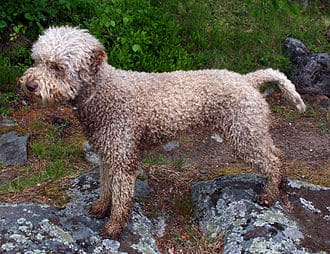
The Lagotto Romagnolo is a medium-sized Italian water dog, curly coat and prodigious smell, recognized throughout the world as the truffle dog par excellence. Beneath his stuffed appearance lurks a tireless worker, intelligent and deeply attached to his family. If you’re looking for a partner who’s versatile, affectionate and barely loosens his hair, the Lagotto Romagnolo has plenty of cards for you to fall in love with.
Is the Lagotto Romagnolo for you?
Before you get carried away with those adorable curls, you should know what it means to share life with a Lagotto Romagnolo. It’s a balanced and manageable dog, but also a hardworking breed that needs a busy head and company. Here are its lights and shadows at a glance.
In favour .
- It barely loosens hair and is suitable for many allergy sufferers.
- Very smart and easy to train with positive reinforcement.
- Medium comfortable size, suitable for flat and house with garden.
- Loving, loyal and an excellent family companion.
- Versatile: scent, search, canine sport and quiet home life.
- I was long-lived, with a life expectancy of about 15 years.
To be taken into account
- Its curly coat requires regular brushing and periodic trimming.
- He needs daily exercise and, above all, constant mental stimulation.
- He doesn’t do well with prolonged solitude; he’s very attached to his own.
- Their instinct for digging and sniffing can lead to war in the garden.
- The breed carries neurological problems that require responsible breeding.
- It’s still rare: finding serious breeders can be expensive.
Character and temperament
The Lagotto Romagnolo was bred for centuries to work side by side with people, and that has shaped a docile, attentive and hugely collaborative character. It’s a very keen sensory dog, with an eye more sensitive to movement than detail, a legacy of its past as a collector in the marshes. This natural alertness makes him alert and curious, always aware of what is happening around him.
On a day-to-day basis, he is loyal, balanced, and deeply loving to his family. He ‘s not a nervous dog or barks for no reason . When you’ve covered your activity needs, you relax at home and enjoy the company. His intelligence is one of his greatest assets, but also a responsibility, because a bored Lagotto will find ways to entertain himself on his own, usually digging or sniffing anything he finds. Keeping your brain busy is the key to living with a happy, well-behaved dog.
Coexistence: children, other pets, flat and loneliness
- With children: is a patient and playful companion that fits very well in families with small children, as long as the games are supervised and their rest times are respected.
- With other pets: has been socialized since puppyhood, coexisting smoothly with other dogs and even cats.
- On the floor:‘s medium size and quiet interior make it suitable for living on the floor, provided you take it out daily and give it enough stimulation.
- In the face of loneliness: is his weakness, very attached to his people, doesn’t like to spend long hours alone and can develop anxiety or destructive behaviors if left unattended.
- With strangers: is usually reserved but not aggressive; it warns of news without becoming a compulsive barker.
Education and training
Few breeds make it as easy to train as the Lagotto Romagnolo. It is smart, sensitive and loves to please, a combination that makes it quickly learn commands, routines and tricks. It responds excellently to positive reinforcement (rewards, play and a kind voice) and turns off immediately with harsh methods or screams, which only generate distrust in such an emotional dog.
Early socialization is the best investment: Exposing him as a puppy to people, other animals, noise and different environments builds him into a safe and balanced adult. Use your child’s powerful sense of smell to approach learning as a search-and-seek game, not only educating him but channeling his mental energy. Working on tolerance for loneliness from a young age, with brief and progressive absences, will prevent separation anxiety problems later on.
Exercise and activity
The Lagotto is a working dog with medium-high energy that needs to be spent daily. He’s not an extreme athlete, but he’s not a couch dog either. With one or two long walks, moments of play and some searching session he is usually satisfied, adding up to about an hour to an hour and a half of daily activity. It naturally enjoys water, so swimming is an ideal exercise for it and a nod to its aquatic origin.
Where it really makes a difference is in the mental plane. Smell games, hiding prizes, search work and dog sports like agility or mantrailing keep him balanced and happy. A Lagotto who is given only physical exercise but no head stimulation will end up bored; on the other hand, a good olfactory challenge leaves him more exhausted and contented than a long run.
Care: fur and hygiene
The Lagotto’s woolly, curly coat is its hallmark and also its main demand for care. Unlike most breeds, it does not change seasonally: The hair grows continuously and is retained in the curls instead of falling out, which explains why it hardly dirty the house, but also that it entangles easily. If left unattended, these curls become tangled together to form strands and knots that stick to the skin.
The recommended routine includes regular brushing or flossing to untangle tangles and a trim every month or two, either at the hairdresser or at home with scissors and machine. It is not advisable to abuse the bathroom: with washing it when it’s really dirty is enough, using soft shampoos specifically for dogs. It complements hygiene with regular checking of the ears (their fall and hair favor moisture and otitis), cutting nails and dental care usual in any dog.
Foodstuffs
The Lagotto Romagnolo does not have exotic dietary needs, but it does deserve a quality diet adapted to its average size, age and activity level.A complete and balanced feed, a quality moist diet or a homemade ration or BARF well formulated by a veterinarian are valid options; the important thing is that they cover its requirements without exceeding in quantity.
It is advisable to divide the food into two servings a day in the adult and monitor the weight, because overweight punishes their joints and reduces the quality of life of a dog designed to move. Rewards are a great tool in training, but they must be counted within the daily ration so as not to end up fattening the dog based on good intentions. Always fresh and available water completes the picture.
Health and life expectancy
Overall, the Lagotto Romagnolo is a rustic and hardy dog, with a remarkable life expectancy of around 15 years. Still, like any race with a reduced genetic pool, it carries with it some predispositions that are worth knowing. Among the neurological disorders identified in the breed are cerebellar abiotrophy and idiopathic epilepsy, which is why responsible breeding and genetic testing of breeders are so important.
Choosing a serious breeder who performs the available health checks is the best guarantee of bringing home a healthy puppy. From there, regular veterinary checkups, a daily schedule of vaccination and deworming, weight control, and ear and tooth care are the keys for your Lagotto to enjoy a long and full life. His good longevity makes him a companion for many years.
Physical appearance
The Lagotto Romagnolo is a small to medium sized dog, rarely over 50 cm at the withers, of robust build and rustic appearance. Its silhouette is practically square, with a body length similar to the height, which gives it a compact and balanced image. The males measure 43 to 48 cm at the withers and weigh 13 to 16 kg; the somewhat smaller females measure 41 to 46 cm and weigh 11 to 14 kg.
Its most characteristic feature is the coat: dense, woolly in texture and curly in tight rings covering the whole body, including the head, with well-marked eyebrows, mustache and beard. The colours allowed range from white and dirty white to brown, passing through white specimens with brown or orange spots, orange or uniform brown, and the characteristic mottled roan. White spots tend to get bigger with age. The eyes, large and round, range from dark yellow to deep brown and convey an attentive, sweet expression.
Origin and history
The Lagotto Romagnolo is an Italian breed originating from the ancient and extensive marshes of the Po Delta, in areas such as Comacchio and Ravena, in the eastern part of the historical region of Romagna, today integrated into Emilia-Romagna. Its very name alludes to that past lake: It can be translated as “Romania’s lagoon dog”. It has been known since the 16th century, although it did not become widespread until the 19th, and is depicted in paintings from northern Italy, such as the small dog from the The House of the Bridegroom that Andrea Mantegna frescoed in Mantua between 1465 and 1474.
For centuries its function was that of water-collecting dog: He would retrieve the slaughtered waterfowl and bring them back to land or to the boats. When much of the wetlands were drained in the 19th and 20th centuries, the Lagotto turned its fine sense of smell to the search for truffles, an unrivalled trade. In the 1970s the breed was on the brink of extinction, until a group of breeders organized to preserve it: in 1988 the Club Italiano Lagotto was founded in Imola, in 1992 the standard was approved and the breed was recognized by the Ente Nazionale della Cinofilia Italiana. The International Canine Federation accepted it provisionally in 1995 and definitively in 2005.
Curiosities
- It’s the the only dog breed in the world specifically recognized as a Truffle Dog at work, not as a secondary skill.
- His name comes from the Romañol dialect – What ?, related to “laguna”, in reference to the marshes where he worked.
- Its sense of smell is so fine that in addition to truffles, it has been used to locate other valuable mushrooms, such as boletus.
- The curly, waterproof coat is a perfect fit for getting into the cold waters of the lagoons without getting cold.
- It shares with the poodle and other water breeds the hair texture that barely comes off, hence its reputation as a breed suitable for allergy sufferers.
- It was on the brink of extinction in the 1970s and owes its survival to a handful of committed Italian breeders.
If you are attracted by the profile of the Lagotto Romagnolo, you may be interested in other breeds that share its aquatic origin, its curly coat or its vocation as a collector. The Portuguese Water Dog is its closest relative in spirit, another curly swimmer of seafaring tradition. The Caniche shares that barely loose coat and a past as a water collector. For those looking for a versatile Italian hunter is the Spinone Italiano, and if what you fall in love with is the collector and family character, the Golden Retriever is a classic and docile alternative.
Frequently asked questions about Lagotto Romagnolo
Is the Lagotto Romagnolo hypoallergenic to you?
No breed is 100% free of allergens, but the Lagotto Romagnolo is considered one of the most suitable for sensitive people. Its coat is woolly and curly, grows continuously and barely loosens hair, which greatly reduces the dispersion of dandruff and particles around the house.
How long does a Lagotto Romagnolo live?
With proper nutrition, daily exercise, veterinary checkups, and responsible breeding that controls the breed’s own neurological problems, many dogs can easily outlive a dozen years in good shape.
Is the Lagotto Romagnolo good with children?
Yes. It is a loyal and affectionate dog that enjoys family life and usually gets along well with children when it has been socialized since puppyhood. As with any breed, it is advisable to teach the little ones to respect their rest times and supervise play so that coexistence is safe for all.
How much exercise does a Lagotto Romagnolo need?
It is a medium-high-energy working dog. It needs one or two long walks a day plus playing or searching, adding up to about an hour to an hour and a half of activity. As important as physical exercise is mental stimulation: olfactory and searching games keep it satiated and avoid destructive behaviors from boredom.
Is it difficult to educate the Lagotto Romagnolo?
On the contrary, it is one of the easiest dogs to train. It is very intelligent, sensitive and eager to please, so it responds wonderfully to positive reinforcement. It quickly learns commands and tricks, especially if presented as a game.
Does the Lagotto Romagnolo look for real truffles?
Yes, it is the quintessential truffle dog. Its extraordinary sense of smell and methodical character made it the specialist in locating truffles underground in Italy, after the marshes where it used to gather birds were drained.
Does the Lagotto Romagnolo shed a lot of hair?
Their curly coat retains the dead hair instead of letting it go, so they hardly leave any residue at home.
Can a Lagotto Romagnolo live in a flat?
Yes, it adapts well to living on the floor as long as you cover its needs for daily exercise and mental stimulation. It is medium-sized and quiet at home when it has exhausted its energy. What it does not tolerate well is prolonged solitude: it is a dog very attached to its family that can suffer if it spends too many hours alone.