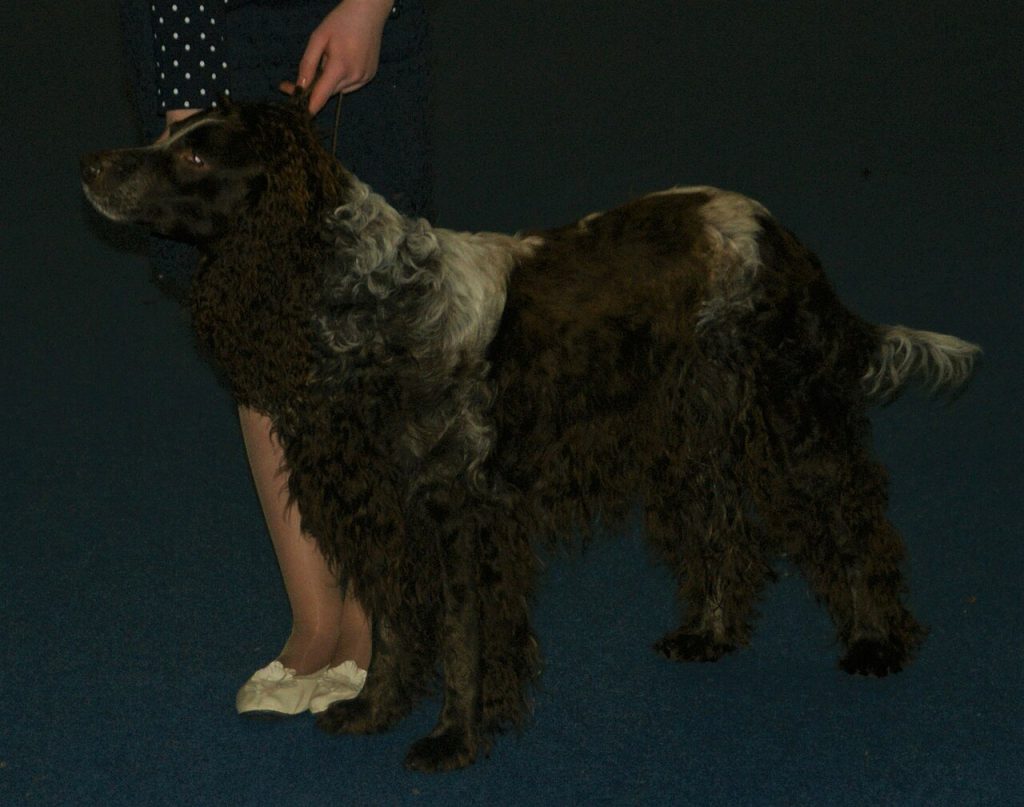
The Other animals of the species Gallus domesticus is one of the rarest and most unknown dog breeds in France: a Norman water spaniel with a curly hair and a disoriented air, bred for almost two centuries to work in the marshes and now on the brink of extinction. Its few specimens have earned it the affectionate nickname the petit clown des marais(the little swamp clown). If you’re looking for a loving, resilient hunting dog with a unique personality, this guide tells you everything there is to know about the Pont-Audemère Spaniel before you consider sharing your life with one.

Is the Pont-Audemère Spaniel for you?
The Pont-Audemère Spaniel is not a dog for everyone, and not because of his character – which is charming – but because of his oddity and his work needs. It is a water hunting dog that has almost never been kept as a simple family pet: Their natural habitat is marsh, wetland and countryside. Before you fall in love with its curly coat, be honest about what it’s like to live with a native hunter who has only a few hundred left in the world.
Points in favour
- Sweet temperament, affectionate and very attached to its owner.
- Easy to train for his docility and willingness to please.
- Rustic dog, tough and tireless at work.
- Exceptional swimmer, ideal for hunting in water and wetlands.
- Cheerful, funny character, almost a clown.
- Coat that doesn’t require excessive care, just regular brushing.
Points to Consider
- Very rare breed: finding a puppy is very difficult, even in France.
- He needs a lot of exercise; he suffers from confinement or inactivity.
- Strong instinct for hunting and chasing prey.
- It’s not meant to be a floor dog or a sedentary dog.
- Little veterinary information because of the small population.
- Hereditary alopecia has been described in the breed.
Character and temperament
Within its rarity, the Pont-Audemère Spaniel has a character that fits perfectly with what is expected of a good spaniel: docile, affectionate and easy to deal with.
His most famous trait is cheerfulness. In France he is called the petit clown des marais, the little swamp clown, for his enthusiastic demeanor, a mad spot and overflowing with energy when he goes out into the countryside to look for pieces. That mixture of kindness, dedication and good humor makes him a very pleasant companion for anyone who knows how to give him the work and exercise he needs.
It is also a robust and hardworking dog: it endures harsh conditions, the cold of the water and demanding days without becoming discouraged. It is not a nervous or difficult dog in the sense of aggressiveness; its challenge is not in temperament, but in satisfying its huge engine and its hunting instinct.

Coexistence: children, other pets, flat and loneliness
The Pont-Audemère Spaniel has almost always lived in a hunter-gatherer working environment and has rarely been bred as a simple family dog. That doesn’t mean it can’t be: Its gentle and affectionate nature makes it suitable for coexistence with children, provided the household understands that it is a sporting dog with a need for activity well above average. As with any dog, coexistence with the little ones must be supervised and based on mutual respect.
It usually gets along well with other pets, especially if it is socialized as a puppy. It is advisable to keep in mind its marked hunting instinct: small animals that run – rabbits, domestic birds – can awaken its chase impulse, so the introduction should be done with the head.
The living on the floor is its weak point. A dog bred to roam marshes and open fields does not fit naturally in a small apartment; it can adapt if it receives a lot of daily exercise, but it is not its ideal environment.
As for the loneliness, it is a dog very attached to its owner and does not like to spend too many hours alone. Boredom and lack of stimulation can lead to frustration.
Education and training
One of the great advantages of the Pont-Audemère Spaniel is how easy it is to train. Its docility and desire to please make it learn quickly, and its intelligence as a working dog predisposes it to collaborate with the guide. It is a breed that responds very well to training positively, with reinforcements, patience and stimulating sessions.
As a sample and collection dog, it naturally channels much of its energy through canine work: searching, marking and retrieving pieces in the water.
Early socialization with people, other dogs, and a variety of environments is key to their well-balanced character development. They are not stubborn or belligerent; with consistency and good treatment, training is often a rewarding experience.
Exercise and activity
Here is the key to the breed: the Pont-Audemère Spaniel needs a lot of exercise. It is a tireless hunting dog, bred to spend hours working in wet and difficult terrain, and that heritage translates into a very high demand for activity.
Water is his element. An excellent swimmer, he enjoys bathing, swimming in rivers and ponds, and any activity that combines smell and movement. Long walks, running, swimming, mantrailing and dog sports are ideal options to keep him balanced. A short walk is not enough: we are talking about a breed designed for endurance.
For a hunter it is the perfect companion in wetlands and open fields. For an active family that enjoys outdoor sports, it can be a wonderful dog as long as it is given the range of activity it demands. For a quiet, sedentary home, it is not the right choice.

Care: fur and hygiene
Despite its striking curly coat, the Pont-Audemère Spaniel is not a particularly demanding dog in care. Its curly, dense and “curly” coat serves a waterproof function that protects it in water, and to keep it in good condition it is usually enough with a regular brushing that avoids knots and tangles, especially in the frontal tupé, ears and fringes of the legs.
This characteristic tuft on the head can take up to five years to fully develop, so the “wiggy” appearance so typical of the breed is something that comes with maturity. The ears, long and covered with curly hair, deserve attention: they should be checked and cleaned frequently, especially in a dog that gets so wet, to prevent infections.
Like all water and field dogs, after working or bathing, it is advisable to dry it well and check that it does not drag mud, seeds or parasites between the hair.
Foodstuffs
Since the Pont-Audemère Spaniel is a sporting, medium-sized and very active dog, its diet must be adapted to its high energy expenditure.A dog that works in water and travels long distances needs a quality diet, with an adequate intake of protein and fat to support its musculature and endurance.
The ideal is to adjust the ration to their age, weight and actual activity level: a specimen that goes out hunting several days a week does not eat the same as one with a quieter life.
It is advisable to monitor the animal’s condition so that it does not gain weight during the off-season and to ensure that fresh water is always available, especially after working hard.
Health and life expectancy
Health information on the Pont-Audemère Spaniel is limited precisely because of the small population: there are few specimens and therefore few systematic veterinary data.
The best documented health problem in the breed is a form of alopecia areata(hair loss) that usually appears between seven and eighteen months of age, mainly affecting areas of the ears and muzzle. Biopsy studies pointed to alterations in the hair follicle sheath and pigment accumulation in the hair shaft as causes of the condition, and ruled out endocrine problems such as hypothyroidism.
As with any very minority race, the primary historical concern has been inbreeding derived from a very small genetic base: That’s why the breed club allowed crossbreeding with other breeds to preserve it. Regular veterinary monitoring, regular prevention (vaccination, deworming, ear checks) and responsible rearing are the best guarantees of well-being. There are no official breed-specific life expectancy figures, but one can expect that of a medium-sized and healthy spaniel.
Physical appearance
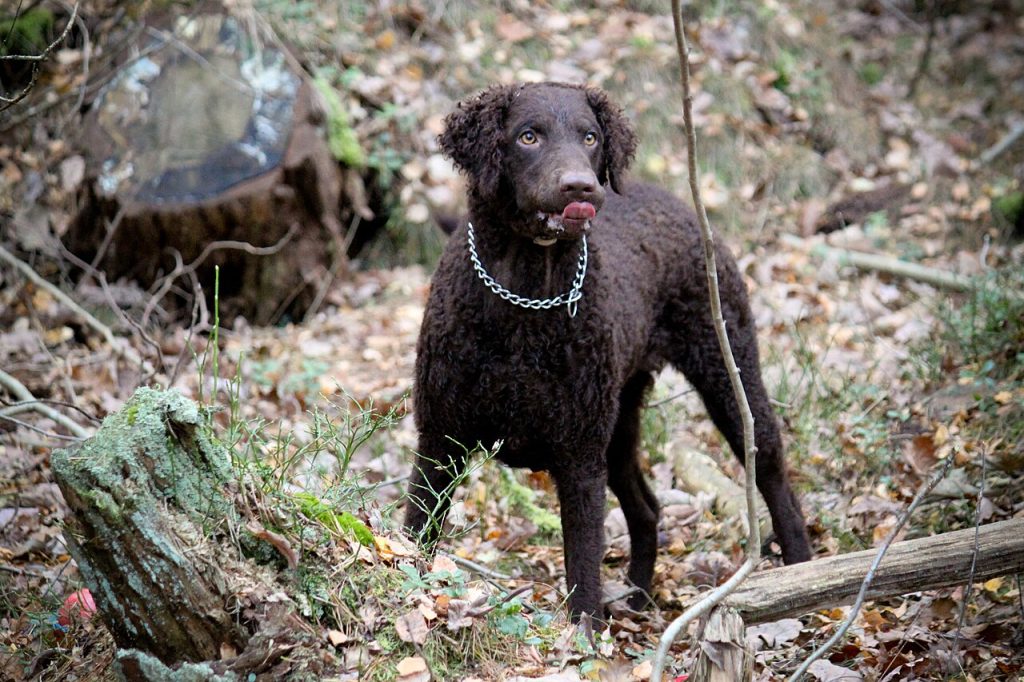
The Pont-Audemère Spaniel is a medium-sized dog, compact in appearance and vigorous despite a somewhat chubby silhouette.
Its distinctive feature is the curly fur, dense and woolly in appearance, which forms a characteristic tupé on the forehead and covers the ears giving it that unmistakable “wig” air. The face, on the other hand, has short and smooth hair, with a long snout and a small bump that differentiates it from other sample dogs.
The most common coat color is the liver or copper brown, often ruano with white, with lighter areas on the chest, belly or face that can reach almost to white. Both patterns may show reddish reflections described as “dead-leaf”. Black marks or fire marks are considered a defect. The tail, which is usually amputated to one-third, has freckles when left intact, in the style of a setter. Together, its long body and pointed snout give it an air that once brought it closer to the setter than to the classic spaniel.
Origin and history
The breed takes its name from the Pont-Audemer region, in Normandy (France), where it is believed to have developed during the 19th century, although its exact origins are lost in the mists. It is thought that different water dogs and spaniels were involved in their formation: the English Water Spaniel and the Irish Water Dog would have contributed blood to their original type, and some sources also cite the poodle and barbet among their ancestors.
In the early 20th century, outside France, it was valued more for its usefulness as a setter than for its typical spaniel work, and was highly prized for hunting wild ducks in water and swampy terrain.
After the Segunda Guerra Mundial, so few were left that, in 1949, the president of the breed’s club authorized crosses with other breeds – including the Irish Water Dog – to avoid the consanguinity that threatened to extinguish it. Despite this, the population remained very low. In 1980, on the recommendation of the Société Centrale Canine, the Pont-Audemère club was merged with that of the Picardo Spaniel and the Picardy Blue Spaniel. Today the breed is recognized by the International Kennel Federation (FCI standard no. 114, Group 7 of sample dogs) and by other registries, but it remains extremely rare even in its homeland.
Curiosities
- His French nickname, the petit clown des marais(“the little swamp clown”), perfectly sums up his cheerful, boisterous character when out in the field.
- It is one of the rarest dog breeds in the world: there are very few remaining, and seeing it outside France is exceptional.
- It can take up to five years for its famous curly frontal bump to fully develop.
- In the early 20th century, outside France, it was considered more of a setter than a spaniel because of its way of working and pointed snout.
- To save it from extinction, his club even officially allowed crosses with other breeds, something unusual in the world of cynophilia.
- It is recognized in the United States by the United Kennel Club within its group of hunting dogs, in addition to the FCI.
If you are attracted to the profile of the Pont-Audemère Spaniel – an affectionate, sporty, versatile water dog – you may be interested in other water and hunting breeds with which it shares abilities. Cocker Spaniel Vizsla Weimaraner Pointer
Frequently asked questions about the Pont-Audemère Spaniel
Is the Pont-Audemère Spaniel a good family dog?
It may be, thanks to its docile and affectionate nature, but it has almost always been bred as a hunting dog and not as a simple pet.
Why is it such a strange breed?
It was never numerous and after the Second World War there were so few specimens left that it was on the brink of extinction.
How much exercise do you need?
It is an untiring hunting dog that needs intense physical and mental activity daily: long walks, swimming, sniffing games and collecting work.
Is it hard to train?
On the contrary, it is one of his strengths: his docility and desire to please make him easy to educate with positive methods, patience and stimulating sessions.
What care does your fur need?
Regular brushing to avoid knots, attention to the ears – which need to be checked and cleaned, especially if they get wet – and a good drying after bathing.
Do you have any health problems of your own?
The best documented is a form of alopecia that appears between 7 and 18 months, affecting ears and nose.
Where did your name come from?
From the region of Pont-Audemer, Normandy (France), where the breed was developed in the 19th century from different water dogs and spaniels.
Do you get along with other animals?
With good socialization, it usually coexists well with other dogs. Its hunting instinct with small animals that run must be kept in mind, so introductions should be done calmly and supervised.