The Armant is a herding and guard dog native to Egypt, almost unknown outside its borders but deeply rooted in the Egyptian countryside, where it has been driving and defending herds for generations. Also called the Egyptian Shepherd, Ermenti or “Hawara dog”, the Armant is a rustic, brave and intensely loyal animal, today endangered by indiscriminate crosses. In this guide, we’ve gathered everything we know about the breed: We must not invent what we don’t know.
Is the Armant for you?
Before fantasizing about an Armant, a dose of realism is in order: we are talking about a rare breed outside Egypt, without widespread commercial breeding and without FCI standards. For the vast majority of households it is not a realistic option to acquire, but a fascinating breed that deserves to be known and, above all, preserved.
In favour .
- Born guardian: protector with his family, his home and his reindeer, with a courage that in Egypt earned him the nickname “lion”.
- Smart and hardworking: enjoys having a homework assignment and learning by reading his pastor.
- Deep loyalty: binds intensely with his dueno and his group.
- Rustic and resistant: adapted to hard work and demanding climates, with few “luxury” requirements.
- Simple maintenance of the mantle: a functional coat that requires regular brushing, but little trickery.
To be taken into account
- Almost impossible to get: barely exists outside of Egypt and the race itself is threatened.
- Reserved with strangers: is naturally suspicious; it needs serious and early socialization.
- Lots of energy: is a working dog, not a couch dog; without activity it becomes frustrated.
- Strong guarding instinct: requires an experienced duen, firm hand and at the same time kind.
- Few data on health and breeding: without FCI standard or extensive programs, there is variability and little systematized health information.
Character and temperament
The temperament is probably the best documented of the Armant. Sources agree in describing a dog brave, intelligent and very loyal. to his dog, shown cautious and suspicious of strangers. He’s not an open dog or effusive with anyone: keeps his affection for his people and watches the rest with caution. That combination of cool head and intense attachment is the signature of herding and guard dogs that have worked side by side with humans for centuries.
Where the Armant becomes truly remarkable is on the defence of the reindeer. His ferocity in protecting the animals in his care is such that in Egypt he is popularly known as Sabe, which in Arabic means “lion”. It’s not a decorative beacon: He’s a guardian who really stands between the threat and what he considers his. This same determination, outside the context of their work, demands responsible management; a dog is thus educated not on the basis of imposition but of trust and clear direction.
In everyday life, the well-balanced Armant is stable, attentive and not nervous without reason. He reads the environment, anticipates and acts. He is not a “good-nonsense” dog who tolerates everything: he is a thinking companion who needs to understand his role and who needs to be won over.
Coexistence: children, other pets, flat and loneliness
With its family, the Armant tends to be loyal and protective, traits that fit well with a core that respects it and gives it structure. Like any strong-willed watchdog, coexistence with children must be built on supervision, mutual respect and clear rules; its protective instinct may be a virtue, but it never replaces adult vigilance or teaching toddlers to treat the dog.
Faced with foreign, his natural distrust is the trait to manage: without broad and early socialization, that caution can lead to reactivity. Introducing him as a puppy to people, noises, situations and varied environments is the best investment for him as an adult to distinguish everyday from threatening.
With other pets one must keep in mind its origin: it is a dog accustomed to living with livestock that it protects, not to chase it, but its territorial character can generate tensions with other dogs, especially of the same sex.
As for the floor and loneliness, let’s be honest: the Armant is a field dog, bred to work outdoors and patrol territory. It is not a natural candidate for apartment life or long days in solitude. It needs space, activity and purpose; locked up and bored, a dog of this profile ends up frustrated and can develop problematic behaviors.
Education and training
The good news is that the Armant is smart and willing to work.: it learns and wants to collaborate. The bad news is that it is not a dog for beginners. Its independence as a shepherd and its strong guarding instinct require a dog owner who knows what he is doing.
The keys that work best with this type of dog are universal and easy to enunciate, although they require consistency:
- Positive reinforcement and coherence: rewards what you want to see and is predictable.
- Intensive and early socialization: is a top priority given his natural suspicion, the more people he knows as a puppy, the more balanced he’ll be as an adult.
- Kind but firm leadership: needs to know who makes the decisions and trust that judgment.
- Mental work: a bored herding dog invents tasks giving him exercises, useful commands and problems to solve channels his head.
Harnessing his instinct instead of fighting it is the most effective way: the Armant shines when it has a function: guard, drive, watch.
Exercise and activity
It is a high energy work dog. It was conceived to spend the day on the move, driving and guarding livestock in the Egyptian countryside, and that heritage does not disappear by living at home. It needs daily heavy physical exercise and, as important as that, mental stimulation.
Long walks, running space, collectible games, hiking on varied terrain and, above all, meaningful chores keep you balanced. Disciplines that combine obedience, smell and teamwork suit him especially well for his thinking dog profile. An energy-starved Armant is a dog prone to boredom, frustration, and behavior problems; a well-exercised one is stable and quiet at home.
Care: fur and hygiene
The Armant’s mantle is rough, long and untidy, a functional coat designed to protect you from the elements, not to look out of place in an exhibition hall.
Beyond brushing, its care is that of any dog: baths only when necessary.(excess dries the skin and degrades the natural protection of the coat), periodic revision and cleaning of ears, cutting some when they do not wear themselves out and regular dental hygiene.
It is a good idea to check after field trips for spikes, ticks, or small wounds that the thick hair may hide.
Foodstuffs
There is no “official” nutritional guideline for the Armant, so it is reasonable to feed it like any medium size, active and working dog: a complete and balanced diet, adjusted to its age, weight and, most importantly, to its actual activity level.
The golden rules are always the same: measured rations to avoid overweight, fresh water always available, distribution in two takes daily in the adult and attention to the body condition rather than the number of the bowl.
Health and life expectancy
It is important to be transparent here: no systematic health data are available of the Armant like those found in breeds of very controlled breeding. Being not recognized by the FCI and lacking extensive and registered breeding programs, the statistical basis that would allow to talk about specific predispositions with rigor is lacking.
What can be said is that it is a rustic and functional dog, selected for generations for its ability to work in harsh conditions, a trait that is usually accompanied by overall robustness.
Regarding life expectancy, there is no official verified figure for the breed, so we prefer not to give it as a closed fact; the prudent thing is to place it in the usual range of a medium-sized rustic herding dog and let each specimen, its genetics and its care mark the reality.
Physical appearance
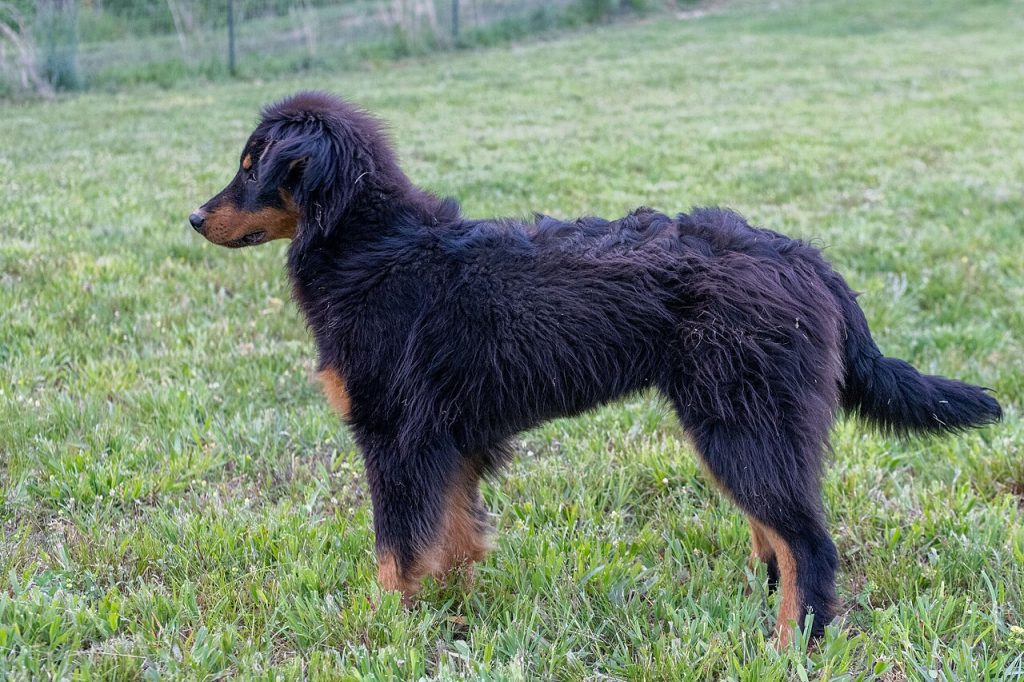
The Armant is a medium size and rectangular silhouette(slightly longer than tall), functionally built and not exaggerated dog.
Its most characteristic feature is the rough and untidy coat, which appears in a variety of colors: black, black and white, grizzled or light brown. The tail deserves a note: the not amputated breed, but some specimens are born with a hereditary short tail(congenital bobtail), a curious genetic peculiarity that occurs naturally.
As a whole it conveys what it is: a robust, attentive and resistant working dog, without aesthetic flourishes, whose morphology is at the service of the function for which it was bred.
Origin and history
The Armant takes its name from the city of Armant, in Upper Egypt, near Luxor, on the west bank of the Nile, the place attributed to the origin of the breed. It is also known as hawara dog, in reference to the hawwara tribal confederation that used it with its cattle, and as Ermenti or Egyptian shepherd.
several competing theories coexist on their provenance . One holds that the Armant descended from briards brought to Egypt by Napoleon’s armies, then crossed with local dogs. Another one points to dogs brought in with russian travelers in the 19th century. Scholar Desmond Morris points out that both hypotheses could help explain the thick, hairless coat, but they lack solid evidence to support them. Against them, the Egyptian Kennel Federation advocates a entirely African origin, linking the Armant to the North African village dogs, a thesis that has gained weight in recent years.
The present of the breed is delicate: the Armant is considered in danger for crossing with other breeds, which has been diluting the pure specimens.
Curiosities
- His ferocity defending the reindeer earned him the Arabic nickname of Sabe, “lion”.
- It’s the name of a thousand-year-old city. Armant is a town in Upper Egypt of pharaonic roots (ancient Hermontis), a cult center of the war god Montu.
- Dog of two trades. In Egypt it is used interchangeably as a shepherd who leads the cattle and as a guardian who protects them, a dual function that defines its character.
- Short tail from birth. never has its tail amputated, but some individuals are born with a natural hereditary bobtail.
- Mystery of origin. Napoleonic Briards, Russian travellers or African village dogs: their origin is still a matter of debate among cinologists.
- A race against the clock. Their preservation today depends on local clubs searching for pure specimens before crosses make them disappear.
If you’re interested in herding and guarding dogs with character like the Armant, you’d love to meet other breeds that share their intelligence and work instinct: the tireless Border Collie, the versatile Pastor Australiano, the classic Collie and the versatile Pastor Aleman, all shepherds with an alert head and tremendous dedication.
Frequently Asked Questions about the Armant
What is the Armant and where does it come from?
The Armant is a herding and guard dog native to Egypt, named after the city of Armant, in Upper Egypt. It is also known as the Egyptian Shepherd, Ermenti or Hawara dog.
Is the Armant a good family dog?
With its people it is loyal and very protective, but is reserved with strangers and has a strong guarding instinct.
Why do they call Armant “lion”?
In Egypt it is nicknamed Sabe, which in Arabic means lion, in reference to the courage with which it stands up to any threat to the animals it protects.
How tall and how much does an Armant weigh?
It is a medium-sized dog: females measure about 45-55 cm at the withers and males 50-60 cm, with an approximate weight of 23 to 29 kg (50-65 pounds).
How much exercise does the Armant need?
It is a high-energy working dog that needs plenty of daily physical exercise and mental stimulation. Long walks, running space and, above all, meaningful tasks keep it balanced; without activity it becomes bored and frustrated.
What skin care does the Armant need?
Their rough and untidy coat requires regular brushing to avoid tangles and remove dead hair and dirt. Other things, bathing only when necessary, cleaning ears, cutting nails and dental hygiene: a simple and routine maintenance.
Is the Armant recognized by the FCI?
No, the Armant is not recognized by the FCI, but it is recognized by the Egyptian Kennel Federation, and the Egyptian Armant Herding Club works to preserve purebred specimens, as the breed is threatened by crosses.
Is it easy to get an Armant out of Egypt?
No, it’s very difficult. It’s a rare breed, practically non-existent outside Egypt and endangered within its own country. For almost any household it’s more of a breed to know and value than a realistic option to acquire.