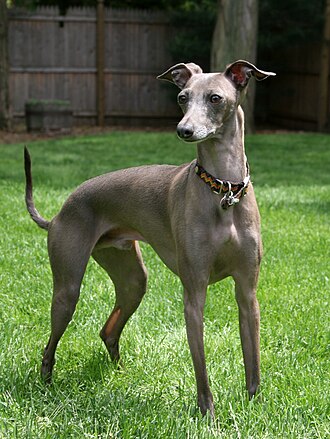
The Galgo Italiano is the smallest of all hares: An elegant, slender and surprisingly fast dog that fits in the lap but retains the silhouette and instinct of a racing greyhound. Loving, sensitive, and very close to his family, he fits in wonderfully in quiet apartments and homes. In this guide, we go through the character, care, health, and history of the Italian Greyhound so that you know if it’s the companion you’re looking for.
Is the Italian Greyhound for you?
The Italian Greyhound is a dog of contrasts: it looks like a glass object and yet it is an athlete capable of flying through the garden.
In favour .
- Mini size, perfect for flooring and carrying everywhere.
- Extremely affectionate and devoted to his family.
- Short hair: barely loosens hair and hardly smells like dog.
- Clean, discreet, and not much of a barker.
- Moderate exercise needs; quiet at home.
- A long-lived breed and, on the whole, quite healthy.
To be taken into account
- Fragile bones up to a year and a half: risk of fractures.
- Very sensitive to cold and humidity: he needs a coat.
- Strong chase instinct. Careful letting go.
- Sensitive; can become shy if not socialized well.
- It’s not ideal with very young, abrupt children.
- Learning to clean at home can be expensive.
Character and temperament
Behind its aristocratic air is a tender, playful dog that is deeply dependent on human affection. The Italian Greyhound lives by its family: it seeks contact, curls up under the blankets and usually chooses as its favorite place the space you leave beside you on the couch. It is what many call a “velcro” dog, of those who follow you from room to room.
As a puppy and young, he is cheerful and mischievous, with bursts of energy in which he runs in circles at full speed and, a minute later, falls asleep as if nothing had happened. As he ages, he becomes calmer and more reserved, especially with strangers, to whom he is cautious rather than aggressive. It is an intelligent dog and very sensitive to tone of voice and environment: tense homes, screaming or prolonged loneliness affect you and can make you shy or nervous. In return, in a quiet and loving home, she returns a loyal and delicate companion hard to match.
Coexistence: children, other pets, flat and loneliness
- With children: is playful and sweet, but its thin legs break easily when young. It coexists well with calm and respectful children; it is advisable to supervise the game and teach the youngest to catch it carefully and not to chase it.
- With other dogs: is sociable and is best understood with small to medium-sized dogs.
- With cats and small pets:, being a hare, retains hunting instinct. It can coexist with a cat with which it has been raised, but birds, rodents or rabbits can awaken its hunting instinct.
- On the floor: is one of the best apartment dogs out there: small, clean, quiet and sleepy. He doesn’t need a garden, but walks and a warm corner to take refuge.
- In the face of loneliness: is his weak point. As attached as he is, he has trouble staying alone for long hours and may suffer from separation anxiety. He fits better with people who spend a lot of time at home or who can carry him around.
Education and training
The Italian Greyhound is smart and quick to learn, but it is so sensitive that the method is everything. It responds wonderfully to positive reinforcement – rewards, caresses, a gentle voice – and is blocked or frightened by punishments, pulling and screaming. Sessions should be short, cheerful and pressure-free.
Two specific challenges mark their education. The first is the called: Like a good hare, if something moves and starts chasing you, you can disconnect from the world; you have to work on the call from a puppy and, until you have it very solid, release it only in safe areas. The second is the learning to clean: It’s a breed that classically finds it harder to defecate outside, partly because they’re uncomfortable going outside when it’s cold or raining. With routine, patience, and lots of positive reinforcement, you can do just that. Early socialization with people, noises, surfaces, and other dogs is key to preventing the adult from becoming fearful.
Exercise and activity
Although at home it is a sleeper, we must not forget that inside it beats a greyhound.The Italian greyhound enjoys running immensely: in open and safe terrain it can jump into that double-suspension gallop – in which all four legs stay in the air – and reach gusts of up to 60 km/h.
Their needs, however, are moderate: Two or three walks a day, some games and the possibility of running once in a while are enough to keep him balanced. It is not a long-distance or extreme sport dog, although it excels in disciplines such as lure coursing(races after a lure), which take advantage of its hunting instinct in a controlled and fun way. That ‘s right . on very cold days it is advisable to shorten the exits or keep it warm.
Care: fur and hygiene
As for the coat, the Italian Greyhound is one of the easiest dogs to maintain. Its hair is short, thin, satin and attached to the body, without undercoat, so it loosens very little and practically does not give off a smell. It is enough to pass a rubber glove or cloth once or twice a week to remove the dead hair and leave it shiny; bathing is only necessary very occasionally.
The real care is in other details. The dental work is his Achilles heel: tends to accumulate tartar and suffer from dental problems, so regular tooth brushing is highly recommended. It is advisable to check and cut the toenails, watch the ears and, above all, protect it from the cold: Because of her very short hair and low body fat, a coat or sweater in winter is not a whim, but a necessity. A good bed, soft and sheltered from currents, will complete your well-being.
Foodstuffs
The Greyhound does not need large amounts of food, but it does need quality and measure. The ideal is a complete and balanced food, adapted to your size, age and activity level, divided into two daily servings. Because of its lightweight structure, care should be taken that it is neither too thin nor overweight: In a dog this thin, a few extra grams put a strain on his joints and his spine, while getting too thin is easy because he moves a lot when he runs.
As a breed prone to dental problems, prizes and the texture of food also count; ask your veterinarian what diet and snacks help to care for your mouth. And, as always with hares, keep fresh water on hand and avoid strenuous exercise right after eating.
Health and life expectancy
The Italian Greyhound looks more fragile than it really is and, in fact, it is a long-lived breed: Their average life expectancy is around 14 years, above the average canine, and many specimens reach and exceed 13-15 years with good quality of life. Interestingly, it’s one of the dogs least affected by hypoplasia of the hip: In a large U.S. study of 157 races, it ranked as the lowest incidence.
His focus is on other things. From puppyhood and up to about a year and a half, his long bones are very delicate. and leg fractures are the most typical injury after a fall or jump from the couch; he must be prevented from jumping from heights and play monitored. The breed may exhibit some basic neurological changes, such as congenital deafness or cervical disc problems, in addition to the aforementioned dental problems tendency. Their sensitivity to cold and to certain anesthetics (common in hares) are factors that your veterinarian will consider. With regular checkups, weight control and dental care, it is a dog that usually accompanies many years.
Physical appearance
The Italian Greyhound is, in essence, a miniature greyhound with harmonious and elegant lines. It measures between 32 and 38 cm to the cross and, according to the FCI standard, should not exceed 5 kg or less in weight, although some specimens of larger lines approach 6-8 kg. His silhouette is unmistakable: deep chest, very reclined belly, long, very thin legs, long, arched neck and a small, elongated, narrow head that ends in a sharp snout.
It moves with a high and elastic trot, almost like a dancer, and to the race unfolds the flying gallop of the hares. The hair is short, fine and satin.. As for the colours, the standard supports black, gray and isabela (a cream-lion tone) in all their shades; only white marks on the chest and feet are accepted.
Origin and history
The Italian Greyhound is a very ancient breed. Very similar dog remains have been found in Egyptian tombs from thousands of years ago, and small hares of its type appear already in the art of antiquity.
During the Renaissance and later centuries, these little greyhounds were true favorites of European nobility and royalty. They are associated with families such as the Medici, the D’Este or the Visconti, with French kings, with Frederick the Great of Prussia, Catherine the Great of Russia or Queen Victoria, and were immortalized in sculptures and paintings by masters such as Giotto or Tiepolo. They arrived in the United Kingdom in the 19th century, where they became known as Italian Greyhounds; there a breed club was founded in 1900 and the American Kennel Club began registering them in 1886.
The modern Piccolo Levriero Italiano became established in the late 19th and early 20th centuries. The two world wars almost wiped out the breed, which only began to recover from the fifties onwards thanks to the efforts of passionate breeders. It was finally recognised by the Fédération Cynologique Internationale in October 1956. Today the FCI classifies it in the Group 10 (labels), Section 3 (short-haired labels), while clubs such as the AKC frame it among the toys or companion breeds, reflecting its double soul of hunter and saloon dog.
Curiosities
- It’s the the world’s smallest hare: a real greyhound reduced to pocket size by selection, not a cross.
- Its gallop is “double-suspension”: there are two moments in each stride when all four legs are in the air.
- It’s from less prone to hip dysplasia dogs of all breeds studied.
- He amassed so many illustrious admirers that he is known as “the dog of kings”: from the Medici to Queen Victoria.
- He loves the heat: It is not uncommon to find him buried among blankets or looking for the hottest ray of sunshine in the house.
- In English it is called Italian Greyhound and in Italian Piccolo Levriero Italiano; the FCI uses the name Italian Sighthound.
If you are attracted to the Italian Greyhound, you may want to compare its temperament and care with that of other hares and related breeds. Take a look at Whippet, its middle-sized close relative; Greyhound, the English racing greyhound; the sleek Saluki; or the spectacular Galgo Afgano.
Frequently Asked Questions About the Greyhound
Is the Greyhound a good dog to live on the floor?
Yes. It’s one of the hares that adapts best to a floor: it’s small, clean, barks little and spends a good part of the day sleeping curled up in a warm place. It just needs to go for a walk and unwind with a few short runs. It’s not the square footage that matters, but the time and company you give it.
How long does an Italian Greyhound live?
It is a long-lived breed, with an average life expectancy of about 14 years, often reaching 13 to 15 years, and although it appears frail, it usually enjoys good health if its weight, teeth, and protection from the cold are taken care of.
Does the Greyhound lose a lot of hair?
Very little. It has short, fine hair attached to the body, no woolly undercoat, so it barely loosens and almost does not smell like a dog.
Does the Italian Greyhound get cold?
It has very short hair, little body fat, and very fine skin, so it is one of the most sensitive breeds to cold and humidity. In winter, it needs a coat or sweater to go out, a warm, sheltered bed, and it is not a dog designed to live outdoors.
Is he good with kids?
It is affectionate and playful, but its bones are very delicate, especially puppy. It coexists well with calm and respectful children who know how to hold it carefully, while sudden games or falls can cause it to fracture. It is not the ideal dog for a house with very small and moving children.
Do you need a lot of exercise?
It has moderate needs. It needs only two or three walks a day combined with some free running time in a safe place, where it can reach its greyhound speed. It is not an overactive dog: after a breeze, it is calm and sleepy at home.
Can you let him off the leash?
It is still a hare with a strong chase instinct: if it starts behind a cat, a bird or a leaf, it is very fast and may not respond to the call. It is advisable to release it only in fenced or safe areas and work hard on the call from a puppy.
How tall and how much does an Italian Greyhound weigh?
It measures between 32 and 38 cm at the withers and, according to the FCI standard, should not exceed 5 kg; some specimens of larger lines can approach 6-8 kg. It is the smallest of all hares.