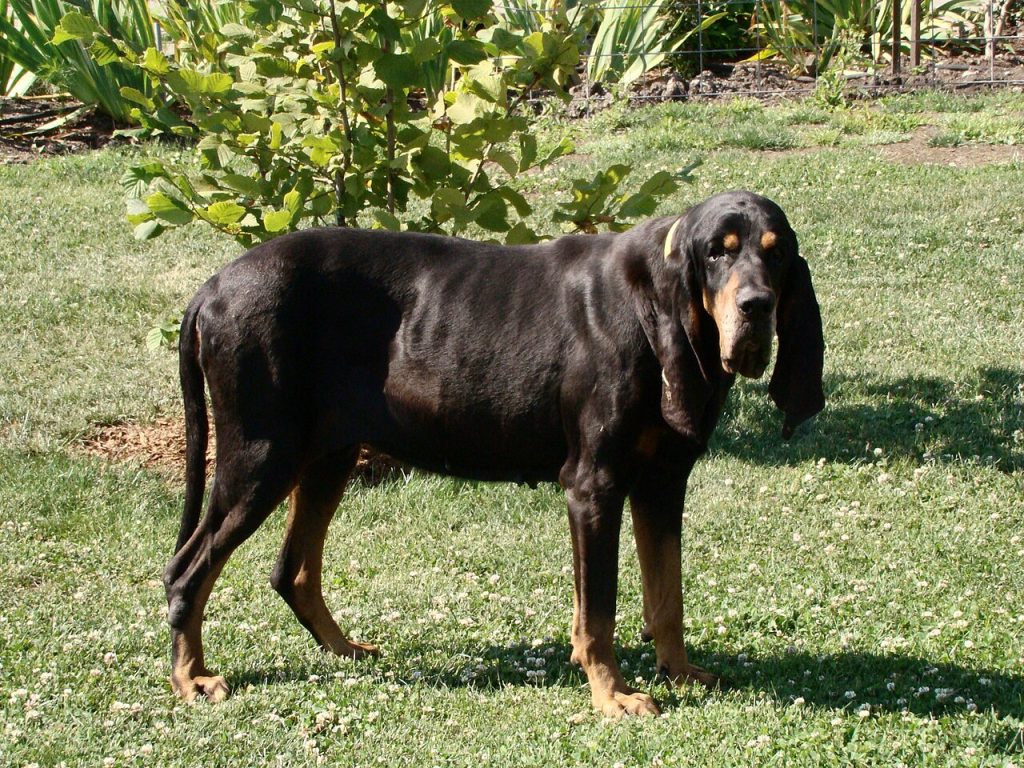
The Black and Fire Coonhound(in English, Black and Tan Coonhound) is a large-sized American hound with a prodigious nose and deep voice, bred for generations to track raccoons through forests and mountains.
Is the Black and Fire Coonhound for you?
Before you fall in love with those endless ears and that good-natured look, let’s be honest: the Black-and-Fire Coonhound is a pure-bred hunting dog. It shines with an active, patient, spacious owner, and suffers locked in a life too small. Here are its lights and shadows at a glance.
In favour .
- Gentle, affectionate and not aggressive inside the house.
- Tolerant and patient with children.
- Short coat that barely needs maintenance.
- Resilient, rustic and generally healthy.
- Extraordinary sense of smell and great intelligence for tracking.
- A good warning dog: he warns of anything new with his voice.
Against
- Absorbent tracking instinct: pull on the strap and escape after a scent.
- Powerful barking and howling; not a silent dog.
- Stubborn and independent – training requires patience.
- He needs daily exercise and a secure garden or fenced area.
- You drool and you should clean your face often.
- He’s not a dog to live in isolation or ignored.
Character and temperament

The Black-and-Fire Coonhound has a very marked dual personality, and understanding it is the key to living with it. Inside the house is a surprisingly calm dog: kind, quiet, unpretentious, able to spend hours lying close to his people without disturbing anyone. That domestic serenity is deceptive, for as soon as he goes outside and his nose catches a trail, the hunter he carries inside ignites and it is almost impossible to get him off the track.
It’s a strong, brave, independent hound with a good dose of stubbornness inherited from centuries of working alone, away from the hunter. It is not a subservient dog that lives by obedience; rather, it cooperates when it deserves it. With his family he is affectionate and loyal, while with strangers he is usually reserved, not aggressive, and often announces his presence with that deep, resonant voice so characteristic of the breed.
It is worth remembering that we are dealing with a pack and field dog: it enjoys company, is easily bored if left alone for too many hours and, driven by smell, can wander for miles if it finds a niche.
Coexistence: children, other pets, flat and loneliness
With children: is one of its strong points. The Black and Fire Coonhound is gentle and tolerant with the smallest, and its stable temperament fits well in families. Of course, its independence makes it not always the tireless playmate who seeks a very moving child: sometimes it prefers its tranquility. As with any large dog, it is advisable to supervise encounters with small children.
As a pack dog, With other dogs: usually gets along well with other dogs and enjoys canine companionship.
With cats and other pets: has a very strong tracking and chasing instinct, and small or elusive animals can activate their hunting impulse.
Floor and solitude: is not the ideal dog for a small flat. It needs space, long walks and, if possible, a well-fenced garden where it can snoop safely. It does not tolerate prolonged solitude: a bored Coonhound howls, and that sonorous wailing will not make the neighbors happy. If you spend many hours outside, this is not your breed.
Education and training
Training a Black and Fire Coonhound is an exercise in patience and a sense of humor. It’s intelligent, no doubt, but its intelligence is geared toward tracking, not pleasing the human. Added to his stubbornness, this means that forced training fails: He responds much better to positive reinforcement, to short, motivational sessions and, most of all, to food as a reward, because he’s a very gluttonous dog.
The call (come when called) is the great workhorse. When this hound is following a scent, it stops hearing the world: that’s why almost all experts recommend never releasing it in an open area without a fence. It works the call from a puppy, in controlled environments, and assumes that it will rarely be 100 percent reliable outdoors. A secure fenced area is not a luxury, it’s a necessity.
Early socialization – people, dogs, noises, environments – helps him manage his reserve with strangers and grow into a balanced adult. And if howling worries you, work on it early: teaching him alternatives and not reinforcing barking for attention prevents it from becoming a difficult habit to control.
Exercise and activity

He is a good distance runner. A fit Black and Fire Coonhound can run for miles without getting tired, although in the day to day he is content with a good pace: moderate jogs, long walks and, if possible, some outing to the field where he can use his nose.
Calculate at least one or two hours of daily exercise spread over several outputs. Activities that combine body and smell – hiking, tracking games, hunting for hidden prizes, dog sports like nose work or tracking– are ideal for channeling your energy and instinct. A well-trained dog of this type is calm at home; a bored one, on the other hand, ventures his frustration by howling, scratching, or trying to escape.
For your safety, remember the golden rule: always ride with a leash, except in completely enclosed spaces.
Care: fur and hygiene
As for the coat, the Black and Fire Coonhound is low maintenance. Its short, dense, shiny coat only needs occasional brushing – once a week is enough – to remove the dead hair and keep it shiny.
The real focus is the ears. Long, wide and falling, they create a warm, poorly ventilated environment in which infections proliferate. Check and clean them regularly, and watch for signs such as bad breath, redness, or heavy head shaking. Many examples of babean to a greater or lesser extent, so having a cloth on hand to wipe his face and the folds of the beak is part of the routine.
Complement hygiene with the usual for any dog: cut your nails when they hit the ground, maintain good dental hygiene with proper brushes or biters, and check your eyes and pads, especially after field trips.
Foodstuffs
As a large and very tasty hound, the Black and Fire Coonhound needs a quality diet tailored to its size, its age and, above all, its actual activity level. A hunting dog that works long days in the countryside expends much more energy than an urban companion who goes for a walk; the ration must reflect this difference to avoid overweight, which punishes its joints.
His voracity and his nose are a dangerous combination: It’s a dog capable of opening garbage cans, stealing food off the counter or swallowing anything on the floor. It is advisable to control rations, avoid excessive prizes (count them within the daily total) and keep food out of their reach. In large, deep-chested dogs, it is wise to divide the food into two servings and avoid vigorous exercise right after eating, as a precaution against digestive problems. Always have fresh water available and consult your veterinarian about the most appropriate diet for each stage of your life.
Health and life expectancy
The Black and Fire Coonhound is, as a whole, a robust and healthy dog, the result of generations raised more for its functionality than for its aesthetics.
- Dysplasia of the hip: As with many large breeds, it is advisable to choose breeders who evaluate the breeders and take care of the weight and exercise of the puppy as it grows.
- Hearing problems: their long, drooping ears favor otitis and infections; some cases of ear cancer have also been described.
- Eye problems:, like other dogs with somewhat loose eyelids, may present eye discomfort or irritation that should be monitored.
As always, regular veterinary check-ups, daily vaccination and deworming, a balanced diet and maintaining a healthy weight are the best recipe for healthy and active old age.
Physical appearance
The Black and Fire Coonhound conveys an impression of power, agility and alertness. It is a large hound with a muscular body and strong bones, with long legs in proportion to the body, designed to cover the ground with wide, rhythmic strides for hours.
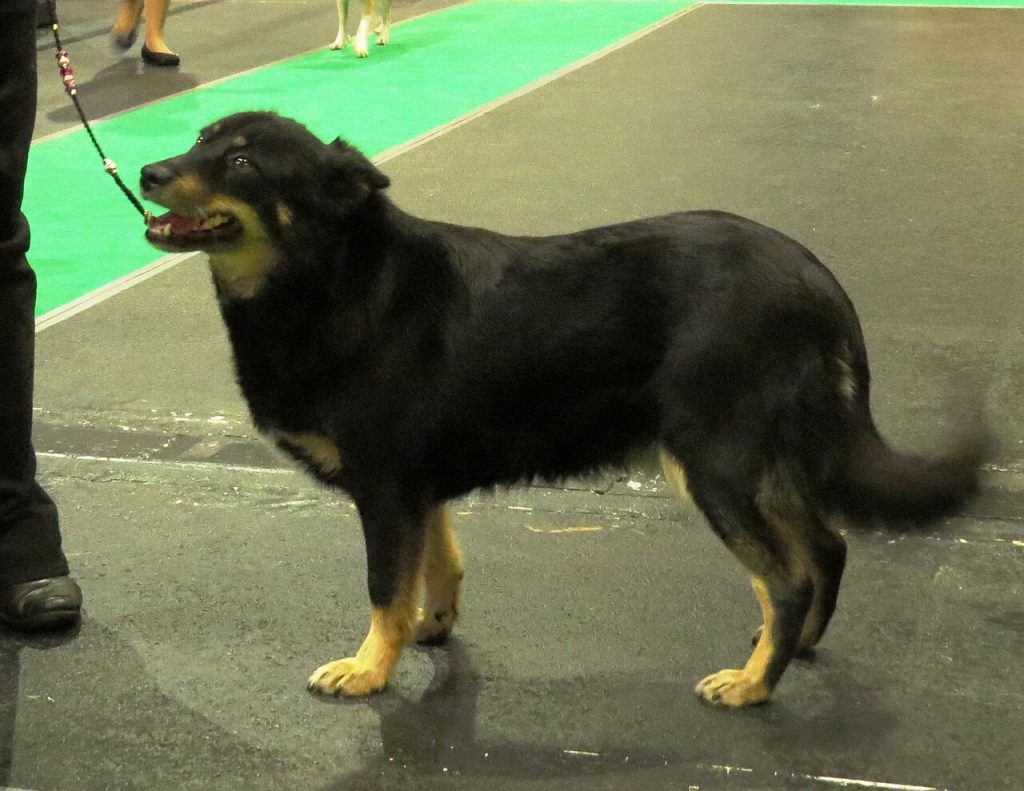
According to the FCI standard, the males measure between 64 and 69 cm to the cross and the females between 58 and 64 cm. The standard does not fix a weight, but as a reference the males are usually around 23 – 34 kg and the females 18 – 29 kg. Its most unmistakable feature is the coat: short, dense and shiny, black azate with fire markings over the eyes, on the snout, chest and legs, a pattern very similar to the Doberman or the Rottweiler.
The head wears low-insert very long, wide and fine ears s, which hang well below the throat line and help lift and swirl odors from the ground into the nose. The eyes range from hazel to brown, with a friendly expression. The tail is inserted slightly below the dorsal line and, when the dog is alert or excited, is held up almost at right angles. His voice, that low, berry-like barking reminiscent of a deep howl, is so personal that many hunters recognize their dog from a great distance just by the sound.
Origin and history
The Black and Fire Coonhound is one of the few breeds that can boast of being authentically American. His family tree, however, has its roots in old Europe: It is considered a descendant of the Talbot, a hound of Norman origin popular in medieval England from the 11th century onwards, and very especially of the Bloodhound and the Foxhound, through the Black and Tan Virginia Foxhound. From the Bloodhound, he inherited his robust bone structure, his long ears and, most of all, that legendary sense of smell. The great blue hound of Gascony and the Kerry beagle are also cited among their ancestors.
The breed took shape in the mountains of southern Appalachia, where settlers needed dogs capable of following the raccoon’s trail in the middle of the night and cornering it on top of a tree – the characteristic work of treeing– until the hunter arrived. It was soon discovered that this hound was also suitable for larger animals such as the deer, bear or puma, making it a versatile ally of life on the border.
In 1900, the United Kennel Club recognized it under the name American Black and Tan Fox and Coonhound. Two decades later, about 1921, William N. Cosner, founder of the National Black and Tan Club, identified the type of long ears that define the breed today. Along with other pioneering breeders he drafted the standard that would lead to the Recognized by the American Kennel Club in 1945, making it the first of the six coonhounds to achieve that recognition, within the Hound Group. The others – Redbone, Plott, Bluetick, American English, and Treeing Walker – would not arrive until much later.
Curiosities

- It is said that George Washington had four black and tan types, a fact that reinforces the idea of the breed as a genuinely American dog.
- It was the first coonhound recognized by the American Kennel Club, in 1945, ahead in decades of its relatives.
- It hunts guided entirely by smell., not by sight: it is capable of following cold tracks, hours old, over great distances.
- Each dog has a distinctive and recognizable voice; experienced hunters distinguish their hound from several only by the sound of its barking in the distance.
- The pattern of black and fire color is so characteristic that it is directly comparable to that of the Doberman and the Rottweiler, although their origin and function have nothing to do.
If you are attracted to the American hound’s character, you may want to learn about other scent and tracking breeds with which it shares roots or abilities. Its direct ancestor is the Bloodhound, the undisputed king of smell; the Basset Hound shares those huge ears and the passion to follow a trail stuck to the ground; the Beagle is its smaller cousin and cheerful temperament; and the Dachshund proves that sniffing doesn’t understand heights.
Frequently Asked Questions About the Black and Fire Coonhound
Is the Black and Fire Coonhound a good family dog?
Yes. He is gentle, affectionate, and especially tolerant of children, and inside the house he behaves quietly and unpretentiously. He needs, of course, an active family that gives him exercise, company and a safe environment, because he does not tolerate isolation.
How much exercise do you need a day?
A well-trained Coonhound is serene at home; a bored one howls and tries to escape.
Can you have it on one floor?
It is not ideal. It is a large, active, vocal dog that enjoys space and a well-fenced garden to snoop around. In a small apartment and with owners absent for many hours, it tends to get bored and howl, something that often bothers the neighborhood.
Does he bark or howl a lot?
It is a dog with a powerful voice. Its low barking and berry howling are part of its essence as a hound, and it uses them to warn, express emotion or when it is bored or alone. With socialization and exercise it modulates, but it is not a silent breed.
Is it easy to train?
It is intelligent, but independent and stubborn, so it requires patience. It responds well to positive reinforcement and food as a reward, and badly to imposition. The call is its pending subject: when it follows a trail it stops attending, so it is advisable never to release it in unfenced areas.
How long do you live and what health problems do you have?
Its life expectancy is around 10 to 12 years. It is a robust dog, although it is advisable to watch for hip dysplasia, ear infections (due to its long and dropped ears) and some eye problems.
Do you get along with other dogs and cats?
With other dogs it usually coexists very well, as it is a pack dog. With cats and small pets you have to be careful: its strong tracking and chasing instinct can be activated. Coexistence is possible if you grow up with them from a puppy, but without trusting them completely.
Do you need a lot of hair care?
Their short, dense hair is maintained with weekly brushing and occasional bathing. The greatest hygiene effort is to check and clean their ears frequently to prevent infection, and to dry their facial spots when they do.