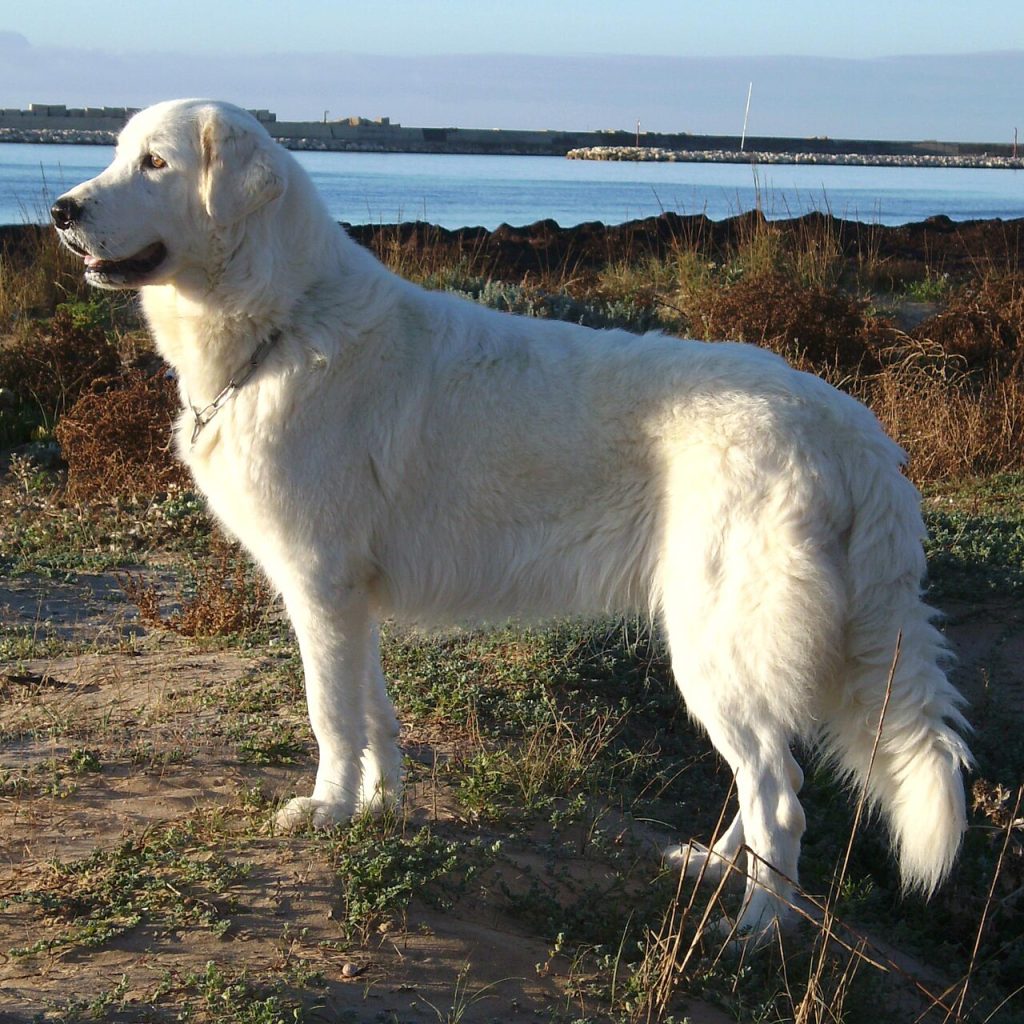
The Shepherd of the Maremma(in Italian Cane da Pastore Maremmano-Abruzzese and other, also called Maremmano-Abrucense) is a huge white guard dog that has been doing the same thing for over two thousand years: Stand between the flock and the wolf. It is not a companion dog to use, but an independent watchdog, bred in the mountains of the Abruzzo and in the marshes of the Tuscan Maremma to work alone, make its own decisions and deter any predator. If you’re looking for an obedient dog that follows you everywhere, this isn’t it. If you’re looking for an imposing sentry, serene and deeply attached to what he considers “his”, the Maremma Shepherd is one of the oldest and most authentic breeds in existence.
Is the Shepherd of Maremma for you?
The Maremma Shepherd is a working livestock watchdog (LGD), not a breed designed for urban life. Before falling in love with its bear-white imprint, it is advisable to look head-on at what it means to live with a watchdog who was selected for centuries to act on his own. These boxes summarize who fits and who does not.
It suits you if…
- You have a large estate, farm or plot with cattle, chickens or simply space and a solid fence.
- You want a territorial watchdog who watches by instinct, no need to “send” him to work.
- You value a dog that is calm, balanced, and gentle with its family.
- You accept an independent dog who decides for himself and doesn’t constantly seek your approval.
- You can assume its size, its nighttime patrol bark and its plump fur coat.
Think about it if…
- You live in a flat or in a house without land: it is an outdoor dog and of large spaces.
- You want sporting obedience or a dog that executes orders instantly.
- You get a lot of visitors or there’s a constant movement of strangers on your property.
- It’s your first dog and you have no experience with independent breeds and guard dogs.
- You can’t tolerate barking at night or white hair all over the house.

Character and temperament
The temperament of the Maremma Shepherd is that of a born guard: balanced, self-assured and surprisingly serene for its size. It is not a nervous or excitable dog; its default mode is vigilant calmness. It spends much of the day observing its territory with apparent indifference, until something changes and then reacts decisively.
The key word to understand this race is independence. For centuries it has worked in the mountains without a shepherd giving it constant instructions; its function was to stay with the flock, assess the situation and decide alone if an intruder was a threat. That wiring’s still intact. The Shepherd of Maremma thinks for himself, does not obey because he does and needs to understand the “why” of things. It’s not stubbornness. It’s the autonomy of the guardian.
With his family, however, he is a gentle, calm, protective dog. He forms a deep bond with the people and animals he considers “his” group, and his instinct is to care for them. With strangers he is reserved and suspicious – just as a good guard dog should be – without being gratuitously aggressive: Your first line of defense is deterrence, not attack. It is a dog that barks to warn and to mark territory, especially at night, when it traditionally enters patrol mode.
Coexistence: children, other pets, flat and loneliness
With children: Well socialized and raised in a family, the Maremma Shepherd is usually patient and protective with the children in his home, whom he integrates into the “flock” he must care for. Their enormous size, however, requires constant supervision of interactions with young children, and young ones should be taught to respect their space. His guarding instinct can cause him to misinterpret rough play between other children, so he needs to be managed with his head.
With other pets: is one of its great virtues. This dog was selected precisely to live in harmony with sheep, goats, cows and even birds, protecting them. It coexists wonderfully with other animals of the house or farm if it grows up with them, and develops a strong protective bond. With unknown dogs and the same sex can show territorial, especially among males.
On the floor: discouraged. The Maremma Shepherd is an outdoor dog, of large dimensions and with a vocation to patrol and bark. Locking him in an apartment causes him frustration and you, problems with the neighbors. He needs land, open air and a perimeter to watch.
In the face of loneliness: tolerates loneliness better than many breeds, because it is not emotionally dependent on constant human presence; it is used to spending hours alone with the herd. Of course, it needs company – human or animal – and a purpose; it is not a dog to be left isolated and forgotten in a corner of the garden.
Education and training
Training a Maremma Shepherd is not like training a German Shepherd or a Border Collie. Here there is no dog eager to please that executes orders for the pleasure of pleasing; there is a keeper who evaluates each request and decides whether to compensate it.
The early socialization is the most important piece. A Maremma puppy must know people, noises, animals and various situations from the first weeks to learn to distinguish the normal from the threatening; otherwise, a dog of this size and with this instinct can become overly suspicious. Interestingly, in its traditional use as a herding dog, the opposite occurs: the pups are placed among the sheep at just 40 days of age and human contact is minimised to bind them to the cattle. As a family dog, the approach should be the opposite: A lot of positive, varied contact.
Positive reinforcement, calm firmness, and respect are the way to go. Harsh methods don’t work: a dog that is so independent and strong-willed will shut down or become reactive if treated harshly. Don’t expect precise obedience; you can achieve a reliable dog, with good manners and basic control. It requires an experienced guide and calm leadership.

Exercise and activity
Here’s where you need to clear up a misunderstanding: The Maremma Shepherd is a big, tough dog, but he’s not a hyperactive athlete who needs miles of running a day. Their traditional job is guarding, not herding like herding dogs; they move around a lot but at their own pace, patrolling the perimeter and resting between rounds. It’s a ground dog, quiet resistance, not explosive.
What you really need is space and purpose. A wide terrain that he can travel and monitor gives him more satisfaction than any imposed exercise routine. Long walks, access to a large garden, and, if possible, a flock or animals to care for provide plenty for their needs. The mental stimulation of “having something to protect” is as important as the physical. Without space or function, it’s a dog that gets bored and can become barking or escapist.
Care: fur and hygiene
The Maremma Shepherd wears a long, dense, rough-to-the-touch, white, double coat that forms a characteristic gorge around its neck, protecting it from the cold of the mountains, rain, and even a predator’s bite on its neck.
A weekly brushing keeps your hair untangled and clean most of the year. During seasonal mowing – especially in the spring – hair loss is abundant, and daily brushing is needed to remove the dead undercoat. Its coat has some self-cleaning ability and repels dirt, so it does not need frequent bathing; in fact, excessive bathing undermines the natural protection of the hair. Just bathe him when he’s really dirty. Complete the routine with regular ear checks, nail trimming and dental hygiene.
Foodstuffs
As a giant breed dog, the Maremma Shepherd has specific needs. In the puppy stage, a feed formulated for large or giant breeds is essential, which controls the supply of calcium and energy so that bone growth is slow and orderly; too fast growth predisposes to joint problems. A puppy of this size should never be overfed or accelerated in development.
As an adult he is a rustic dog with an efficient metabolism: Despite its size, it does not eat as much as one would expect and easily gets fat if overfed. Divide the daily ration into two servings to reduce the risk of gastric torsion(dilatation-volvulus), a real danger in deep-breasted dogs, and avoid strenuous exercise right after eating. Keep fresh water available at all times and adjust the amounts according to your activity and condition.
Health and life expectancy
The Maremma Shepherd is a rustic dog of robust build, forged by centuries of outdoor life under demanding conditions. However, we must be honest with one fact: the median age of death recorded for this breed is 7.5 years, compared to a median of 10 years for the set of dogs in Italy. It is a moderate longevity, typical of large breeds, in which the heart and joints bear a lot of load.
Like all giant breeds, it is prone to hip and elbow dysplasia and the aforementioned gastric torsion, two of the points to watch more closely. Choosing a serious breeder who tests for dysplasia in the breeders is the best way to reduce risk. Keeping the dog at a proper weight throughout its life, avoiding overwork on the puppy, and dividing meals help protect its joints and digestive system. Regular veterinary checks and daily vaccination and deworming complete the basic care.
Physical appearance
The Maremma Shepherd is a large, powerful, rustic-looking and at the same time majestic dog, whose body is slightly longer than the height at the cross.
- Height at the cross: males measure between 65 and 73 cm; females, between 60 and 68 cm.
- Peso: males weigh around 35 – 45 kg; females, 30 – 40 kg. Some specimens are considerably larger.
- Cabeza: large and flat, conical in shape, traditionally compared to that of a polar bear.
- Black Truffles, lips and eyebrows:, contrasting with the white cloak.
- Pelaje: is long, dense, rough to the touch and solid white; slight yellowish or ivory hues are allowed.
White is not an aesthetic whim: originally it allowed the shepherd to distinguish the dog from the wolf in the penumbra, a detail already recommended by Roman authors.

Origin and history
Few races can boast such a long and documented history. The Maremma Shepherd is native to central Italy, especially the Maremma region – the marshes of Tuscany and Lazio – and the mountains of the Abruzzi, where for centuries it has protected herds of sheep from wolves. Descriptions of large white herd-guarding dogs already appear in Roman literature, in authors such as Columella, Varron, and Palladius, and in countless sculptures, frescoes, and paintings from Antiquity to the present day.
The name “Maremmano” comes from the marshes of the Maremma, where shepherds, dogs and hundreds of thousands of sheep spent the winter; the appellation “Abruzzese” alludes to its ubiquity in the Abruzzi, where grazing is still vital and the Apennine wolf continues to be an active and protected predator. Until 1958, the Pastore Maremmano(from the Maremma) and the Pastore Abruzzese(from the Abruzzo) were considered two distinct breeds. On 1 January of that year, the ENCI – the Italian national herding organisation – unified them, finding that the trans-humanization of herds from one region to another, especially after the unification of Italy in 1860, had produced a ‘natural fusion’ of the two types.
The first entry of a Maremmano in the Italian pedigree book dates from 1898 (four dogs), and the first breed standard was drafted in 1924. Today the Maremma Shepherd continues to work with Italian breeders and has been exported as a guard dog to countries such as Australia, Israel, New Zealand, the United States and Argentine Patagonia, always with the same mission: Protect livestock from predators.
Curiosities
- Keeper of the penguins. Since 2006, on Middle Island (Warrnambool, Australia), several Maremma Shepherds have been protecting a colony of small Australian penguins from invading foxes.
- Against the Beast of Gévaudan. Abruzzi wolfhounds were imported to France in the 18th century and were used in the famous Gévaudan Beast hunt in 1765.
- The necklace with spikes. The working specimens traditionally wore the roccale(or i ‘m going to tell you .), a spiked iron collar that protected the dog’s neck in hand-to-hand combat with the wolf.
- Strength in numbers. In practice, three or four Maremmanos are sufficient to defend a herd of wolves and wild dogs; their work is mostly deterrent, and actual physical combat is relatively rare.
- White relatives all over Europe. shares a possible common ancestor with other similar looking and function guard breeds: the Pyrenean Mountain Dog, the Hungarian Kuvasz, the Polish Tatra Shepherd and the Balkan Šarplaninac.
If you’re drawn to the world of large guard and mountain dogs, you may be interested in other breeds with big hearts and imposing faces. You might meet the Swiss rescue giant San Bernardo, the swimmer and lifeguard Terranova, the sleek Gran Danés or the muscular Italian guard Cane Corso, all with their own character and history.
Frequently asked questions about the Maremma Shepherd
Is the Maremma Shepherd a good family dog?
It may be, but with nuances. It is affectionate, calm and protective of its family, and gets along well with children and other pets in the house if it grows up with them. However, it is an independent guard dog, large in size and designed to live outdoors in wide areas, not a floor companion dog. It fits in families with property, experience and space, not in urban homes.
Can you have a Maremma Shepherd in a flat?
It is not recommended. It is a large, outdoor dog, with a vocation to patrol and bark, especially at night. It needs terrain, a perimeter to watch and space to move at its own pace. In an apartment it becomes frustrated and generates problems of coexistence.
Is it hard to train?
It requires patience and experience. It is a very intelligent but independent dog, which evaluates orders rather than simply obeying. It responds to positive reinforcement, calm firmness and respect, never to harsh methods. Do not expect sports obedience; it is a reliable and well-mannered dog if you socialize it early and well.
How long does a Maremma shepherd live?
The median age of death recorded for the breed is about 7.5 years, a moderate longevity typical of large dogs. With good care, proper weight and a breeder who controls the dysplasia, many specimens exceed that figure.
Does he bark a lot?
Yes, it’s part of their job. The Maremma Shepherd barks to warn and mark territory, especially at night, when it traditionally goes into patrol mode. It’s a deterrent barking, not a nervousness barking, but it’s worth keeping in mind if you have neighbors nearby.
Do you get along with other animals?
All right, it’s one of his great virtues. He was selected to live with and protect sheep, goats, cows and birds, so he develops a strong protective bond with the animals in his group.
How much hair does it loosen and how much care does the mantle need?
It has a double, long, dense coat that is quite loose, with very intense moulting in spring. A weekly brushing is enough most of the year, but during the moult you have to brush daily.
Is he an aggressive or dangerous dog?
Not for nothing. It is reserved and suspicious of strangers, as befits a good guard, but its first weapon is deterrence, not attack. Well socialized and balanced, it is a calm dog and gentle with its family. Its size and its guarding instinct demand, of course, responsible handling.