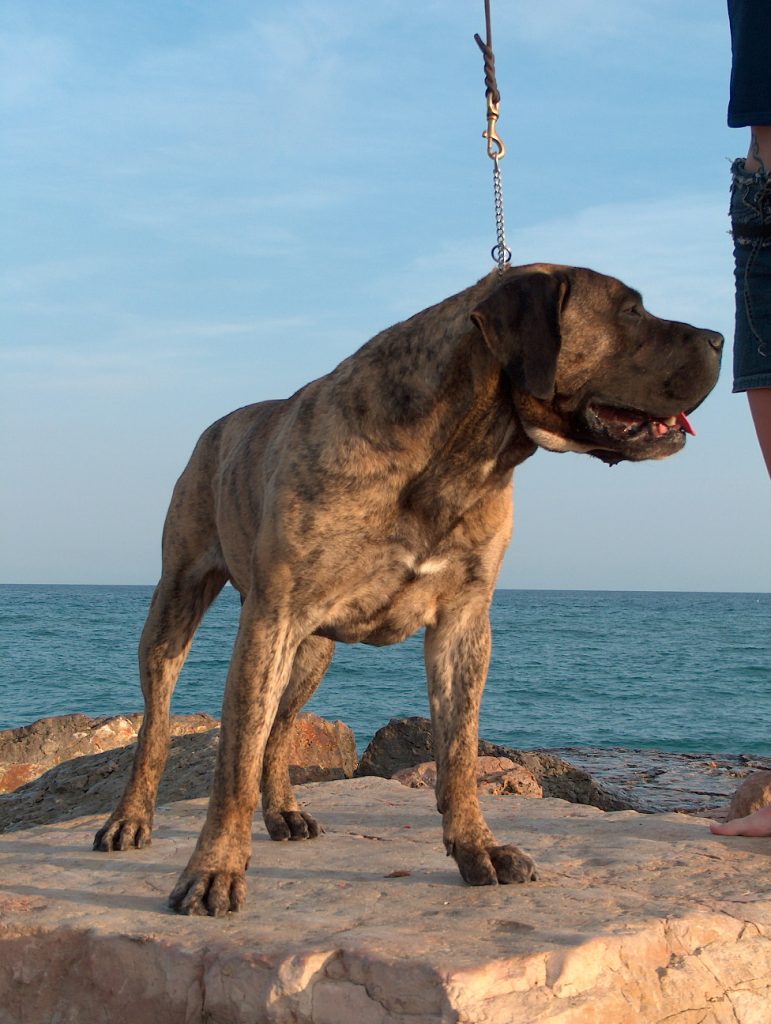
The Canary hound is a large, powerful and rustic Spanish harvest moose, born in the Canary Islands for guarding, managing wild livestock and – in another era – fighting. A natural symbol of the island of Gran Canaria, it is a loyal and imposing guardian that should only live with experienced owners willing to socialize and educate it thoroughly. If you’re looking for an easygoing, compliant companion dog, it’s not for you; if you’re looking for a serious, balanced, canary-rooted protector, the Canary Hound is one of the best.
Is the Canary Hound for you?

The Canary Hound is not a dog for everyone. It is a strong, dominant and territorial race guardian, with a very marked protective instinct and considerable physical power. With his family, he is loyal, calm, and deeply connected; with strangers, he is reserved and vigilant. He needs an owner with character and experience, consistent in the rules, able to give him leadership without harshness and to socialize him as a puppy. In the right home, it is a balanced companion; in the wrong, a serious driving problem.
In favour .
- Exceptional guardian: territorial, courageous and deterrent.
- Very loyal and devoted to his family.
- Balanced and self-assured when he’s well-bred.
- Short hair, easy to maintain.
- Rustic and hardy, the fruit of centuries of functional selection.
To be taken into account
- Considered potentially dangerous in several countries (license, muzzle, insurance).
- It requires an experienced owner and constant socialization.
- Strong territorial and dominance instincts with other dogs.
- He needs space, exercise, and daily stimulation.
- Short life expectancy, like all large molluscs.
Character and temperament
The temperament of the Canary Hound is that of a classic guard moose: calm and confident in its territory, attentive to everything that happens around it and firm when it perceives a threat. It is not a nervous dog or a barking sport; its strength lies in its presence and willingness to act. With his own he is affectionate, calm and surprisingly balanced, able to spend hours relaxing at home. That calm coexists with a low reaction threshold to what it considers an intrusion, so early socialization and serious education are not optional: They’re the difference between a reliable guard and an unpredictable dog.
It is a domineering dog that needs to know its place. It responds very well to calm and consistent leadership, and badly to harshness or lack of rules. Its intelligence and independence make it more valuable to an owner to trust than one to obey out of fear.
Coexistence: children, other pets, flat and loneliness

However, due to their size and power, supervision with small children is mandatory and it is advisable to teach toddlers to respect their times and rest.
With other pets the matter is more delicate. Its territorial instinct and tendency to dominance can generate conflicts with dogs of the same sex, and its past as a prey dog makes coexistence with small animals require careful socialization.
About the floor: it is not its ideal habitat. It performs best in a house with fenced and safe terrain. It can live on the floor if it is compensated with exercise and outings, but a dog of this size and energy appreciates space. As for the loneliness, it tolerates spending time alone, but it is a dog very attached to its people: leaving it isolated for long days favors boredom and destructive behaviors.
Education and training
The education of the Canary Hound must begin on the first day and never end. The early socialization– exposing him as a puppy to people, noises, environments and other dogs in a controlled and positive way – is the most important piece to having a safe, non-reactive adult. It is an intelligent dog that learns quickly, but it is also independent and strong-willed, so it needs firm, consistent and positive training, with clear rules from the beginning.
Positive reinforcement works much better than imposition: punishing a mole of this size only creates distrust or tension. Work on basic obedience, impulse control, and leash handling, and – if you have no experience with guard breeds – lean on a professional trainer.
Exercise and activity
Although quiet at home, the Canary Hound is a medium-high-energy working dog that needs real daily exercise. He is good at long walks, walks, games and, above all, work that combines body and mind: Obedience, follow-up, control exercises. A dog that spends its energy and uses its head is a balanced dog; one that is bored and with no way out accumulates frustration that can lead to destructiveness or overreactivity.
It is not a dog for high-speed sports or extreme endurance, but it is for an active, purposeful life.
Care: fur and hygiene

Good news for the owner: maintaining the coat of the Canary Hound is simple. It has the short hair, rustic and attached to the body, without woolly undercoat, so it is enough with a weekly brushing to remove the dead hair and keep the skin healthy.
The important thing for a large dog is routine hygiene: check and clean the ears regularly (especially if they are not trimmed), trim the nails when necessary, take care of dental hygiene and watch the folds of the face. With that and proper feeding, it is a very portable care dog.
Foodstuffs
As a large moose, the Canary Hound needs a high-quality, protein-rich diet tailored to its size, age and activity level. It divides its daily ration into two meals – never one large meal – to reduce the risk of gastric dilation-torsion, a serious problem in large, deep-chested dogs.
During growth, a large breed puppy should eat a specific feed for large breeds, which controls the rate of development and protects the joints. In the adult, watch the weight: overweight punishes his joints and his heart. If in doubt about quantities or diet, consult your veterinarian.
Health and life expectancy
The Canary Hound is a rustic and hardy dog, but shares the typical problems of large moles. Its life expectancy is around 9-11 years old, although an extensive study in the UK placed the average longevity of the breed at about 7.7 years, well below the general average of 12.5 years for dogs; as in almost all giants, life is shorter than in small breeds.
Among the pathologies to be monitored are hip and elbow dysplasia, gastric dilation-torsion(for its deep chest), heart problems and eye disorders. Prevention goes through acquiring the puppy from a responsible breeder who does health tests to the breeders, keep the dog in its weight, follow the calendar of vaccination and deparasitisation and go to periodic veterinary checks.
Physical appearance
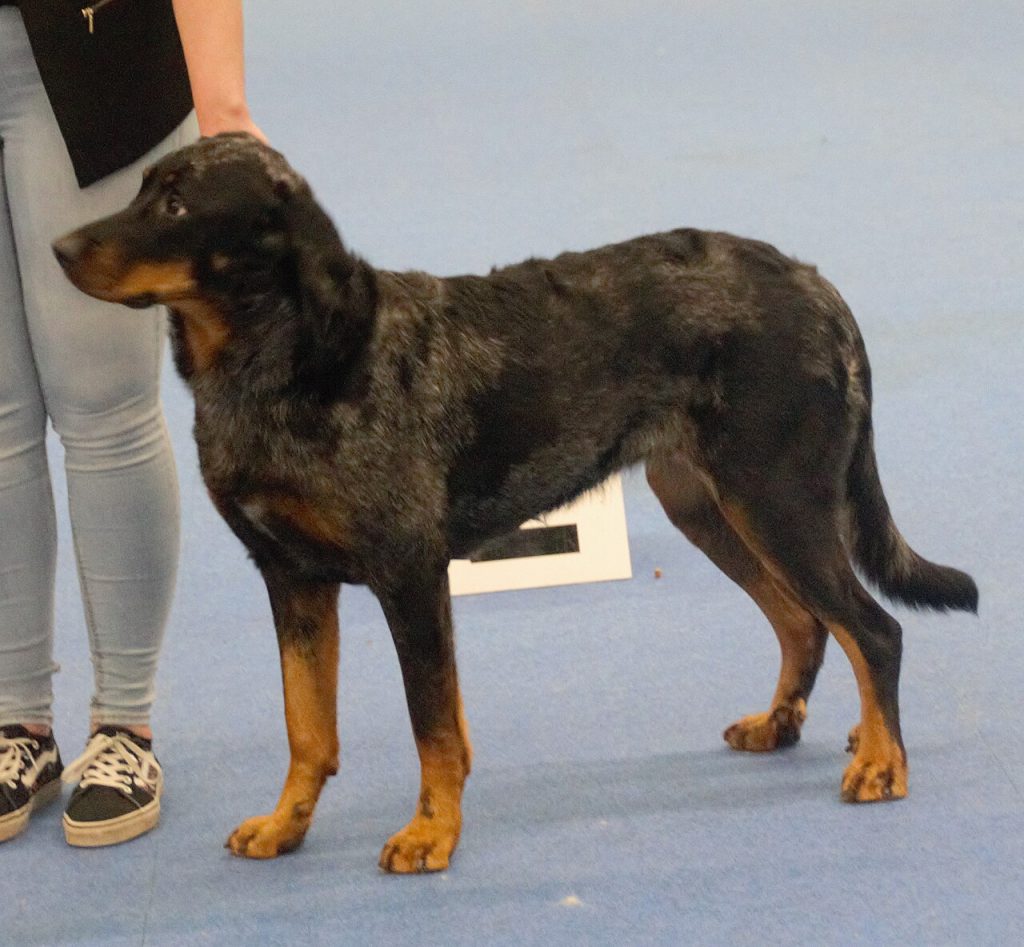
The Canary Hound is a big, sturdy and very muscular, rectilinear looking and powerful dog that transmits strength without falling into heaviness. According to the 2023 international standard, males measure between 61 and 66 cm at the withers and weigh about 45-57 kg, and females measure between 57 and 62 cm with weights of 40-50 kg. The head is broad, massive, square and brachycephalic, with a serious and imposing expression. When not trimmed, the ears fall glued to the head in the shape of a rose; where trimming is forbidden, they remain natural.
The hair is short and rough. The most characteristic color is the triggered(bringado) in its entire range, from the greenish bardino – the famous “verdino” inherited from the majorero bardino – to the leonado and the red atigrado; black also appears in the line of prey. Many specimens have a black mask on their face. The set is that of an agile, athletic, pushing prey mollusk, not that of a heavy mastiff.
Origin and history
The origin of the Canary Hound is in the Islas Canarias, where since the 16th century there are abundant documentary references to hounds dedicated to the guarding and management of cattle. Its basis is the bardic majorero, the rustic dog of Fuerteventura, crossed over time with Spanish dam molos brought to the islands during colonial times and, later, with bulldog and bull terrier-type dogs brought by British residents between the 18th and 19th centuries. Much of his expression, character, and greenish fur come from that bard.
For decades it was selected for its function – guard, cattle fighting and dog fighting, legal in Spain until 1936 – rather than a fixed type. With fighting banned and the massive arrival of alien races, the breed came close to extinct by 1960. Its recovery began in 1970: in 1982 the Spanish Club of the Canary Whale was created, in 1989 the Royal Canine Society of Spain approved its standard and in 1991 it was declared a natural symbol of Gran Canaria. The FCI accepted it provisionally in 2001 (as Dogo Canario) and definitively in 2011; in 2018 it officially recovered the name Presa Canario.
Curiosities
- It is the symbol of Gran Canaria. By law of the Government of the Canary Islands, the Canary Hound is a natural symbol of the island of Gran Canaria, along with the cardon.
- El «verdino». The greenish-coated specimens are popularly called “verdinos”, a trait inherited directly from the bardic major.
- It’s a dogfight. Many traditional breeders argue that the canary hound (functional line) and the canary dog (exposure line recognized by the FCI) are not exactly the same, with differences in size, morphology and colours.
- Banned on the antipodes. Its import and sale are prohibited in Australia and New Zealand due to its consideration as a dangerous breed.
- Dog with teeth. was traditionally used as a “tooth dog” to hold cattle and in big game, showing its bite power and bravery.
If you are attracted to the profile of the Canary Hound, you may be interested in other molosser and powerful guard dogs: the imposing Cane Corso, the versatile Rottweiler, the gigantic Mastín or the athletic Bóxer.
Frequently Asked Questions About the Canary Hound
Is the Canary Hound a dangerous dog?
It is a powerful, territorial prey mollusk that is listed as a potentially dangerous species in several countries, and is even banned from importation into Australia and New Zealand. It is not an aggressive dog by nature, but its strength, guarding instinct, and reaction threshold require experienced guidance, early socialization, and responsible handling. In the wrong hands, it can become a serious problem; a well-educated one is a balanced, self-assured guardian.
How long does a Canary Hound live?
Their life expectancy is around 9-11 years, although a large study conducted in the United Kingdom placed the average longevity of the breed at around 7.7 years, well below the average of 12.5 years for all dogs.
Is the Canary Hound fit to live in a flat?
It is not ideal. It is a large, territorial and very active dog that performs best in a house with fenced and secure terrain. It can live on the floor if it receives enough daily exercise and stimulation, but it needs space, frequent outings and an owner who compensates for the lack of yard with activity and mental work.
Does the Canary Hound get along with children?
It is usually loyal, balanced, and protective of the family with which it lives, and can get along well with the children of the house if it grows up with them and is well socialized.
How much does a Canary Hound weigh and measure?
According to the 2023 international standard, males measure 61-66 cm at the withers and weigh about 45-57 kg, while females measure 57-62 cm and weigh 40-50 kg. The previous standard (2018) allowed even larger weights in males, up to 65 kg.
Does the Canary Prey Dog need a lot of exercise?
Yes. It is a medium-high energy working dog that needs long walks, daily exercise and mental stimulation. It is not enough to take a short walk around the block: it appreciates walks, play, obedience work and a routine that channels its energy and its guarding instinct.
Are the Canary Hound and the Canary Dog the same breed?
It’s a matter of debate. The FCI recognizes the breed and, since 2018, at the request of the Royal Canine Society of Spain, changed the official name from “Dogo Canario” to “Presa Canario”. However, many traditional breeders in the Canary Islands consider the Canary hound a functional and rustic line distinct from the exposed Canary dog, with differences in size, morphology and colours allowed (e.g. black is common in the hound).
How much does it cost to keep a Canary Hound?
It is a large dog, so it eats a lot and its expenses (think quality, veterinarian, prevention) are proportional to its size. Add liability insurance and, in many places, the legal requirements for holding potentially dangerous dogs: license, muzzle and leash on public roads.