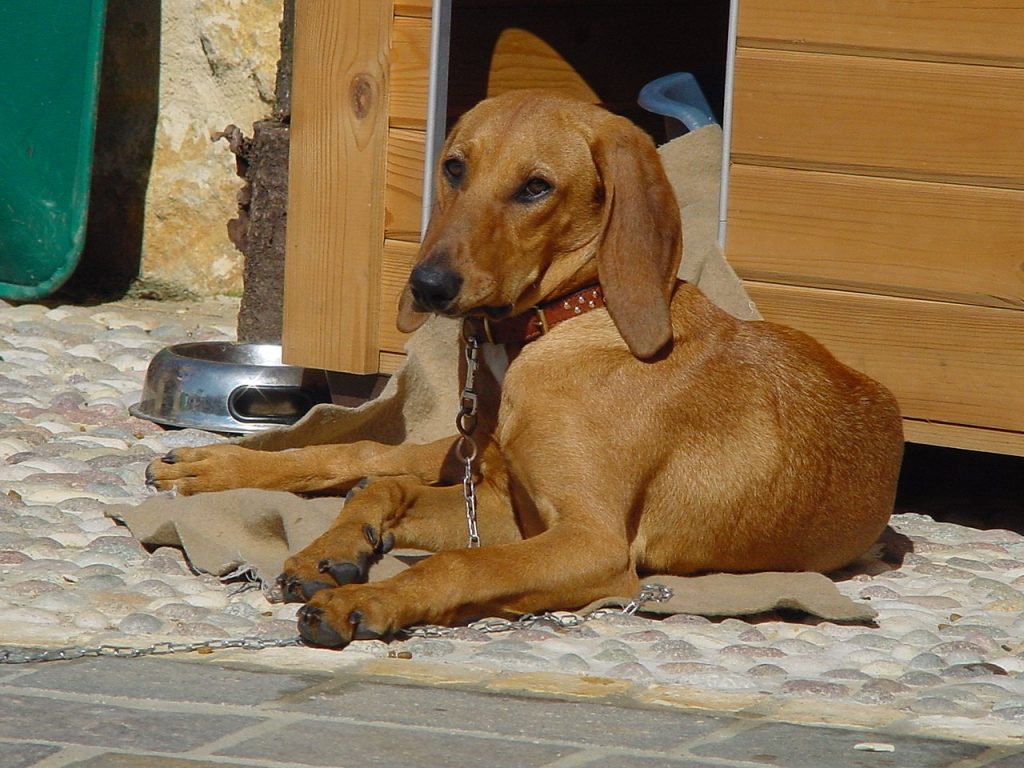
The Italian Hound(Segugio Italiano) is the hunting dog par excellence of Italy: A born tracker, tireless, with a prodigious sense of smell and a voice that echoes across the mountain when he follows a trail. With an almost square and elegant silhouette, it combines the nose of a greyhound with the lightness and physical background of a greyhound. Outside the field he is a noble and affectionate companion, but it is advisable to know him well before falling in love with his sweet look: He’s still, first and foremost, a race hunter.
Is that the Italian Hound for you?

The Italian Hound is a magnificent breed, but very specific. It shines with an active family that goes out into the countryside, that understands its tracking instinct and that doesn’t expect immediate obedience from it like a sheepdog. If you’re looking for a quiet couch dog or a beginner easy to handle in the city, this probably isn’t your breed.
In favour .
- Exceptional sense of smell and endurance – a tireless tracker.
- Noble, sweet and balanced with his family.
- Rustic, healthy and easy to maintain.
- Medium size and manageable, not a heavy dog.
- Little barking at home (though very vocal on the trail).
- He’s good with other dogs, used to the pack.
To be taken into account
- Very strong hunting instinct: he jumps for any trail.
- Stubborn and independent; obedience is difficult for him.
- He needs a lot of exercise and mental stimulation every day.
- Uncontrolled release can result in fugitives chasing prey.
- It’s not ideal for small apartments or sedentary living.
- He can howl and “sing” following his canine nature.
Character and temperament
The character of the Italian Hound is that of a tenacious hunter wrapped in a sweet wrapper. With its people it is affectionate, calm, and balanced; it rarely shows aggression and usually gets along well with strangers. But beneath that nobility lives a fighter engine that never shuts down completely. As soon as he catches an interesting smell, his brain switches channels: He lowers his nose, concentrates, and follows the trail with a single-minded dedication, much like the Bloodhound. The difference is that the Hound doesn’t just follow the trail: It also chases, captures and hunts prey.
That mixture of hound smell and greyhound physique defines his personality. It’s independent and stubborn, a dog that was bred for centuries to work on its own away from the hunter, making decisions without waiting for orders. That ‘s why I don ‘t try to please in a servile way like a Golden or a Border Collie: He loves you, but he decides for himself. With patience and respect, you gain their cooperation; with impositions or harshness, you close in on them. It’s sensitive, and it responds much better to positive reinforcement than to excessive firmness.
Coexistence: children, other pets, flat and loneliness
With children: The Italian Hound is patient and of good breed, a good family dog that tolerates well the treatment of the youngest as long as their rest times are respected.
With other dogs: is one of its great virtues, being used to hunting in packs, it is usually very sociable and tolerant of its congeners.
With cats and small pets: here you have to be realistic. Its powerful hunting instinct makes it unreliable with rabbits, rodents, birds and even cats you don’t know. If you live with a cat from a puppy you can learn to respect it inside the house, but outside any small animal that runs will awaken its chase impulse.
On the floor and in solitude: is not a small apartment dog. It can live on the floor if it is guaranteed plenty of daily exercise, but it greatly enjoys a fenced garden (well fenced: it is an escapist when it smells something). It tolerates loneliness reasonably well if it is well exercised, although a bored and energy-free hound can become vocal and seek entertainment on its own.
Education and training

Training an Italian Hound is an exercise in humility and patience. It is intelligent, but its intelligence is oriented to solving hunting problems, not to repeating obediences. The Italian dog tradition already warns: of stubborn and stubborn character, it must be educated from a very young age to correct its bad habits, and as it is very independent, its education must be constant.
Some keys that work with this breed:
- It starts soon. Socialization and basic norms are settled much better as a puppy, before the hunting instinct takes over.
- Positive reinforcement and food. is delicious and sensitive; reward, not punish.
- Short and varied sessions. Bored with repetition; keep training short, fun and highly motivated.
- The call, your big challenge. when it follows a trail, it stops hearing you, it works the call from a puppy, in controlled environments, and it assumes that total release will only be safe in enclosed areas.
- It channels the smell. Tracking and search games are pure gold: they give you the mental work your head asks for.
Exercise and activity
If there is one point that does not support negotiation, it is this. The Italian Hound is a distance runner bred to spend up to twelve hours in the field without rest. A short walk around the block does him no good. He needs abundant and daily exercise: long walks, running, hiking, exploring wide terrain where he can use his nose.
Just as important as exercise is the mental stimulation. A hound that runs alone keeps its head restless; the sniffing games, tracking clues, and hunting simulations really tire and satisfy it. Sports like mantrailing or sports tracking fit like a glove. A well-exercised hound, physically and mentally, is a calm and charming dog at home; a bored one is an inexhaustible source of trouble.
Care: fur and hygiene

In terms of care, the Italian Hound is most grateful.
- Of a width not exceeding 30 cm straight and short hair all over the body, minimal maintenance, a weekly brushing is all it takes to remove dead hair.
- Of a thickness not exceeding 1 mm rough and hard hair, no more than 5 cm, more suitable for hunting in cold and mountain areas.
Beyond brushing, hygiene follows the routine of any working dog. Pay special attention to the ears: They are long, sloping, and low-inserted, so they retain moisture and dirt; check and clean them regularly to prevent otitis, especially if you go outdoors. Baths only when necessary, and don’t forget your nails, teeth and a skin check after days in the mountains to rule out ticks or wounds.
Foodstuffs
As a good working dog, the Italian Hound is not particularly sensitive to food, but its high energy expenditure commands. An active or hunting dog needs high-quality food, with a good supply of protein and fat, adjusted to its actual activity level: it does not eat the same in the middle of the hunting season as in a quiet month.
Practical suggestions:
- Share the rations in two daily doses in the adult for a more stable energy supply.
- Watch the weight. is tasty; between that and his constant use of rewards in training, it’s easy to pass up.
- Avoid strenuous exercise just before or after eating, a sensible precaution in deep-chested dogs.
- Water always available, especially after long days in the field.
Health and life expectancy
The Italian Hound is a rustic and healthy breed, forged by centuries of actual work in the field rather than by competition fashion.
Nevertheless, it is good to have on the radar the typical points of a sport hound:
- Orejas: due to its sloping shape and low insertion, is prone to otitis if not checked frequently.
- Articulaciones: As in any athletic race, maintaining a proper weight protects hips and elbows in the long run.
- Field injuries: cuts, spikes, ticks, and blows are the hallmarks of a working dog’s trade; checking after each outing is key.
With regular veterinary checkups, daily deworming, vaccinations, and good exercise and weight management, the Italian Hound usually enjoys a long, active life.
Physical appearance
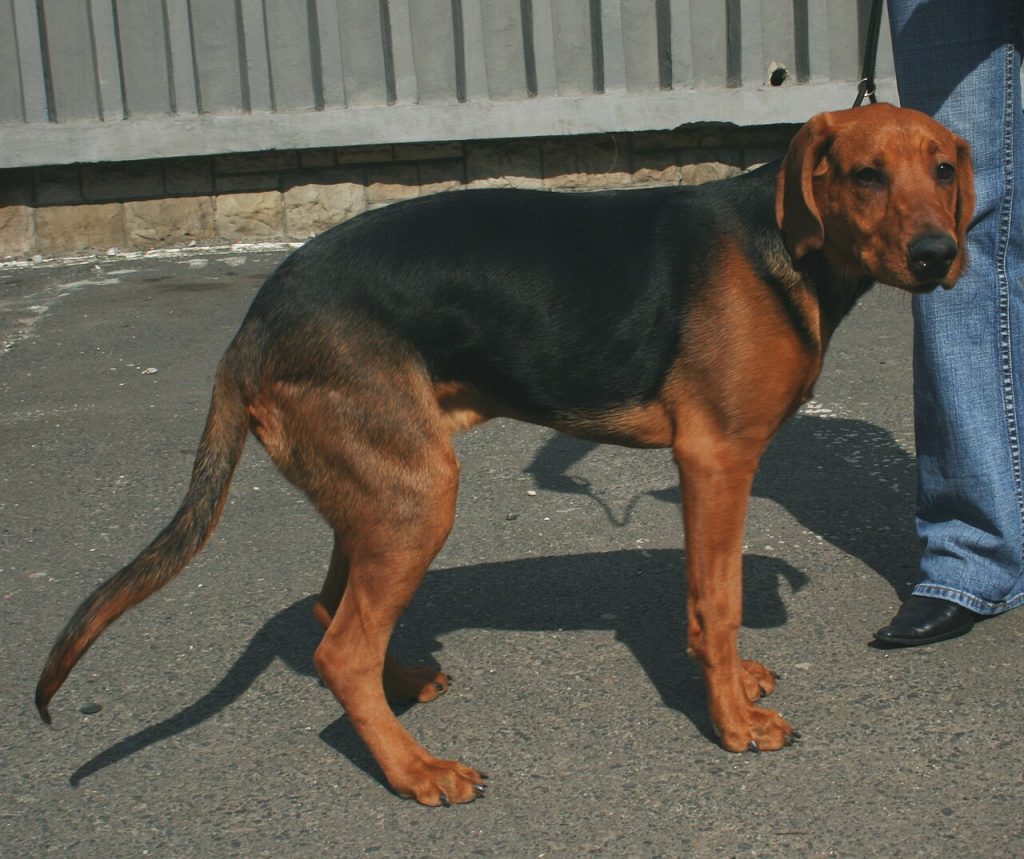
The Italian Hound is a medium-sized dog with a almost square silhouette: the body length is approximately equal to its height at the cross, so that when viewed from a profile it appears to be inscribed in a square.
Tamaño. In the shallow-haired variety the males measure about 50-58 cm at the cross and the females about 2 cm less; in the hard-haired the males reach 52-60 cm. The weight is around 20-28 kg in both varieties and sexes. (Old standards cited slightly smaller sizes, around 45-52 cm.)
Head and expression. shows clear hound traits: narrow and elongated skull, long, sharp snout with fine lips that do not hang, and the characteristics of long, sloping and low-inserted ears.
The body of a greyhound. The tail is long, thin and sharp, and it is usually carried high when hunting, which helps to locate it among the vegetation.
Two colors are supported: the lemonade(purple) in all its shades, from intense fox red to a very pale hue, and the black and fire.
Origin and history
The Italian Hound is one of the oldest breeds in Italy, although its exact origins are lost in time. He’s considered a very remote bloodline: Some sources trace it back to ancestral hounds from pre-Roman Egypt. Dogs of a very similar type already appear in the statuary of Ancient Rome, where Diana the huntress is depicted accompanied by a hunting dog reminiscent of the modern Segugio; there are examples in the Vatican Museums in Rome and the National Archaeological Museum in Naples. In Povegliano (province of Verona) were also described two skeletons of dogs type hound or hare from a Lombard necropolis of the VII century, morphologically similar to the current Segugio, although taller.
During the Italian Renaissance, dogs of this type starred in large hunts with numerous horse-mounted escorts. In 1886 smooth-haired and hard-haired specimens were exhibited in Milan, still without a clear breed distinction. The organization arrived in the 20th century: In 1920 the Società Italiana Amatori of the Segugio and of the Cane da Tana was founded in Lodi and a first standard was drafted, but the society was dissolved in 1939 and, after World War II, the race was on the brink of extinction.
In 1947 the Società Italiana Pro Segugio was born with just 69 registered specimens; the Giuseppe Solaro canineologist revised the standard and the breed began to recover. The International Cinological Federation (FCI) fully recognized the hard-haired variety in 1956 and the plain-haired variety in 1993. Today the Italian Hound, framed in the Group 6 of the FCI(hound type dogs), is one of the most numerous breeds in Italy thanks to its performance in hunting.
Curiosities
- Two dogs in one. combines the smell of a greyhound and the athletic body of a greyhound, an unusual combination.
- Unlike the Bloodhound, the A hound that does hunt. is not limited to tracking: it chases, captures and hunts prey.
- Diana had him by her side. The Roman goddess of the hunt appears in ancient sculptures with a dog reminiscent of this breed.
- He almost disappeared. After World War II there were very few registered examples left; a handful of amateurs saved it.
- Cola-antena. When hunting it raises its tail high enough for the hunter to locate it in the brush.
- Genetically almost twins. Flat-haired and hard-haired varieties are virtually indistinguishable at the genetic level.
If you are attracted to the Italian Hound for its portentous nose and noble temperament, you may be interested in other hound breeds and hunting dogs with which it shares virtues. Bloodhound Beagle Basset Hound Vizsla
Frequently Asked Questions About the Italian Hound
Is the Italian Hound a good family dog?
Yes, with the right family. It is noble, sweet, balanced and patient with children, and very sociable with other dogs. The condition is that it is given plenty of exercise and mental stimulation: it is not a sedentary dog or a small floor.
Can you have an Italian Hound on a floor?
It can live on the floor if it is guaranteed long outings and intense daily activity, but it is not ideal. It enjoys much more with access to a well-fenced garden and space to move around.
Is it hard to train the Italian Hound?
He’s intelligent but stubborn and independent, raised to work on his own, so obedience is hard for him. He responds well to positive reinforcement, to short sessions and to starting early. The call is his weak point: when he follows a trail, he stops listening.
How much exercise do you need?
He is a long-distance runner who can work up to twelve hours in the field. He needs plenty of daily exercise (long walks, running, hiking) plus mental stimulation with olfactory and tracking games. A short walk is not enough.
Do you get along with cats and other small animals?
With other dogs, it’s fine: it’s built for the pack. With cats and small pets, beware: its strong hunting instinct makes it unreliable. Living with a cat since puppyhood helps, but any animal that runs outside will awaken its chase impulse.
How long does an Italian Hound live?
It is a rustic and healthy breed, with few serious hereditary diseases, although it is advisable to monitor the ears (prone to otitis) and maintain an adequate weight.
What’s the difference between straight hair and hard hair?
Basically the mantle. The plain hair has short and smooth hair; the hard hair (pelo forte) has rough and hard, up to 5 cm, more suitable for the mountain and the cold. The hard hair variety is slightly larger. Genetically they are almost identical.
Does the Italian Hound bark or howl a lot?
At home, it is usually quiet and not very barking, but it is a hound, and when it follows a trail, it “sings”: it barks and howls loudly in pursuit of prey.