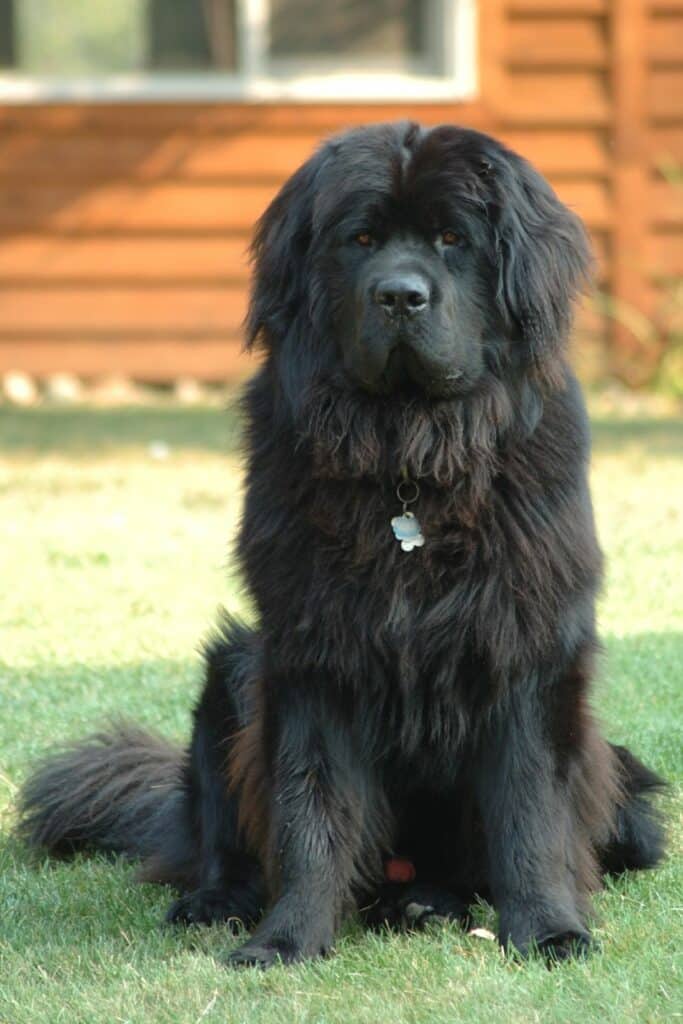
The Newfoundland is a giant dog, with a dense coat and a sweet character, originally bred by fishermen from the Canadian island that gives it its name. Famous for his instinct for water rescue and his legendary patience with children, he has earned the nickname “gentle giant”. If you’re looking for a quiet, loyal, oversized companion, here’s everything you need to know before you share your life with a Newfoundland.
Is Newfoundland for you?

The Newfoundland is not a dog for any household. Its enormous size, its fondness for water and mud, and the amount of hair and slime it spreads around the house make it a demanding choice. Instead, it offers one of the most balanced and affectionate temperaments among giant dogs. Before deciding, weigh honestly what it gives and what it asks.
In favour .
- She’s sweet, calm and very patient with children.
- Huge loyalty and a strong bond with his family.
- Sociable with people and usually other animals.
- Intelligent and cooperative; easy to educate with good treatment.
- An exceptional swimmer with a natural rescue instinct.
- He’s usually a little barking and not nervous around the house.
To be taken into account
- Giant size: it needs space and everything costs twice as much (food, car, vet).
- She sheds a lot of hair and drools remarkably.
- It barely tolerates heat because of its dense double coat.
- Short life expectancy, around 9-11 years.
- Predisposition to joint, heart and gastric torsion problems.
- He loves water and mud. Get ready to clean.
Character and temperament
If there is one word that defines the Newfoundland, it is serenity. It is known worldwide as the “gentle giant”, and the nickname is well deserved: it is a docile, balanced and uncommonly noble dog.
That sweetness doesn’t make me an apathetic dog. The Newfoundland is loyal to the core and deeply connected to its people; it enjoys being close to its own and participating in family life. His famous role as the “dog sitter” isn’t just literature: It has a mild protective instinct, without the harshness of a guard dog, and a remarkable tolerance for children’s movements. Still, it is good to remember that behind this angelic character is a 60- or 70-kilogram animal that is not always aware of its own strength.
It is a sensitive dog that responds much better to affection and consistency than to a harsh hand. Abrupt treatment turns it off; positive reinforcement brings out the best in it. It barks little and, when it does, its low voice imposes, which makes it a deterrent more by presence than by character.
Coexistence: children, other pets, flat and loneliness
- With children: is one of the most recommended breeds. Patient, tolerant and protective, fits very well in families with small children. The only precaution is its size: an already huge puppy can throw a small child to the ground unintentionally, so it is advisable to supervise the games.
- With other pets: generally gets along well with other dogs and animals, especially if socialized as a puppy.
- On the floor: is not his ideal environment. Because of his volume, his hair and his taste for water, he is much better in a house with a garden or land. He can live on the floor if he gets enough walks and exercise, but you have to be realistic with space.
- In the face of loneliness: is a family dog that needs company. It does not like to spend long hours alone; if it is bored or feels isolated, it may become apathetic or develop undesirable behaviors.
- With the heat:‘s coat designed for icy waters makes it very sensitive to high temperatures. In summer it needs shade, fresh water and avoid exercise in the hottest hours.
Education and training
The Newfoundland is intelligent and, above all, eager to please, a combination that makes training much easier. It quickly learns basic routines and enjoys having “jobs” to do, a legacy of its origins as a working dog.
The early socialization is fundamental in any giant breed: a dog this large has to learn from puppyhood to move with courtesy, not to jump over people and to relate to other dogs, noises and situations.
It works with positive reinforcement, patience and perseverance. It is a sensitive dog, so coercive methods are counterproductive. Teaching it from a young age to walk correctly on a leash is especially important: when it reaches its adult weight, controlling it by force will be impossible, and education is the only thing that guarantees comfortable walks.
Exercise and activity

Despite its calm indoors, the Newfoundland needs daily activity to stay healthy and at its weight. It is not a hyperactive dog and does not ask for strenuous runs, but regular walks and the opportunity to move that huge body. A couple of daily outings at a good pace, plus some playing time, are usually enough.
Its star activity is undoubtedly the swimming. With its padded legs, waterproof fur, and enormous lung capacity, the Newfoundland is made for the water. Swimming is the perfect exercise for him: It burns energy, strengthens your muscles and protects your joints, which is very valuable in a race prone to hip problems. If you have access to a quiet lake, river or beach, you’ll enjoy it just fine.
Important: during the growth stage it is advisable to moderate impact exercise. Puppies of giant breeds have joints still in formation, and jumping or excessive running can damage them.
Care: fur and hygiene
Keeping the coat is one of the great commitments of this breed. The Newfoundlander wears a double coat: a soft, dense undercoat that insulates it from the cold and a longer, thicker, water-resistant outer coat.
During seasonal mowing the brushing becomes almost daily, because it releases a remarkable amount of hair. Whoever has a Newfoundland should assume that there will be hair throughout the house and that the toilet is part of the routine. The bath should not be excessive so as not to spoil the natural protection of the mantle.
Another detail of the breed: babies. Not at the level of some moldy extremes, but enough to leave marks. In addition, due to its taste for water and mud, it will come wet and dirty more than once. It is advisable to check and dry well the folds, ears and legs. As in all dogs, complete hygiene with care of nails, teeth and ears.
Foodstuffs
Feeding a giant dog has its own science. The Newfoundland needs a quality diet, balanced and adapted to its size and stage of life. In the puppy phase it is key to use a feed formulated for large or giant breeds: too fast growth, favored by an excess of calories or a poor calcium balance, increases the risk of joint problems in the future.
In the adult, the important thing is to adjust the rations to maintain a healthy weight and not to overload joints that already bear a lot. Obesity is one of this race’s worst enemies. Splitting food into two daily servings, rather than one very large one, is a sensible measure to reduce the risk of gastric torsion, a serious emergency to which deep-breasted dogs like the Newfoundland are especially prone. Avoiding strenuous exercise right after eating helps in the same way. Always consult your veterinarian about the most appropriate amounts and types of feed.
Health and life expectancy
Like many giant breeds, the Newfoundland has a relatively short life expectancy, around 9-11 years old.
The most relevant problems are:
- Hip and elbow dysplasia: the Newfoundland is among the breeds most prone to hip dysplasia. Choosing puppies from parents with evaluated joints reduces the risk.
- Subaortic stenosis: a common heart defect in the breed that can cause sudden death in young dogs, which is why cardiac screening in the breed is recommended.
- Dilated cardiomyopathy: another heart condition to which this breed shows a certain tendency.
- Cistinuria: a hereditary defect that favors the formation of stones in the bladder.
- Gastric torsion (dilatation-volvulus) is defined as: vital urgency inherent in large, deep-chested dogs; knowing its signs can save the animal’s life.
- Cross-ligament rupture and skin problems: also appear more frequently than average, along with conditions such as hypothyroidism.
The best prevention is a combination of a responsible breeder testing the health of the breeders, a balanced weight, adequate exercise and regular checkups, and extreme caution with heat, its great weakness.
Physical appearance

Newfoundland is, first and foremost, large and imposing. It fits right in the category of a giant dog: males normally weigh between 65 and 80 kg, and females between 50 and 65 kg, with specimens far exceeding these figures. At cross height, males average around 71 cm (and can approach 80), while females stay slightly below, around 66 cm. Its plump coat makes it appear even bulkier than it already is.
It shares many traits with moles and mountain dogs: very strong bones, large head with a wide snout, robust neck and a powerful musculature, designed to withstand waves and cold currents.
In terms of colors, the most typical is the black, but there are also brown, gray specimens and the black and white variant known as “Landseer”, in honor of the painter Edwin Landseer who immortalized it.
Origin and history
The Newfoundland was born on the island of Newfoundland, now part of Canada, as fisherman’s working dog. Its mission was to help in the hard tasks of the sea and the coast: towing nets from the water, pulling carts with the equipment and, above all, saving those who fell into the icy waters of the North Atlantic.
The breed descends from indigenous dogs of the island, which are believed to have been influenced by the mastiffs brought by European fishermen, which explains their moluscous build. In the 19th century, two types of working dogs were described in the Great Banks: the large, long-haired Newfoundlander – the direct ancestor of today’s breed – and the smaller Newfoundlander, or St. John’s water dog, who would become the founder of modern collection dogs such as the Labrador.
Newfoundland’s footprint on other races is enormous. It was introduced into St. Bernard breeding in the 18th century, when a distemper epidemic threatened that population, and was part of the foundation of the Leonberger, another large water rescue dog. After almost disappearing in the UK during the two world wars, the breed recovered strongly from the 1950s onwards to establish itself as the beloved companion we know today.
Curiosities
- Literary star: the character of “Nana”, the babysitter dog of the Darling brothers in Peter Pan, is inspired by author J. M. Barrie’s Newfoundland.
- Four-legged scout: a Newfoundland named Seaman accompanied the explorers Lewis and Clark on their three-year expedition across North America, to the Pacific and back.
- War hero:“Sergeant Gander”, the mascot of a Canadian regiment in World War II, was posthumously awarded the Dickin Medal – the animal equivalent of a military decoration – for removing a grenade from wounded soldiers.
- Artist dog: in the 19th century, a Newfoundland named Napoleon was the great attraction of a circus in England, able to “spell” words with letters and jump obstacles to the beat of music.
- Muse of painters: for two centuries the Newfoundland has inspired numerous artists, who have portrayed it in paint, bronze and porcelain as a symbol of fidelity and courage.
If you are attracted to the Newfoundland’s noble character and large size, you may be interested in other races from its molluscan and mountain world, or its aquatic relatives. Take a look at San Bernardo, another gentle rescue giant; Leonberger, who shares blood and swimming vocation; Gran Pirineo, white mountain giant; and Labrador Retriever, a direct descendant of the St. John’s water dog who shares home island with Newfoundland.
Frequently asked questions about Newfoundland
Is the Newfoundland a good dog for families with children?
Yes, it is one of the most recommended breeds for families. Its gentle, patient and protective nature has earned it the nickname “nanny dog”. The only precaution is its enormous size: it is advisable to supervise games so that it does not accidentally knock down the smaller ones.
How much does an adult Newfoundlander weigh and measure?
Males typically weigh between 65 and 80 kg and measure around 71 cm at the withers, while females weigh between 50 and 65 kg and measure around 66 cm. It is undoubtedly a giant category breed.
Does Newfoundland drool and shed a lot of hair?
Yes to both. It drools appreciably and sheds a lot of hair, especially in the seasonal shoots. It needs frequent brushing and you have to assume that there will be hair and drool as part of the coexistence.
How much exercise do you need?
It needs moderate daily activity: regular walks and some play. It is not hyperactive, but it does benefit from exercise to maintain its weight and its joints.
Can he live in a flat?
Because of its size, hair, and taste for water and mud, it’s much better in a house with outdoor space. It can adapt to a floor if it gets enough walks, but you have to be realistic about the space it takes.
Do you really rescue people from the water?
The Newfoundland was bred precisely for water rescue and has a natural instinct for it, as well as a perfect physique: flabby legs, waterproof fur and great lung capacity.
How many years does a Newfoundland live?
Like almost all giant breeds, their life expectancy is relatively short, around 9-11 years. Good care, a fit weight, and regular veterinary checkups help to make the most of those years.
What health problems are most common in the breed?
Highlights include hip and elbow dysplasia, heart problems such as subaortic stenosis, cystinuria, gastric torsion and cruciate ligament rupture.