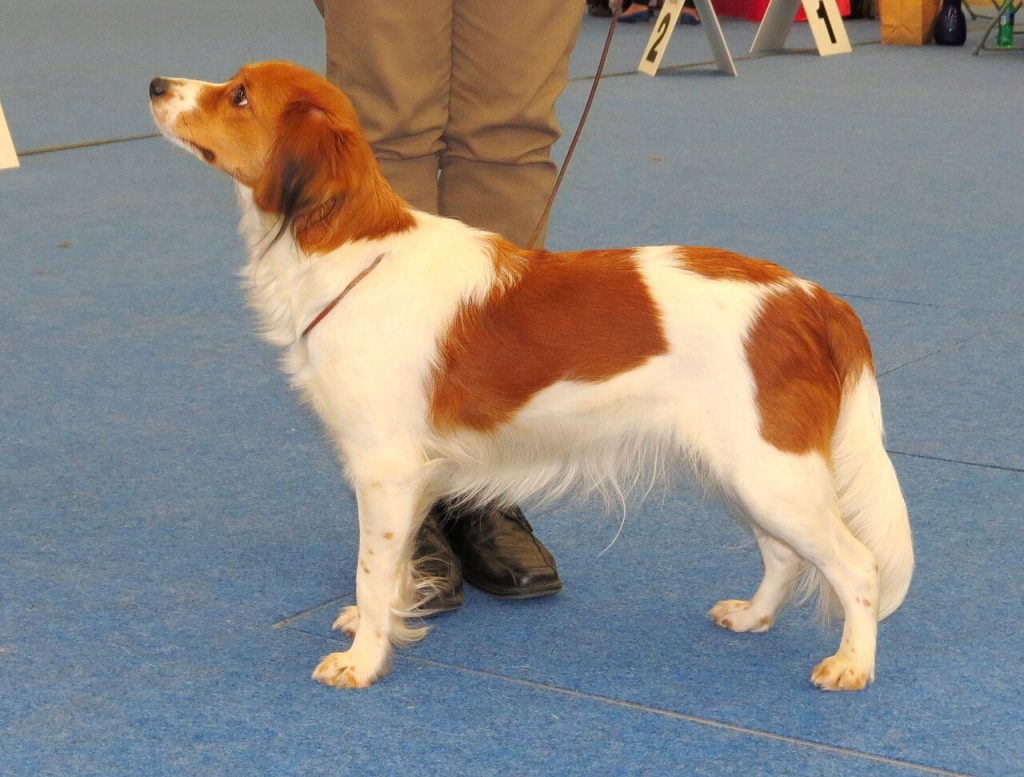
The Kooikerhondje is a small spaniel dog of Dutch origin, bred since the 16th century to attract ducks to hunting traps. Behind its sweet face and showy white and orange coat hides an intelligent, sensitive working dog deeply attached to its family. Little known outside the Netherlands, the Kooikerhondje wins over those who treat it for its cheerful character and manageable size, although it requires socialization, exercise and an owner attentive to their emotions.
Is the Kooikerhondje for you?

Before you fall in love with the photos, you should know what it means to share life with a Kooikerhondje. It is a wonderful companion dog for those who can give it presence and activity, but its sensitivity makes it unsuitable for chaotic homes or for those who spend many hours outside. These are its main pros and cons.
In favour .
- Small size and light weight, easy to handle and transport.
- Very attached and affectionate to his family; excellent companion.
- Intelligent and eager to learn, he enjoys cooperating.
- Sociable with children and other well-groomed dogs.
- Attractive coat that doesn’t require complex hairstyles.
- A good watchdog who warns of new developments.
Against
- Sensitive: suffers from screaming, haste and tense environments.
- Reserved with strangers; needs constant early socialization.
- It tends to bark as a warning, something to value on floors.
- Hereditary diseases that force good breeder selection.
- Rare breed: waiting list, high price and few breeders.
- He doesn’t like prolonged loneliness.
Character and temperament
The Kooikerhondje combines the temper of a working dog with the tenderness of a companion dog. It’s cheerful, attentive and remarkably intelligent, a trait that’s been with it for centuries helping the hunter attract ducks: This job required an alert dog, able to work quietly and respond to subtle cues. That’s why today it’s a very connected companion to its owner, aware of what’s going on around it and quick to read the atmosphere of the house.
Their most defining trait is sensitivity. The Kooikerhondje easily perceives people’s moods and responds much better to friendly treatment than to abrupt firmness. An elevated tone or a harsh training method can make them shut down or become fearful. With affection and consistency, however, they bring out the best in themselves: they are confident, playful and devoted.
With strangers it is usually somewhat reserved, without reaching aggressiveness. It is not a dog that rushes to greet anyone, but observes and takes its time. This prudence, combined with its instinct of alertness, makes it a good warner who barks at the unusual, although not a true guardian by its size and its friendly nature of background.
Coexistence: children, other pets, flat and loneliness

With children. The Kooikerhondje is patient and affable, and usually enjoys the company of children as long as they learn to respect their rest times. Because of its sensitive nature, it fits better with minors who already know how to treat a dog calmly than with babies or very moved children who scare it.
With other pets. As it proceeds from work in farms and packs, it tends to get along well with other dogs. Coexistence with cats is possible if they grow together or are made gradual introductions, although it is worth remembering their hunting instinct towards birds and small animals, which can be awakened by domestic birds or rodents.
On the floor. Its small size makes it suitable for living in an apartment, as long as its needs for exercise and stimulation are met.
In the face of solitude. is a companionable dog that can have a hard time if left alone for too many hours. It is not the ideal breed for someone who is out all day. With progressive adaptation it tolerates reasonable absences, but prolonged solitude favors anxiety, barking and destructive behaviors.
Education and training
Training a Kooikerhondje is usually rewarding. It is smart, eager to please and learns quickly when the method is based on positive reinforcement. Rewards, play and praise work much better than any harsh correction, which in this sensitive breed is counterproductive and can undermine their confidence.
Early socialization is key. Because of its natural tendency to reserve, it is advisable to expose it from puppyhood and in a positive way to different people, other dogs, noises, surfaces and varied environments. A well socialized Kooikerhondje is safe and balanced; one who is not can become shy or overly barking in the face of the unknown.
As a good working dog, it appreciates that education has a mental component. Short, varied and fun sessions, scent games, and activities that give it purpose keep it motivated. Disciplines such as agility, tracking, or obedience fit well with its cooperative character and help channel its energy and intelligence.
Exercise and activity
The Kooikerhondje has an average energy that must be satisfied daily. It needs about an hour long of activity divided into several walks, to which it is convenient to add moments of play and mental stimulation.
Their origin from water hunting gives them a taste for water, tracking and collecting. Taking advantage of these instincts with search games, throwing and field trips makes them especially happy and strengthens the bond with their owner. A physically and mentally satisfied Kooikerhondje is calm and balanced; a bored one tends to bark and look for trouble.
Care: fur and hygiene
The coat of the Kooikerhondje is double, of medium length and slightly wavy, with characteristic fringes on the ears, legs and tail. Despite its showy appearance, its maintenance is simple: a weekly brushing is enough to remove the dead hair and avoid tangles, which should be intensified during the two annual moults, when hair loss increases significantly.
She does not need a haircut or specialised hairdressing; her hair is kept in good condition naturally. It is advisable to check and clean the ears regularly, as their fallen shape favors moisture, and pay attention to the fringes of the limbs after field trips. Baths only when really needed, nails daily and good dental hygiene complete the care routine.
Foodstuffs
As a small and active dog, the Kooikerhondje benefits from a quality diet tailored to its size, age and activity level. A good complete feed or a balanced diet supervised by the veterinarian covers its needs without complications.
Weight control is essential. Overweight overloads the joints and aggravates problems such as knee dislocation, common in the breed. It is advisable to weigh the ration, moderate the rewards and adjust the food according to the actual exercise of the dog. Water always fresh and available, especially in a dog who likes activity.
Health and life expectancy
The life expectancy of the Kooikerhondje is around 12 or 13 years. It is, as a whole, a robust dog, but its history affects its health: the breed was about to disappear after the Second World War and was rebuilt from very few specimens, which reduced its genetic variability and fixed several hereditary diseases that today it is convenient to know.
Among the conditions documented are dislocation of the kneecap, very common (a Dutch study on 842 specimens found it in 24% of the dogs examined, although its prevalence has been decreasing with selection), type III von Willebrand disease is also known as:, a serious bleeding disorder, inflammatory myopathy, necrotizing myelopathy, renal dysplasia and atrophy. The best prevention is to go to breeders who subject their breeders to genetic and orthopedic testing, and maintain regular veterinary checkups throughout the dog’s life.
Physical appearance
The Kooikerhondje is a small and well-proportioned dog, of elegant and harmonious appearance. The height preferred to cross is about 40 cm in males and 38 cm in females, with a margin that the FCI standard places between 38 and 41 cm in males and between 36 and 39 cm in females.
Its hallmark is the cloak: white with well-defined orange-red spots, double-headed, medium-length and slightly wavy, attached to the body. The ears, sloping and fringed, often have highly prized black tips that enthusiasts call “hangers”. The tail, horizontal and adorned with a showy white plumage, was once used to attract the ducks’ attention. The head is of sweet and attentive expression, and the ensemble conveys balance between strength and finesse.
Origin and history

The Kooikerhondje was developed in the Netherlands around the 16th century with a very specific mission: to attract ducks to the andendenkooi, hunting traps made up of channels and nets. The technique was inspired by the behavior of foxes: The hunters noticed that the ducks were curiously approaching a fox playing by the water, as long as the fox wasn’t looking straight at them. The dog, with its waving white tail, imitated that cry and led the birds into the trap. Hence its name, which in Dutch roughly means “duck hunter’s dog”.
The breed enjoyed its heyday in the 17th and 18th centuries, when it often appeared in the paintings of the great Dutch masters; it can be seen in works by Jan Steen, Rembrandt and Johannes Vermeer, testimony to its popularity in homes of the time. With the decline of duck traps, the dog gradually lost its function and came close to extinction during World War II.
Their salvation is due to Baroness van Hardenbroek van Ammerstol, who in the forties searched for the few remaining specimens and undertook their recovery. The Dutch Kennel Club did not officially recognize the breed until 1971. Since then it has been exported to other countries: The British Kennel Club reclassified it from hunting dogs to utility dogs in 2014, and the American Kennel Club recognized it in 2018. It is also considered one of the ancestors of the Nova Scotia Duck Tolling Retriever, with which it shares the technique of claiming.
Curiosities
- Its Dutch name, Kooikerhondje, directly alludes to the “kooiker”, the man who handled the duck traps, and the dog that helped him.
- The hunting technique was inspired by foxes: Ducks, interestingly, approach a playing predator if the latter does not look at them.
- It appears in paintings by Rembrandt and Vermeer, making it one of the races with the most presence in Dutch Golden Age painting.
- The highly prized black tips of their ears are affectionately called “hangers”.
- The white feathered tail is not only aesthetic: it was the working tool with which it attracted the ducks.
- He gained recent fame in the United States thanks to “Decoy”, the Kooikerhondje of baseball player Shohei Ohtani.
If you are attracted to the Kooikerhondje because of its cheerful nature and its origin as a collection dog, you may be interested in other related breeds. The Golden Retriever and Labrador Retriever share a passion for water and bird hunting, while the Cocker Spaniel is another hunting spaniel of restrained size and loving temperament. And if you’re seduced by their intelligence and willingness to work, the Border Collie will give you plenty of game in training and dog sports.
Frequently asked questions about the Kooikerhondje
Is the Kooikerhondje a good dog for beginners?
It can be if the owner is willing to spend time with you. It is a docile dog, very attached to its family and of manageable size, which facilitates daily handling. However, their sensitivity and tendency to be reserved toward strangers demand careful early socialization and calm treatment. He’s not a tough, stubborn breed, but neither is a dog that’s content to spend the day alone: Whoever is looking for a present and collaborative companion will have it easier than whoever wants an independent dog.
How much exercise does a Kooikerhondje need a day?
It is a hunting dog that enjoys tracking, collecting and working its nose, so it appreciates field trips and search games. It is not hyperactive indoors if it has spent energy, but a bored and under-exercised Kooikerhondje can become barking and restless.
Does the Kooikerhondje bark a lot?
It tends to warn. It is an alert dog that barks at noises, visitors or new situations, a trait inherited from its role as a farm dog and claim. With socialization and working the calm from puppy is well controlled, but it is worth knowing that it is not a particularly quiet breed, something to take into account if you live in an apartment with close neighbors.
Do you get along with children and other dogs?
Yes, in general it is an affable and patient breed that lives well with children, especially if they respect their time and rest. With other dogs it is usually sociable, and its origin in cage work helps. As always, presentations should be done calmly and coexistence with small children supervised, more to protect the sensitive dog than to risk aggression.
How long does a Kooikerhondje live?
With good nutrition, adequate exercise, weight control, and veterinary monitoring for hereditary diseases, many dogs survive well beyond that age.
What health problems does the breed have?
Since a small number of specimens were collected after World War II, it carries several hereditary diseases: If you have any further questions on this medicine, please contact your doctor or pharmacist. Buying from breeders who perform genetic and orthopedic testing on breeders is the best way to reduce risk.
Does the Kooikerhondje shed a lot of hair?
It lays moderately, with more intense moults twice a year. Its double and wavy hair is kept in good condition with a weekly brushing, which in moult season should be increased. It does not require cutting or complex hairstyle, but attention to the ears and to the fringes of legs and tail to avoid entanglements.
Is a Kooikerhondje easy to find and expensive?
It is still a rare breed outside the Netherlands and some northern European countries, although it has gained popularity in recent years.In Spain there are few breeders, so there is usually a waiting list and high prices.It is worth prioritizing the health and seriousness of the breeder over speed or price.