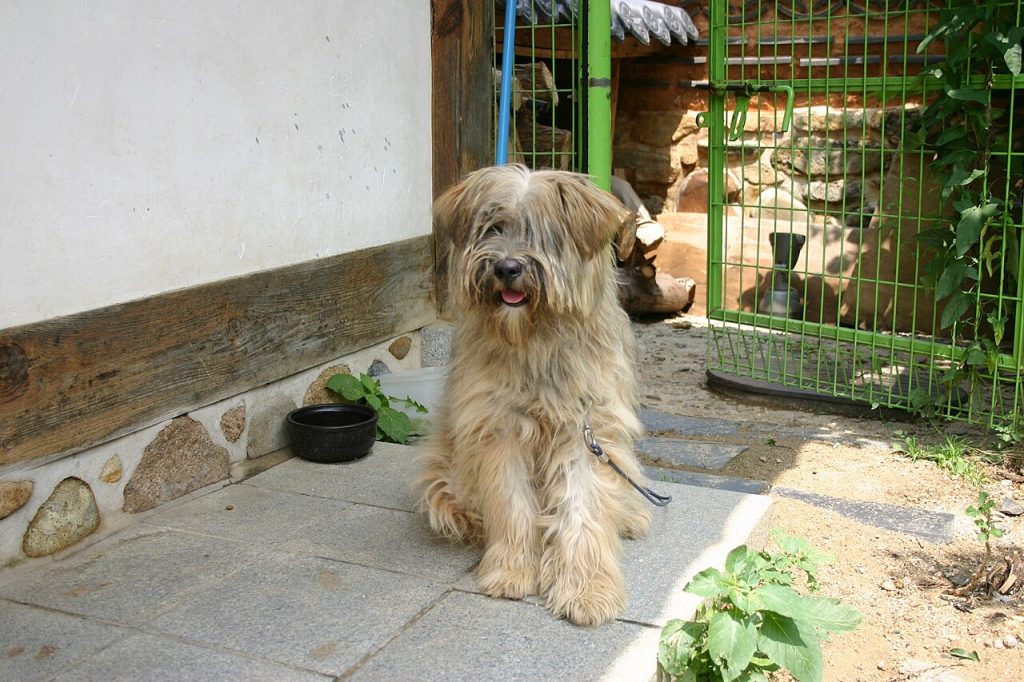
The Sapsali is a long-haired, tangled, stocky Korean dog with a gaze hidden behind a thick bang, which for centuries has been credited with the power to ward off evil spirits and bad luck. Beyond legend, the Sapsali is a loyal companion, quiet and deeply attached to his family, so valuable to South Korea that in 1992 it was declared a Natural Monument of the country. If you’re looking for a dog with a noble character, an imposing appearance, and a history that defies myth, this furry giant deserves to be thoroughly explored.
Is Sapsali for you?

The Sapsali is a medium-sized dog with a calm but brave temperament, very attached to its people and with a dense coat that demands commitment to the brush. It fits well with quiet families that can give it presence, daily walks and good maintenance of the coat. It is not the ideal dog for those who spend the day outside the house or for those who hate to find hair and mud in the living room.
In favour .
- Loyal and protective, very close to his family.
- Balanced and tolerant character, good therapy dog.
- He looks spectacular, like a lion dog.
- Rustic and cold-resistant thanks to its fur.
- Quiet in the house if you do your exercise.
To be taken into account
- The long coat requires frequent brushing to avoid knots.
- He can be reserved and a little stubborn with strangers.
- Rare breed outside Korea: hard to find and with little internationally regulated breeding.
- He needs company; prolonged solitude is not good for him.
- His size and his hair don’t fit in any apartment.
Character and temperament
The word that best defines the Sapsali is the balance. It is a bold and courageous dog when the situation calls for it, but in day-to-day life it is calm, patient and remarkably affectionate with its own. Korean tradition describes it as “bold and loyal to its owner”, and that loyalty is the trait that stands out most to anyone who lives with it: The Sapsali chooses his family and gives himself to it seamlessly.
Beneath that bang that covers his eyes is an attentive, observant dog. He is not particularly barking or nervous; rather, he processes what is happening around him before reacting. With strangers he can be reserved and cautious, making him a good natural warning without being an aggressive dog. Because of its gentle temperament and friendly nature, it is now often used as a therapy and companion dog in South Korea.
It is important to understand that the Sapsali is not a “turn on and off” dog. Its strength lies in the bond: the more you integrate it into your life, the better it behaves. A Sapsali ignored or relegated to the yard loses much of that nobility that makes it special and can become stubborn or apathetic.
Coexistence: children, other pets, flat and loneliness
With children:‘s patient and protective nature makes it, in general, a good companion for families with children, always under supervision and with the basic rules of respect for the dog.
With other pets:, socialized as a puppy, lives well with other dogs. Like any robust and territorial breed, it is advisable to introduce it gradually and work on early socialization, especially with males.
On the floor: can live on the floor if it commits to daily exercise, but its size, fur and need for companionship make it more comfortable in a house with some outdoor space.
Soledad: is its weak point. The Sapsali is a close-knit dog that does not like to spend long hours alone. If your routine involves long daily absences, this is not the most suitable breed.

Education and training
The Sapsali is intelligent and wants to please his family, but he also has an independent streak inherited from centuries as a rustic dog. He responds much better to positive reinforcement – rewards, play, praise – than to harsh methods, which only get him in a band.
The keys with this breed are the consistency and the early socialization. Being a reserved dog with strangers, exposing him as a puppy to people, noises, other animals and various situations is essential for him to grow up safe and balanced.
It doesn’t need sophisticated training, but a calm, reliable guide who calmly sets clear boundaries.
Exercise and activity
It is a medium-energy dog: neither a tireless athlete nor a sedentary. With one or two good walks daily and some play or exploration covers its needs. It especially enjoys long and quiet walks and sniffing the environment, more than high-intensity sports.
Its past as a companion of aristocrats and then of the plain people made it a versatile and resistant dog, able to accompany in days outdoors.
Care: fur and hygiene
The Sapsali has a long, thick and double layered coat that protects it from the cold but that tangles easily. It needs frequent brushing – ideally several times a week, daily in moulting seasons – to avoid knots and tangling, paying special attention to friction areas such as behind the ears, armpits and legs.
The eyelashes should be checked and kept clean so that they do not disturb the eyes or accumulate dirt. Baths should be occasional, only when it is really dirty, using specific shampoo for dogs and ensuring a complete drying up to the inner layer: a dense coat poorly dried favors skin problems.
Like all dogs, it completes hygiene with ear care (watching for moisture and infections under so much hair), nail trimming and regular dental cleaning.
Foodstuffs
The Sapsali has no exotic dietary requirements: it needs a complete and balanced diet, adapted to its medium-large size, to its age and to its activity level.
As it is a relatively deep-chested and good-sized dog, it is prudent to apply the usual precautions against gastric dilation-torsion: do not let it eat with anxiety, avoid intense exercise just before and after eating and consult your veterinarian if you notice signs of abdominal discomfort.
Health and life expectancy
The Sapsali is, on the whole, a rustic and hardy dog. Their modern history, however, is marked by a dramatic genetic bottleneck: By the mid-1980s, there were only eight left. The recovery of the breed was run by geneticist Dr. Ha Ji-hong, who used DNA methods precisely to reconstruct the population, and rule out congenital problems, a rare effort that has helped clean up the lineage.
Even so, in any breed with a small base, reliance on serious breeders who work on health and genetic diversity is desirable. Preventive care is the same as usual: periodic veterinary checks, daily vaccination and deworming, weight control and special attention to skin and ears due to their abundant fur. There are no widely published official longevity figures for the breed; for its size, a life in the usual range of medium-sized dogs with good care can be expected.
Physical appearance
The Sapsali catches the eye immediately: body covered by long and plentiful hair that gives it a small lion’s look. The head is large and, along with the mane, reinforces that lionlike comparison that is so attributed to it. The ears are sloping and the snout is relatively blunt, not pointed like that of the Jindo, another Korean breed.
In terms of size, the males are around 51 cm at the withers and the females about 49 cm, with a solid constitution according to their fur. The mantle supports a wide variety of colors, solid or mixed: black, gold, orange, brown, gray, blue and white.

Origin and history
The Sapsali is an indigenous breed of South Korea with very ancient roots. Its trace goes back to the Three Kingdoms period, around 220-280 AD. During the reign of Silla it was bred mainly as a companion dog of the aristocracy, but after the fall of the Unified Silla it also passed into the hands of the plain people, becoming a popular and close dog.
His own name betrays it: Sapsalgae means something like “dog that drives away evil spirits and misfortune”. Not surprisingly, it is repeatedly featured in Korean songs, folk tales, and paintings, and is known by such nicknames as “ghost hunter”, “sun dog” for its supposed supernatural qualities, or “lion dog” for its mane and large paws. A 300-year-old stone stele in the southeast of the country even tells the story of a Sapsali who threw himself into a river, soaked his hair, and put out a fire with it to save his sleeping owner, at the cost of his own life.
The 20th century almost wiped the race off the map. During the Japanese occupation of Korea, many Sapsalis were massacred to make winter coats for the army in Manchuria. In the late 1960’s, professors at Kyungpook National University collected about 30 specimens to try to preserve the breed, but by the mid-1980’s the Sapsali was on the brink of extinction, with only eight dogs left. The genetic work of Dr. Ha Ji-hong allowed the population to recover and, in 1992, the Sapsali was declared one of the Natural Monuments of South Korea, with protected status and funding for its conservation as a cultural heritage. Today its population numbers in the thousands.
Curiosities
- The Sapsali is officially recognized by the Korean Kennel Federation and is Natural Monument of South Korea since 1992, an honor reserved for species and items of cultural value.
- His nicknames are pure folklore: “ghost hunter”, “sun dog” and “lion dog”.
- A Sapsali was chosen mascot of the 2011 IAAF World Championships in Athletics in Daegu.
- The breed was on the brink of extinction – down to just eight before its recovery.
- Because of its large head and mane, it is often compared to a small lion rather than a working dog.
If you are attracted to the Sapsali for its noble character and build, you may also be interested in other breeds with strong personalities and strong roots. at razasperro.com you can meet the Akita, another loyal and imposing-looking Asian dog; the spectacular Chow Chow, also hairy and lion-like; the tough double-coated Samoyedo; or the elegant Husky Siberiano, another cold-loving dog.
Frequently Asked Questions about Sapsali
Is the Sapsali a good family dog?
Yes. It is loyal, patient and protective, and its balanced temperament makes it suitable for families, even with children under supervision. In fact it is used as a therapy dog because of its gentle nature. Its main condition is not to leave it alone for too many hours.
How tall and how much does a Sapsali weigh?
The males are around 51 cm at the withers and the females about 49 cm, with a solid constitution according to their abundant coat.
Why is Sapsali said to ward off spirits?
Its name, Sapsalgae, means “dog that scares away evil spirits and misfortune”. It is a deeply rooted traditional Korean belief, present in songs, stories and paintings, which has earned it nicknames such as “ghost hunter” or “sun dog”.
Do you need a lot of hair care?
Her long, double-layered hair is easily tangled and needs frequent brushing, several times a week and daily during moult, as well as thorough drying after bathing to prevent skin problems.
What colours can Sapsali be?
It supports a wide variety of colors, solid or mixed: black, gold, orange, brown, gray, bluish, and white.
Is it a rare breed or hard to find?
Outside of South Korea it is a very rare breed. It was on the brink of extinction in the 1980s and its recovery is linked to the country, where it enjoys Natural Monument status.
Does the Sapsali get along with other dogs?
Since it is a robust breed and can be territorial, it is advisable to make gradual introductions, especially among males.
How much physical activity do you need?
It has average energy. With one or two good walks a day and some play covers its needs. It enjoys quiet walks and sniffing more than extreme exercise, which should be avoided in hot climates because of its dense coat.