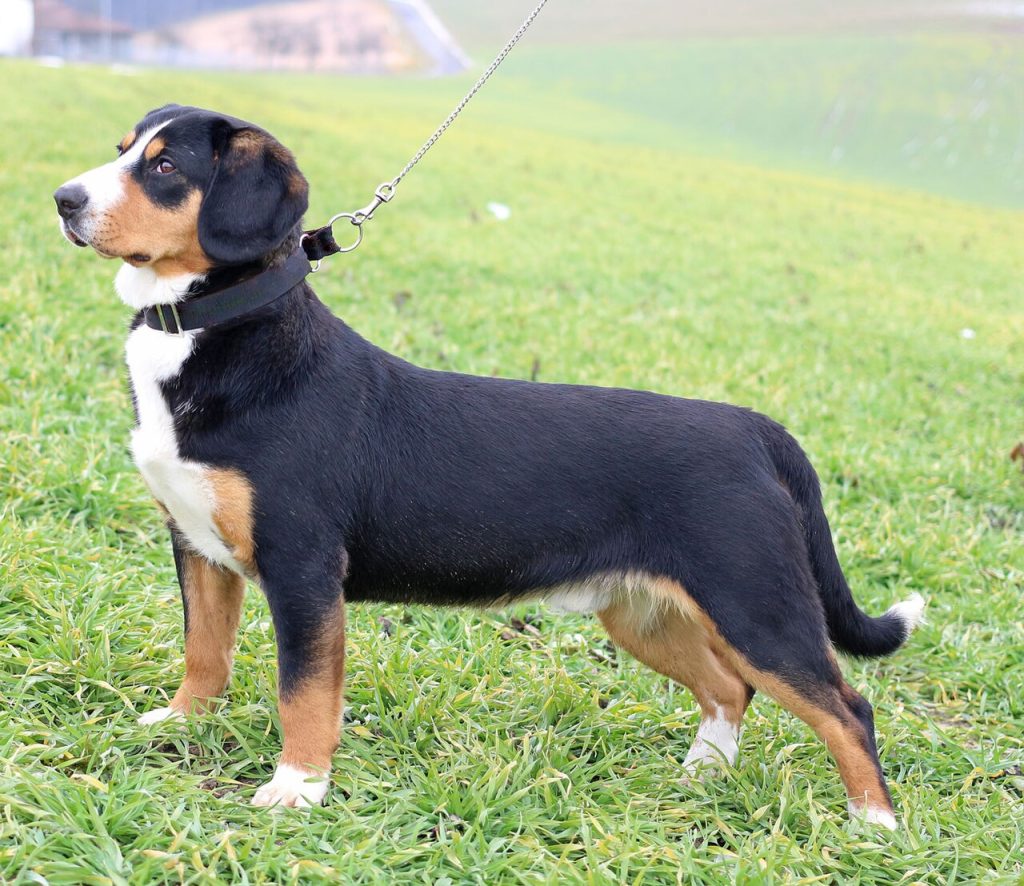
The Boyer of Entlebuch is the smallest and fastest of the four Swiss boyars: a compact, tricolored dog with amazing musculature, bred for centuries to guide and guard cattle in the alpine valleys of the canton of Lucerne. Behind his manageable size is a tireless worker, alert and deeply attached to his family. If you’re looking for an athletic companion, smart and infrequent, the Entlebuch Boyero deserves your attention, but it’s good to know what you’re getting into.
Is the Boyero of Entlebuch for you?
The Entlebuch Boyer is not a dog for any household. It is a pure breed boyer: it needs to move, think and feel useful. In the hands of an active family that gives it mental and physical work, it becomes an exceptional companion. In a sedentary household, however, it may get bored, bark and develop heavy behaviors. Before falling in love with its tricolor pattern, weigh these points.
In favour .
- Very loyal and attached to his family, “house dog”.
- Intelligent and quick to learn; brilliant at dog sports.
- Medium in size and manageable, more comfortable than their giant cousins.
- Short hair, easy to maintain.
- Excellent warning guard, watching everything that happens.
- Robust, athletic and tough, ideal for outdoor living.
Against
- High energy: requires daily exercise and mental stimulation.
- Strong character and tendency to control; not for passive novices.
- Reserved with strangers and barking if not managed.
- You can try “shepherding” children and other pets.
- Rare breed: few breeders and waiting lists.
- Mismatched, it suffers and becomes destructive with loneliness.

Character and temperament
The breed standard describes the Entlebuch Boyero as a dog “of good character and devoted to the people he meets, slightly suspicious of strangers”.
He’s a lively, cheerful, self-assured dog. He inherited from generations of working with cattle a mixture of courage, independence and a desire to make decisions for himself. That makes it fascinating, but it also means it needs a clear guide: If he senses a leadership gap, he’ll fill it. It is not aggressive, but it is dominant in attitude and quite “talky”, with a repertoire of barking and vocalizations to warn of any novelty.
His intelligence is remarkable. He learns fast, connects commands to context, and enjoys solving problems. That same sharpness, if not channeled, turns against you: a bored Entlebuch Boyero invents his own games, almost never to the liking of his owners. Early socialization – with people, dogs, noises and situations – is the best investment to have a balanced adult and not a suspicious or reactive dog.
Coexistence: children, other pets, flat and loneliness
With children: is well socialized, is an enthusiastic and protective playmate. Of course, its boyar instinct can lead it to push or “drive” the little ones as it would with a cow, and its overflowing energy can knock a child unintentionally.
With other pets:, if it grows up with them, usually coexists without problems. With dogs of the same sex or strangers it may be more firm, and with small animals caution is warranted because of its impulse to chase and group.
On the floor: is not his ideal environment. He may live in a always apartment that guarantees a demanding routine of long walks and activity, but a dog of this energy level is very appreciative of a house with a garden to patrol and vent. His tendency to bark can also clash with community life if not worked.
Soledad: is his great Achilles heel. Entlebuch’s Boyero is so attached to his family that it is fatal to be alone for many hours. Isolation causes stress, barking and destructive behavior.
Education and training
Few breeds learn as fast as this one, and that’s both a blessing and a challenge. The Entlebuch Boyero wants to work and enjoys the complicity with his guide, so he responds wonderfully to positive reinforcement, short sessions and reward games. But he’s also quick to spot inconsistencies: if one day you let him up on the couch and another doesn’t, he’ll notice and test the limit.
The key is to start early, be consistent and fair, and not fall into harsh methods. He’s a sensitive dog under his rough appearance; physical punishment only creates distrust and blockage. He sets clear rules from puppyhood, reinforces call and self-control, and gives him “duties”: orders, tricks, sniffing. He needs to feel that he has a role in the family.
Because of its independence, it is not the easiest dog for an absolute beginner. Anyone who has never trained a dog of character can be overcome by its intensity and its occasional stubbornness. With experience, patience and sense of humor, on the other hand, it is a brilliant student who asks for more.
Exercise and activity
There are no shortcuts here: the Entlebuch Boyero is an athlete and needs to expend energy daily. We’re talking about a lot more than a round the block. Long walks, running, intense play and, above all, mental work. It’s a dog designed to move for hours driving cattle over mountainous terrain, and that motor is still there.
He shines in virtually any canine sport: agility, obedience, canicross, flyball, mantrailing, sports shepherding or treibball(ball shepherding), a discipline that fits like a glove with your boyer instinct. Combining physical exercise with mental challenges is the formula for having a happy, calm dog at home. A properly mentally “tired” Entlebuch Boyero is an exemplary companion; a boring one, a problem.
In puppies it is advisable to dose the effort to protect the growing joints, avoiding jumping and extreme running until the skeleton matures.
Care: fur and hygiene
The Entlebuch Boyero wears short, dense, shiny and well-attached body hair, which is controlled with a weekly brushing to remove the dead hair and distribute the natural fat.
Bathing is only necessary occasionally, when it gets really dirty; washing it excessively dries its skin. As with any dog, basic care includes checking and cleaning the ears to prevent infection, cutting the nails when they click, and maintaining dental hygiene with proper brushes or biters.
Foodstuffs
As a medium-sized, very active and muscular dog, the Entlebuch Boyero needs a complete and high-quality diet, adjusted to its age, weight and actual exercise level.
Divide the daily ration into two meals and avoid overweight at all costs: The extra pounds punish hips that already have a predisposition to problems. Measure the quantities, control the rewards (very useful in training, but counting as calories) and always have fresh water available. In growing puppies, a specific medium-sized feed helps a balanced bone development. If you have any questions about quantities or special diets, it is best to consult your veterinarian.

Health and life expectancy
The Entlebuch Boyero is, in general, a rustic and resistant dog, but it carries an important peculiarity: the breed was on the verge of disappearing and was rebuilt from very few specimens.
The most frequent health problem is hypoplasia of the hip, typical of medium to large working breeds. Cases of hemolytic anemia and progressive atrophy of the retina (PRA), a degenerative eye disease, have also been documented in the breed. That is why it is essential to go to responsible breeders who perform hip tests and genetic tests on breeders: associations such as NEMDA (North America) are working precisely to reduce these diseases through responsible breeding and genetic diagnosis.
The life expectancy of a healthy Entlebuch Boyero is usually around 11 to 15 years. Regular veterinary checkups, weight control, adequate exercise and good nutrition are the best tools for him to enjoy them to the fullest.
Physical appearance
The Entlebuch Boyero is a medium-sized, compact, solid-built dog, slightly longer than it is tall, with obvious musculature that betrays its past work. Females tend to have a more square silhouette, while males are somewhat elongated and robust.
The head is proportionate, with a flat and strong skull, small triangular ears hanging sticky, and rather small brown eyes of lively and alert expression. The body rests on strong legs with compact feet, and the hips are broad and muscular. The tail may be naturally short (birth tail or the bobtail) or of normal length; tail cutting, formerly common, is now prohibited by law in many countries.
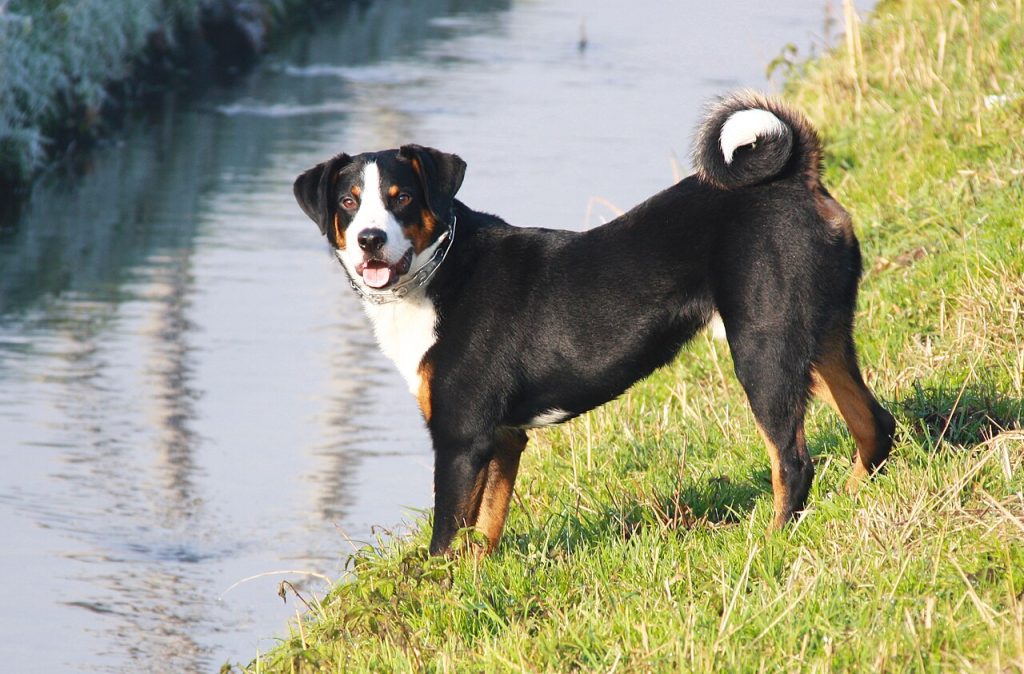
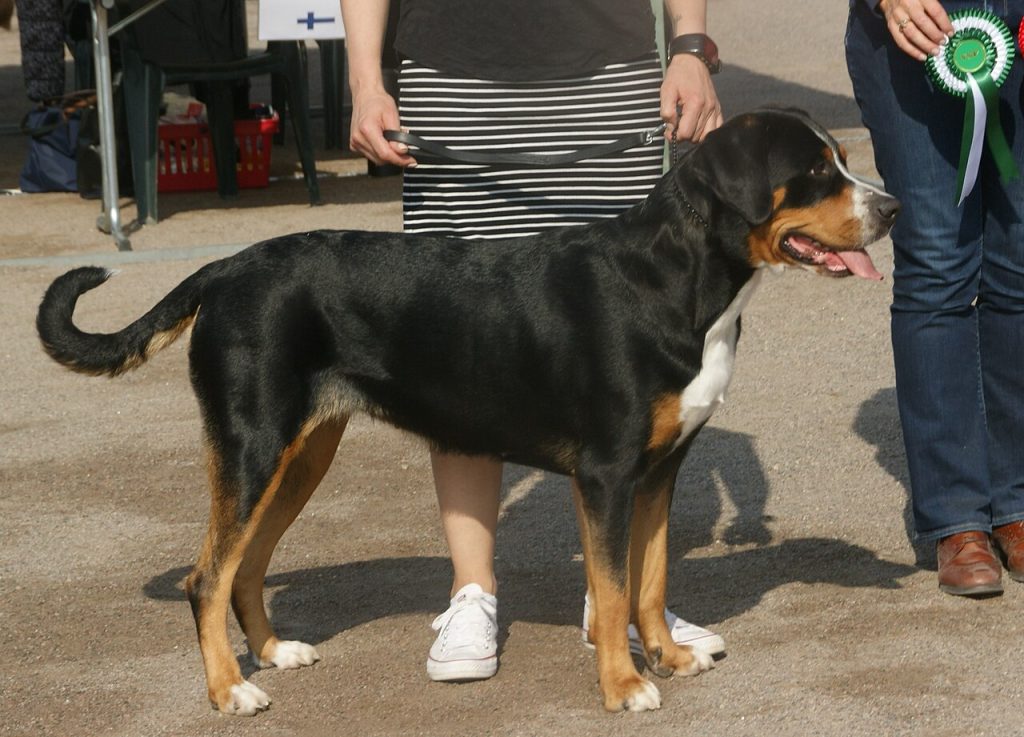
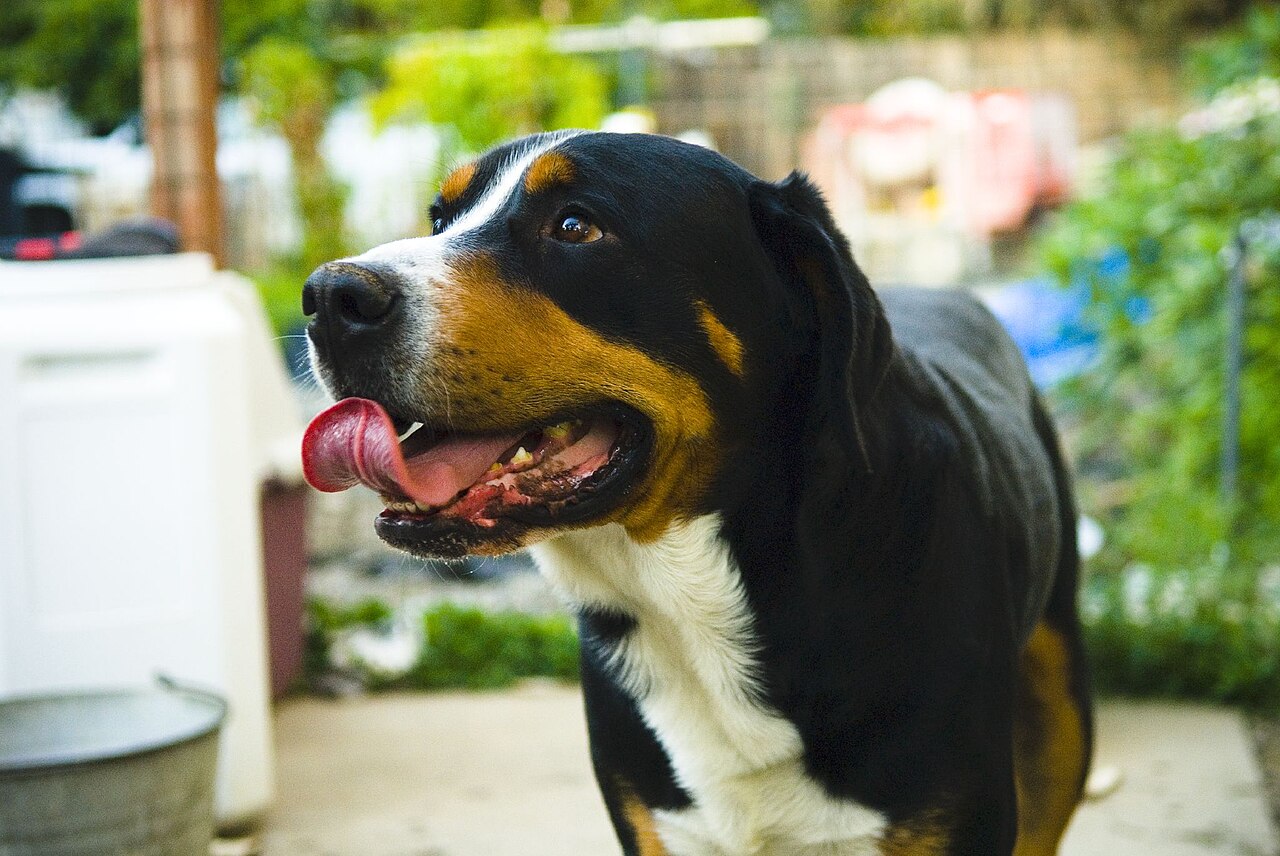
Its hallmark is the cloak: short, smooth and shiny, with the classic tricolor symmetric pattern of black, fire (cinnamon) and white. The white appears on the fingers, the tip of the tail, the chest and a stripe – the list or the blaze.– that goes up the nose and skull, where the hair is softer. The fire is always between black and white, drawing those characteristic spots over the eyes, cheeks and extremities. It is, in miniature, the same livery worn by his Swiss boyar cousins.
Origin and history
The Entlebuch is named after Entlebuch, a region in the Swiss canton of Lucerne. It is the smallest of the four Sennenhunde or Swiss boyars – along with the Appenzell Boyero, the Berner Boyero and the Great Swiss Boyero – a group of related farm breeds.
A widespread theory holds that all Swiss boyars are descended from large molosoid dogs that the ancient Romans brought to present-day Switzerland. During the 19th century these farm dogs were highly variable and were not considered separate breeds; in fact, for years the Entlebucher was hardly distinguished from the Appenzell Boyero. The breed was described as differentiated by 1889, and in 1908 the Swiss Kennel Club began to formally classify the various boyars.
The turning point came in 1913, when Dr. Albert Heim – a strong advocate of these endangered breeds – was presented with four short-tailed specimens. The breed entered the Swiss book of origins, but the First World War broke out and, at the end, hardly any dogs of this type could be found. The first club of the breed was not founded until 1926 and in 1927 only 16 specimens were located, from which the population was patiently rebuilt. Today, although still a rare breed, it is recognized by the Fédération Cynologique Internationale (FCI) and was admitted to the American Kennel Club book of origins on December 1, 2010, competing in the herding group since 2011.
Curiosities
- The little brother of the Swiss boyars. Of the four Sennenhund breeds, the Entlebucher is the smallest and also the most nimble and fast.
- He barely survived. After World War I, the breed nearly became extinct; the entire current population descends from a handful of specimens found in the 1920s.
- Natural short tail. Some are born with the bobtail, a short tail at birth, a trait that caught the attention of early selectors.
- Name with many variations. In English it has been called Entlebucher Mountain Dog, Entelbuch Mountain Dog or Entlebucher Cattle Dog, all for the same dog.
- Late recognition in the United States. did not enter the American Kennel Club registry until late 2010, despite its antiquity in Switzerland.
- A real boyer. Their cattle-driving instinct is still so vivid that many specimens attempt to “shepherd” people and pets at home.
If you are attracted to the Entlebuch Boyer – an energetic, intelligent, and close-knit herding dog – you may also be interested in other breeds with a similar work ethic and temperament, such as the Border Collie, the versatile Pastor Australiano, the small large boyer, the Welsh Corgi Pembroke, or the imposing Rottweiler, another cattle tricolor.
Frequently asked questions about the Entlebuch Boyero
Is the Entlebuch Boyero a good family dog?
It’s very loyal, affectionate with its own and protective of children, as long as it’s well socialized and gets the exercise and mental stimulation it needs.
How much exercise does an Entlebuch Boyero need?
It’s a high-energy athletic dog that requires long walks, running and play every day, in addition to mental work. It enjoys dog sports like agility, obedience or treiball. Without getting carried away, it tends to bark and get bored.
Does he adapt to living in a flat?
He needs a very demanding routine of walks and activity to compensate for the lack of space, and his tendency to bark can be an inconvenience in the community.
Is it easy to educate?
It learns very quickly and responds wonderfully to positive reinforcement, but it is independent and strong-willed. It needs consistent and consistent guidance from puppyhood. Because of its intensity, it is not the most recommended option for someone with no experience with temperament dogs.
Do you lose a lot of hair?
It has short hair and easy maintenance, with a weekly brushing is enough most of the year.
How long does a Boyero from Entlebuch live?
A controlled weight, adequate exercise, good nutrition, and regular veterinary checkups help you to enjoy a long and healthy life.
What health problems does the breed have?
Because of its reconstruction from a few specimens, it has a predisposition to hip dysplasia, and cases of hemolytic anemia and progressive retinal atrophy (PRA) have been described.
Is he a rare, hard-to-find dog?
Yes, it is a rare breed outside Switzerland. There are few breeders and there are usually waiting lists. It is advisable to look for responsible and registered breeders, to avoid the rush and to be suspicious of those who offer it as a simple “exotic breed”.