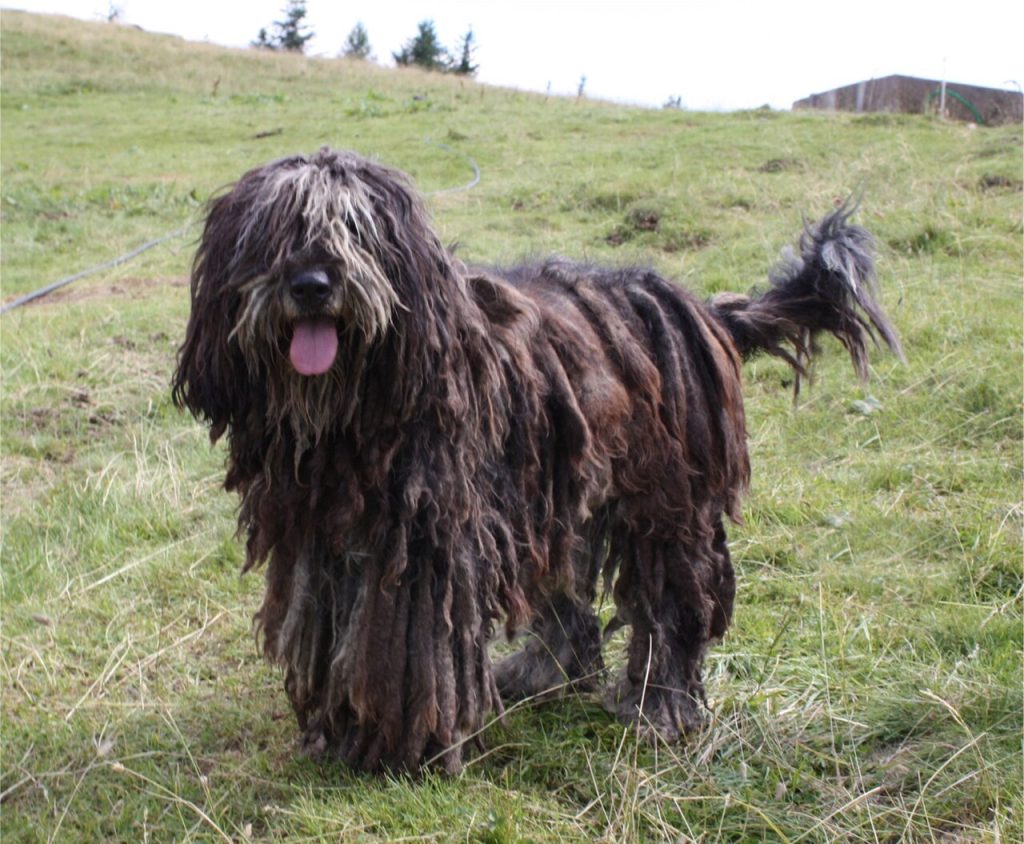
The Pastor Bergamasco is one of the most distinctive dogs in the world: Hiding beneath its famous coat of flattened strands, resembling felt tracks, is a serene, highly intelligent Italian shepherd dog of unusual loyalty. Raised for centuries in the Bergamo Alps to drive sheep and cows, the Bergamasco Shepherd combines the rusticity of the mountain dog with the sober head of a good herder. If you’re looking for a quiet companion at home, tough and full of personality, this breed deserves a thorough introduction.
Is Pastor Bergamasco for you?
The Bergamasco Shepherd is an easygoing dog for those who understand its nature, but its unique coat and independence mislead many.
In favour .
- Balanced and quiet inside the house, no nerves.
- Remarkable intelligence and enormous connection to his family.
- Good and patient with children; protective instinct without aggression.
- A coat that barely loosens hair and needs little daily maintenance.
- A rustic breed, healthy and very long-lived for its size.
- He resists the cold and the weather like few.
Against
- Independent: does not obey mechanically, needs motives.
- He needs daily exercise and, above all, mental stimulation.
- The coat takes years to form and you have to know how to separate it.
- Poor heat tolerance: be careful in summer.
- Rare breed: difficult to find and of scarce breeders.
- He doesn’t like prolonged loneliness or being isolated from the group.
Character and temperament

If we had to sum up the Bergamasco Shepherd in one word, it would be the balance. It is a calm, observant and reflective dog, which seems to always be evaluating the situation before acting. That calmness is not laziness: it is the heritage of generations of dogs who spent whole days with the herd, deciding for themselves when to intervene and when to wait.
It develops a deep and constant attachment to its family. It is not the typical effusive dog that jumps over anything that comes; rather, it establishes an equal-to-equal, almost cooperative relationship, in which it looks you in the eye and expects to get along with you.
In front of strangers it is reserved but polite. It is not an aggressive or nervous dog: it watches, evaluates and, only if it perceives a real threat, marks distances. This combination of prudence and composure makes it an excellent discreet guard, which warns without becoming a compulsive barker.
Coexistence: children, other pets, flat and loneliness
With children. The Bergamasco Shepherd is usually a patient and caring companion with the little ones. His shepherd instinct leads him to “watch” the group, and treats children with a calm tolerance.
Since With other pets. is a driving dog and not a prey dog, it gets along well with other dogs and, if it grows up with them, also with cats and other animals.
On the floor. can adapt to a floor because indoors it is very quiet, but in return it demands quality daily outings.
Soledad. is a close-knit dog that does not fit well with long days in solitude. If it spends too many hours it can only get bored and frustrated. It works best in homes where someone is present a good part of the day or where it can accompany its people.
Education and training
Training a Bergamasco Shepherd is a different experience than training a “obedient” dog. This breed was selected to think for itself: in the mountains, the dog made decisions away from the shepherd, so blind obedience was never part of its job. That means it collaborates when it understands why you ask, not by mere repetition.
The key lies in positive reinforcement, consistency and mutual respect. It is a sensitive dog that responds fatally to harsh methods: in the face of abruptness it closes and distrusts. Instead, with patience, rewards and short and varied sessions, it learns quickly and retains what it has learned very well.
Early socialization is essential so that their reserved nature does not lead to excessive shyness. The more the puppy is exposed to people, noises, surfaces and other animals, the more secure and sociable he will be as an adult.
Exercise and activity
The Bergamasco Shepherd has a well-channelled medium-high energy: it is not a hyperactive dog, but it does need to expend body and, above all, head. A couple of long walks a day, with time for sniffing and exploring, cover its base; from there, the more varied the activity, the happier it will be.
Where it really shines is in tasks that combine physical and mental effort. Shepherding is its natural discipline, but it also enjoys agility, trawling, obedience games or long mountain walks, the terrain for which it is designed.
The important thing is not to get caught up in the routine: such a clever dog gets unmotivated with always the same walks. Changing routes, posing small challenges and reserving playtime with his family is the best recipe for a balanced Bergamasco.
Care: fur and hygiene

The Bergamasco Shepherd’s mantle is, paradoxically, much easier to maintain than it looks. The key is to understand how it works. The breed has three types of hair: a woolly, greasy undercoat, a rough intermediate coat called “goat coat” and a finer, woolly coat on top. These three types intertwine and, over time, form the characteristic flattened and sharpened layers, the flocks or locks, that protect the dog from cold, rain, and blows.
These strands are not brushed: they separate by hand.. They begin to form around the year of life and take several years to reach their final length, reaching almost the ground in adult specimens. Once or twice a year you have to open with your fingers the areas where the strands begin to join each other, so that they are well defined and aerated.
The Bergamasco barely loosens its hair, because the dying one is trapped inside its own lock, and it also does not give off a strong smell.
Foodstuffs
As a medium to large-sized rustic dog, the Bergamasco Shepherd is not particularly demanding with food, but does appreciate a quality diet well adjusted to its activity.
In the puppy it is advisable to control the growth rate with a suitable feed for large breeds, avoiding overfeeding so as not to force some joints still developing. In the adult, monitoring the weight is important: under so much hair it is easy to go unnoticed the extra kilos, so it is advisable to feel the body from time to time besides looking at it.
Fresh water is always available, especially in summer when your coat makes you more sensitive to heat.If you have any questions about rations, supplements or specific diets, it is best to consult your veterinarian.
Health and life expectancy
The Bergamasco Shepherd is one of those breeds that has maintained enviable health. Its status as a rustic working dog, bred for centuries for its functionality and not for aesthetic fashions, has given it a solid constitution and a low incidence of hereditary diseases. The population is small but is carefully managed by breeders, which helps to keep the genetic heritage healthy.
As with any medium to large dog, it is advisable to monitor hip dysplasia and, in general, joint health, so it is advisable to acquire puppies from parents with health tests. Its coat, although protective, requires attention to drying and to the skin to avoid moisture. With basic care, a schedule of daily vaccination and deworming, and regular veterinary checkups, it is a dog that causes few problems.
The life expectancy cited by breed clubs is around 13 to 15 years, a remarkable figure for a dog of its size and another indication of its natural robustness.
Physical appearance

The Bergamasco Shepherd is a medium-sized, robust and well-proportioned dog, with a rustic and compact appearance.
But what visually defines the breed is undoubtedly its coat. It covers the entire body and forms, especially in the posterior third, those long, sharp locks that hang like raspberries. In front the hair is rougher and curls in waves, like a goat’s, while on the head it is thinner and falls over the eyes. The colour allowed ranges from gray in all its shades – from lighter to matte black – with possible Isabella or leonado hues.
Under all that wool you can guess an athletic dog, with strong limbs and wide and fluid movement, able to spend the day working on difficult terrain.
Origin and history
The Bergamasco Shepherd takes its name from the Alps and Prealps of Bergamo, in Italy’s Lombardy, where it has been used for centuries as a sheep and cow herding dog. Their exact origins are lost in time; a 2018 genetic study found haplotypes shared with other European breeds, such as the Picardy Shepherd, the Bernese Boyer and the Briard, pointing to a common trunk of ancient shepherd dogs from the continent.
The first clear documentary trace comes in 1881, when a dog of this type was exhibited at the first Italian canine exhibition, held in Milan. The first entry of the breed in the Libro Origini Italiano, the national pedigree book, dates from 1891. In 1949 the association of the breed was founded, today called Associazione Amatori del Cane da Pastore Bergamasco, and in 1956 it obtained the recognition of the Ente Nazionale della Cinofilia Italiana and, that same year, that of the International Cinological Federation (FCI), which classifies it in Group 1 (shepherd dogs and boyeros), Section 1 (shepherd dogs).
Despite its age, it is still a small breed. Between 2011 and 2019, annual registrations in Italy averaged less than a hundred a year, which gives an idea of how rare and exclusive it is.
Curiosities
- Their famous strands are not random raspberries – they are a three-dimensional structure of hair that forms by itself over the years and insulates the dog from cold and predator bites.
- The strands take several years to reach their full length; a puppy is born with soft hair and no one would say that it will end up looking like a carpet with legs.
- Its resemblance to the Hungarian Komondor is only apparent: the Komondor forms rounded strings, while the Bergamasco forms flat, broad layers.
- It is a dog that hardly needs a hairdresser: once the locks are separated, its maintenance is one of the lowest among the long-haired breeds.
- In the mountains, the gray and jasper color of the mantle served as camouflage between the herd and the rocks.
If you are attracted to the intelligent and hardworking character of the Bergamasco Shepherd, you may also be interested in other shepherd breeds with their own personality: the tireless Border Collie, the versatile Pastor Australiano, the multifaceted Pastor Alemán or the elegant Collie.
Frequently Asked Questions about Pastor Bergamasco
Is the Bergamasco Shepherd a good family dog?
Yes. The Bergamasco Shepherd is a balanced, patient and very close family dog. He treats children with an almost vigilant tolerance, the fruit of centuries of caring for herds, and rarely shows aggression. He needs to be part of the family nucleus: he is not a dog to live isolated in a garden.
Do you have to brush Pastor Bergamasco’s hair?
It does not brush like a normal dog. Its coat forms flat strands (the so-called flocks) that are not combed, but are separated by hand once or twice a year so that they do not pinch each other.
How long does a Bergamasco Shepherd live?
According to the records of the breed clubs, life expectancy is around 13 to 15 years, a high longevity for a dog of its size.
Does the Bergamasco Shepherd lose a lot of hair?
Once the strands are formed, they barely let loose hair around the house: the dead hair gets trapped inside the flock itself. Nevertheless, no dog is completely hypoallergenic, because the allergy is usually due to dandruff and saliva, not just hair. Sensitive people should live with a specimen before deciding.
How much exercise does a Bergamasco Shepherd need?
It needs daily activity of medium to high level: one or two long walks and, above all, mental stimulation. It is a thinking working dog, so it enjoys herding, agility, tracking or obedience games. Inside, however, it is quiet and lies down without giving war.
Is it difficult to educate Pastor Bergamasco?
It’s not difficult, but it’s independent. It’s used to making decisions alone in front of the herd, so it doesn’t obey mechanically: it collaborates if it understands the meaning of what you’re asking. With positive reinforcement, consistency and early socialization, it learns quickly; with harsh methods, it closes in.
How tall and how much does a Bergamasco Shepherd weigh?
The males measure 58-62 cm at the withers and weigh about 32-38 kg. The females are about 4 cm shorter and weigh on average about 6 kg less.
Does Pastor Bergamasco adapt to living in a flat?
It can live on the floor if it covers its daily exercise and does not spend too many hours alone, since it is serene inside the house.