The Shepherd of Beauce(Beauceron or Shepherd of Beauce) is one of the oldest and least known French shepherd dogs outside their homeland: a rustic, imposing and remarkably intelligent guardian, bred for centuries to guide and defend cattle on the great plains of central France. If you’re looking for a partner who’s athletic, loyal and characterful, but you’re willing to give him work and leadership, the Beauce Shepherd can be an extraordinary dog. If you don’t, he’ll probably outgrow you.
Is Pastor Beauce for you?

The Beauce Shepherd is not a dog for everyone. It is large, strong, territorial, and endowed with a mind that needs constant occupation. In the right hands, it becomes a balanced keeper and an outstanding workmate; in the wrong, a frustrated and difficult-to-manage animal. Before you fall in love with its image, be honest about your lifestyle.
In favour .
- Extremely high intelligence and enormous capacity for learning.
- Loyalty and a deep bond to his family.
- Natural guardian, courageous and deterrent without gratuitous aggression.
- A rustic breed, healthy and resistant to cold and weather.
- Versatile: shepherding, guarding, canine sports, tracking and assistance.
To be taken into account
- He needs a lot of physical and mental exercise every day.
- It matures slowly: up to three years old it is still a puppy.
- Stubborn at first; not a good first race.
- Distrustful of strangers: requires early and serious socialization.
- Size and strength demanding space, better house with garden.
Character and temperament
The temperament of the Beauce Shepherd is that of a serious working dog: calm and self-assured at home, attentive and reserved outside of it. The calf has looked for an intelligent, calm, gentle and fearless animal, and that shows in its behavior. It is not a nervous dog or barking without a reason, but an observer who evaluates before acting.
To his family he is affectionate and deeply loyal, able to follow his owner from room to room and to be patient with the children of the house. With strangers, however, he is naturally suspicious: That’s where its value as a guardian lies, but also why it needs early and well-executed socialization. A poorly socialized or ill-mannered Beauceron can become overly suspicious or reactive.
Unlike other large breeds, the Beauceron does not fully mature mentally or physically until about three years of age. During this time, you should be patient: you will have a dog with an adult body and a teenage head, bright but at times stubborn.
Coexistence: children, other pets, flat and loneliness

With children: The Beauce Shepherd is usually patient and protective with the little ones in his family, which he tends to watch almost like a flock.
If With other pets: grows up with them, it coexists well with dogs and other animals. Males can be dominant with other dogs of the same sex, and their guarding instinct demands calm introductions.
Floor and solitude: is not a breed suitable for a small flat or for someone who spends the day outside. It tolerates indoors if it gets a lot of exercise, but it shines in houses with terrain. It tolerates sleeping outdoors thanks to its waterproof coat, although that should never be an excuse to isolate it: it is a dog that needs its people. Prolonged loneliness generates anxiety and destructive behaviors.
Education and training
Few breeds reward good training as much as the Beauce Shepherd, and few punish inconsistency as much. It is an eager learner, capable of reaching very high levels in obedience, tracking, mondioring or herding. But behind that ability is a dog that needs to understand who sets the rules.
The key is to start early, be consistent, and use positive reinforcement. Given their slow maturation, several short sessions of five to ten minutes a day work much better than long, demanding training. Haste and harshness are counterproductive: they produce a suspicious, blocked, disobedient dog.
It needs an active, serene, firm but affectionate guide, whom it can trust and who will impose clear boundaries on it. With this type of handling, the Beauceron unleashes its full potential and becomes a companion capable of performing almost any task.
Exercise and activity
This is the point that most people underestimate. The Beauce Shepherd was bred to travel miles guiding herds across the plains of Beauce, and that need for movement is still intact. A couple of short walks are not enough for him: he requires intense physical activity and, above all, mental stimulation every day.
The ideal is to combine long walks or runs with search games, obedience work and some canine sports. Pasture, tracking, agility or sports protection sports fit perfectly with his awake mind. A Beauceron that releases its energy is a balanced dog; one that does not release it ends up channeling it into wrecks, escapes or barks.
Care: fur and hygiene
The Shepherd de Beauce’s coat is twofold: a hard and short outer coat and a woolly undercoat that becomes dense with the cold, especially if the dog sleeps outdoors.
The exception is the seasonal muds, in which it is advisable to brush more often to remove the dead undercoat. The baths should be occasional, only when the dog is really dirty, so as not to damage the natural protection of its skin.
Foodstuffs
As a large, athletic and slow-growing dog, the Beauce Shepherd needs a high-quality diet well adjusted to its life stage.
In adulthood, the diet should be adapted to your actual activity level: A working Beauceron spends a lot more than a companion. As a deep-chested breed, it is wise to divide food into two servings a day and to avoid strenuous exercise just before and after eating, a simple measure against the risk of gastric torsion. Keep fresh water available at all times and watch your weight so that you do not gain weight.
Health and life expectancy
The Beauce Shepherd has a well-deserved reputation as a rustic, healthy and long-lived breed; in fact, the standard describes it as a breed without specific health problems.
That said, it shares some risks with other large, deep-breasted breeds that you should be aware of: gastric torsion or dilation (a veterinary emergency) and hip dysplasia. Going to responsible breeders who do health checks on the breeders, keeping the dog at his weight, feeding and keeping up-to-date with veterinary checks are the best guarantees for a long and healthy life.
Physical appearance
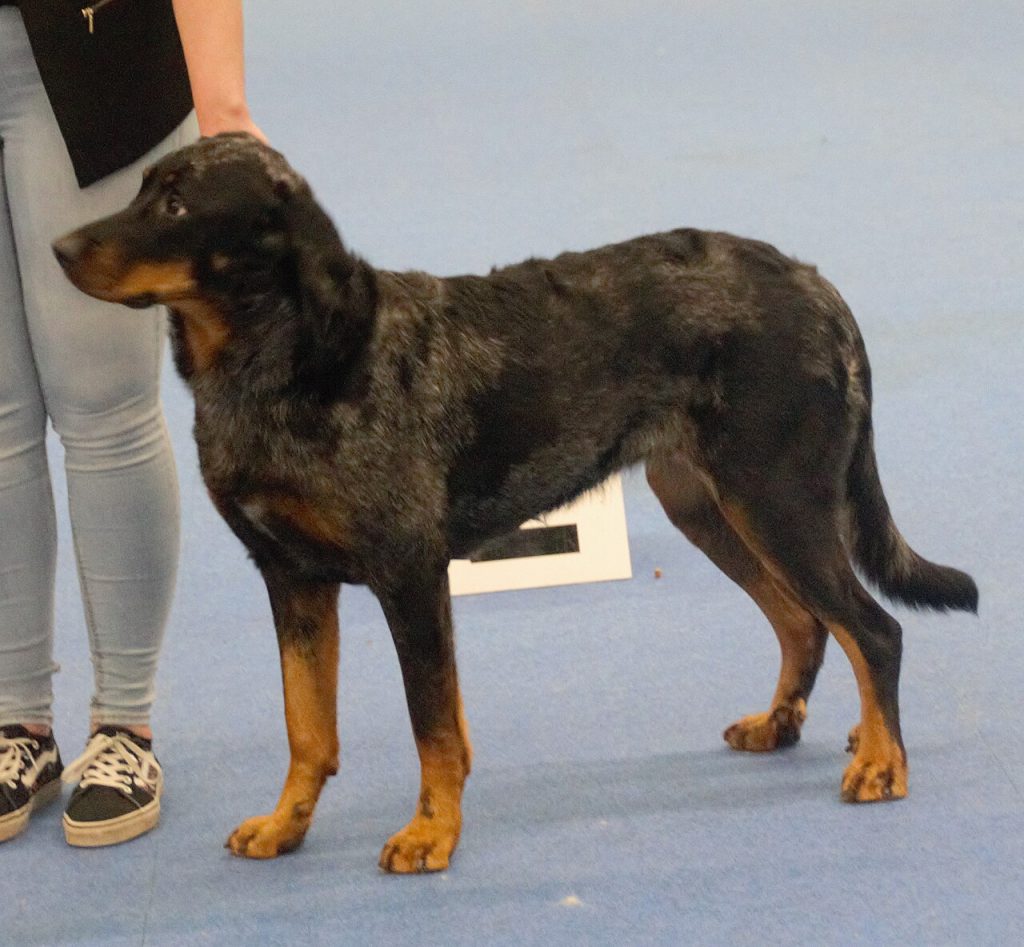
The Beauce Shepherd is a large dog, of solid and muscular build but never heavy, transmitting strength and rusticity. Males measure 65 to 70 cm at the withers and females 61 to 68 cm, with an approximate weight of 30 to 45 kg. The head is long and well-chinned, with the skull flat or very slightly rounded and a slightly marked stop; the nose always black and the eyes almond-brown in color.
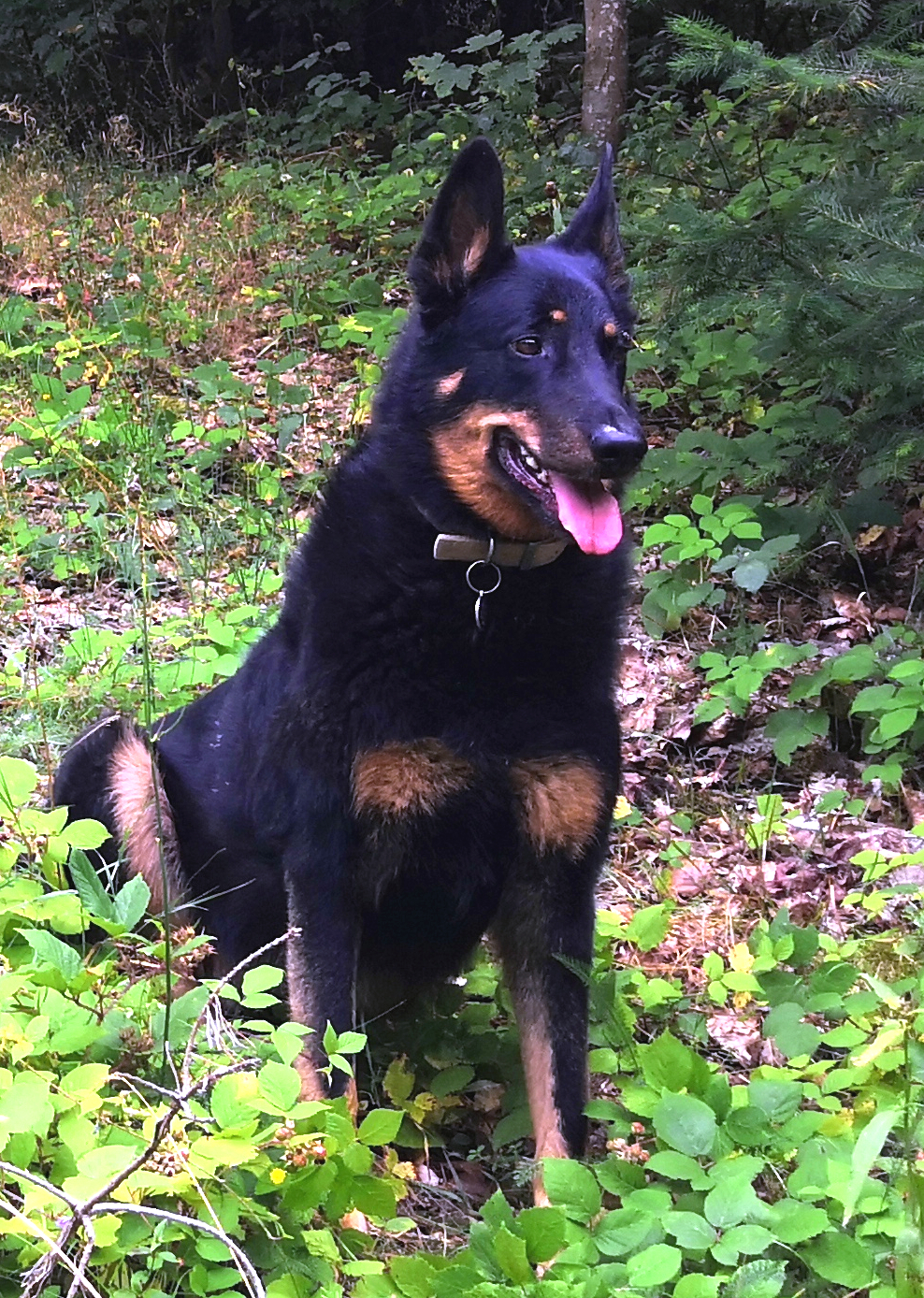
Their classic color is black and fire, with the ⁇ squirrel red ⁇ tone markings on the eyebrows, muzzle, chest and extremities, earning them the nickname bas rouge( ⁇ red socks ⁇ ). There is also the harlequin variety, which mixes gray, black and fire. The most unique feature of the breed is the double spur on the hind legs, required by the standard, which forms two well-separated ⁇ thumbs ⁇ joined by bone. The tail, short and long, ends in the shape of ⁇ j ⁇ .
Origin and history
The Beauce Shepherd takes its name from the Beauce region, the large agricultural plain south of Paris, although it was actually developed over much of central France. It’s a race of very ancient origin: The first written mention of these sheepdogs dates from 1587, and the name Shepherd of Beauce was fixed in 1809, when it was distinguished from the Brie (long-haired) to the Beauce (short-haired) Shepherd.
For centuries it was the all-purpose dog of French farms: He guided and protected flocks of sheep and cattle, and defended property. The first club of the breed was founded in 1911. His courage and intelligence led the French army to use him as a military dog, especially in the two world wars, in messaging and detection tasks. Today he continues to work as a herding dog, guard dog and in police forces, in addition to gaining ground as a sports and companion dog.
Curiosities
- His nickname bas rouge( ⁇ red socks ⁇ ) alludes to the fire-colored marks on his legs.
- The double spur on the hind legs is mandatory in the standard: a Beauceron that does not have it is disqualified from exhibition.
- It is related in origin to the Brie Shepherd: both descend from the old French shepherd dogs.
- Despite its ⁇ perrazo ⁇ shape, it does not fully mature until about three years of age.
- It was one of the dogs used by the French army in the two world wars.
If you’re attracted to the Beauce Shepherd for its blend of intelligence, protective instinct, and working dog energy, you may be interested in other breeds with a similar profile. Check out the Pastor Alemán, Dóberman, Rottweiler, and Border Collie, all intelligent, athletic, and very attached to their owners.
Frequently Asked Questions about Pastor de Beauce
Is the Beauce Shepherd a good family dog?
Yes, but with nuances. It is a deeply loyal, patient and protective dog with the children in its own home, and enjoys being part of family life. Now, it is not an ornamental dog: it needs an active home, with clear rules and daily dedication. In families that are sedentary or spend many hours outside, its energy and intelligence turn into frustration and behavior problems.
How much exercise does a Beauce Shepherd need a day?
At least between one and two hours of physical and intellectual activity spread over several outings. It is not enough to walk: it needs to jog, explore, play and, above all, work its head with obedience, tracking or dog sports. It is a breed bred to cover large areas guiding cattle, so insufficient exercise is the most common cause of its problems.
Is it an easy dog to train for someone with no experience?
It is not the best first breed. It is very intelligent and learns quickly, but it is also stubborn at first and matures slowly: it does not reach mental maturity until about three years of age. It needs a consistent, firm guide without harshness and patience. With positive reinforcement and short sessions it gives spectacular results; with harsh or incoherent methods it becomes suspicious.
What size and weight is the Beauce Shepherd?
It is a large dog. Males measure 65 to 70 cm at the withers and females 61 to 68 cm. Weight is around 30 to 45 kg depending on sex and constitution.
How long do you live and what health problems do you have?
It is a rustic breed and, in general, healthy and long-lived, with a life expectancy that is usually around 10-12 years. Being a large and deep-chested dog, it is advisable to monitor gastric torsion and hip dysplasia, common in breeds of its size.
What is Pastor de Beauce’s double spur?
Unlike other breeds, they are joined by bone and the standard requires that they be present; their absence disqualifies the dog in exhibition.
What colours can a Beauce Shepherd be?
The classic color is black and fire, with squirrel-colored markings on the eyebrows, muzzle, chest and legs (hence the nickname ⁇ bas rouge ⁇ , red socks).
Can you have a Beauce Shepherd on one floor?
It can adapt to living indoors if given plenty of daily exercise and companionship, but it is a large, territorial dog designed for the countryside. It fits much better in homes with a garden and active owners. In a small apartment with long hours of solitude it will suffer and develop destructive behaviors.