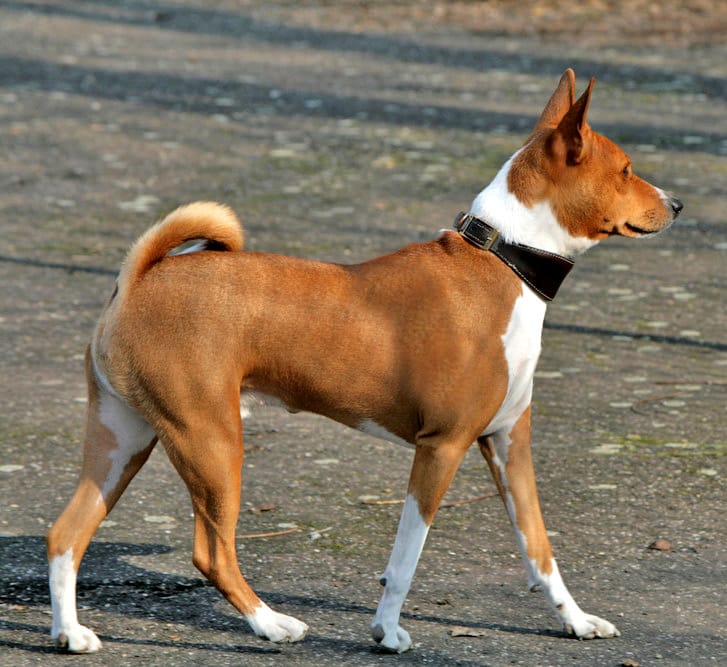
The Basenji is one of the oldest and most unique dogs in existence: an African hunter of small size, athletic and almost feline cleanliness who, moreover, barely barks. Instead of the typical “guau”, it emits a hoarse sound, between howling and Tyrolean singing, which has earned it the nickname “dog that does not bark”. If you’re looking for an independent, clean, intelligent partner with a strong personality, the Basenji will surprise you. But it’s good to get to know him well before you decide, because he’s not a dog for everyone.
Is the Basenji for you?
Before you fall in love with its elegant silhouette, be honest: the Basenji is a primitive dog, with a strong hunting instinct and an independence that reminds you more of a cat than a classic companion dog.
In favour .
- Barely barks: ideal for neighbours sensitive to noise.
- Extremely clean and almost no dog body odor.
- Short hair that needs minimal maintenance.
- Small size and athletic, easy to handle physically.
- Very intelligent and resolute; long-lived and, in general, healthy.
- Affectionate and very attached to his reference person.
To be taken into account
- Independent and stubborn: one of the least “obedient” dogs.
- High prey instinct; chases cats and small animals.
- Escapist: climb fences and seek freedom if bored.
- He needs a lot of exercise and mental stimulation.
- He hates the rain and getting wet.
- Predisposition to hereditary kidney problems (Fanconi syndrome).
Character and temperament

The Basenji is an alert, alert, curious and energetic dog, but reserved with strangers. It is not the typical effusive dog that rushes to greet anyone; it observes, evaluates and decides. With its family, on the other hand, it is affectionate and usually creates an intense bond with a specific person in the household, whom it follows everywhere.
What most puzzles people of other races is their independence. In the well-known ranking of “obedient intelligence” by psychologist Stanley Coren, the Basenji is listed as one of the dogs least willing to execute human orders, only ahead of the Afghan Greyhound. But that doesn’t mean I’m clumsy: It’s quite the opposite. His intelligence is manifested when he has to solve a problem for his own benefit, such as opening a door, escaping from a garden, or getting food. He’s cunning, not subservient.
It also has a very strong instinct for prey, and any quick movement (cat, squirrel, bird) activates its hunting mechanism. Another peculiarity is its habit of standing up on its hind legs, leaning or alone, like a mermaid, to scratch what is around it when something intrigues it.
Coexistence: children, other pets, flat and loneliness

The basenji can be an excellent companion, but its fit in each home depends on a number of factors.
- With children: usually gets along well with the children in the house, especially if he grows up with them. He is playful and mischievous.
- With other dogs: with well-socialized dogs from puppyhood can coexist without problem, although its decided temperament sometimes clashes with equally dominant dogs.
- With cats and small pets: here is its great weakness. Its prey instinct is very high and tends to chase cats, rodents, rabbits or birds. Coexistence with small animals is risky and not always possible.
- On the floor:‘s compact size and the fact that it barely barks make it surprisingly suitable for floors, as long as your daily exercise need is met.
- In the face of loneliness: is a very attached dog and does not take long absences well. If it spends too many hours alone and without stimuli, it can develop destructive behaviors or escape attempts.
Education and training
Training a Basenji is an exercise in patience and humility. He is not a dog who lives to please; he needs to understand what he gains by collaborating with you. Positive reinforcement (rewards, food, play) works infinitely better than any harsh correction, which will only get him to close in on you.
Some key differences with this breed:
- Short and varied sessions: gets bored right away with repetition. Better several moments of a few minutes than one long session.
- Early socialization: Exposing him as a puppy to people, noises, environments and other dogs is essential to softening his natural reserve.
- I remember unreliably:, due to its hunting instinct, the call will never be completely safe, so it is best to keep it on a leash in unfenced areas.
- The Basenji’s stubbornness is earned by motivation, not pulses.
Assume that you will never have a dog of millimeter obedience. What you can achieve is a polite coexistence, with good manners at home and a bond of mutual trust.
Exercise and activity
Behind its elegant appearance is a true athlete. The Basenji is capable of reaching between 48 and 56 km/h in running, a remarkable speed for its size. It needs to release that energy daily: long walks, controlled runs and, above all, games that test its head.
He loves to run and chase and explore. Disciplines such as lure coursing, agility, or food puzzles and scent games fit very well into his mindset. A physically tired and mentally stimulated Basenji is a quiet dog at home; a bored one, on the other hand, will find its own “fun”, usually at the expense of your furniture or the integrity of your fence.
Care: fur and hygiene
If there’s one thing that’s easy about a Basenji, it’s their hair care. It has a short, thin, shiny coat that practically keeps on its own. In fact, this breed has the very uncanine habit of grooming itself by running its tongue through it like cats do, which keeps it clean and barely odor-free.
In practice, care is reduced to:
- Cepillado: a weekly check-up with a soft glove or brush is enough to remove the dead hair.
- Besides, the Basenji hates water, so the fewer baths, the better for both of you.
- Basic hygiene: checking and cleaning ears, trimming nails when needed and regular tooth brushing to take care of your oral health.
- Cold and rain:, having short hair and a tropical origin, appreciates shelter in cold climates and will resist going out on rainy days.
Foodstuffs
The Basenji is not a particularly gluttonous dog, but its active nature requires a quality and well-adjusted diet.
It is advisable to control the rations and weight, since overweight punishes the joints and the organism of any dog. Sweets are an invaluable tool in their education, but they should be discounted from the daily ration so as not to go overboard. As with any breed, fresh, clean water should always be available. If your Basenji has a predisposition to digestive or kidney problems, your veterinarian may recommend a specific diet tailored to your case.
Health and life expectancy
The Basenji is, in general, a robust and remarkably long-lived dog: its life expectancy is around 13 to 16 years, slightly above the average of similarly sized breeds.
- Fanconi syndrome: is the most characteristic disease of the breed. A kidney disorder in which the kidney tubules do not properly reabsorb nutrients and electrolytes. It usually appears between 4 and 8 years of age and its symptoms (excessive thirst and urination, glucose in urine) can be mistaken for diabetes. It’s treatable, and the sooner it’s detected, the better the prognosis. It is recommended to test the dog’s urine once a month from the age of 3 years.
- Haemolytic anaemia: of recessive genetic origin. There is a non-invasive DNA test to identify carriers before breeding.
- Eye problems: progressive retinal atrophy (which can cause blindness), coloboma and persistence of the pupillary membrane.
- Dysplasia of the hip: less common than in large breeds, but present.
- Intestinal malabsorption: an autoimmune enteropathy that causes chronic diarrhea and weight loss, manageable with specific diet.
- Otros: dermatitis, hypothyroidism and urinary tract infections are among the ailments recorded in the breed.
The best prevention is to go to responsible breeders who perform the relevant genetic and health tests, and to maintain regular veterinary checks, especially the recommended monthly urine check.
Physical appearance

The Basenji is a small, compact dog with elegant lines, surprisingly strong for its size. Its build is “square”: as long as high. The males measure about 43 cm at the cross and the females about 40 cm, with an approximate weight of 11 to 13 kg in males and 9 to 11 kg in females.
Its most recognizable features are unmistakable:
- Orejas: small, thin, pointy and always upright.
- Frente: streaked with fine wrinkles, especially marked on puppies and when the dog is alert.
- High-implantation Cola:, tightly screwed in one or two turns on the back.
- Ojos: almond shaped, dark and intelligent in expression.
- Manto: short, thin and very bright.
As for color, the breed has several combinations: red, black, tricolor (black and fire) and tiger. In all cases they always show white marks on the feet, chest and tail tip, well defined against the base color.
Origin and history
The Basenji is one of the oldest breeds in the world, a true living relic. It comes from central Africa, specifically the region of the present-day Democratic Republic of the Congo and neighbouring tropical countries. There, local communities have appreciated it for centuries for its intelligence, its courage, its speed and, above all, its silence during hunting, where it was used to track and lift pieces.
Their antiquity is astonishing. Dogs with curled tails and erect ears, very similar to the Basenji, appear in depictions of ancient Egypt from about 4,500 years ago, associated with a type of dog called Tesem. Modern genetic studies confirm that the Basenji is a basal breed, prior to most breeds that emerged in the 19th century, related to dogs of primitive spitz type.
The Western world began to take notice of it in the mid-19th century. An 1843 painting belonging to Queen Victoria is cited, showing a dog clearly identifiable as Basenji, brought from an expedition to the Niger River. Europeans formally described the race in the Congo in 1895. Early attempts to bring it to England failed, as imported specimens died of diseases such as roundworm. It was not until the 1930s that a stable foundation group was established in England and, shortly thereafter, in the United States. The American Kennel Club officially recognized the breed in the 1940s.
Curiosities
- The dog that doesn’t bark:‘s larynx, unusually shaped, prevents it from barking like other dogs, instead emitting a whistling sound, a kind of Tyrolean song or “barroo” very characteristic.
- Cat’s whiskers cleans by licking its hair like a feline and lacks the typical dog smell.
- Suricate posture: stands on its hind legs to monitor what is happening around it.
- A zeal a year: Unlike most breeds, Basenji females usually have a single annual zeal, a trait they share with some primitive canids.
- Genetically unique:‘s DNA puts it very close to the most ancestral canids, far from the pattern of most modern breeds.
- Professional runner: climbs wire fences easily, so it needs really secure fences.
If you have been captivated by the Basenji’s primitive, independent nature, you may want to get to know other breeds with a similar spirit: Shiba Inu, another ancient spitz with a strong personality; the sleek The power of the Pharaoh Hound and stylish Podenco Ibicenco, two primitive hunters related to the same group; and Rhodesian Ridgeback, another large dog of African origin.
Frequently Asked Questions about Basenji
Does the Basenji really never bark?
It does not bark in the usual way because of the particular shape of its larynx, but it is not mute.
Is this a dog suitable for beginners?
Their independence, stubbornness, and strong hunting instinct demand patience, perseverance, and dedication to exercise and socialization.
Can he live in a flat?
Its small size and the fact that it barely barks make it suitable for floors, provided it is provided with sufficient daily exercise and mental stimulation to avoid boredom.
Do you get along with cats?
It’s complicated. The Basenji has a very high prey instinct and tends to chase cats and other small animals. Coexistence is risky and not always viable, even with early socialization.
How long does a Basenji live?
It is a long-lived breed, with a life expectancy that is usually between 13 and 16 years, slightly above the average for dogs of its size.
What health problems are typical of the breed?
The most characteristic is Fanconi’s syndrome, a hereditary kidney disorder. Hemolytic anemia, progressive retinal atrophy, hip dysplasia and intestinal malabsorption may also occur.
Does it need a lot of hair maintenance?
Very little. Its short coat stays almost alone and the dog grooms itself like a cat. All it needs is a weekly brushing and sporadic baths, since it also hates water.
Is it easy to train?
Not particularly. It’s considered one of the least obedient dogs to human commands, although it’s very intelligent. It works best with positive reinforcement, short sessions and motivation, assuming its memory will never be entirely reliable.