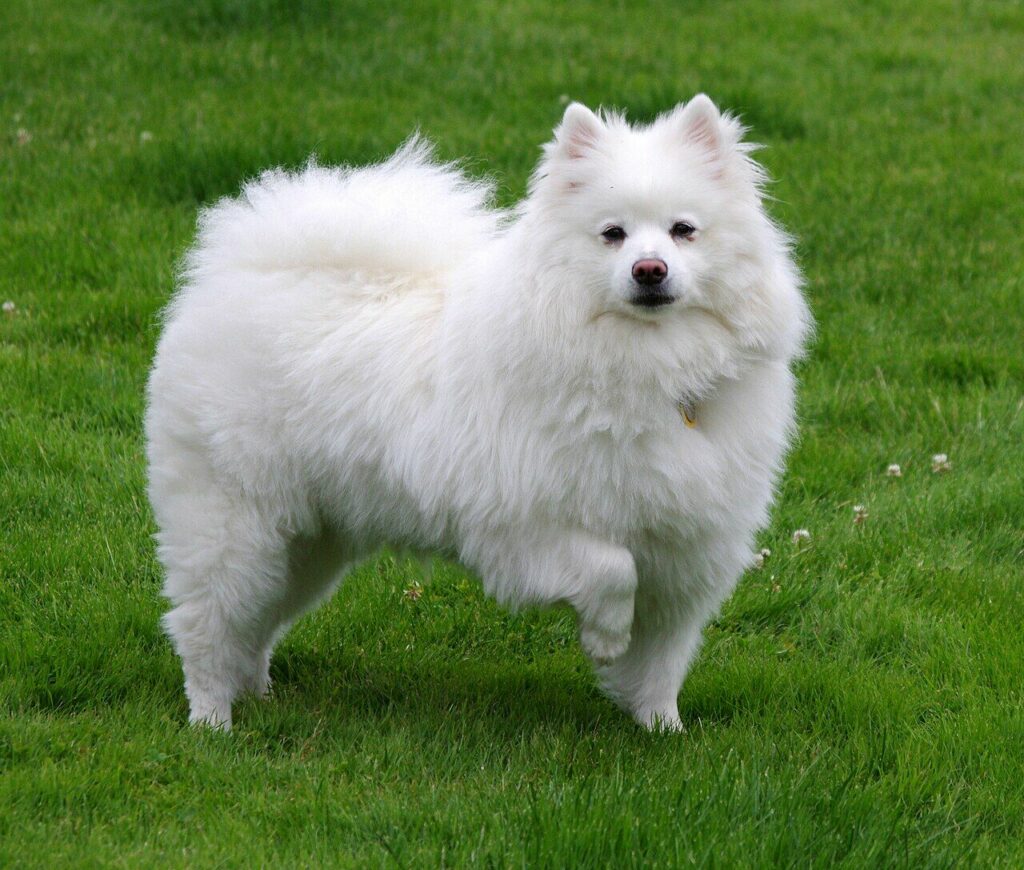
The American Eskimo Dog is a snow-white spitz dog with an alert look and sociable character that, despite its name, was not born in ice: It is descended from the German Spitz and was forged as a companion dog in the United States. It combines striking beauty – dense fur, feathered tail, and that eternal smiling expression – with an uncommon intelligence that makes it one of the easiest spitz to train. She’s alert and a top alarm guard, but at the same time affectionate and deeply attached to her people. If you’re looking for a lively, smart, manageable-sized companion, the American Eskimo Dog deserves a good look.
Is that the American Eskimo Dog for you?
Before you fall in love with that stuffed face, you should know what you’re getting into. The American Eskimo Dog is a brilliant and very demanding dog: it’s not a decorative ornament, but an active mind that needs companionship, encouragement, and an owner who enjoys interacting with it. Here’s the honest balance.
In favour .
- Outstanding intelligence and tremendous ease in learning tricks and obedience.
- Flexible size: There is a variety of toy, miniature and standard for each home.
- Very loving and loyal, a real velcro dog attached to his family.
- An excellent alarm dog: alert and attentive to everything that happens in the house.
- Good overall health and longevity for his size.
To be taken into account
- It sheds a lot of hair and requires constant brushing; it’s not hypoallergenic.
- It tends to bark: without guidance it can become overly vocal.
- He gets bored and suffers if he spends many hours alone or without stimulation.
- His white coat and energy demand time for care and daily exercise.
- He can be reserved with strangers if he doesn’t socialize soon.
Character and temperament

If we had to sum up the American Eskimo Dog in one word, it would be “awake”. It’s a dog that’s always connected to what’s happening around it, with a lively, curious expression that betrays the machinery inside it. The standard describes him as a dog neither shy nor aggressive: balanced, alert, and friendly, though a little conservative when it comes to making new friends. That mixture of confidence and prudence is just what you look for in a good companion dog.
With his is flour from another basket: It flips over completely. He loves to be involved in everything, follow you from room to room and be part of family life as one more. That devotion has a B-side, and that is that it does not tolerate prolonged loneliness or being left out. He’s also a proud and sensitive dog: It responds fatally to harsh methods and wonder to affection and play. Its instinct for alertness makes it a magnificent rattlesnake with legs, always ready to warn anyone approaching, without it implying aggression.
Coexistence: children, other pets, flat and loneliness
- With children: is one of its strong points: playful, patient and resilient, enjoys the activity of the little ones.
- With other pets: is well socialized and can live comfortably with other dogs and even house cats.
- On the floor:‘s manageable size makes it perfectly suitable for floors, as long as your walks and your daily dose of mental stimulation are covered.
- In the face of loneliness: is your big Achilles heel. It is a family dog that needs company; many hours alone daily lead to boredom, barking and destructive behavior. It is not the ideal breed if you spend the whole day outside the house.
Education and training

This is where the American Eskimo Dog comes in. We are dealing with one of the most intelligent and eager to learn Spitz breeds, a breed that once made a career in American circuses by walking the tightrope and performing tricks in public. That same ability you put at your service: He learns commands and tricks at an astonishing speed, and he genuinely enjoys the training process when you approach it like a game.
The key is positive reinforcement: awards, cheerful voice and short, varied sessions. It’s a dog that gets bored with mechanical repetition, so keep it motivated with new challenges. Two pillars cannot be missing: the early socialization, so that that natural prudence with strangers does not lead to distrust, and the control of barking, soon teaching him a command of silence. Well-guided, he’s a model student; careless, his intelligence turns against you in the form of mischief.
Exercise and activity
Don’t be fooled by her couch stuffed look: The American Eskimo Dog is an active dog that needs to burn energy every day. We’re not talking about an endurance athlete like a husky, but we’re talking about a dog that appreciates one or two walks a day, moments of play and, most of all, mental challenges. Cognitive stimulation is as important to this breed as physics: Intelligence toys, olfactory games, trick-or-treating sessions or dog sports like agility keep you happy and balanced.
An Eskie who gets enough mental and physical exercise is a quiet dog at home. A bored one, on the other hand, will find his own entertainment barking, digging or nibbling what he shouldn’t. Reserving time for active interaction daily is the best policy against behavior problems.
Care: fur and hygiene
The American Eskimo Dog’s spectacular white coat is its hallmark and at the same time its main maintenance requirement. It has two layers: a dense, woolly undercoat that insulates, and a straight covering hair that forms a mane around the neck and shoulders. This means that it sheds its hair year-round and, twice a year, “explodes” the mantle in very apparent seasonal changes.
Brushing is non-negotiable: two to three times a week under normal conditions and daily in full moult to remove dead undercoat and avoid knots and tangles. The good news is that your hair has some self-cleaning ability, and dirt tends to come off as it dries, so you don’t need frequent baths; just bathe it when it’s really dirty so it doesn’t dry out. Very important: you should never shave its double cloak, as it fulfills the function of insulating from both cold and heat. Complete the routine with regular dental care, nail trimming, and ear checkups.
Foodstuffs
Since there are three such different sizes, the American Eskimo Dog’s rations vary widely: A 10-pound toy doesn’t eat the same as a standard 18-pound toy. The guideline is to provide a complete and quality food, adjusted to their size, age and activity level, divided into two daily intakes in the adult. The essential thing is monitor the quantity: it’s a breed with a tendency to gain weight, and under that much hair it’s not always easy to notice the extra pounds.
Overweight is not just an aesthetic issue: it aggravates joint problems and predisposes to metabolic disorders such as diabetes, to which the breed is somewhat more prone. Measure rations, control rewards (use them in training, but deducting them from food) and maintain an ideal weight.
Health and life expectancy

Overall it is a robust and long-lived dog, with a life expectancy of about 13 to 15 years. Still, as with all races, there are hereditary predispositions that are worth knowing. The main one is progressive atrophy of the retina (PRA), an eye disease that leads to blindness and for which there is a genetic test that good breeders use. hypoplasia of the hip, more relevant in the standard variety, is also monitored by radiographic evaluation of the reproductors.
Other conditions to have on the radar are the dislocation of the kneecap, the legg-Calvé-Perthes disease, also known as Legg-Calvé-Perthes(more frequent in toy and miniature specimens) and a somewhat higher propensity to the the following:. The best health prescription combines three things: acquire the puppy from a responsible breeder who carries out eye and hip tests, maintains an appropriate weight, and attends regular veterinary checks. With such care, the American Eskimo Dog often gives many years of companionship.
Physical appearance
The American Eskimo Dog is the classic spitz brought to its maximum elegance: compact and well-proportioned complexion, triangular and erect ears, sharp snout and dark eyes that, together with the black pigmentation of the nose, lips and eye contour, give that characteristic contrast over the light coat.
There are in three varieties of size that share standard and only differ in height and weight:
- Toy: 22-30 cm at the withers and between 2.7 and 4.5 kg approximately.
- Miniatura: 30-40 cm and about 4.5 to 9 kg.
- Estándar: 38-50 cm and between 6.8 and 18 kg.
As for the color, pure white is king, although white with cream tones or “biscocho” is also allowed.
Origin and history
The name’s misleading on purpose. The American Eskimo Dog is neither Eskimo nor from the Arctic: It belongs to the spitz family and is directly descended from German Spitz. Their ancestors were brought to the United States by European immigrants in the early 20th century, especially to New York, with blood from keeshond, small white Pomeranian and Italian volpino among other continental spitz.
The name change has a curious and very contemporary explanation. During the years of World War I, anti-German sentiment led the owners to stop calling it the “German Spitz” to rename it first as the “American Spitz” and finally as the American Eskimo Dog. It was during these years that these white dogs rose to national fame becoming circus stars: In 1917, the Cooper Brothers’ Railroad Circus was already exhibiting them, and in the 1930s a specimen called Stout’s Pal Pierre became famous walking the tightrope with the Barnum & Bailey circus. Many of today’s Skis are descended from those artist dogs.
Officially, the United Kennel Club (UKC) recognized it very early, as early as 1919. In 1970 the National American Eskimo Dog Association was born and in 1985 the breed club oriented to the American Kennel Club, which ended up recognizing it in 1995 within its group of non-sporting dogs. The Canadian Kennel Club did the same thing in 2006. It should be noted that the FCI does not recognize this breed as such, as its common trunk is the German Spitz.
Curiosities
- A circus star: much of its popularity in the 1930s and 1940s was due to its circus numbers, including the famous loop walk.
- His name is pure patriotic marketing: went from “German Spitz” to “American Eskimo” because of the anti-German climate of World War I, with no real relationship to Eskimos.
- Three dogs in one: is one of the few breeds to be officially bred in three different sizes under one standard.
- Distinguished relatives: bears an enormous resemblance to the Japanese spitz, the Italian volpino and the Samoyed, all of which are in the large spitz family.
- The cloak is self-cleaning:‘s hair repels dirt, which comes off when it dries, so it doesn’t need as many baths as you’d expect from a dog this white.
If you are drawn to the world of Spitz and spectacular coat dogs, you will be interested in meeting some relatives and related breeds of the American Eskimo Dog. Don’t miss the imposing Samoyedo, with whom he shares that smiling polar bear air; the Keeshond, one of his direct ancestors; the small and charismatic Pomerania, also present in his family tree; and the cheerful Spitz Finlandés, another vocal and awake member of this great Nordic family.
Frequently Asked Questions About the American Eskimo Dog
Is the American Eskimo Dog good with children?
Yes. It is a playful, patient, and family-oriented dog, so it usually gets along well with children who treat it with respect. As with any breed, it is advisable to supervise play with the little ones and teach children not to disturb it while it eats or rests.
How long does an American Eskimo Dog live?
Their life expectancy is about 13 to 15 years, and it is not uncommon for some well-cared-for animals to exceed that.
Do you lose a lot of hair?
Yes, quite a bit. It has double coat and loose hair all year round, with two intense seasonal mouldings in which it loses a lot of undercoat. Brushing it two or three times a week (daily during moulting) keeps the problem under control.
Is that a dog that barks a lot?
It has a tendency to bark: it is alert and an excellent alarm dog that warns of any novelty.
Can the American Eskimo Dog be kept on one floor?
Yeah, as long as you cover his daily exercise and mental stimulation needs, his manageable size makes him floor-worthy, but he’s an active, vocal dog, so he needs walks, play and company so he doesn’t get bored or bark too much.
Is it easy to train?
It’s one of the most intelligent and eager to learn spitz breeds; in fact, it shone like a circus dog. It responds wonderfully to positive reinforcement, learns tricks quickly, and enjoys having “work” to do.
How many sizes of American Eskimo Dogs are there?
Three: toy (22-30 cm), miniature (30-40 cm) and standard (38-50 cm). They share standard and character; the difference is height and weight, ranging from about 3 kg in the toy to 18 kg in the standard.
Where does the American Eskimo Dog really come from?
Despite its name, it is not related to the Arctic peoples. It is descended from the German Spitz that European immigrants brought to the United States in the early 20th century; it was renamed “American Eskimo” by the anti-German sentiment of the time of the First World War.