Viajar en coche con tu perro: seguridad, ley y consejos anti-mareo
A brake at 30 miles an hour turns a 20-pound dog into a 700-pound mass thrown forward. This data, which the DGT itself uses in its campaigns, sums up why traveling in a car with a dog demands something more than opening the door and letting it settle wherever it wants. And it’s not just a matter of security: Keeping it loose is a violation that can cost you a fine, and on top of that a lot of dogs have a hard time because they get dizzy.
In this guide you have the three legs of the perfect trip: how to hold it well (and which system suits it according to its size), what exactly the Spanish law says, and how to prevent dizziness with guidelines used by the veterinarians themselves.
Why your dog can’t go free (or in arms)
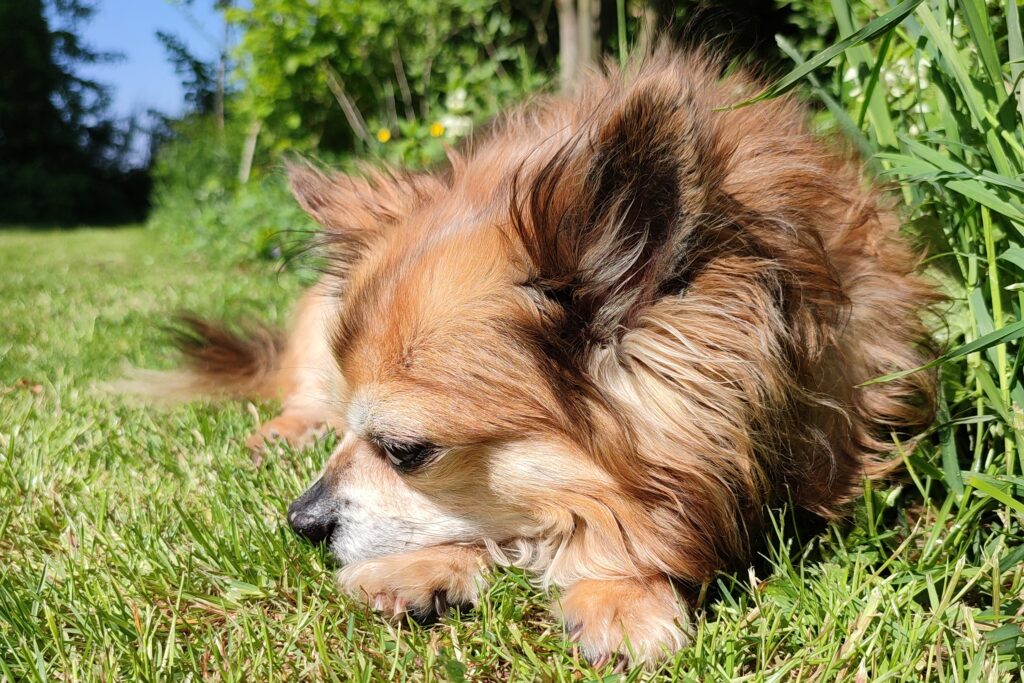
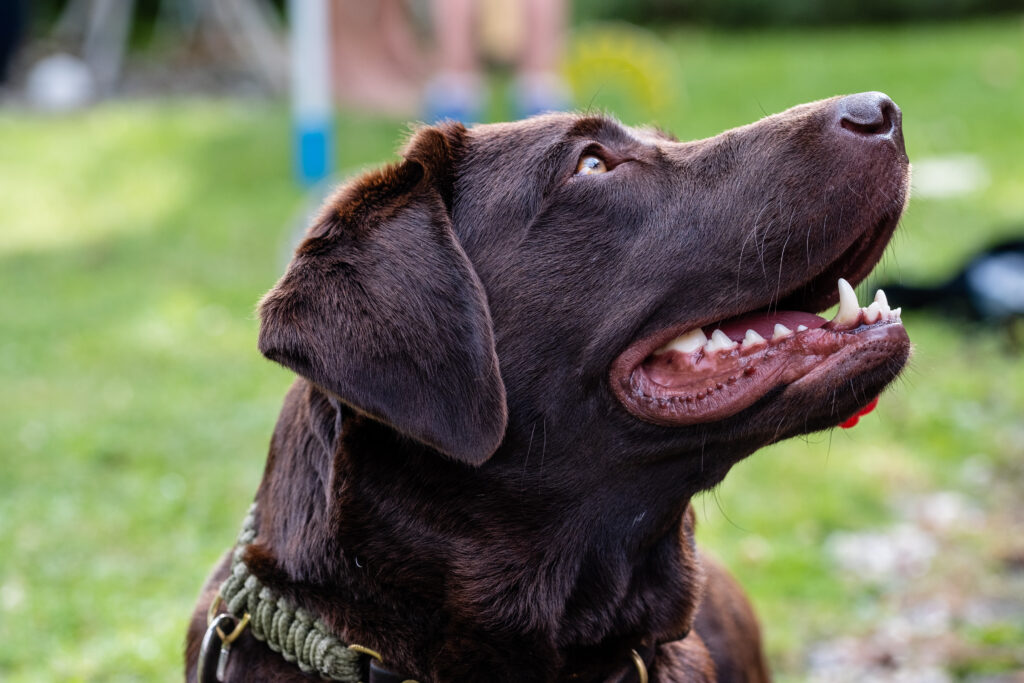
Physics does not negotiate. In an impact at 50 km/h, the weight of any unrestrained occupant is multiplied by about 35 times. A 3-kilogram Chihuahua hits as if it weighed more than 100; a 30-kilogram Labrador Retriever, as if it weighed a ton. That “bullet” can seriously injure the dog and people ahead.
But the accident isn’t the only risk.
- Distracting the driver: moving to the front seats, leaning on the shift gear or blocking your vision.
- Interfering with the airbag: if it is in the arms of the co-pilot, the airbag deployment crushes it against the person holding it.
- Running away after a hit: A frightened dog who gets fired or slips through an open door ends up running down the track, risking a second accident.
- Injury from a window: taking your head out at 60 miles an hour exposes your eyes and ears to insects, gravel and compressed air.
What the law says: DGT regulations and fines
In Spain, the reference is the article 18 (1) of the General Road Traffic Regulation: the driver must maintain his freedom of movement, field of vision and constant attention, and take care of “the proper placement of the objects or animals transported so that they do not interfere with driving”.
On the sanctions it is better to be honest, because the figures are dancing depending on the source: the basic offence for taking the animal loose moves between EUR 80 and EUR 100, and may reach The amount of the allowance if the officer considers that the conduct compromises safety (e.g. dog climbing onto the driver’s lap, which can even be categorised as negligent driving). There is no single ‘official’ amount for all cases: It depends on how you characterize each situation.
Two more notes that a lot of people miss:
- The Law 7/2023 on animal welfare prohibits leaving the dog in a closed vehicle exposed to life-threatening conditions.Leaving the dog “five minutes” in the car in summer is not only dangerous: it is punishable.
- Your the insurance company can put up pegs. when it comes to covering damages if the dog was traveling without proper restraint, because it’s considered driver negligence.
An important nuance: unlike child seats, there is no mandatory official approval for pet restraint systems.The DGT recommends double anchor harness, conveyor or separator grille, and there are manufacturers that subject their products to crash tests; look for that information before buying.
Restraint Systems – Which to Choose According to Your Dog
There is no one-size-fits-all system: it depends on the size of your dog and your car.
Rigid conveyor: the safest option for small dogs
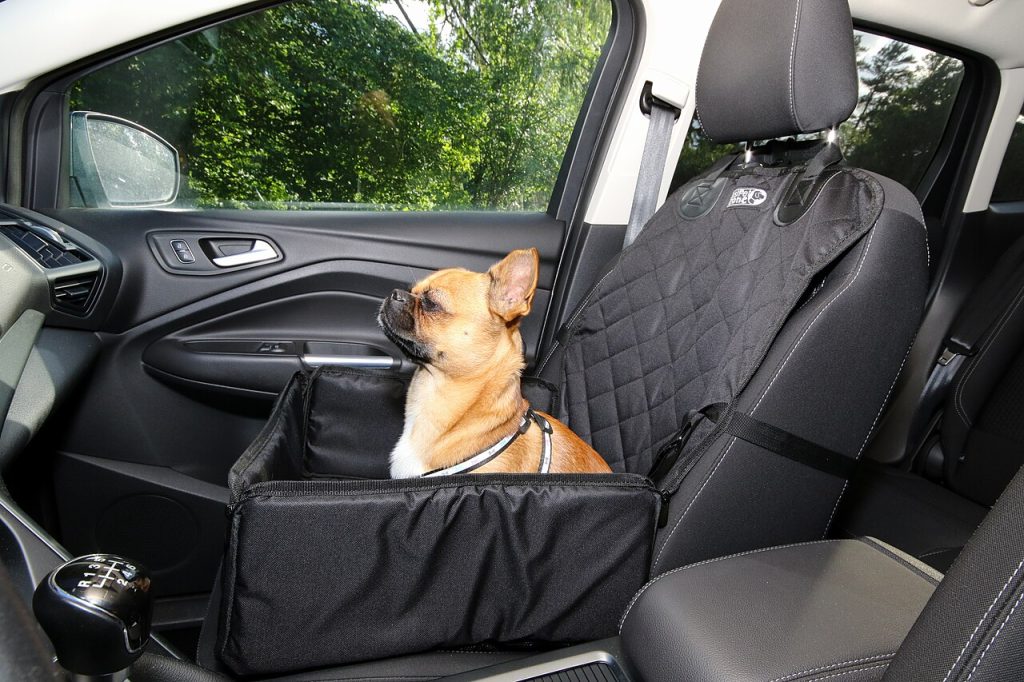
For a Yorkshire Terrier, a Chihuahua or any dog under 8-10 kg, the rigid conveyor is the most protective option. The key is in the placement: on the car floor, between the front and rear seats, in the transverse position. There it barely moves in case of braking. In the seat, held only with the belt, a conveyor can break or be fired.
Double anchorage harness: for medium dogs in the rear seat
If your dog travels in the backseat, you need a car-specific harness with two anchorages and short leashes, connected to seat belt closures or Isofix anchors. Long one-hook harnesses do not hold the body well in an impact and the DGT advises against them. And a golden rule: the anchorage always goes to the harness, never at the necklace.– in a brake, a collar anchorage can cause serious neck injury.
Trunk with partition: the solution for large dogs
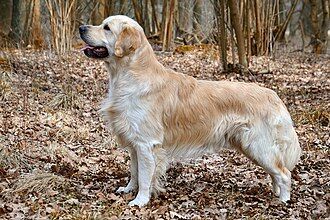
A Golden Retriever or a large-sized dog travels best in the trunk (in family-type cars or SUVs, with trunk communicated to the passenger compartment), separated by a well fixed rigid grating or barrier.
| The system | Ideal for | Where it’s placed | Level of protection |
|---|---|---|---|
| Rigid conveyor | Mini and small dogs | Floor, behind the front seat | Very high. |
| Double anchorage harness | Small and medium sized dogs | Rear seat | High (with short straps) |
| Dividing grid | Large dogs | Between trunk and passenger compartment | Stop it ! |
| Grid + conveyor | Any size | Box, cross-sectional | The highest (DGT recommendation) |
Anti-tide tips for driving with your dog
Dizziness in the car (kinetosis) is very common and has a physiological explanation: The brain receives conflicting signals between the inner ear, which detects movement, and what the dog sees and feels. It’s especially common in puppies, because their vestibular system is not yet mature; most outgrow it by their first year of life. In adults, the problem is often no longer the ear but the learned anxiety: the dog associates the car with dizziness (or going to the vet) and enters stressed, which worsens the circle.
Typical signs, even before vomiting: excessive drooling, re-licking, continuous yawning, whining, uneasiness or sudden apathy.
Guidelines That Work
- Almost empty stomach: avoid copious food before going out. In very prone dogs, some veterinarians recommend up to 8 hours without food before the trip. Water, always available.
- Forward facing: looking in the direction of the gait reduces sensory conflict.
- Fresh air: lower the windows with a pair of fingers to balance the pressure and keep the cabin cool.
- Smooth driving: the chain curves and the accelerators swim more than the kilometers.
- Gradual desensitization: if your dog has a bad day, he starts again from scratch. First sessions with the parked car and prizes; then minute trips with a pleasant destination (the park, not the vet); then 20-30 minute walks. Days or weeks, at his pace.
- Exercise Before Going Out: a dog with accumulated energy, such as a Border Collie, travels much worse.
- Familiar smells and sounds: its usual blanket on the transporter and quiet music at a low volume help more than it seems.
- Stops every 2 hours: to drink, to pee, to stretch your legs, always with the belt on before opening the door.
What about the dizziness medication?
It exists and it’s effective, but always on veterinary prescription. The reference drug is maropitant(Cerenia), a dog-specific antiemetic that acts on the vomiting centre: In clinical trials, about 93% of susceptible dogs treated did not vomit during the journey, compared with less than half on placebo. It’s administered about two hours before you leave. Your veterinarian may also recommend antihistamines (dimenhydrinate, meclizine), anxiolytics if the problem is stress, or calming pheromones. On natural remedies like ginger, the evidence is limited: It is not a bad thing to ask in consultation, but it does not replace the above. What you should never do is give him pills for humans on your own.: Doses and toxicity cannot be extrapolated.
Checklist for the day of travel
- Restraint system fitted and tested before D-Day.
- Fresh water and travel drinker (folding or anti-slip).
- Leash on or hand before to open doors at every stop.
- Health records and documentation; updated chip and plate with your phone.
- Your usual food for the destination: dietary and routine changes together are a surefire recipe for diarrhea.
- Cleaning kit: bags, paper, soakers and an old towel in case the dizziness wins the game.
- Go outside in the cool summer hours and graduate the air conditioner without jetting directly to the dog.
- Extreme caution with heat if your dog is brachycephalic – flat-nosed breeds like the Bulldog Francés or Pug have poor temperature regulation and are much more susceptible to heatstroke.
- And the rule of thumb: never leave the dog alone in the car.. In 10 minutes, the indoor temperature can go up about 10°C even with the windows open; in summer, a car in the sun can go over 50°C in less than half an hour.
Common Mistakes to Avoid
- Carrying him in my arms, although small and quiet: it is the most sanctioned and the most dangerous situation with airbag.
- Fasten the belt to the collar instead of a car harness: real risk of neck injury.
- Wearing a walking harness with a single long strap: does not hold the body in an impact.
- Leave the transporter loose. on the seat or on the tray: becomes another projectile.
- Plenty of food just before we left.: almost guaranteed dizziness in sensitive dogs.
- Let him stick his head out the window.: eye and ear injuries, and possible penalty.
- Launching trips with a 500 km journey: without prior habituation, the first long journey usually goes wrong.
- Automedicar with biodramine or other human medicinal products without consulting a veterinarian.
With the right restraint system, the law on your side, and dizziness under control, the car stops being a bad drink and becomes what it should be: the doorway to more plans together.
Frequently Asked Questions
Is it compulsory to take the dog in the car?
Yes. Article 18.1 of the General Traffic Regulations requires that transported animals do not interfere with driving, which in practice requires a conveyor, double-anchored harness or separator grille.
Can the dog ride in the front seat?
The norm does not explicitly prohibit it if it is well held, but it is a bad idea: the co-pilot’s airbag can cause serious injury and its presence distracts the driver more.
What can I give my dog for dizziness?
The reference treatment is maropitant (Cerenia), a highly effective prescription antiemetic given about two hours before travel. Do not use human medicines on your own: doses are not extrapolated and can be toxic.
How often do you have to stop on a long trip with a dog?
Every 2 hours or so, to drink, go to the toilet and stretch, always strap in before opening the door, and look for areas away from traffic.
Can I leave the dog alone in the car for a few minutes?
No. The indoor temperature can rise about 10°C in just 10 minutes, even with the windows half-open, and heat stroke can be fatal.
Is it normal for a puppy to get more dizzy than an adult?
Yes. The vestibular system of the inner ear, responsible for balance, is not fully developed in puppies, so they get dizzy more easily. Most outgrow it by their first year of life, especially if they get used to the car gradually and positively.