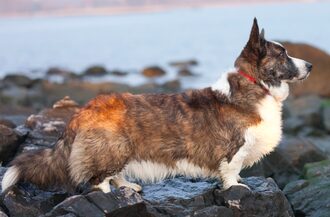
The Welsh Corgi from Cardigan is a long-bodied, short-legged herding dog, one of the oldest herding breeds in the British Isles. Intelligent, loyal and surprisingly robust despite its size, it combines the hardworking character of a Welsh cattle farmer with a bomb-proof camaraderie. If you’re looking for a small-to-medium dog with a head, instinct and a desire to be with you, the Cardigan Welsh Corgi deserves your attention. Here’s the complete guide to deciding if it’s a good fit for you and how to take good care of it.
Is the Welsh Corgi from Cardigan for you?
Before you fall in love with those huge ears and that elongated body, you should look at the breed honestly. The Cardigan is a herding dog in a compact format: it has energy, head and opinion of its own. It is not a sofa stuffed animal, but neither is it a tireless athlete. These are its lights and shadows.
In favour .
- Very intelligent and eager to please: he learns fast.
- Loyal and affectionate to his family, good companion dog.
- Manageable size that fits a flat or house with garden.
- Versatile: good for agility, obedience, shepherding or just living together.
- A good watcher: he warns despite his small stature.
- A rustic breed, with good health and good longevity.
To be taken into account
- Shepherding instinct: may try to “catch” children and pets by biting their heels.
- It sheds all year round, with two strong shoots.
- He needs mental stimulation every day or he gets bored.
- Reserved with strangers; may bark to warn.
- His long back makes him prone to disc problems if he gets fat or jumps badly.
- He doesn’t like prolonged solitude: he wants to be with his people.
Character and temperament

If we had to sum up the Cardigan in one word, it would be versatile. It’s an alert, observant dog with an unusual ability to adapt: just as happy in an urban apartment as it is on a farm, and just as comfortable with quiet walks as with family play days. Of course, that shepherd’s brain needs homework: a busy Cardigan is a balanced Cardigan.
Compared to its cousin the Pembroke, the Cardigan is usually described as somewhat more thoughtful and reserved. It is not a dog that jumps to greet anyone; it is cautious with strangers and needs a moment to trust. When he relaxes, however, his playful, clownish and deeply devoted side to his people appears. He’s affectionate, sensitive to the mood of the house and very affectionate: He considers himself one more member of the pack and loves to participate in everything.
His herding instinct is very much alive. It retains a tendency to control movement, so it can try to group children, cats, or other dogs together by slapping them or biting their heels. It ‘s not aggression . It’s pure work. With education and positive reinforcement, it redirects smoothly. He’s also a born vigilante: Despite its size, it warns with barking of any novelty, making it a good four-legged alarm.
Coexistence: children, other pets, flat and loneliness
- With children: is gentle, patient and protective, a good family choice. You have to supervise the play with the little ones because their instinct can lead them to “shepherd” by biting their heels; teaching them from a puppy not to do it solves it.
- With other dogs: usually gets along well, especially if socialized early.
- With cats and other pets: can live comfortably with them if it grows up with them, although that same instinct to pounce can annoy an impatient cat.
- On the floor: fits perfectly into an apartment as long as you cover his daily exercise and companionship needs.
- The Cardigan wants to be with his family and can’t stand long absences; spending too many hours can only lead to barking or destructive behavior.
- Clima:‘s double layer makes it resistant to cold and reasonably tolerant to heat, although in summer it is advisable to avoid the sunniest hours.
Education and training
Few small dogs learn as quickly as a Cardigan. It is very intelligent and has a strong desire to please, so it responds wonderfully to training based on positive reinforcement, rewards, and play. It is, in fact, an excellent first pet for inexperienced owners: loyal, responsive, and eager to do well.
The key is to start early. early socialization– introducing him to people, dogs, noises and varied environments during puppyhood – softens his natural reserve and prevents excessive shyness or barking. Equally important is channeling the herding instinct from the beginning: teaching him not to bite his heels and offering alternatives (toys, search games) gives him a healthy outlet.
It is a dog of habits: it learns routines easily and enjoys predictability. It uses that memory to set habits, but it varies the exercises so that it does not get bored. Short, frequent and fun sessions work better than long training. It avoids harsh methods: the Cardigan is sensitive and an unfair treatment blocks it.
Exercise and activity

The Cardigan has a moderate-high energy that regulates well depending on who he lives with, but don’t be fooled by his short legs: He’s a working dog who needs to be moved. With a couple of good daily walks and some play he usually has enough, although he is grateful to be able to stretch out more when given the opportunity. The important thing is not only the physical exercise, but the mentally challenged: Smell games, interactive toys and obedience keep him happy.
Where he really shines is in dog sports. Agility, obedience, rallying, flyball, tracking and, of course, herding tests are his element. Participating in these activities not only tires him, but it strengthens your bond and taps into his intelligence.
A warning for its anatomy: having a long back, the control the jumps is suitable from sofas or cars and avoiding overweight, which loads the spine.
Care: fur and hygiene
The Cardigan wears a double coat: a dense, insulating inner coat underneath a medium-length, rather water-resistant outer coat that protects it from the cold and farm mud, but comes at a price: it loosens hair year-round and lives through two intense seasonal moults, in spring and autumn.
The maintenance, however, is simple. A weekly brushing is sufficient most of the year to remove dead hair and keep the mantle healthy; during mowing it is advisable to brush every two or three days so as not to end up with hair all over the house.
Complete the routine with the basics of any dog: checking and cleaning the ears (those big ears ventilate well, but it is advisable to monitor them), cutting the nails when they hit the ground, brushing the teeth several times a week and monitoring the pads.
Foodstuffs
The Cardigan is not a particularly delicate dog with food, but it does have a characteristic that forces you to be attentive: tends to gain weight easily. Its chondrodysplastic structure (long body, short legs) causes each extra kilo to fall on an already demanding spine, so maintaining a fit weight is not aesthetic, it is health.
Offer them a quality, complete and balanced diet, tailored to their age, size and activity level. Respect the recommended rations, divide them into two meals a day, and measure the amount instead of filling the bowl “by the eye”.
As a practical reference, you should be able to feel their ribs without them sticking out and see a waistline marked from above.
Health and life expectancy
Overall, the Cardigan Welsh Corgi is a rustic and quite healthy. dog, with few serious hereditary diseases and a pleasant longevity.
That said, it’s good to know your weaknesses to prevent:
- If you have any of the following: is their primary watch. Being a breed with a long body and short legs (chondrodysplastic), it shares with the Dachshund the risk of herniated discs.
- Patients who have been diagnosed with progressive retinal atrophy is an inherited eye disorder that can lead to vision loss.
- Cataratas and other eye problems.
- Hip and elbow dysplasia: less common, but present in the breed.
The most common causes of death recorded in the breed are cancer, old age, and neurological disorders. Choosing a serious breeder puppy that tests parents, keeping up with veterinary checkups, and taking care of weight are the three best investments in their health.
Physical appearance

The Cardigan is, in the words of the old American standard, “a German shepherd with short legs”: a long, short, strong, well-anchored dog with large, upright, rounded ears and a characteristic long, fox-brush-shaped tail. Precisely that tail is one of the keys to distinguishing it from a glance at the Pembroke, which carries it short. The Cardigan is also somewhat larger and heavier than its cousin.
Males weigh between 14 and 17 kg and females between 11 and 15 kg, a notable density for their height that betrays their robustness.
Their biggest mark of identity is the variety of colours, much wider than most breeds: red, sable, brindle in all its shades, black with or without fire, and the spectacular blue merle(blue-gray jasper, often with light eyes). White markings on the chest, neck, legs, snout, tail tip, and a streak on the head usually appear on any of these colors. The only rule of color is that it must not be predominantly white.
Origin and history
The Cardigan comes from Gales, specifically from the Ceredigion region (Cardigan, in its anglicised form), whence it takes its name. It is one of the oldest herding breeds in the British Isles: It is estimated that dogs of this type have been in Wales for over 3,000 years. The most widespread theory about its origin relates it to the teckel type dog family, the same one that gave rise to the Dachshund, which explains its long body and short legs.
The Welsh word colour literally means “dwarf dog”, and the breed was formerly called the “yard-long dog” (c-llathed). Originally it was mainly a farm keeper which, over time, took over the job of driving and grazing cattle: Barking and nibbling on the heels of the cattle, bending over to dodge the kicks. His short stature, far from being a defect, was an advantage in that trade.
Pembroke and Cardigan were first exhibited together in 1925 and the British Kennel Club initially registered them as a single breed. In 1928 they were recognised as distinct varieties, still under the umbrella of “Welsh Corgis”, and it was not until 1934 that they were officially separated and shown separately. The Cardigan arrived in the United States in 1931. Despite his age and virtues, he never reached the popularity of his cousin Pembroke, partly because of the latter’s famous link to the British royal family.
Curiosities
- The name “Cardigan” comes from its region of origin, i ‘m not . from its marks reminiscent of a rebeca (cardigan in English): it is a coincidence.
- Its long brush tail is the quickest way to differentiate it from the Pembroke, which wears it short.
- He shares ancestry with the Dachshund: hence the long, short body of both.
- Their adaptability is legendary: there are Cardigans living happily ever after from the frigid Alaska to the Arizona desert.
- Although it lives in the shadow of the Pembroke in popularity, many enthusiasts consider it the “original” and more versatile corgi.
- The blue merle, associated with this corgi, requires careful crossing: a responsible breeder never mates two merles because of health risks.
If you are attracted to the hardworking character and compact size of the Cardigan, you may want to compare it with related breeds before deciding. The most obvious resemblance is to its land sibling, the Pembroke Welsh Corgi, somewhat more popular and short-tailed. You will also be interested in the tireless Border Collie, the robust Australian Cattle Dog– another specialist in driving cattle – and the classic herding dog par excellence, the Pastor Alemán, that breed that the Cardigan reminds you of “in short legs version”.
Frequently asked questions about the Cardigan Welsh Corgi
Is the Cardigan Welsh Corgi a good dog for families with children?
Yes. He is gentle, patient and protective, and enjoys family life. The only nuance is his shepherding instinct, which can lead him to “catch” children by biting their heels; supervising play with the little ones and educating him from puppyhood solves it without problem.
How tall and how much does a Cardigan Welsh Corgi weigh?
It measures approximately 25 to 33 cm at the withers. Males weigh between 14 and 17 kg and females between 11 and 15 kg. It is a short but solid dog with strong bones, somewhat larger and heavier than the Pembroke.
How is the Cardigan different from the Pembroke Welsh Corgi?
The most noticeable difference is the tail: the Cardigan has a long, fox-brush-shaped tail, while the Pembroke has a short one. The Cardigan is also somewhat larger, tends to have a somewhat more reserved character and supports more colors, including the blue merle.
How long does a Welsh Corgi from Cardigan live?
It is a long-lived breed. A British study from 2024 placed its life expectancy at around 13 years, above the average of purebred dogs. With good care, adjusted weight and veterinary checkups, many outlive that age.
Do you lose a lot of hair and how much care do you need?
It has a double coat and loose hair all year round, with two intense seasonal mouldings in spring and autumn.
Does he need a lot of exercise? Can he live in a flat?
He has moderate to high energy. With a couple of good daily walks, play and, above all, mental stimulation he is satisfied. He adapts perfectly to a floor whenever you cover his exercise and don’t leave him alone for too many hours, because he takes loneliness badly.
Is it easy to educate?
It is very intelligent and eager to please, which makes it one of the easiest small dogs to train, suitable even for first-time owners. It responds to positive reinforcement, short sessions and early socialization; it avoids harsh methods, because it is sensitive.
What health problems do you have most often?
Its main surveillance is intervertebral disc disease (IVDD), linked to its long body: controlling weight and limiting jumps prevents it. It can also inherit progressive retinal atrophy (PRA) and cataracts, and less commonly hip or elbow dysplasia.