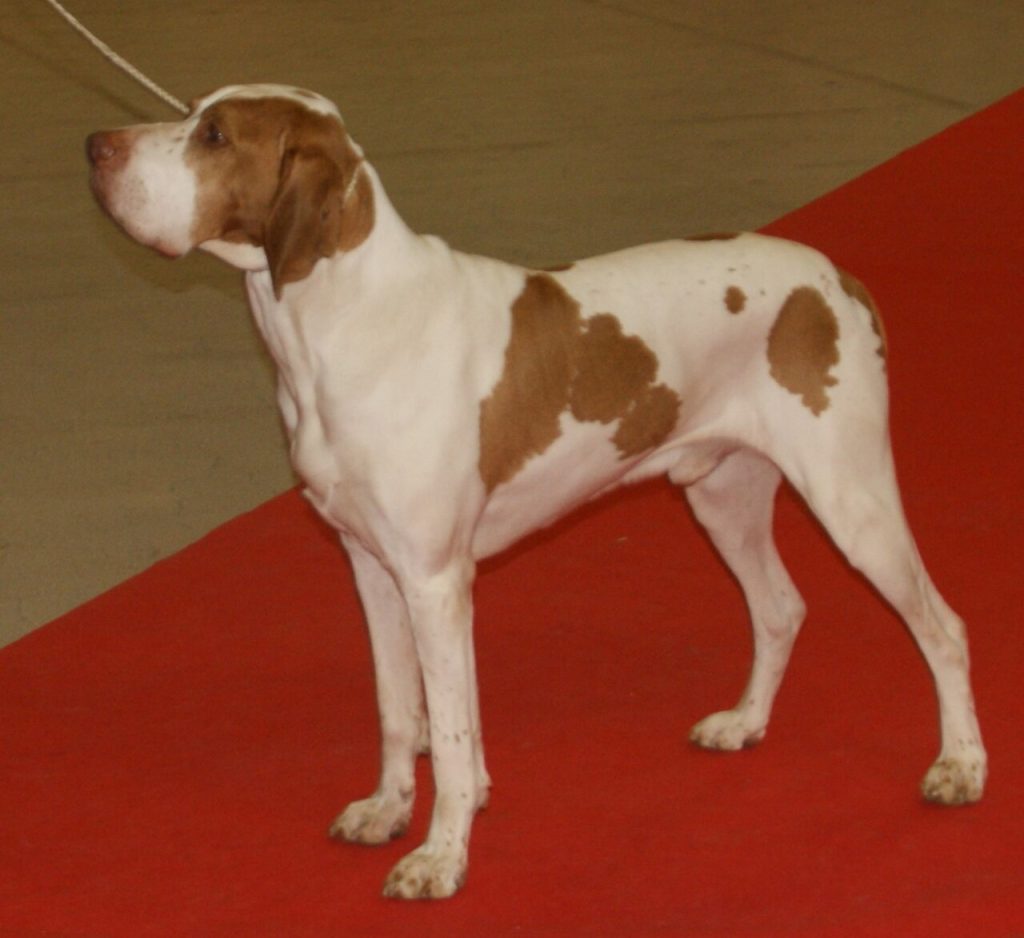
The Braco of the Ariège is one of the rarest and most unknown show dogs in France: a large, white male with orange or brown spots, bred for generations by southwestern hunters to look for and mark hare and partridge. It is a purebred wild dog – energetic, resilient, and independent – that was on the brink of extinction and survives today thanks to a handful of passionate breeders. If you’re looking for a quiet couch companion, this isn’t your dog; if you want a tireless hunter and a field athlete, the Ariège Braco deserves to be known.
Is the Brace of the Ariège for you?
The Braco del Ariège is a continental working dog. Before you fall in love with its elegant appearance, be honest: this breed requires intense daily activity, space and a person who enjoys the countryside. It is not an ornamental dog or a salon stuffed animal. Instead, it offers a noble, balanced and deeply connected companion to its family.
In favour .
- Docile temperament, sweet and easy to educate for those who give it structure.
- Endurance athlete: ideal for active people, hunters and dog sports.
- Short coat that barely needs maintenance.
- Extraordinary sense of smell and enormous ability to concentrate on the trail.
- Loving and attached to his own, he usually gets along well with children.
To be taken into account
- He needs plenty of daily exercise; bored and withdrawn, he becomes frustrated.
- Very independent: the hunting instinct can win the call.
- Bad candidate for small apartments or totally urban living.
- Very rare breed: finding a puppy involves waiting lists and travel.
- Little medical documentation for its small population census.

Character and temperament
The FCI’s own standard describes the Braco del Ariège as a resilient, docile and easy to educate dog, and that phrase sums up its essence well. He is a smooth-looking, frank and intelligent arm, with a calm character at home that contrasts with the intensity he shows on the field. As soon as it smells like game, it turns into: He concentrates, walks the field methodically and remains motionless marking the piece with that “stop” that defines all the sample dogs.
It ‘s important to understand we ‘re dealing with a independent dog . It works at a distance from its guide, makes decisions on its own when following a trail, and it’s not the typical dog that looks at its human every two seconds waiting for orders. That autonomy is just what was sought when it was created, and it should be respected: The Ariège Braque is stubborn not on a whim, but because it was selected to think while hunting.
In the domestic environment, it is an affectionate and sensitive dog, which is very attached to its family and prefers gentle methods. It does not respond well to harshness or screams; it loses confidence and closes.
Coexistence: children, other pets, flat and loneliness
With children.‘s docile and affectionate nature makes it a good companion for families with children, always with the supervision that any large and energetic dog deserves.
With other dogs. Accustomed to hunting in packs and matching with other dogs in the wild, it is usually sociable with its congeners.
It is a hunting dog with a marked prey instinct towards small fauna. It can learn to live with a cat if it grows up with it from puppyhood, but small animals (rabbits, birds, rodents) awaken its instinct and are rarely a safe combination.

Life on the floor. is not his ideal environment. He is a large, athletic dog and used to walking miles in the open field. He can live in a flat if – and only if – he is guaranteed several long and demanding outings a day, but he will fit much better in a house with land, in a rural or peri-urban environment with access to spaces to run.
Soledad. is a dog attached to its people and does not do well long days in solitude. Boredom and lack of stimulation easily lead to frustration, wrecking or barking. If you spend many hours away from home, you will need company, midday walks or a routine designed so that you do not stay alone for too long.
Education and training
The good news is that the Ariège Braco is a quick and cooperative dog, which makes it relatively easy to train. The FCI describes it as docile and easy to train, and the breeders who recovered it highlight precisely its willingness to learn. The key is to work from motivation and positive reinforcement, never from imposition.
The challenge is not intelligence, but the independence and the very strong hunting instinct. The order that ‘s going to cost you the most and the most important one is the call (recall): When it picks up an interesting smell, its brachial brain goes into working mode and can ignore you. Train the lap from puppyhood, in increasingly distracted environments, with high-value rewards, and keep the long or safe zone until the answer is reliable.
- Early socialization: exposes me as a puppy to people, dogs, noises and different environments.
- Short and varied sessions: gets bored with repetition; better little and entertaining.
- Mental stimulation: sniffing and tracking games take advantage of its best quality.
- Consistency and patience: clear rules from the start, no harshness.
Exercise and activity
If you’re left with just one idea from this guide, let it be this: the Braco del Ariège needs a lot of exercise. It was created to spend whole days beating the field, and that machinery is still inside each specimen even if it never gets to hunt. A couple of short walks a day isn’t enough for it.
We are talking about a dog that appreciates at least one or two hours of intense activity daily: running, long walks on varied terrain, loose moments in safe areas where it can gallop and use its sense of smell. It is an excellent companion for running, hiking, mountain biking, canicross or olfactory sports. If you also dedicate it to hunting, it will find its full meaning.
An Ariège with its exercise covered is a calm and happy dog at home. One without enough activity becomes restless, frustrated and prone to seeking trouble. It is not a matter of whim: it is a need of the breed.
Care: fur and hygiene
Fortunately, the maintenance of the Braco del Ariège is very simple. Its hair is short, dense and shiny, even finer and shorter on the head and ears. With a weekly brushing to remove the dead hair and distribute the natural fat is enough to keep it clean and shiny.
Baths should only be necessary, as too much dries the skin. What does deserve special attention are the drooping ears: being stuck and poorly ventilated, they retain moisture and dirt, especially in a dog that enters and leaves the mountain. Check and clean them regularly to prevent infections. Complete the routine with cutting nails when necessary and good dental hygiene.
After each field day, it is advisable to quickly check the skin, pads and spaces between the fingers for spikes, ticks or small wounds, a classic in any hunting dog.
Foodstuffs
The Ariège Braco is a large, muscular and very active dog, and its diet should reflect this. It needs a complete and quality diet, with a good supply of protein to maintain its muscle mass and enough energy to sustain its rhythm. The rations are adjusted to its actual activity level: a dog that hunts or trains daily burns much more than one with a quieter life.
As with most large, deep-chested breeds, split the food in two. is recommended and avoid intense exercise just before and after eating, a prudent measure to reduce the risk of gastric dilation-torsion. Watch your body condition: you should stay fibrous and athletic, without overweight, which would punish your joints.
Health and life expectancy
The Braco del Ariège is, in general, a rustic and robust dog, the result of a selection oriented to work and functionality rather than to extreme aesthetics. It does not carry the problems associated with exaggerated morphologies and, if well cared for, is usually a healthy and long-lived dog. There is no comprehensive record of hereditary diseases specific to the breed, largely because its population is very small.
It is precisely that small census that is its main health vulnerability: With only a few specimens, genetic variability is limited and responsible breeding is crucial. As a precaution, and as with all large breeds, it is advisable to monitor for conditions typical of active dogs of their size, such as hypoplasia of the hip or elbow, and hearing problems resulting from drooping ears. It always comes to breeders who prioritize health and genetic diversity.
Regular veterinary checkups, weight control, proper exercise and parasite prevention are the best recipe to accompany him for many years.

Physical appearance
The Braco del Ariège is a powerful and robust construction, but no weight Braco type dog, with a vigorous and athletic appearance.
It’s a big dog. Males measure around 60 to 67 cm at the cross and females somewhat less, around 56 to 65 cm, with an approximate weight of 25 to 30 kg. The head is elongated and noble, with fine, long, inserted ears at eye level or below, not attached to the head. The eyes, slightly oval and well-open, convey a sweet and intelligent expression, with a dark amber or brown iris depending on the layer. The tail, strong at birth and tapering toward the tip, was traditionally shortened to about four-tenths of its length, although it is admitted to be whole.
Its hallmark is the coating: short, tight and shiny hair, with a white background strongly dotted with light orange (fauve) or brown/brown-colored spots, especially on the head and ears.
Origin and history
The Ariège Braco takes its name from the the department of Ariège, in the region of Occitania, in the southwest of France, next to the Pyrenees.
The breed is considered to have emerged in the 19th century from crosses between French type Charles X hounds and southern white and orange-coated strain hounds, with the aim of obtaining a more active, lightweight hunting dog adapted to the warm southern climate. Cynologists have noted their resemblance to the white and orange dogs painted by Jean-Baptiste Oudry in paintings preserved in the Louvre and Versailles, attributing to them a certain role as ancestors. For generations it was the reference specimen dog of southwestern hunters, both on the plains and in the lowlands.
The 20th century almost wiped him out. The two world wars decimated its population and, after World War II, the breed was reduced to a handful of specimens kept by local hunters. The situation became critical: since 1964 no dog has been entered in the French book of origin (LOF). In 1990, a team of passionate breeders – with Alain Deteix at the head – decided to dedicate themselves to their salvation and founded that same year the This Regulation shall be binding in its entirety and directly applicable in all Member States. to recover and promote the breed. At the end of the nineties there were already about a hundred registered specimens and the number of births was growing again, although it is still one of the rarest breeds in France.
Curiosities
- A race on the edge of the abyss: for more than two decades not a single puppy was registered in the French stud book.
- The white and orange dogs in the paintings of Jean-Baptiste Oudry, in the Louvre and at Versailles, are considered a reflection of their ancestors.
- Different names, same breed: before being “de l’Ariège” was called braco de Toulouse and braco du Midi.
- Specialist in hares and partridges: is specially equipped for hunting hare and partridge in its native range.
- Relative of another Aryan: shares land and name with the Ariégeois, a hound from the same region, although they are different breeds with different functions.
If you are attracted to the hardworking character and elegance of the show dogs, you will be interested in learning about other related breeds such as the Pointer, the versatile Vizsla and the elegant Weimaraner; and if what you value is a versatile hunting dog with a good family character, the Cocker Spaniel is also worth a look.
Frequently asked questions about the Ariège Brac
Is the Braco del Ariège a good family dog?
Yes, for an active family. It is docile, affectionate and very attached to its own, and usually gets along well with children. Of course, it needs a lot of exercise: it is a hunting dog, not a couch dog, and only shines in homes willing to give it daily activity.
How much exercise do you need a day?
Enough. At least one to two hours a day of intense activity: running, long walks and leisure time in safe areas where he can gallop and sniff. He loves canicross, hiking and olfactory sports. Without that outlet he becomes frustrated.
Does he adapt to living in a flat?
It is not his ideal environment. It is a large, athletic dog accustomed to the open field. It can live on the floor if it is guaranteed several long and demanding outings a day, but it fits much better in a house with land or in a rural environment.
Is it easy to train?
It is intelligent, docile, and collaborative, so it learns easily with positive reinforcement. The challenge is its independence and hunting instinct: the most difficult order is the call, which should be worked hard from a puppy.
How tall and how much does a Braco del Ariège weigh?
It is a large dog. Males measure about 60-67 cm at the withers and females slightly less (about 56-65 cm), with an approximate weight of 25-30 kg.
Why is it such a strange breed?
The two world wars almost extinguished it and, since 1964, no specimen was registered in the French book of origin. Only in 1990, thanks to the Club du Braque de l’Ariège, began its recovery.
What kind of skin care do you need?
Their short hair requires only a weekly brushing and occasional bathing, and their droopy ears require regular checking and cleaning to prevent infection, especially if they frequent the countryside.
Do you get along with other dogs and pets?
With other dogs it is usually sociable, as it is accustomed to hunting in company. With cats it can live if it grows up with them, but its prey instinct towards small animals (rabbits, birds, rodents) is strong and much caution is warranted.