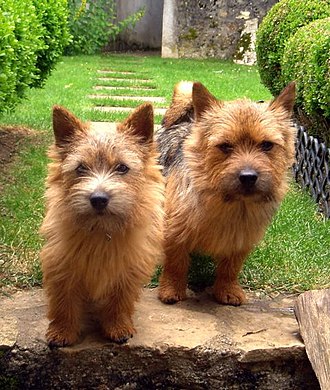
The Norwich Terrier is one of the world’s smallest working terriers: a compact, robust, erect-eared dog bred in eastern England to hunt rats and vermin. Under its plush appearance is a lively, courageous and deeply sociable character. If you are looking for a small companion but with a hunter’s soul, the Norwich Terrier deserves all your attention.
Is the Norwich Terrier for you?

The Norwich Terrier is a dog of large character within a tiny body. It is cheerful, affectionate, and easy-going, but retains the terrier temperament intact: curiosity, stubbornness, and a strong hunting instinct. It is not an ornamental dog; it needs companionship, stimulation, and an owner who enjoys its energy.
In favour .
- Small and manageable, ideal for floors if you exercise.
- Very sociable and affectionate – a true companion dog.
- Resilient, healthy and long-lived in purebred dogs.
- He usually gets along well with children and other dogs.
- He barks little for free, though he warns of visitors.
- Wise and funny, brilliant at agility and olfactory games.
To be taken into account
- Strong prey instinct: dangerous with rodents and poultry.
- Stubborn: needs patient and constant education.
- Hard hair requires manual stripping, not machine cutting.
- Greedy appetite: tends to overweight if the ration is not controlled.
- He doesn’t tolerate prolonged solitude well; he’s a lap dog.
- Rare breed with small litters: it can be hard to find.
Character and temperament
If we had to sum up the Norwich Terrier in one word, it would be “vibrant”. It is an alert, cheerful and curious dog by nature, who is interested in everything that happens around him and wants to participate in it. Unlike some more nervous or reactive terriers, the Norwich stands out for a balanced temperament and especially sociable: It enjoys human and canine company, and rarely seeks a fight.
This does not mean that the Norwich is a soft dog. The Norwich is assertive and courageous, a direct inheritance of its past as a predator hunter. It can show determination and stand up when it feels necessary, but, well socialized and educated, it is neither aggressive nor stubborn. It is this mixture of courage and gentleness that has made it one of the most beloved terriers as a family pet.
It is also important to understand its stubborn side. Like any good terrier, the Norwich has its own opinions and remarkable independence. It is eager to please its owner, but in its own way and at its own pace. This combination of intelligence, energy and stubbornness makes it an entertaining dog, but one that demands an involved owner who knows how to channel his character.
Coexistence: children, other pets, flat and loneliness
- With children: is generally a good companion for small children, patient and playful. Its robust size makes it less fragile than other mini-size dogs, although it is always advisable to teach children to respect it and supervise play.
- With other dogs: has been well socialized since puppyhood, usually living peacefully with other dogs.
- With other pets: was bred to hunt rodents and retains a strong prey instinct. Hamsters, rabbits, gerbils or birds can be seen as prey, however much they are raised together. Coexistence with cats is possible if they are accustomed from puppies, but requires caution.
- On the floor:‘s small size and tendency to bark little make it a good apartment dog, provided you meet its daily exercise and stimulation needs.
- In the face of loneliness: is a lap dog that greatly enjoys the company of its family. It is not made to live in the yard or to spend long days alone; if it is bored or feels abandoned, it may develop behaviors such as barking or digging.
Education and training
The Norwich Terrier is intelligent and quick to learn, but its terrier stubbornness demands an intelligent approach. The key lies in positive reinforcement: rewards, play and enthusiasm work much better than toughness, which only gets this dog in a band. Short, varied and fun sessions keep its attention and prevent it from getting bored.
Early socialization is essential. Exposing a puppy to people, dogs, noises and different environments builds a safe and balanced adult. It is also advisable to work early on the call and control of the prey instinct, because a Norwich that detects a trail can completely ignore its owner and shoot out after the “hunt”.
Two very terrier behaviors are worthy of attention: Barking and digging. Both are hereditary and appear especially when the dog is bored or without stimulation. Early and consistent training, along with sufficient mental and physical activity, helps to keep them under control. As a reward, the Norwich is an enthusiastic pupil who enjoys learning tricks and participating in dog sports.
Exercise and activity

Just because it’s small doesn’t mean it’s sedentary, quite the contrary. The Norwich is a working dog, bred to accompany its owners on horseback and search for prey for hours. It’s resilient and active, and needs to expend energy daily to be balanced. A boring Norwich is a Norwich that barks, digs and looks for trouble.
At a minimum, he needs a good daily walk, but ideally, give him about an hour of activity divided into walks, runs, scent games, or training sessions. He loves to explore and smell, so varied walks, where he can do research, provide both mental and physical stimulation.
Its alert nature and agility make it a great performer in dog sports such as agility and flyball, where its energy and desire to please find a perfect outlet. These activities, besides burning energy, strengthen the bond with its owner and keep its mind active.
Care: fur and hygiene
The Norwich Terrier has a very characteristic double coat: a hard, rough and almost wired outer layer, and a soft and warm inner undercoat that protects it from cold and moisture.
The fundamental technique is the stripping or manual pulling of dead hair. It consists of removing the dead hairs from the outer layer by hand (or with a stripping knife) so that the mantle retains its hard texture, intense color and waterproof function. It should be done at least twice a year, in autumn and spring, although the ideal is to work it regularly in what is known as rolling, keeping hair of all lengths growing; thus the sessions are shorter and simpler.
Very important: norwich must not be shaved or cut with scissors or a machine.. Doing so destroys the structure of the fur and ruins the natural color and texture of the coat, leaving it soft and dull. Between stripping sessions, a weekly brushing with a steel comb is enough to remove loose hairs and prevent knots. The rest of the hygiene is the usual: checking and cleaning ears, cutting nails, maintaining dental hygiene and bathing only when necessary.
Foodstuffs
The Norwich Terrier has a reputation for being a voracious eater: its voracious appetite leads it to eat anything minimally edible. This trait, coupled with its small size, makes it especially prone to overweight, so controlling the amount of food is key to its health. A few extra grams in such a small dog make a big difference.
It is advisable to provide them with complete, high-quality food, appropriate to their age, weight, and activity level, in measured portions, preferably twice a day. It is advisable to moderate the rewards and table extras, which add up quickly. Weighing the dog regularly and monitoring its figure is the best way to detect any excess in time. As always, your veterinarian is the point of reference for setting a specific diet.
Health and life expectancy

Overall, the Norwich Terrier is a healthy and robust breed, with an estimated life expectancy of around 13 to 14 years according to studies conducted in the United Kingdom and the United States.
Among the documented conditions, several stand out:
- Portosystemic shunt: an American study of more than 90,000 dogs placed the Norwich as the second most predisposed breed to this malformation of the liver vessels, with 7.41% of affected versus 0.35% of mixed breed dogs.
- Cataratas: U.S. hospital records show a prevalence of 4.02% in the breed, compared to 1.61% in mixed-race.
- Obstructive airway syndrome: some Norwich breeds suffer from a respiratory disorder of their own, distinct from brachycephalic breeds, associated with alterations of the larynx. A 2019 study linked it to a mutated variant of the ADAMTS3 gene, and is working on genetic testing to reduce its transmission.
- Complications of childbirth: is a small litter breed (one to three puppies) with a high C-section rate, which partly explains its rarity.
A 2006 British Kennel Club health survey identified old age (30.4%), cancer (21.4%), heart disease (12.5%) and neurological causes (7.1%) as the leading causes of death.
Physical appearance
The Norwich Terrier is one of the smallest working terriers in existence. It measures at most about 25 cm at the withers and weighs about 5 to 5.5 kg, with a compact, low and surprisingly strong constitution for its size.
Its hallmark is the well-separated ears erect and pointed, which gives it that alert and mischievous expression so recognizable. In fact, this is the most visible difference from its close relative, the Norfolk Terrier, which carries them down.
The body is short and well proportioned, with a good depth of chest and a robust back; the legs are short and the tail, of moderate length, is carried upright with ease.
Origin and history
The Norwich Terrier is native to eastern England, specifically the East Anglia region, where it has existed as a working terrier since at least the 19th century. He was raised for a very specific task: hunting rats and vermin in stables and farms, chasing foxes in their burrows and accompanying their owners, who often travelled on horseback. Small red terriers, related to the Irish Terrier, have inhabited the area since the 1860s and are among their likely ancestors.
The breed had several names before setting the current one. It became known as Cantab Terrier, because it became fashionable among students at Cambridge University, and also as Trumpington Terrier, after Trumpington Street where a breeder kept his dogs. Later, a man named Frank Jones popularized these terriers and gave them much of their current form; when the specimens were exported to the United States in the early 20th century, they were known as Jones Terrier.
The British Kennel Club officially recognized the breed in 1932. From the very beginning, puppies were born with upright ears and others with sloping ears, and both types were admitted to exhibitions, generating decades of debate. The matter was settled when, in 1964, the Kennel Club recognized the variety of dropped ears as a distinct breed: the Norfolk Terrier. The American Kennel Club, the United Kennel Club and the Canadian Kennel Club did the same in 1979. Until then, both varieties were distinguished by the abbreviation P.E. (ears up) and D.E. (Ears dropped)
Curiosities
- One of the rarest breeds in Britain. The Norwich is on the British Kennel Club’s Vulnerable Native Breeds list, reserved for native breeds with fewer than 300 registered puppies per year.
- Norwich and Norfolk, separated brothers. For years they were the same breed with two types of ears; today they are two different official breeds, practically identical except for the ears: erected in Norwich, fallen in Norfolk.
- The college terrier. His passage through Cambridge earned him the nickname Cantab Terrier and made him a fashionable mascot among students in the late 19th century.
- A possible cameo in the painting. It has been speculated that the puppy that appears at the couple’s feet in Jan van Eyck’s The Arnolfini couple(1430) resembles the current Norwich, although this is only a curious coincidence of appearance.
- Tiny layers. has between one and three puppies per birth, with frequent caesarean sections, explaining much of its scarcity and high price.
If you are attracted to the Norwich Terrier, you will surely enjoy getting to know other terrier breeds of similar character. Its closest relative is the Norfolk Terrier, practically its drop-eared twin. Border Terrier Cairn Terrier Yorkshire Terrier
Frequently Asked Questions about the Norwich Terrier
How tall and how much does a Norwich Terrier weigh?
It is one of the smallest terriers: it measures at most about 25 cm at the withers and weighs around 5 to 5.5 kg. Despite its size, it has a compact and robust constitution.
Is the Norwich Terrier good with children?
Yes, it is generally a patient, playful, and sociable dog that usually gets along well with children. Its sturdy body makes it less fragile than other miniature breeds, but play should be supervised and children taught to treat it with respect.
How long does a Norwich Terrier live?
Their life expectancy is around 13 to 14 years, according to studies in the United Kingdom and the United States.
Does the Norwich Terrier bark a lot?
As a good terrier, it may bark more if it is bored or does not expend enough energy, so exercise and early training help to control it.
Can you have a Norwich Terrier on one floor?
Yes, its small size and tendency to bark little make it well suited for apartment living, provided it is provided daily with sufficient exercise, walks, and mental stimulation.
How much exercise does a Norwich Terrier need?
It needs at least a good daily walk, and ideally around an hour of activity between walks, games and training.
How is the Norwich Terrier’s coat taken care of?
Its hard coat requires stripping (manual pulling of dead hair) at least twice a year, in autumn and spring, and a weekly brushing with a steel comb.
What’s the difference between the Norwich Terrier and the Norfolk Terrier?
They were the same breed until they were officially separated in 1964. The main and most visible difference is the ears: the Norwich has them erect and pointed, while the Norfolk carries them down.