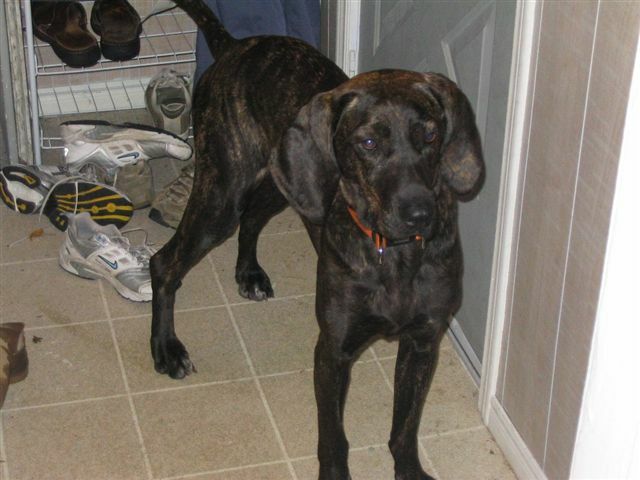
The Plott Hound is a large, athletic, unmistakably jagged-coated track dog bred in the mountains of North Carolina to hunt bears and wild boars. Courageous, tireless and with an extraordinary sense of smell, it is one of the few dogs born in the United States and the official dog of the state of North Carolina. This guide tells you exactly what it’s like to live with a Plott Hound: Her character, her real needs and if she fits in with you.
Is the Plott Hound for you?
The Plott Hound isn’t a dog for everyone. It’s a workaholic to the core, with a lot of energy, an all-around sense of smell and a powerful voice. In the right family, it’s a loyal, brave and devoted companion; in the wrong, a frustrated whirlwind. Before you fall in love with its gaze and its jagged coat, look honestly at these two columns.
In favour .
- Loyal, brave and very close to his family.
- Smart and eager to please when he trusts you.
- Huge stamina and energy – perfect for very active people.
- Exceptional sense of smell, ideal for tracking, mantrailing and nose sports.
- It’s a short coat, easy to maintain.
- It usually gets along well with other dogs: it was bred to hunt in packs.
Against
- He needs a lot of daily exercise; he gets bored and frustrated without it.
- Powerful barking and howling that can disturb the neighbors.
- Strong prey instinct: risk with cats and small animals.
- Smell tells you: without a secure fence, you’re following a trail.
- Independent and stubborn when he’s focused on a smell.
- It’s not an ideal dog for the floor or for someone who spends a lot of time outside.
Character and temperament

The Plott Hound was bred for generations for a quality that American hunters call gameness: the courage to follow and face a large prey without giving up. That heritage explains its temperament. It is a determined, courageous and remarkably tenacious dog, able to work for hours on end in difficult terrain without becoming discouraged.
At home, however, this same intense dog transforms into a loving and deeply loyal companion. He is very attached to his people and enjoys participating in family life. He is alert and observant, which makes him a good warner, although he is not an aggressive guard. With strangers he may be reserved at first, but is rarely hostile if he is well socialized.
Two things should always be remembered: it is a vocal dog, with a deep, sonorous howl inherited from its hunting work, and it is a sniffing dog. When it catches an interesting trail, its attention goes entirely to the nose. It is not disobedience or gratuitous stubbornness: it is exactly what it was designed for.
Coexistence: children, other pets, flat and loneliness
- With children: is usually tolerant and playful with the children in his family.
- With other dogs: was bred to hunt in packs, so it tends to get along well with other dogs, especially if it socializes early.
- With cats and small animals: here is the delicate point. His prey instinct is strong; coexistence with cats is possible if he grows up with them, but you have to be careful and never leave him loose with small animals that he can chase.
- On the floor: is not his ideal environment. He needs space, intense exercise and an outlet for his voice. On the floor he can live only if the owner compensates with a lot of daily activity, but howling can be a problem with the neighbors.
- In the face of loneliness: is a close companion dog. If he spends too many hours alone and without stimulation, he gets bored, barks, howls and can become destructive. He doesn’t fit in with someone who is away from home all day.
- Fences and security: the smell rules it. It needs a well fenced garden; a Plott Hound that catches a trail is able to go for miles without looking back.
Education and training
The Plott Hound is smart and quick to learn, but training it has its tricks. He’s an independent dog, used to making decisions on his own while tracking, so he doesn’t obey just because he obeys: He needs to understand what’s in it for him. Positive reinforcement, with high-value rewards and short, motivational sessions, works much better than any imposition-based method, which just gets you to close in on the band.
Early socialization is key. The sooner you get to know people, dogs, noises and different environments, the more balanced and secure you will be as an adult. Basic obedience should be fixed early, before the strength and bossyness of the adult complicates things.
The big challenge is the call. With a dog so guided by the nose, the response to the call is never 100% reliable in open spaces: if there is a trail in the middle, its instinct can do more. So in unfenced areas, the most sensible thing is to always work with a long leash until you have a very solid call, and still maintain caution.
Exercise and activity

There are no half-measures here: the Plott Hound needs a lot of exercise. It was bred to chase bears and wild boars through mountainous terrain for hours, and that endurance is still intact. A couple of short walks a day are not enough for it; it will get bored and look for undesirable ways to waste energy.
The ideal are long, demanding sessions: hiking, running, pulling games, and very especially activities that put your sense of smell to work. Tracking, mantrailing and searching games fill you up both physically and mentally, because they combine effort with the pleasure of using your nose. A Plott Hound that tracks is a happy Plott Hound.
Mental stimulation is as important as physical stimulation. A dog that smart and energetic needs a job, a purpose. If you give it both – tired body and busy mind – you’ll have a calm and satisfied companion at home. If not, you’ll have a problem.
Care: fur and hygiene
The maintenance of the Plott Hound is simple, one of its great advantages. Its hair is of fine to medium texture, short or medium length, smooth and shiny. With a weekly brushing is enough to remove the dead hair and keep the coat in good condition; baths only when really needed.
Like a good dog with dropped ears, it accumulates moisture and dirt in the ear canal, so it is advisable to check and clean them regularly to prevent infections, especially if you have been in the field or have been wet.
Foodstuffs
As a large, athletic, high-energy dog, the Plott Hound needs a high-quality diet well-adjusted to its activity level.
As it is a large, deep-chested dog, it is advisable to divide the food into two daily servings instead of one very abundant one, and avoid intense exercise just before and after eating; it is a sensible precaution against the risk of gastric torsion, typical of breeds with this conformation. Water always fresh and available, and weight control so as not to overload your joints. If you have any doubts about the quantity or type of feed, it is best to consult your veterinarian.
Health and life expectancy
The Plott Hound is, in general, a rustic and healthy dog, the result of generations of selection for its working capacity rather than for aesthetics.
That said, he shares some predispositions of large, deep-chested dogs to watch out for: hip dysplasia, gastric torsion (swelling or swelling of the stomach) and, because of their droopy ears, ear infections. None of this is inevitable: good nutrition, regular veterinary check-ups, weight control and ear care greatly reduce the risk and help you enjoy a long, active life.
Physical appearance

The Plott Hound is a medium-sized, athletic, muscular and agile hound. Unlike other hounds, it does not have excess or fallen skin: its silhouette transmits speed, resistance and depth.
Its hallmark is the jagged cape, the famous brindle: a pattern of fine stripes on a lighter or darker background. Many shades are acceptable – yellow, red, maroon, brown, black, gray, and the so-called Maltese (blackboard gray or gray-blue) – in addition to black with sharp reflections and solid black. Some white in the chest and feet is tolerated, but white in other areas is considered a defect. The hair is short or medium in length, thin to medium, smooth and shiny in appearance.
Origin and history
The story of the Plott Hound is the story of a family of German immigrants and the mountains of North Carolina. Their ancestors were boar hunting dogs in Germany. Around 1750, Johannes “George” Plott (c. 1733-1815) emigrated from Germany to the English colony of North Carolina with a few Hannover hounds, dogs used to hunt bears and wild boars, selected for generations for their background and courage.
The family settled in the mountains of western North Carolina. In 1780 the herd passed into the hands of his son Henry Plott, who settled in Haywood County in the early 19th century and was responsible for the further development of the breed. Legend has it that the breed remained remarkably pure, with very few external crosses. The Plott Balsams Range in North Carolina bears precisely this family’s name, as does the breed.
The Plott is the only breed not descended from the foxhound. It is also the only breed native to North Carolina and one of the few born in the United States. It was registered by the UKC in 1946, recognized by the American Kennel Club in 2006 and presented at the prestigious Westminster Exhibition in 2008.
Curiosities
- In 1989, the North Carolina General Assembly named it official state dog.
- He’s the only coonhound from the UKC that doesn’t have foxhound ancestry.
- The Plott Balsams range owes its name to the Plott family, as does the breed.
- It is one of the very few native breeds in the United States and the only one native to North Carolina.
- Two Plott Hound puppies came to be trained as K9 dogs for the Guilford County Sheriff’s Department, taking advantage of their sense of smell and tracking ability.
- Its jagged coat is so distinctive that it is enough to distinguish it at a glance from the rest of the American hounds.
If you are drawn to the world of tracking hounds and dogs with extraordinary scent, you may be interested in comparing the Plott Hound to other breeds in the same family. Take a look at the American Foxhound, another American-born hound; the Bloodhound, the undisputed king of tracking; the ever-popular Beagle; or the unmistakable Basset Hound. They all share that prodigious sense of smell that defines great hounds.
Frequently Asked Questions About the Plott Hound
Is the Plott Hound a good family dog?
Yes, in the right family. He is loyal, affectionate, and very close to his people, and is usually tolerant of the children at home.
How much exercise does a Plott Hound need?
He was raised to work long hours in the mountains, so he needs long, demanding sessions every day, ideally combined with olfactory activities like tracking or mantrailing.
Does the Plott Hound bark a lot?
It is a vocal dog by nature, with a deep and powerful howl inherited from hunting. It tends to express itself with the voice, which can be an inconvenience in flats or with close neighbors.
Do you get along with other dogs and cats?
With other dogs it usually coexists well, because it was bred to hunt in packs. With cats and small animals you have to be careful: its prey instinct is strong and can chase them. Coexistence with cats is easier if you grow up with them.
Is it easy to train?
It is intelligent and learns quickly, but also independent and stubborn when following a trail. It responds very well to positive reinforcement with short, motivating sessions, and needs early socialization. Calling in open spaces is the biggest challenge for its sense of smell.
How long does a Plott Hound live?
Their life expectancy is about 12 to 14 years, a very good figure for a dog of their size. With proper nutrition, exercise, and regular veterinary checkups, they can enjoy a long and active life.
Can he live in a flat?
It needs space and plenty of exercise, and its howling may disturb neighbors. It can live on the floor only if the owner compensates with lots of daily activity, but it generally fits better in a house with a well-fenced garden.
What care does your fur need?
Its coat is short and easy to maintain, with a weekly brushing and occasional bathing. Regular care is needed for the dropped ears, which must be checked and cleaned to prevent infection.