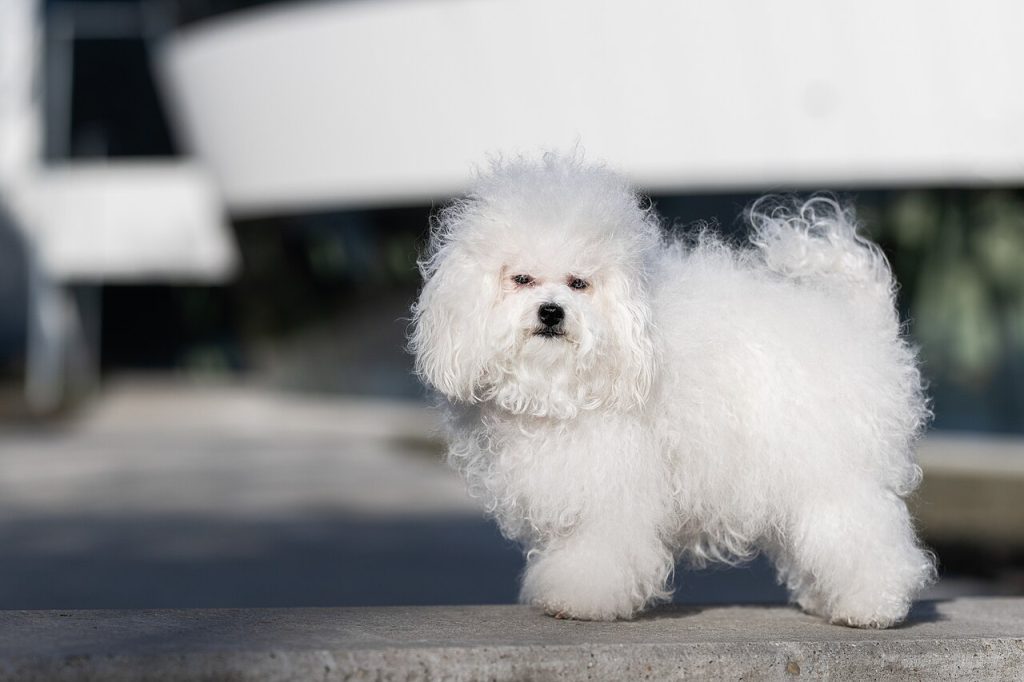
The Bichón Boloñés is a small, white, curly-coated companion dog that was born for one mission: Being around people. Originally from the Italian city of Bologna, it was for centuries the favorite gift of kings, tsars and ladies of the court, and today it remains a quiet, alert and deeply attached companion to his family. If you’re looking for an indoor dog, discreet, who sheds very little hair and who will follow you from room to room, the Bolognese Bichon has plenty of cards to fall in love with.
Is that Bichon Bolognese for you?
Before you get carried away by that stuffed face, let’s be honest: the Bolognese is a companion dog in the most literal sense of the word. It wasn’t bred to work, nor to run marathons, but to live close to its people. That makes it ideal for some homes and not recommended for others. Here’s the straightforward summary.
In favour .
- Very little hair loss – good choice for tidy homes and often better tolerated by sensitive people.
- Mini size: It fits nicely into small apartments and city life.
- A balanced and affectionate character, neither nervous nor compulsive barker.
- Very intelligent and attentive; he learns quickly what you teach him.
- Modest exercise needs: Daily walks and play at home are enough.
- Healthy and long-lived: often over 13-14 years of age.
Against
- It is a “velcro” dog: it is fatally lonely and can develop separation anxiety.
- The curly white coat requires constant brushing so as not to become soiled.
- Reserved with strangers; without socialization he can become overly wary.
- Rare breed: Finding a serious breeder can take time and a waiting list.
- The white hair marks the tear stains and dirt on the beard.
- Their fragile size forces them to supervise their dealings with very young children.
Character and temperament
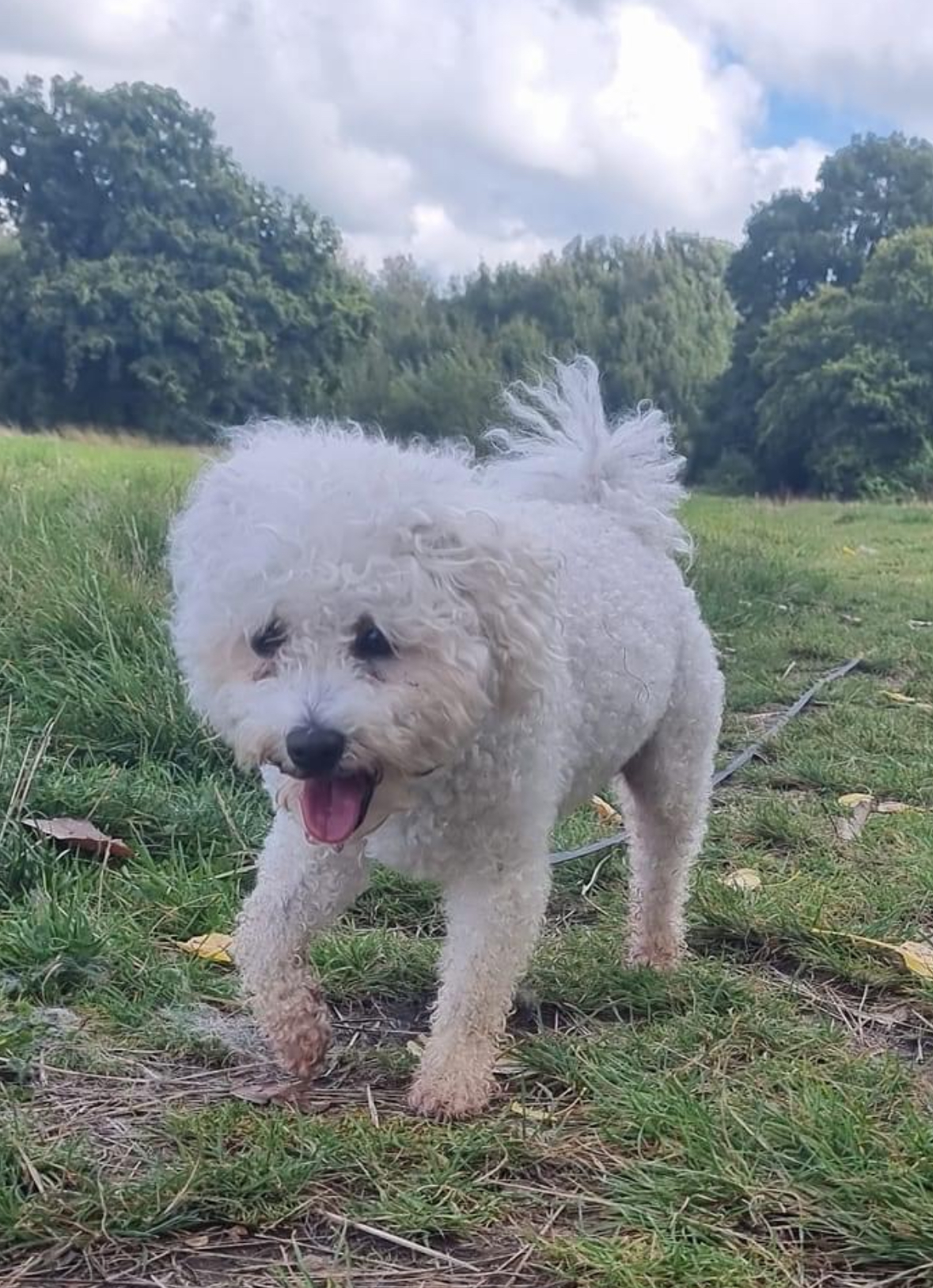
If we had to describe the Bolognese Bichon in one word, it would be company. It is a calm, observant and surprisingly intuitive dog, which seems to read the mood of its family and adjust to it. It does not have the festive impulse of a Bichon Frise or the nervous spark of other toy dogs: its is an elegant calm, that of the dog that prefers to be near you rather than make a fuss.
This calmness should not be confused with apathy. Behind its dark, round gaze is remarkable intelligence. It learns routines, anticipates your movements, and memorizes words with ease. It is a dog that enjoys solving small challenges and responds wonderfully to positive reinforcement, for it simply enjoys pleasing you.
With its people it is affectionate to the bone; with strangers, on the other hand, it is reserved. It is not an aggressive dog, but prudent: it observes, evaluates and usually warns with barking if something seems strange to it. Well socialized since puppyhood, this caution becomes a discrete function of “timbre” and nothing more.
Coexistence: children, other pets, flat and loneliness
The Bolognese Bichon is one of those dogs that fits into almost any quiet home. With the children gets along very well thanks to its sweet and patient character, but its small size makes it fragile: it is advisable to teach the smallest to hold it carefully and monitor the game to avoid falls or involuntary squeezes.
With other pets usually coexists smoothly. It accepts other dogs and, when presented calmly, also cats. It has no marked prey instinct, so peaceful coexistence is the norm rather than the exception.
As for the floor, it’s practically the perfect street dog: it takes up little space, makes little noise if it’s well-behaved and doesn’t need a garden to be happy.
And here comes its big “but”: the loneliness. The Bolognese is an extremely attached dog, bred for centuries to live in its owner’s lap. Leaving it alone for many hours a day is against its nature and can lead to separation anxiety, barking or destructive behavior. It is not the ideal dog for someone who spends all day outside the house.
Education and training
Educating a Bolognese Bichon is, in general, a grateful task. It is intelligent, highly motivated to please and enjoys interaction, so it quickly assimilates basic commands and coexistence habits. The key is in the positive reinforcement: rewards, friendly voice and play. Harsh methods or scolding block it, because it is a sensitive dog that deflates in the face of harshness.
The first is the early socialization: the sooner he meets people, noises, other animals and diverse environments, the less reserved and alert he will be as an adult. The second is to prevent the excessive dependency: as much as he loves your company, it is advisable to get him used from a puppy to being alone for short periods, in his bed and in his space, so that loneliness does not become a drama.
Like many small breeds, it may take a little longer to control your needs, so routine, consistency, and plenty of reinforcement when you do it right.
Exercise and activity
Don’t be fooled by its parlor dog look: the Bolognese Bichon needs to move, albeit in moderation. A couple of medium-duration daily walks and some playing time at home cover its physical needs abundantly. It’s not a dog of great efforts or sports days, but it does appreciate stimulation.
In fact, their minds require as much work as their legs. Smell games, interactive toys, little tricks, and short obedience sessions keep them balanced and avoid boredom, which in such an attached dog can translate into anxiety. A mentally active Bolognese is a quiet Bolognese at home.
Care: fur and hygiene

The great feature of the Bolognese Bichon is its single coat, white and curly, and precisely there is the bulk of its care. Unlike other breeds, it has no undercoat: its coat falls into loose curls and “floated” throughout the body, with shorter hair on the face.
The ideal routine is a thoroughly brushed several times a week– ideally daily in long coats – to untie knots before they turn into raspberries. Bathing should be periodic, with products specifically for white hair, and always with a full drying to prevent moisture at the base of the hair.
Since their coat is a very pure white, the tear stains under the eyes and dirt on the beard are very noticeable; cleaning these areas daily with appropriate products helps to maintain their clean appearance.
Foodstuffs
Due to its small size, the Bichon Bolognese eats little, but that same smallness demands precision.
Control of the quantity is important: in a dog of a few kilos, an almost imperceptible daily excess soon translates into overweight, which punishes joints and heart. Measure the rations, moderate the rewards (better healthy pieces than industrial sweets) and always have fresh water available.
Health and life expectancy
The Bolognese Bichon is, taken together, a robust dog and long-lived. Life expectancy is around 12 to 14 years, and a study conducted in the UK in 2024 placed the median longevity of the breed at around 14.9 years, above the general canine average.
There is an interesting historical nuance: the breed was on the brink of extinction and its recovery relied on a few specimens, which for a time meant a certain consanguinity and the resulting genetic fragility.
As with most small breeds, it is advisable to be attentive to issues typical of the mini format: dental health (accumulation of tartar), eye care and ear hygiene.
Physical appearance
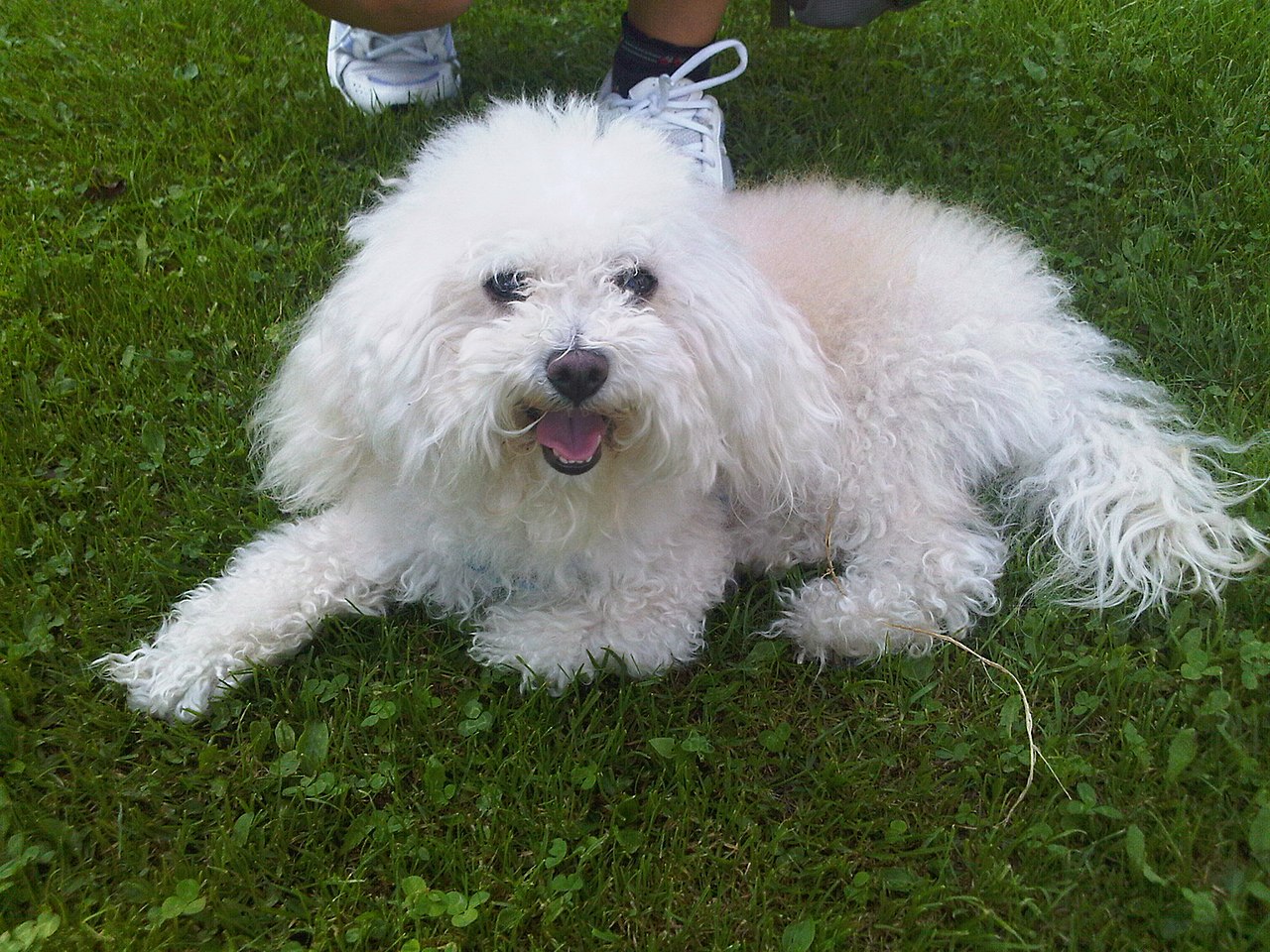
The Bolognese Bichon is a small, compact and almost square-shaped dog, covered from head to tail by its characteristic curly coat.
The standard colour is pure white, without stains or nuances, although very pale ivory tones are allowed. The head, medium-sized, looks like a large, round, dark eyes of waking expression, with the black truffle matching. The ears, long and high-inserted, fall to the hair-framed sides, and the tail rests elegantly on the back. Everything about him conveys balance and a somewhat stately distinction, a legacy of his centuries among royalty.
Origin and history
The Bolognese Bichon belongs to the old family of pigeons, that group of white companion dogs that shares roots with the Maltese, the Frisian Bichon, the Löwchen, the Habanero and the Tulear Cotton.
Its exact origins are lost in antiquity. Very similar dogs already appear under the name of “Melitenses dogs” in classical texts – Aristotle is even quoted – and, above all, were the most coveted gift of the European courts between the XI and XVI centuries. It is said that Cosimo de’ Medici sent eight puppies to Brussels as a prestigious gift, and that Philip II of Spain, after receiving two from the duke of Este, wrote that they were “the most majestic gift that can be made to an emperor”.
No wonder these puppies posed for the great masters of painting: They appear in works by Tiziano, in paintings by Goya– such as his famous portrait of the Duchess of Alba in white – and by Brueghel or Watteau. Among its illustrious owners are Tsarina Catherine the Great of Russia, Madame de Pompadour and Empress Maria Theresa of Austria. The Federación Cinológica Internacional officially recognized the breed in 1989, with the number 196, within Group IX of companion dogs, bichon section. In 1990 she came to England with Liz Stannard and began to appear in major competitions, debuting at Crufts in 2002.
Curiosities
- Its coat is completely devoid of undercoat, which is uncommon and explains why it sheds so little hair and its texture is woolly rather than silky.
- Although often listed as “non-moving” dogs, no dog stops moving altogether – it simply does so in very discrete amounts.
- It was, literally, a diplomatic coin: giving a Bolognese between royal houses was a gesture of utmost esteem.
- The uncontaminated white of their hair is not accidental: human selection favored this variant for purely aesthetic reasons; their ancestors were darker.
- It was on the brink of extinction in the 20th century and owes its survival to the efforts of a handful of passionate breeders.
If you are attracted to this classic white dog, you may want to compare its character with that of other small companions before deciding. Take a look at the Shih Tzu, the curly and versatile Caniche, often Yorkshire Terrier and the inseparable Chihuahua: breeds with which the Bolognese Bichon shares that vocation as a companion dog made to live alongside you.
Frequently asked questions about the Bichon Bolognese
Does the Bichon Bolognese shed a lot of hair?
Because it has a single coat with no undercoat, it has minimal mutilation, making it very comfortable to live in the home.
Is that a hypoallergenic dog?
It is usually better tolerated than other breeds because it barely moults and releases little dandruff into the environment, but it should be clear: no dog is 100% hypoallergenic.
How long does a Bolognese live?
A British study from 2024 calculated a median longevity of close to 15 years for the breed, above the average for all dogs.
Is he good with kids?
Yes. It is affectionate, patient and calm, which makes it a good family companion. Because of its small size it is fragile, so it is advisable to teach children to treat it gently and supervise play with the little ones.
Can you stay alone for many hours?
The Bolognese is very affectionate and can’t handle prolonged loneliness, with the risk of separation anxiety. It’s not the best choice for someone who spends all day outside; getting him used from puppy to being alone for short periods of time helps a lot.
Does he bark a lot?
It is not a compulsive barker, but it does warn of strange or unfamiliar noises, because it is cautious with what it does not know.
How much exercise do you need?
Little and moderate: a couple of daily walks and playtime at home are enough. What he appreciates most, besides movement, is mental stimulation with olfactory games and small challenges.
Is it hard to take care of your hair?
It requires consistency. It is advisable to brush it thoroughly several times a week to avoid knots, bathe it regularly and monitor tear stains under the eyes.