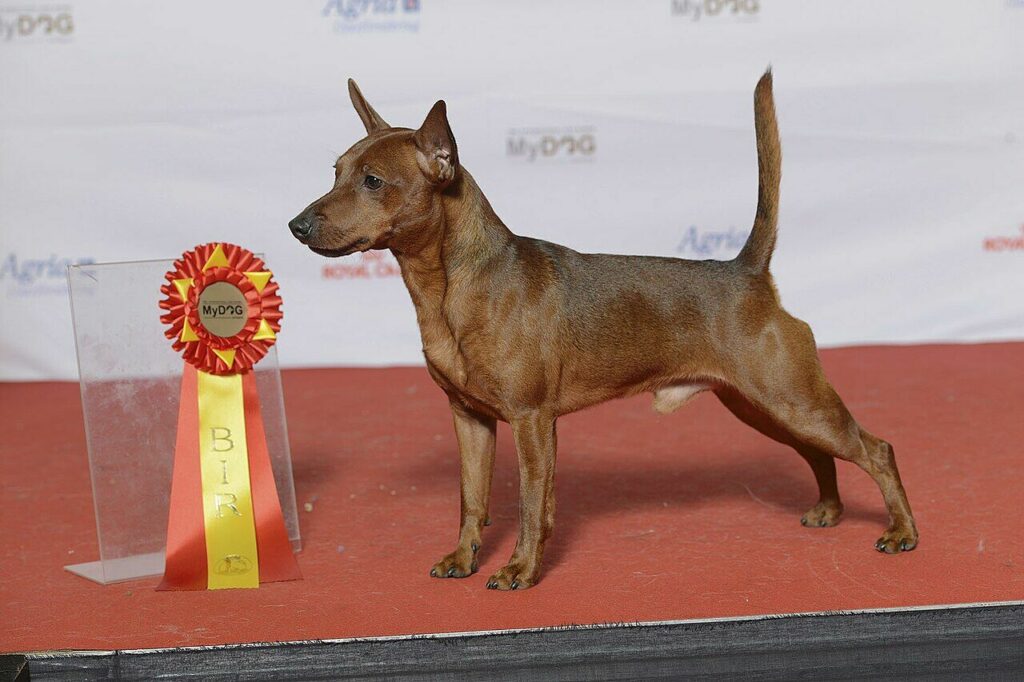
The Pinscher Miniatura is a small dog with a great personality: compact, muscular and with a self-confidence that exceeds its size. Originally from Germany, where it is known as Zwergpinscher, it was born as a scavenger hunter and today is a faithful, lively and vigilant companion.
Is that the Miniature Pinscher for you?
The Miniature Pinscher is not a quiet lap dog: it is pure energy in a tiny body. These are its advantages and aspects that you should value.
In favour .
- Ideal size for flooring and carrying almost anywhere.
- Short hair: minimal maintenance and little dirt in the house.
- A robust, long-lived breed with few health problems.
- Smart, funny and very close to his family.
- He’s an excellent warning dog. He warns of everything.
- Athletic and versatile: enjoys sports and adventure.
To be taken into account
- He needs more exercise and stimulation than his size suggests.
- He can be a barker if he doesn’t socialize well.
- He has a hard time dealing with loneliness. Separation anxiety.
- He is independent and stubborn; he requires constant education.
- Brave to the point of recklessness: plant face to huge dogs.
- Sensitive to cold: needs a coat in winter.
Character and temperament

If we had to summarize the character of the Miniature Pinscher in one word, it would be self-confidence. It is an alert, curious dog with a sense of humor that hooks. It lives each day with intensity: the same thing starts to play that stands firm in front of a strange noise. That mixture of spark and courage is what makes those who live with it fall in love.
It is a dog deeply attached to its people. It usually chooses a reference person whom it follows everywhere, although this does not prevent it from loving and obeying the rest of the family. This devotion has a counterpart: it does not tolerate being alone for many hours and can develop separation anxiety if left unattended for too long.
Despite its size, it retains intact the guardian instinct of its ancestors, who defended the house and the blocks from intruders and rodents. It is an alert dog that warns of everything, which makes it a bell with excellent legs.
Coexistence: children, other pets, flat and loneliness
The Miniature Pinscher adapts to almost any home as long as its needs are met.
- With children: is a good playmate, especially with older children who understand that it is a small and delicate dog.
- With other pets: lives comfortably with cats and other dogs, especially if you grow up with them. Of course, its hunting instinct can be aroused by very small animals, such as hamsters or loose birds.
- On the floor:‘s size makes it perfect for apartment living, provided you take it for walks and give it enough activity.
- In the face of loneliness: is its big weakness. It is not a breed for households where it spends many hours alone every day; it needs company and routine to be balanced.
- With strangers: reserved and vigilant at first, warm when he confides, always warning of every visit.
Education and training
Here you should not be fooled by its appearance: the Miniature Pinscher is very intelligent and learns at a remarkable speed. It has a great capacity for understanding and, when it understands what you ask it, it executes it enthusiastically. The challenge is not its intelligence, but its independent character and somewhat stubborn.
It works wonderfully with positive reinforcement: prizes, play and lots of cheer. Sessions should be short, dynamic and fun, because you get bored with repetition. Harshness and punishment are counterproductive; they only result in closure and distrust. Early socialization is key for him to grow up confident and tolerant, and to keep barking and the tendency to stand up to other dogs at bay.
Like a good, smart dog, he will test the boundaries and try to get his way; if the family is consistent, he becomes an obedient and loving companion.
Exercise and activity

Just because it’s small doesn’t mean it’s sedentary, quite the contrary. The Miniature Pinscher is a off-road dog: agile, fast and resilient. It enjoys walking, hiking, running alongside you or accompanying you on a bike. For it, the important thing is to participate and be with you.
It doesn’t just need physical exercise: it also needs mental stimulation. Intelligence games, olfactory carpets, and positive training are ideal for expending that restless energy and keeping it calm at home. Canine sports, such as agility or canicross, fit perfectly with its temperament and allow it to show off its athleticism.
A Miniature Pinscher that burns its energy is a balanced dog; one that doesn’t burn it, looking for exhaust valves in the form of barking and mischief.
Care: fur and hygiene
In terms of maintenance, the Miniature Pinscher is one of the most comfortable dogs in existence. Its hair is short, smooth and attached to the body, without undercoat, so it hardly requires care. With a weekly brushing with a glove or a soft brush is enough to remove the dead hair and keep the coat shiny.
The rest of the hygiene is the usual for any dog: checking and cleaning the ears, monitoring dental hygiene (important in small breeds), trimming the nails when they grow and keeping up with deworming.
The point you should not neglect is your sensitivity to cold. Lacking undercoat and having thin ears, it suffers from low temperatures. In winter or cold weather, a dog coat ceases to be a whim and becomes a necessity.
Foodstuffs
As a small but very active dog, the Miniature Pinscher needs a high-quality diet, tailored to its size and energy level. Ideally, a feed or diet formulated for small breeds, with a good supply of protein and croquettes suitable for its jaw.
Ration control is important: Even though he’s athletic, in such a small body, the excess weight comes on quickly and weighs on the joints. Divide the food into two daily servings, measure the amounts according to your weight and activity, and use part of your ration as a reward in training instead of adding extras. Fresh water is always available and, if you have any questions about quantities or type of diet, consult your veterinarian.
Health and life expectancy
One of the great virtues of this breed is that, unlike many miniature dogs, its reduced size has no associated health problems. The Miniature Pinscher is a robust, vital and healthy dog, without the pathologies typical of breeds bred seeking extreme miniaturization.
As for longevity, the data are excellent: a British study from 2024 calculated an average life expectancy of 13.7 years, above the average for purebred dogs.
As with any small breed, it is also wise to monitor dental health and regularly check joints and eyes with the veterinarian.
Physical appearance

The Miniature Pinscher is a square construction dog: its length is practically equal to its height at the withers, giving it that compact and well-proportioned appearance.
Under its delicate appearance is a surprisingly strong and muscular dog, athletic and elegant at the same time, with a characteristic, elevated and springy movement, reminiscent of the trot of a light horse and distinguishable at first glance.
Her hair is short, smooth and shiny. The colors accepted are the monochrome red in its different shades and the black with fire marks.; some standards also accept variants such as chocolate or blue with markings.
Origin and history
The Miniature Pinscher originates from Alemania, where it is known as Zwergpinscher. It belongs to the Pinscher family and is, in essence, a reduced version of the German Pinscher. Their origins are humble and hardworking: For a long time it was used to hunt mice, rats and other animals, as well as birds and small prey. An illustration by Jean Bungartz, from the late 19th century, already compared the Miniature Pinscher to the German Pinscher.
At the beginning of the 20th century the race was very common in Germany. The Pinscher-Schnauzer Klub, founded in 1895 and still active, was key in its history: At that time the smooth-haired pinscher and the hard-haired pinscher (the future schnauzer) were considered the same type, and it was their promoter, Josef Berta, who began treating them as separate breeds. Selective breeding soon consolidated the Miniature Pinscher as a breed of its own and, unlike its older relative, it soon gained a foothold as a companion dog in homes.
Its international leap came early: it was first exported to the United States in 1919 and the American Kennel Club registered it in 1925. The Fédération Cynologique Internationale officially recognized it in 1955 and frames it in the Group 2 (Pinscher and Schnauzer). Interestingly, genetic research published in 2017 pointed out that it shares ancestry with the Toy Manchester Terrier.
Curiosities
- It’s not a miniature Doberman. The resemblance is misleading: the Miniature Pinscher is considerably older than the Doberman, so it cannot be its reduced version.
- The King of Toys. is nicknamed in the kennel world for its lofty demeanor and safety, unsuitable for such a small dog.
- Brave to the point of recklessness. does not hesitate to stand up to much larger dogs, who are often baffled by such courage in a tiny body.
- Dog of high society. At the beginning of the 20th century it became fashionable among the elegant ladies, who boasted of their fine demeanor and their flawless hair.
- He’s a hunter by birth. Before he was a show dog, he made his living controlling rodents in houses and blocks.
If you are interested in the Miniature Pinscher, you will surely enjoy getting to know its relatives and other breeds in the same family. We recommend that you take a look at the Pinscher Alemán, its direct predecessor; the Doberman, with which it is so often confused; the elegant Schnauzer Miniatura, clubmate and history; and the peculiar Affenpinscher, another small pinscher full of character.
Frequently Asked Questions about the Miniature Pinscher
The Miniature Pinscher is a miniature Doberman?
No. It’s one of the most repeated myths, but it’s false: the Miniature Pinscher is a much older breed than the Doberman. Both are descended from the German Pinscher and share that compact, athletic air, hence the resemblance, but neither is a scaled-down version of the other nor is there a direct size relationship between them.
How long does a Miniature Pinscher live?
It is a long-lived breed. A British study from 2024 estimated a life expectancy of 13.7 years, above the average for purebred dogs. With good nutrition, exercise and veterinary checkups it is common for them to exceed 13 or 14 years.
Is he a good dog for the floor?
Yes, its small size makes it ideal for a flat, as long as its need for physical and mental activity is met. It is not a dog to be locked up without stimulation: it needs walks, play and companionship. If it is bored or spends too many hours alone, it tends to bark and look for mischief.
Does the Miniature Pinscher bark a lot?
The good news is that with early socialization and consistent training, it is easily controlled and does not become a compulsive barking dog.
Do you get along with children and other pets?
It is suitable with children, better if they are older and know how to respect a small dog; with the youngest always under supervision, because it is often and does not tolerate rough treatment.
How much exercise do you need?
More than its size suggests. It is an athletic and resistant dog that enjoys walking, running or practicing canine sports such as agility. As a reference, it needs several daily walks and a little play or mental training every day to be balanced.
Is it easy to train?
He is very intelligent and learns quickly, but he is also independent and somewhat stubborn. He responds wonderfully to positive reinforcement, to short sessions and to play; punishment or harshness only makes him shut down. With patience and perseverance he is a brilliant student.
Does the Miniature Pinscher feel cold?
Yes. Its hair is short, without undercoat, and its thin ears are sensitive to low temperatures. In winter or cold weather, take it outdoors in a dog coat and avoid prolonged exposure to the cold.