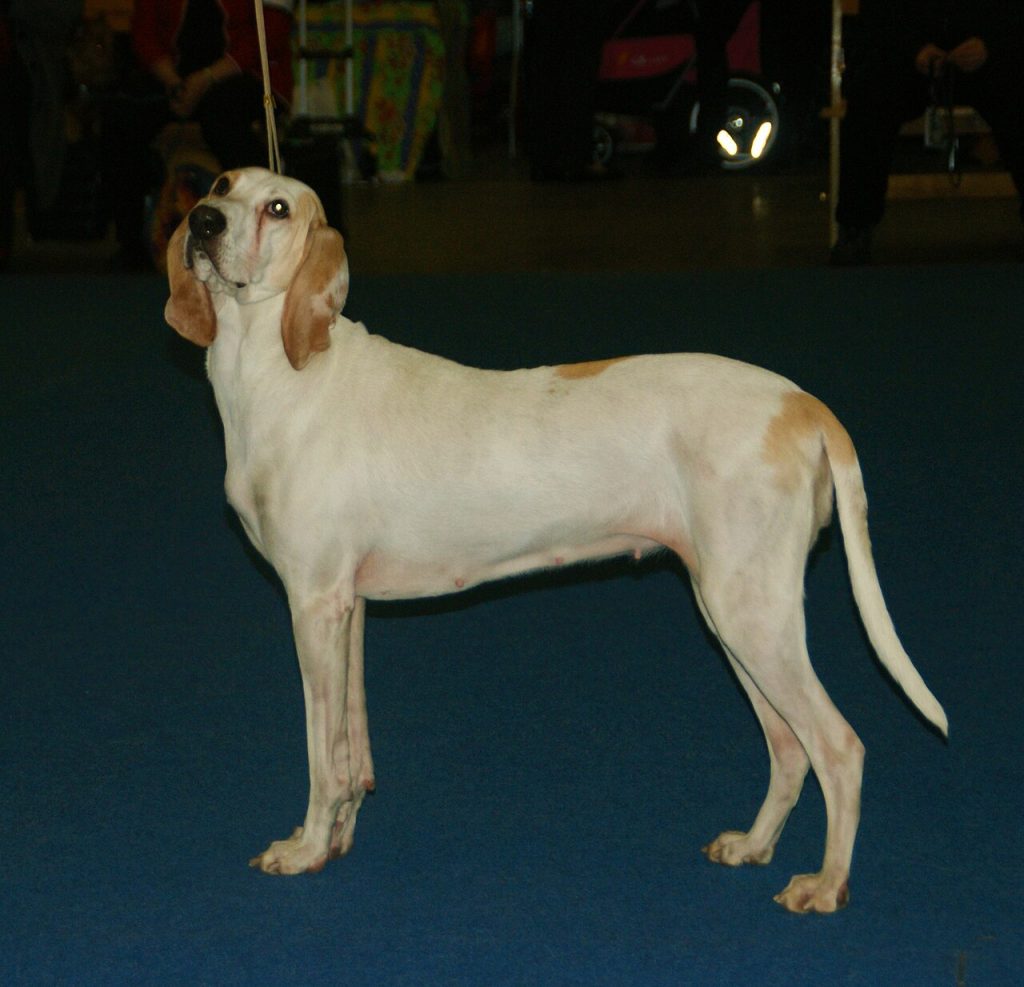
The Porcelaine is one of the oldest and most elegant hounds in France: A bright white-coated hunting dog, almost naughty, from which it takes its name. Fast, tough and with a prodigious smell, the Porcelaine (also called in Spanish Porcelana or, historically, Chien de Franche-Comté) combines the passion of the hunter in the mountains with a sweet and sociable character at home. It’s not a dog for everyone, but for anyone looking for an athletic, well-balanced companion, it’s a little-known gem.
Is the Porcelaine for you?

The Porcelaine is a wonderful dog, but very specific. Before you fall in love with its porcelain coat, you should be honest about what it needs: it is a working dog with a lot of energy, a sense of smell that governs its head and a clear vocation to run around the countryside. It fits wonderfully with active and rural families, and very badly with someone who lives in a small apartment and spends the day outside.
Points in favour
- A sweet, gentle, balanced character at home.
- Very sociable with people and other dogs (herd breed).
- Exceptional sense of smell and endurance, a first-rate hunter.
- Short hair with minimal maintenance.
- A rustic breed, healthy and with few hereditary defects.
- Ideal companion for running, hiking or hunting.
Points to Consider
- He needs a lot of daily exercise; he’s not a couch dog.
- Strong hunting instinct: watch out for cats and small game.
- Independent and guided by the nose: the so-called slope.
- Strong voice; may howl if bored or alone.
- Unsuitable for flat and city life.
- Rare breed: finding puppies is not easy.
Character and temperament
There are two porcelains inside the same dog, and they both live in perfect harmony. In the countryside, it is a passionate, courageous and tenacious hunter, able to follow a trail for hours without getting discouraged and to face prey as serious as the wild boar in the north of its breeding area. At home, however, he is a surprisingly calm, affectionate, and good-natured dog, far removed from the image of a nervous hound.
This duality is the result of centuries of selection for pack hunting. A pack dog cannot be conflicted or aggressive: You have to tolerate dozens of counterparts, accept the man’s hand and work as a team. Hence his sociable and balanced temperament. The Porcelaine is rarely a good watchdog, precisely because he is little suspicious of strangers: He’ll warn you with his voice, but it’s not in his nature to be hostile.
It is, yes, a dog with a dominant olfactory motivation. When it catches an interesting smell, its world is reduced to that clue, and that’s where its independent side trumps obedience. Understanding that is key to living with it without frustration.
Coexistence: children, other pets, flat and loneliness

With children: the Porcelaine is usually patient, tolerant and playful with children, especially if it grows up with them.
With other dogs: excellent. It is one of the most gregarious breeds in existence; life in a pack is part of its DNA. Coexistence with other dogs is usually easy and natural.
With cats and small pets: here you have to be careful. Its hunting instinct is powerful and a running animal can trigger the chase. Coexistence with a cat is possible if they have been bred together, but rodents, rabbits or birds do not get along well with a hound.
On the floor and in the solitude: is its weak point. The Porcelaine is not made to spend long hours alone or to live in a confined space. A bored dog with accumulated energy howls, gets stressed and can become destructive. It needs company, activity and, if possible, terrain.
Education and training
The Porcelaine is intelligent, but it was bred to think for itself while tracking, not to obey a battery of commands. That independence makes its training require more patience than that of a shepherd-type working dog. The good news is that it is sensitive and collaborative when it is well motivated.
The keys to this breed are:
- Positive reinforcement: rewards, food and play work much better than hardness, which only gets you blocked.
- Short and varied sessions: gets bored with repetition; better a few intense, fun minutes.
- Although Early socialization: is sociable by nature, it is advisable to expose it early to people, noises and situations.
- Working the call from a puppy: your big challenge, when you follow a trail, stop listening, reinforce the lap with high-value prizes, and be cautious when releasing it.
Don’t expect the millimeter obedience of a Border Collie: expect a willing mate, but of your own free will.
Exercise and activity
If there’s one thing that defines everyday life with a Porcelaine, it’s the amount of exercise you need. We’re dealing with a distance runner, bred to cover miles behind a trail without getting tired. A short walk around the block does him absolutely no good.
As a reference, it needs between one and two hours a day of actual physical activity, and ideally access to spaces where it can run and, above all, sniff.Mental stimulation through the nose is as important as physical exercise: tracking games, free sniffing walks and canine activities like mantrailing make it happy.
A well-exercised Porcelaine is a calm and pleasant dog at home; one with accumulated energy is quite the opposite.
Care: fur and hygiene
Here the Porcelaine is grateful. Its famous white coat, short, thin and shiny, hardly needs maintenance. A weekly brushing with a glove or a soft brush is enough to remove the dead hair and maintain that characteristic shine. The moult is moderate and the hair, being so short, is easily controlled.
Baths should be sporadic, only when you get really dirty; too much bathing dries your skin. What does require a constant routine are the ears.: long, falling and poorly ventilated, they are prone to accumulate moisture and wax, so it is advisable to check and clean them regularly to prevent otitis, especially after outings to the countryside or the water.
Complement hygiene by cutting your nails when you need to, checking your pads after you leave, and maintaining good dental hygiene.
Foodstuffs
The Porcelaine is a muscular and very active dog, and its diet should reflect this. It needs a quality food, with good protein and energy intake that supports its physical expenditure, adjusting the amount to its actual activity level: a hunting dog in the middle of the season does not eat the same as a companion dog in winter.
It is advisable to divide the ration into two daily intakes in the adult and monitor the weight: Although it is a naturally slender breed and rarely prone to obesity if exercised, a sedentary, overfed dog can gain weight. As with all deep-chested dogs, it is wise to avoid strenuous exercise just before and after eating to reduce the risk of gastric torsion. Fresh water always available, especially on working or hot days.
Health and life expectancy
The Porcelaine is a rustic and globally healthy breed, with a life expectancy of approximately 12 to 13 years. As it is a small breed and bred primarily for work and not aesthetics, it does not drag along the exaggerated genetic flaws of other very popular breeds.
Nevertheless, there are points to watch for:
- Orejas: his long and droopy ears make him prone to otitis; regular cleaning is the best prevention.
- Piel: the white, thin coat provides little sun protection, so care must be taken with sun exposure.
- Locomotive apparatus: like any sporting dog, can suffer injuries or joint wear and tear over the years; keeping it in its weight and musculature helps.
- Field injuries: cuts, ticks and spines are common in a dog working in bushes; check it after every outing.
Choosing a responsible breeder, one that works with healthy, balanced dogs, is the best guarantee of a robust puppy.
Physical appearance

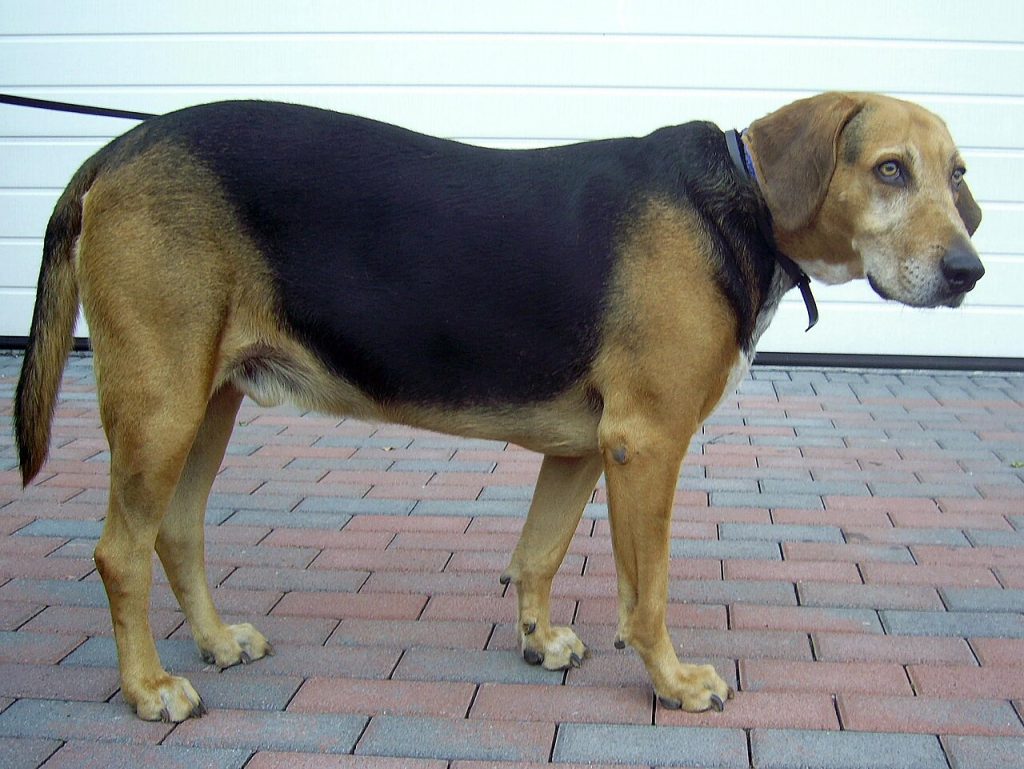
The Porcelaine is a medium-sized hound with elegant, harmonious lines that convey distinction and lightness. The males measure between 55 and 58 cm to the cross and the females between 53 and 56 cm, with a weight around 25 to 28 kg.
Its most famous feature is the coat: very short hair, fine and shiny, of a pure white that looks enamelled, hence the name “porcelain”. It often has orange spots, especially on the ears, and under the white hair the skin shows a characteristic black speck that becomes transparent. The head is thin and elongated, with a black nose with wide nostrils, dark eyes with a sweet expression, and long, thin, curled ears that drop to the sides, reminiscent of those of other hounds. The neck is long and the tail is born thick and sharpened towards the tip.
Origin and history
The Porcelaine is presumed to be the oldest French hound breed. Its historical name, Chien of the Franche-Comté(Franco-County dog), refers to the eastern region of France, bordering Switzerland, where the breed was developed.
It is thought to be descended from a mixture of the English Harrier, some smaller Swiss Laufhounds and the now extinct Montaimboeuf. There are records of the breed in France since the mid-19th century and in Switzerland since 1880. Like so many breeds linked to the nobility and the great hunts, the Porcelaine was on the verge of disappearing after the French Revolution, but was patiently rebuilt by passionate breeders who recovered its type and function.
Today it is still a minority breed, raised mainly by and for hunters, and is also present in small numbers in Italy, where it is used for wild boar hunting.
Curiosities
- Its name comes directly from its coat: the white mantle’s enamelled luster was reminiscent of a porcelain figurine.
- It is often considered the oldest hound in France..
- It was nearly extinct after the French Revolution and had to be rebuilt from the few surviving specimens.
- It hunts in packs following the trails of hare, deer, and, in the north, wild boar, guided almost entirely by smell.
- It is bred in small numbers in Italy, although local hunters usually prefer their own native hounds.
- The black mottling of their skin, visible through their white hair, is a sign of race identity.
If you are attracted to the Porcelaine because of its combination of smell, energy, and good temperament, you may be interested in other hounds and tracking dogs with a similar profile. You may meet the Beagle, another sociable, manageable-sized sniffer hound; the Basset Hound, with even longer ears and a portentous nose; the towering Bloodhound, the king of tracking; or the versatile Pointer, another hunting classic that shares a passion for the countryside.
Frequently Asked Questions about Porcelain
Is the Porcelaine a good dog to live in a flat?
It’s not his ideal environment. The Porcelaine is a hound with a very high energy level and an enormous need to move and smell. In a small apartment, without several hours of daily exercise and no access to open spaces, he tends to get frustrated, bark and howl. It can adapt to urban life only if its family guarantees it long outings, smell and activity; otherwise, it is a breed more thought out for the countryside or terraced houses.
Is he affectionate and good to the family?
Yes. Despite being a fierce hunter in the mountains, at home the Porcelaine is a gentle, balanced and sociable dog, attached to its people. Raised for centuries to work in packs, it tolerates the company of people and other dogs well, and is usually sweet to children if socialized as a puppy.
How much exercise do you need a day?
Enough. At least one to two hours of vigorous physical activity a day, spread over several outings. It is not enough to walk: it needs to run, track and use its sense of smell. It is an excellent companion for active people, runners, hikers or hunters, and a poor choice for those looking for a quiet couch dog.
Do you get along with other dogs and pets?
With other dogs, very well: it is a breed of pack, used to live in groups. With cats and small animals you have to be careful, because their strong hunting instinct can be activated before a prey that runs away. Coexistence with cats is possible if they grow together, but it is advisable to supervise and not leave it loose near small fauna.
Does Porcelaine bark or howl a lot?
It can do it. Like a good hound, it has a powerful, melodious voice that it uses when following a trail or when it is bored. A Porcelaine with enough exercise and stimulation is quieter; one that spends many hours alone or locked up will tend to express its frustration with howls, something to appreciate if you have neighbors nearby.
Is it hard to educate?
It is of medium-high intelligence but independent: it was bred to hunt on its own, without waiting for constant orders. It learns well with positive reinforcement, patience and short sessions, but its nose can do more than your call.
What care does your white hair need?
Very few. The Porcelaine has short, fine and shiny hair, almost no undercoat, so a weekly brushing is enough to keep it clean and distribute the natural fat. Baths only when it gets really dirty. What does require regular care are its long and fallen ears, which must be checked and cleaned to prevent infections.
How long does a Porcelaine live and be healthy?
It is a rustic and generally healthy breed, with a life expectancy of around 12-13 years. Being small in number and bred mainly for work, it does not carry large hereditary defects. The points to watch are the ears (otitis), skin exposed to the sun by its white coat, and the locomotor apparatus in such an active dog.