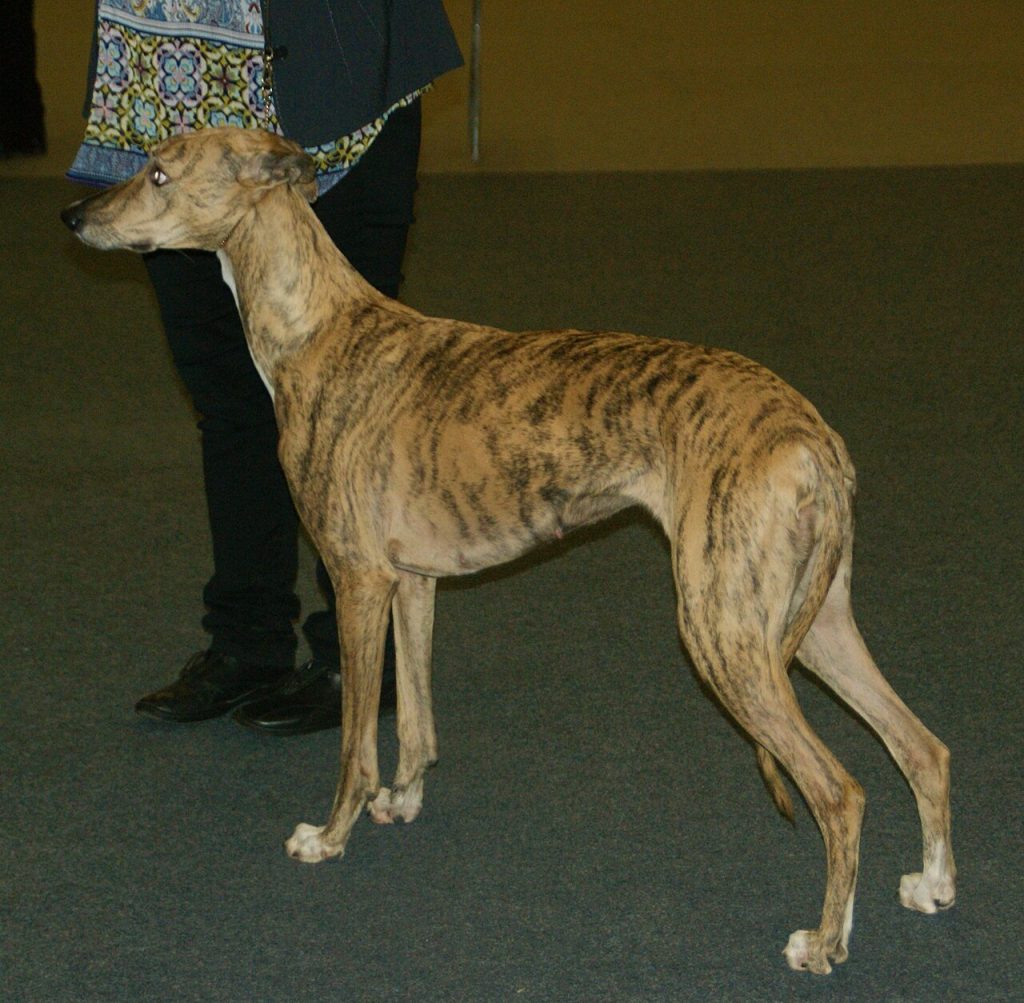
The Hungarian Greyhound(Magyar Agár) is an elegant yet rustic hare, bred for over a thousand years on the plains of Hungary to hunt hares and run alongside riders for miles. Less known than the greyhound, it shares with it the silhouette of the greyhound, but is more robust, with heavier bone, thicker skin and a resistance to cold and long distances that makes it unique. If you’re looking for a quiet companion at home, caring and surprisingly adaptable, but with a runner’s motor that needs to go for a run, the Hungarian Greyhound deserves a thorough introduction.
Is the Hungarian Greyhound for you?
The Hungarian Greyhound is a dog of contrasts: indoors he is a serene companion who spends much of the day sleeping, but outdoors he has a hunting instinct and a need to gallop that you cannot ignore.
It suits you if…
- You can offer him free runs and long walks almost every day.
- You want a quiet, clean, low-maintenance dog at home.
- You’re looking for a partner who’s affectionate, loyal and good with kids.
- You live on the floor or in the house: you fit both if you exercise.
- You value a healthy, rustic dog with discreet guarding instincts.
- You’re attracted to a rare breed with centuries of history behind it.
Think about it if…
- You don’t have access to safe, fenced spaces where I can run.
- You live with rabbits, hamsters or other small animals loose.
- You let the dog off the leash in open areas with no firm recall.
- You’re looking for a dog that plays fetch the ball nonstop.
- You can’t stand a dog feeling cold and shivering in winter.
- You prefer a common breed that’s easy to find close to home.

Character and temperament
The Hungarian Greyhound has a reputation for being affectionate and docile, but without the excitability of other breeds. He is affectionate with his family, loyal and remarkably calm within the home. It does not usually bite or grunt at people and, compared to other hares, retains a more marked guarding instinct: Although it is not a barking or aggressive dog, it is aware of what is happening around it and warns. That surveillance point, coupled with his discretion, makes him a balanced companion.
It’s an intelligent dog, easy to deal with and loyal, though also somewhat reserved. That reservation should not be confused with excessive shyness: a well-socialized specimen is calm and confident, neither frightened nor nervous. Outside the home, however, its true essence emerges. As soon as it detects a movement that resembles prey, its hunter brain takes over. He ‘s not a party dog or a noisy one: is rather of sober temperament, tenacious and very attached to his own, with a quiet loyalty that is earned slowly.
Coexistence: children, other pets, flat and loneliness
With children: The Hungarian Greyhound usually behaves very well with children. It is patient and affectionate, and its calm character inside the house makes it a good family dog. As always, it is advisable to teach the little ones to respect their moments of rest, since it is a dog that sleeps a lot during the day.
With other dogs: is sociable and gets along well with congeners, especially if it has had early socialization.
With cats and small animals: must be cautious here. You can’t forget its heritage as a sniffer dog: it tends to chase anything that looks like a prey. With proper introduction and supervision it can coexist perfectly with cats and small dogs inside the house, but outside, with rabbits or loose rodents, its chase instinct prevails.
On the floor: despite its size, is surprisingly adaptable. It can live comfortably in an apartment – or in an outdoor kennel – as long as it receives enough exercise and human interaction. If it lives indoors, it is easy to teach to defecate outside and becomes a gorgeous, clean pet.
Although Soledad: is independent and spends much of the day sleeping, it needs human companionship. It is not a dog to be left alone for long days without exercise or contact: boredom and lack of physical expenditure are its worst enemies.

Education and training
The Hungarian Greyhound is intelligent and easy to train, an advantage over some hares with a reputation for stubbornness. It responds well to positive reinforcement, short sessions and respectful treatment; it is a sensitive dog that does not fit into harsh methods.
The tender point of the training is the recall(the call). Like all greyhounds, when it starts chasing prey, it goes into a state where it has difficulty listening to the human voice. That’s why the “here” command must be worked out from a puppy, with a lot of patience and always in controlled environments. Early socialization is equally essential: Exposing him to people, dogs, noises and situations from an early age consolidates that serene temperament and prevents the natural reserve from leading to fear.
Exercise and activity
This is the chapter that decides if the breed is right for you. The Hungarian Greyhound was bred for long-distance racing: it was expected to run alongside horse-riding hunters distances of between 30 and 50 kilometers a day. It is not a pure sprinter like the greyhound in the short sprint, but it possesses a much superior endurance and a bottom, ideal for running for long periods.
He needs daily exercise to stay fit and happy. The best formulas are long walks, free runs in safe spaces, and jogging on a bicycle – an activity he loves. It is not usually enthusiastic about chasing balls like other breeds; its thing is to gallop and jog in a line. It can reach and exceed 60 km/h. That said, inside the house it’s the opposite: He spends most of the day sleeping. He’s not a “sofa with legs”, but he’s an athlete who gets plenty of rest between exercises. One important detail: You should never force it to exhaustion, especially in times of intense heat.
Care: fur and hygiene
The maintenance of the Hungarian Greyhound is one of the simplest that exists. Its hair is short, dense, smooth and very attached to the body, somewhat longer in the winter months. Just an occasional brushing is enough to keep it shiny and remove the dead hair; its coat is of the “wash and ready” type.
The skin of this breed is noticeably thicker than that of other short-haired hares, which gives it great rusticity and better tolerance to cold than, for example, an English Greyhound. Even so, he has little body fat and in cold climates he feels the cold and may tremble: In winter he is grateful for a coat for walks and a warm, soft bed at home, which protects his joints. As with all breeds, regular checkups of ears, teeth, and nails are recommended.
Foodstuffs
Being an athletic dog with a stylized structure, the Hungarian Greyhound needs a high-quality, protein-rich diet that supports its musculature without causing it to gain excess weight.
The amount should be adjusted to your activity level, which in this breed can be very high on race days. As with all deep-breasted dogs, it is wise to split the ration into two meals, avoid strenuous exercise just before or after eating, and control water intake after exertion as a precaution against gastric torsion. If you have any questions about specific rations or diets, it is best to consult your veterinarian.
Health and life expectancy
The Hungarian Greyhound is a rustic and generally healthy breed, the result of centuries of functional selection in the Hungarian countryside rather than purely aesthetic criteria.
It does not carry a long list of hereditary diseases associated with it, although it shares some peculiarities with the hare: sensitivity to certain anaesthetics due to their low proportion of body fat (something the veterinarian should take into account), poor protection against cold and the risk, common in deep-breasted dogs, of gastric dilation-torsion. Special attention must be paid in the races: Excessive size of specimens, forced under intense heat, can lead to heart problems at the end of extreme exertion. With regular veterinary checkups, adequate exercise, good nutrition, and protection from the cold, it is a robust, long-lived dog.

Physical appearance
The Hungarian Greyhound is an elegant but sturdy-looking hare. Although reminiscent of the greyhound, it has distinct conformational differences: It’s longer in body than it is tall and has a heavier skeleton, with stronger bone. Its head is more wedge-shaped, with powerful mandibular musculature and a shorter snout, which gives it a less sharp appearance than most English Greyhounds.
The standard does not set a mandatory height, but some references: the height at the withers is around 64 to 69 cm and the weight is between 22 and 31 kg(males, 27 to 31 kg; females, 22 to 26 kg). It has rose-shaped ears, folded backward and raised to half its height, oval eyes of sincere and sweet gaze, long neck, fine limbs, very muscular and arched back and slender tail. The hair is short, dense and smooth, and the skin, thick. It supports a wide variety of coat colors: grey, black, spotted, spotted, lions, red and white, among others. Its movement is elastic; instead of a short gallop, it prefers to jog for miles, and its long gallop, with its very arched back, conveys strength, speed, and elegance.
Origin and history
The Hungarian Greyhound is one of the oldest breeds in Hungary. When the Magyars invaded the Carpathian Basin, Transylvania, and the middle Danube Valley in the 9th-10th centuries, they brought with them a hare from the western Carpathian region. That village was very fond of hunting and used its own greyhounds for this purpose. The earliest archaeological evidence of the breed has been found precisely in the Carpathian Mountains, along the northern and eastern borders of Hungary.
For centuries, this strain was mixed with hares from East and West: Between the 15th and 17th centuries they came into contact with Turkish and Asian greyhounds – probably ancient salukis, the tazis – and with specimens from Africa. The great transformation came in the 19th century, when it was crossed with the English greyhound to gain speed. That crossing is, to this day, a matter of debate among breeders: Some prefer the “old-fashioned” type, sturdy and muscular, and others a lighter, faster dog, with more greyhound air.
The Hungarian Greyhound had special hunting roots in the counties of Szabolcs-Szatmár-Bereg, Hajdú-Bihar and Somogy, in the Hungarian Great Plain (Alföld). Unlike other noble races, it was not reserved for the aristocracy: the peasants bred a smaller version, known as “cazaliebres”, now extinct, while the nobility’s specimens were larger. It is officially recognized within the short-haired hare group in the international breed nomenclature.
Curiosities
- Although it is called the “Hungarian Greyhound” or “Hungarian Greyhound”, many experts consider that name somewhat misleading: the Magyar Agár is a distinct breed of its own, and some prefer to call it the “Hungarian sighthound” or “Hungarian sighthound”.
- It is more cold-resistant than other short-haired hares because of its thick skin and dense coat, which lengthen a little in winter.
- Compared to the greyhound, he is not as fast in the sprint, but he far outperforms him in the distance and endurance: he is made for the distance, not for the hundred meters.
- Its name, Magyar Agár, literally means “Magyar Greyhound” in Hungarian; “agár” is the Hungarian term for greyhound.
- In the event of a fall during a high-speed race, it is able to recover and continue without losing momentum, a demonstration of its enormous presence of spirit.
- Outside Europe it is a rare breed; in the United States there is a small group of specimens that compete in conformation tests of clubs of uncommon breeds and in races and coursing amateur.
If you are attracted to the Hungarian Greyhound, you may be interested in other hare breeds and athletic dogs of similar silhouette. You can compare its character and needs with those of the Greyhound, the greyhound par excellence in speed; with the Whippet, a smaller and very versatile hare; with the Vizsla, another Hungarian dog jewel but a sample; or with the elegant Gran Danés, another giant of hunting origin. This will give you a more complete picture before deciding what your ideal dog is.
Frequently Asked Questions About the Hungarian Greyhound
Is the Hungarian Greyhound the same as a greyhound?
Although sometimes called the “Hungarian Greyhound” or “Hungarian Greyhound”, the Magyar Agár is a distinct breed in its own right, with a longer body, heavier bones, a finer head and thicker skin than the greyhound, and is more oriented to endurance than to sheer speed.
How much exercise do you need a day?
He was raised to run 30 to 50 kilometers a day with riders, so he needs plenty of exercise: long walks, free runs in safe spaces, and jogging with his bike.
Can he live in a flat?
Yes, it’s surprisingly adaptable and can live well in an apartment as long as it gets enough exercise and human interaction.
Do you get along with children and other dogs?
It is affectionate and patient with children and sociable with other dogs, especially if it has had good early socialization. With cats and small animals you have to be careful because of its hunting instinct.
Is it easy to train?
Yes, it is intelligent, docile and faithful, and responds well to positive reinforcement.
How long does a Hungarian Greyhound live?
Its life expectancy is about 12 to 14 years, a good figure for a dog of its size. It is a rustic and healthy breed; with veterinary checks, good nutrition and adequate exercise, it usually enjoys a long life.
Do you need a coat?
It tolerates the cold better than other short-haired hares because of its thick skin, but it has little body fat and in winter it feels the cold and may tremble.
Is it an easy breed to find?
No. The Hungarian Greyhound is a rare breed outside Hungary and central Europe. In Spain and America it is uncommon, so whoever wants a puppy usually has to turn to specialized breeders, often abroad.