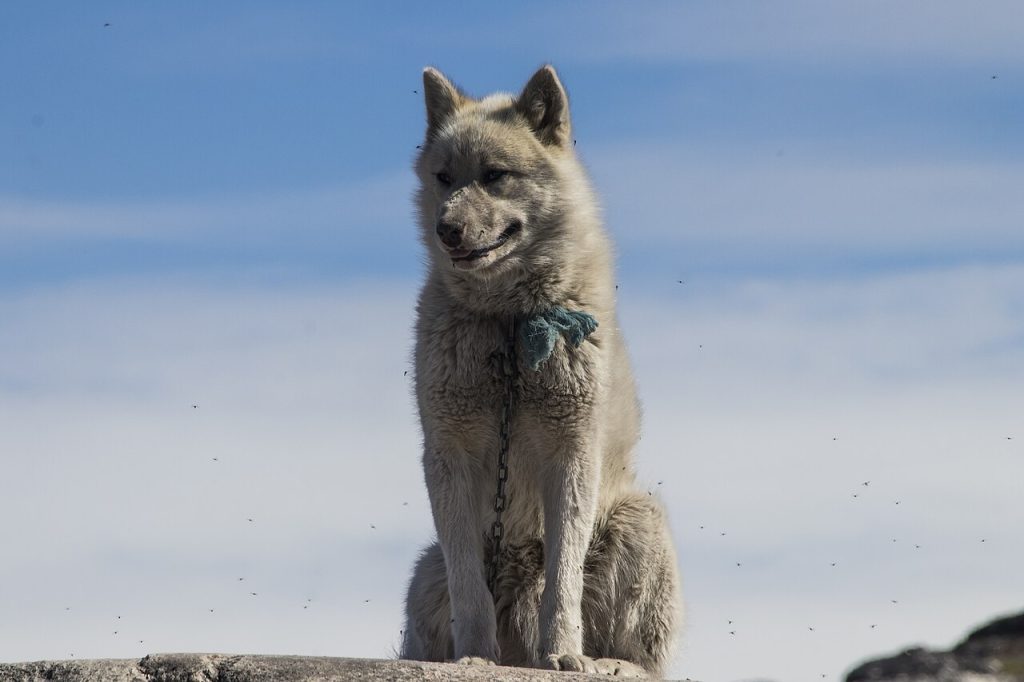
The Greenland dog(Grønlandshund in Danish, Kalaallit Qimmiat in Greenlandic) is one of the oldest dog breeds on the planet: a powerful arctic sled dog who for over a millennium has been pulling sleds, hunting seals and surviving the harshest winters on Earth with the Inuit. It’s not a floor pet or a dog for beginners, but an endurance athlete born to work in the snow. If you’re looking for a rustic, independent companion with almost inexhaustible energy, here’s a complete and honest portrait.
Is the Greenland Dog for you?
Before you fall in love with its wolf-like appearance, be realistic: The Greenland Dog is a pure working dog, selected for centuries for its strength and endurance, not for its docility or its adaptation to domestic life. Outside of its arctic environment and a very active life, it is easily frustrated. Weigh these pros and cons well before taking the step.

In favour .
- Extraordinary physical endurance – a tireless distance runner.
- It tolerates extreme cold better than almost any other breed.
- Rustic, healthy and low maintenance.
- Independent and balanced; not a nervous or destructive dog if working.
- Sociable with people and less aggressive with humans.
- A piece of living history: one of the oldest races in the world.
Against
- Huge exercise needs: not fit on a floor or in a sedentary lifestyle.
- It suffers from heat and humidity; hot weather harms it.
- Very independent: poor candidate for fine obedience or guard.
- Strong prey instinct for seals, birds and small animals.
- He howls instead of barking and can be very vocal.
- Rare breed outside the Arctic and hard to come by.
In short: it is a wonderful dog for those who live in a cold environment, practice shooting or skiing sports and are looking for a resistant adventure companion.
Character and temperament
The temperament of the Greenland Dog is summed up in three words repeated by standards and breeders: energy, mental strength and audacity. It is a tireless sled dog, cheerful at work and remarkably austere: when first hooked on the harness as a puppy, it is happy to pull.
It’s a kind and sociable with people dog, even with strangers, which makes it unsuitable as a guard dog. Its great feature is the independence: He doesn’t bond intensely to a single owner like a shepherd would, but he maintains a more functional, equal-to-equal relationship with his human. This does not mean coldness, but autonomy: He thinks for himself and makes decisions, a vital quality when pulling a sleigh on treacherous ice.
It retains a hunting instinct mark, inherited from generations chasing seals and polar bears.
Coexistence: children, other pets, flat and loneliness
The Greenland Hound is primarily a pack dog used to living outdoors. Its fit in a conventional home is highly dependent on the environment.

With children: is generally friendly and tolerant of people, and its character is not aggressive towards humans. However, due to its size, strength and independent nature, coexistence with small children should always be supervised and it is advisable to teach small children to respect the dog.
With other pets: has an intense prey instinct that makes it unreliable with cats, rabbits, or other small animals. With other dogs it is usually understood, as it is genetically predisposed to live in packs, although it can show dominance and competition among males.
On the floor: completely discouraged. It is a large, very active dog and made for the cold and open space. It needs at least a large garden and, better still, a rural or mountain environment.
Soledad: is a social pack dog that does not do well in prolonged isolation. Without company or activity, it can become vocal and restless.
Education and training
Training a Greenland Dog is not like training a Labrador. Its independence and its habit of making its own decisions make it not systematically compliant. It is not a dog that will excel in competitive obedience or elaborate tricks; its brain is wired to pull a sled and survive, not to sit in line twenty times in a row.
The keys to educating him well are:
- Early socialization with people, dogs and environments from a puppy.
- Positive reinforcement and short sessions: bored with monotonous repetition.
- Calm and Consistent Leadership: responds poorly to hardness and incoherence.
- Channel your instincts. towards real work (shooting, canicross, mushing) instead of repressing it.
It’s a dog for experienced, patient, active owners who understand that their value lies in their endurance and autonomy, not in submission.
Exercise and activity
This is the most important point of the whole chart. The Greenland Dog is a endurance athlete bred to traverse rough terrain at a good pace for hours. Its need for exercise is among the highest in the canine world and is not met with a couple of walks a day.
The ideal exercise is the shooting work: mushing with sled or cart, canicross, bikejöring, skijoring or long mountain hiking. It needs to burn real energy, with prolonged and demanding efforts. A Greenland dog that does not get enough exercise becomes a frustrated, vocal and potentially destructive dog.
A critical detail: he works in the cold, not the heat.. Its double insulating layer makes it incredibly resistant to sub-zero temperatures, but it suffers and can overheat easily in temperate or hot climates.
Care: fur and hygiene

The coat of the Greenland Dog is double: a thick, woolly inner coat that insulates it from the cold, and a longer, rougher, waterproof outer coat that repels water and snow.
In the day-to-day maintenance of the hair is it ‘s simple .: a weekly brushing is enough to keep it in order. The big exception is the seasonal change: twice a year it releases the undercoat massively, and during those weeks it needs frequent brushing to remove the dead hair. It does not require hairdressing or cuts; its mantle is functional and should not be shaved.
The rest of the hygiene is the usual: check ears, teeth and pads (large and robust, adapted to ice) and cut nails when needed.
Foodstuffs
As a large working dog with a very high energy expenditure, the Greenland Dog needs a high in protein and high in fat diet that supports its musculature and its enormous wear and tear.
In a modern home, the key is adjust the ration to the activity level: a dog that mushes vigorously may need twice as many calories as one that is hibernating. It is an austere and efficient dog that makes good use of food, so you need to make sure that it does not gain weight in periods of less exercise. It distributes food, ensures fresh water at all times, and adapts the feed or diet to a large, highly active dog.
Health and life expectancy
The Greenland Dog is a extraordinarily rustic and healthy. breed. Centuries of natural selection in a harsh environment have produced a robust dog, with very little burden of hereditary diseases compared to many modern intensive breeds.
The most relevant health care has to do with its arctic physiology: it tolerates heat and humidity very poorly., so it must be protected from heat stroke. As in all large and active breeds, it is advisable to monitor the joints and avoid overstrain of the puppy.
Physical appearance
The Greenland Dog is a strong and of heavy constitution dog, a polar wolf air spitz.
- Tamaño: large. Males measure approximately 60-68 cm at the withers and females about 55-61 cm; males are clearly larger than females.
- Cabeza: wide and wedge-shaped, with small, triangular, erect ears, covered with thick hair that protects them from freezing.
- Ojos: somewhat oblique, frank and boldly expressive.
- Cola: of high insertion, thick and thick, which is wrapped over the back; when lying down to rest usually covers the muzzle with it.
- Manto: double layer (woolly inside, rough and waterproof outside) of medium length.
- Color: supports all colors, from black to lionside, except albino and the merle pattern.
A curious feature of the standard is the «úlo»: a triangular area over the shoulders, named after a traditional Greenlandic woman’s knife with the same shape.
Origin and history
The Greenland Dog is literally one of the oldest dogs in the world., recognized as such even by Guinness World Records.
The first dogs arrived in Greenland about 4,000-5,000 years ago with the Paleo-Eskimos of the Saqqaq culture. However, the current dog line arrived around 1,000 years with the Thule people, which migrated from Siberia to North America bringing with it these shooting dogs, along with the Canadian Eskimo Dog. In fact, genetic studies indicate that the Greenland Dog and the Canadian Eskimo Dog are essentially the same breed: have not diverged sufficiently despite their geographical isolation.
A 2020 genetic study showed that Greenland sled dogs have remained isolated from other breeds since their arrival with the Inuit, and that their lineage can be traced back to remains from Zhokhov Island, in northeastern Siberia, dated to about 9,500 years ago. They also share some ancestry with the extinct Taimyr wolf, an ancient introgression that may have provided adaptations to extreme cold.
In Europe it was soon known: a female “eskimo” was exhibited at one of the first dog shows, in Darlington (England) in 1875, and the breed was recognized by the Kennel Club at its founding in 1880. His most glorious moment came with polar exploration: Roald Amundsen used dogs from Greenland. in his 1911-1912 expedition and became the first man to reach the South Pole, thanks in large part to the resistance of these animals.
Today the breed is a cultural symbol of Greenland. To protect their purity, in the north and east of the country it is forbidden to import other dogs, and since 2017 all specimens must be microchipped and registered. Even so, its population is declining (about 12,000-15,000 in Greenland according to recent censuses) because snowmobiles and motor vehicles have reduced its role as a draft animal. Several projects seek to safeguard both the breed and the culture of dog sledding.
Curiosities
- He doesn’t bark, he howls. Like many Nordic dogs, it communicates by howling, solo or in chorus, to express grief or joy: what the Anglo-Saxons call the “cry of the wild”.
- He took Amundsen to the South Pole. Its resilience was key to the first human conquest of the South Pole in 1911.
- The “Ulu” of Shoulders takes its name from a traditional Greenlandic woman’s knife with a triangular shape.
- Cola-manta. When resting, it curls up and covers the snout with its thick tail to conserve heat.
- It’s practically the same dog. than the Canadian Eskimo Dog: genetics does not distinguish them as separate breeds.
- Culturally endangered breed: Greenland legally protects its purity and fights to keep the mushing culture alive.
If you are attracted to the Nordic, rustic and independent nature of the Greenland Dog, you may also be interested in other Arctic and sled breeds with which it shares history and temperament. Husky Siberiano Samoyedo Chow Chow Akita
Frequently Asked Questions About the Greenland Dog
Is the Greenland Hound a good pet to live in?
Only in the right environment. It is a very high-energy sled dog, made for the cold and work, and does not fit on a floor or in a sedentary life. It can be a great companion for active people who live in cold climates and practice shooting or hiking sports, but it is a poor choice as a conventional urban pet.
How much exercise does a Greenland dog need?
Very much. He is an endurance athlete designed to pull sleds for hours, so he needs intense and prolonged exercise daily: mushing, canicross, bikejöring or long mountain walks. Without enough activity he becomes frustrated, howls and can become destructive.
Does the Greenland Dog bark a lot?
In fact, it barks hardly at all: like other Nordic dogs, it communicates mainly by howling, often in a chorus.
Is he a good guard dog?
No. The Greenland Hound is sociable and friendly with people, including strangers, and its strong independence means that it does not bind or protect a single owner like a guard dog.
Do you get along with other dogs and cats?
With other dogs it is usually understood, as it is genetically prepared to live in packs, although it can show dominance among males.
Can you handle the heat?
No, its double insulating mantle makes it resistant to extreme cold, but it suffers greatly from heat and humidity, with the risk of overheating.
How long does a Greenland dog live?
It is a very rustic and healthy breed, with little burden of hereditary diseases. Its life expectancy is typical of a Nordic working dog of its size, around 12-14 years when it leads an active and balanced life.
Is it the same as the Canadian Eskimo Dog?
Studies show that the Greenland Dog and the Canadian Eskimo Dog are descended from the same Thule dogs and have not diverged enough to be considered distinct breeds, despite their geographical isolation.