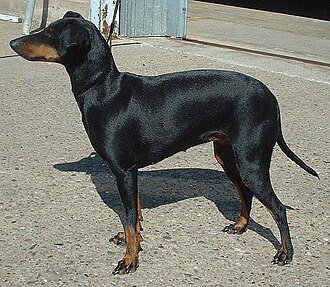
The Manchester Terrier is a black and fire terrier, slender and athletic, that looks like a Doberman in miniature without being related to him. Born on the streets of 19th-century England as a rat hunter, today he’s an alert, loyal and surprisingly easy-to-maintain companion. If you’re looking for a small-to-medium dog with greyhound elegance and terrier character, the Manchester Terrier deserves your attention.
Is the Manchester Terrier for you?
Before you fall in love with his image, you should know what kind of dog you’re going to engage with. The Manchester Terrier is active, smart and very attached to his family, but he also has the hunting instinct embedded in his DNA. These two boxes summarize the good and what you should value with a cool head.
In favour .
- Short, clean hair: minimal maintenance and almost no dog smell.
- Practical size: comfortable on the floor but really sporty.
- Very intelligent and eager to please, he learns fast.
- Loyal, affectionate and attached to his people.
- Healthy and long-lived in well-bred lines.
- Good warning: detects and alerts you to anything new.
To be taken into account
- High prey instinct: rodents, cats and small pets are a challenge.
- He needs daily exercise and mental stimulation, he’s not a couch dog.
- Friolero: short hair leaves him exposed to cold and humidity.
- Stubborn and opinionated if you don’t set clear boundaries.
- It can bark to warn you if you’re bored or lonely too much.
- Rare breed: Finding a serious breeder can be expensive.
Character and temperament

The Manchester Terrier is a “city” terrier, and this is evident in its character. It is alert, observant and tremendously curious: nothing that happens at home escapes it. Unlike some more stubborn and stormy terriers, the Manchester Terrier combines the spark of the terrier with an affectionate and eager to please note that makes it very pleasant to live with.
He is brave and grows up in the face of challenge – not for nothing he was raised to face rats in closed spaces – but with his family he is affectionate, sensitive and very attached.
In Victorian times it earned the nickname “the gentleman’s terrier” (Gentleman’s Terrier) for its dignified and elegant demeanor. Today it maintains that curious mix of fine dog on the outside and pure terrier on the inside: alert, determined and with a hunting instinct that should not be underestimated.
Coexistence: children, other pets, flat and loneliness
Due to its urban origin, the Manchester Terrier adapts well to different households as long as you meet its needs for movement and companionship.
- Niños: gets along well with children and enjoys playing, especially if you grow up with them.
- Other dogs: usually socializes smoothly if accustomed from puppyhood, although it can pull the character out with very dominant same-sex dogs.
- Cats and small pets: here is the big “but”. Its prey instinct is strong; with a cat it can learn to live if raised alongside it, but with rodents, rabbits or birds it is not advisable.
- Life on the floor: is one of the most floor-friendly terriers for its size and clean coat, provided it goes out to expend energy daily.
- Soledad: tolerates moments alone, but not whole days, and if he spends too much time bored and isolated, he may bark or seek mischief.
Education and training
The Manchester Terrier is very intelligent and learns quickly, which plays in your favor and against you if you let it make decisions, it has its own criteria and, like a good terrier, it can become selective or stubborn if the sessions are boring or if it perceives inconsistencies in the rules.
The key is positive reinforcement: Rewards, play, and a gentle voice work much better than toughness, which only gets you to shut up. Short, varied, and entertaining sessions keep your attention. Socialization (people, dogs, noises, city) and calling should be worked on from puppyhood, because their prey instinct can make them run after a squirrel or a cat, ignoring your voice.
It is a breed with abilities for canine sports such as agility, obedience or earthdog; channeling its mental energy into a structured activity greatly reduces behavioral problems.
Exercise and activity

Don’t be fooled by its size: inside that slender body is an athlete with Whippet blood. The Manchester Terrier needs real daily physical activity, not a couple of short walks to the gate. With a good long walk plus some playing or running time it is usually satisfied.
He especially enjoys running, chasing toys, and sniffing. Activities that combine body and head – searching for hidden prizes, sniffing games, agility sessions – are ideal because they satiate his physical and mental need at the same time. A well-exercised Manchester is quiet at home; a bored one finds his own, usually annoying amusements.
Because of its short hair, it needs a coat for long walks in winter and avoids the hottest hours in summer, and remember: in open, unfenced areas, its hunting instinct recommends a leash or a well-trained recall.
Care: fur and hygiene
Here the Manchester Terrier is a gift. Its short, smooth, dense and shiny coat hardly requires maintenance: a weekly brushing with a glove or brush of soft bristles is enough to remove the dead hair and maintain the shine. It has no woolly undercoat, so the coat is discreet and the characteristic dog smell is minimal.
Wash him only when he’s really dirty; too many baths dry out his skin. The rest of the hygiene is routine: checking and cleaning his ears, cutting his nails when they hit the ground, and taking care of dental hygiene with regular brushing to prevent tartar.
Foodstuffs
The Manchester Terrier has no special dietary requirements, but it is advisable to adjust to its athletic constitution. A complete and quality diet, adapted to its age, weight and activity level, keeps its muscles and hair in good condition.
It’s a dog with fine bones and a marked silhouette, so control of rations is important: Overweight strains your joints and reduces agility. Divide the food into one or two servings a day, measure the quantities, and use part of the ration as a reward in training so as not to overdo it. Always have fresh water available and check with your veterinarian for any adjustments, especially in puppies and older dogs.
Health and life expectancy
Overall, the Manchester Terrier is a robust and long-lived breed. Its life expectancy is around 12 to 14 years, with a median close to 13 years according to British Kennel Club health studies, and a good portion of specimens reach old age in good shape.
That said, there are some hereditary disorders that are worth knowing about and for which it is worth requiring testing from breeders:
- Lens dislocation and secondary glaucoma: a relatively common eye problem in terriers, in which internal pressure displaces the lens; it may require surgery.
- If you have von Willebrand disease: is a blood clotting disorder that causes bleeding (gum, nose). It is recessive in heredity and there are DNA tests to detect it and prevent cross-carriers.
Buying from a responsible breeder who performs genetic testing, keeping vaccines and deworming up to date, taking care of diet and checking mouth, eyes and ears are the best tools for your Manchester to enjoy a long and healthy life.
Physical appearance

The Manchester Terrier is a compact, elegant and highly refined dog, with an air reminiscent of a Doberman as a small dog.
The head is long, narrow and wedge-shaped, with a flat skull and a sharp snout. The eyes are small, dark and bright, with lively expression. The ears can be small and bent forward (buttoned) or upright, depending on the specimen and variety.
His trademark is the black and fire(black and tan) cloak: an intense, well-defined azure black combined with mahogany markings on the eyebrows, cheeks, muzzle, chest and extremities, with a sharp separation between the two colours. The hair is short, smooth, tight and very shiny. In terms of size, males measure about 41 cm at the withers and females about 38 cm, with an approximate weight of between 5 and 10 kg in the standard variety.
Origin and history
The Manchester Terrier was born in nineteenth-century England, in the midst of the industrial revolution, in overcrowded, rat-infested cities like Manchester itself.
Its direct predecessor was the old Black and Tan Terrier, a legendary hunting dog. Breeder John Hulme is credited with the idea of crossing it with the Whippet to produce a dog that stood out in both rat-baiting competitions and rabbit racing. From that crossing came a fast, agile, aerodynamic terrier. It is believed that the Italian Greyhound and the Teckel may also have been involved in their formation.
By 1860, the city of Manchester had become the breeding center of these terriers, and from there they took their definitive name at the end of the century. The race lived through difficult times: The ban on rat fights, the ban on cutting off ears, and most of all, World War II almost wiped it off the map. In 1945 there were only 11 registered in the Kennel Club. Thanks to the efforts of a group of enthusiasts and the British Manchester Terrier Club, the breed survived, although today it is still listed as a vulnerable native breed in the UK, with very few births annually.
In the FCI nomenclature, the Manchester Terrier belongs to Group 3 (Terriers), Section 1 (large and medium sized terriers), with standard number 71, and its country of origin is Great Britain.
Curiosities
- He was called “the terrier of the gentlemen” in Victorian times for his elegant and dignified demeanor.
- Despite the striking resemblance to the Doberman, there is no kinship between the two breeds; it is pure coincidence of pattern and silhouette.
- It carries Whippet blood, which explains its aerodynamic body and unusual terrier speed.
- There is a miniature version, recognized in some countries as the Toy Manchester Terrier and in the United Kingdom as the English Toy Terrier (black and fire), considered a separate breed.
- He was so effective at hunting rats that a Manchester called Tiny the Wonder became famous in the mid-19th century in competitions of the time.
- It is one of the most at risk native British breeds, with very low registration figures despite its many virtues as a companion dog.
If you are attracted to this stylish, sporty terrier, you may be interested in other breeds with a similar profile. The Dóberman Pinscher shares its black-and-fire pattern and its larger-scale athletic bearing, while the Pinscher Miniatura is another brave little one of fine lines. For the faster side of his heritage, take a look at the Whippet, his own ancestor, and if you’re looking for another energetic mouse terrier, the Jack Russell Terrier is a very popular alternative.
Frequently Asked Questions about the Manchester Terrier
Is the Manchester Terrier a good dog to live on the floor?
Yes, it is one of the most suitable terriers for the floor because of its small size and its short and clean hair.
How long does a Manchester Terrier live?
Their life expectancy is around 12 to 14 years, with a median close to 13 years according to Kennel Club health studies. With good care and a healthy line, many reach old age in good shape.
Do you get along with children and other dogs?
Yes, it enjoys children and usually gets along well with other dogs if socialized as a puppy.
Does the Manchester Terrier shed a lot of hair?
Their coat is short, smooth, and without woolly undercoat, so the coat is discreet and requires only a weekly brushing.
Is the Manchester Terrier the same as the Doberman?
Although they are very similar in their silhouette and their black coat and fire, they are distinct and unrelated breeds. The Manchester is much smaller and was born as hunter rats in 19th century England.
How tall and how much does a Manchester Terrier weigh?
In the standard variety, the males measure about 41 cm at the cross and the females about 38 cm, with an approximate weight of between 5 and 10 kg.
Do you need a lot of exercise?
Yes, more than its size suggests, it carries Whippet blood and enjoys running and chasing, a good long daily walk plus play or olfactory work keeps it balanced, bored tends to bark and seek trouble.
Is it an easy breed to find?
Not too much. It is listed as a vulnerable native breed in the UK and has few births a year, so it is advisable to seek out a responsible breeder early to perform the recommended health tests.