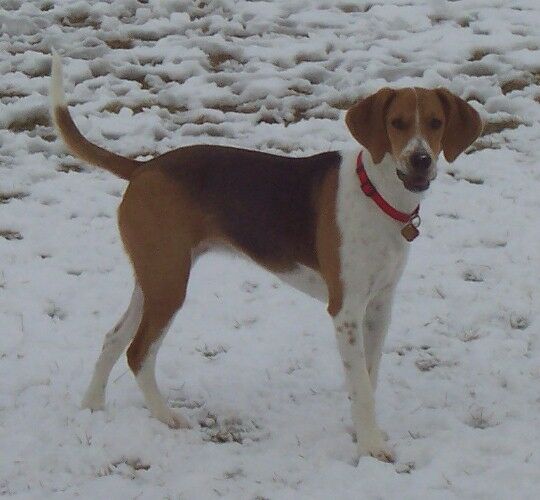
The Harrier is a medium-sized British sighthound, bred for centuries to chase hare in packs by following the trail with its nose glued to the ground. It reminds me of a miniature English Foxhound and a full-grown Beagle: Athletic, tireless and deeply sociable. If you’re looking for a cheerful, resilient, well-balanced dog, the Harrier is one of the most noble hunting breeds in existence, although it requires daily movement and companionship.
Is the Harrier for you?
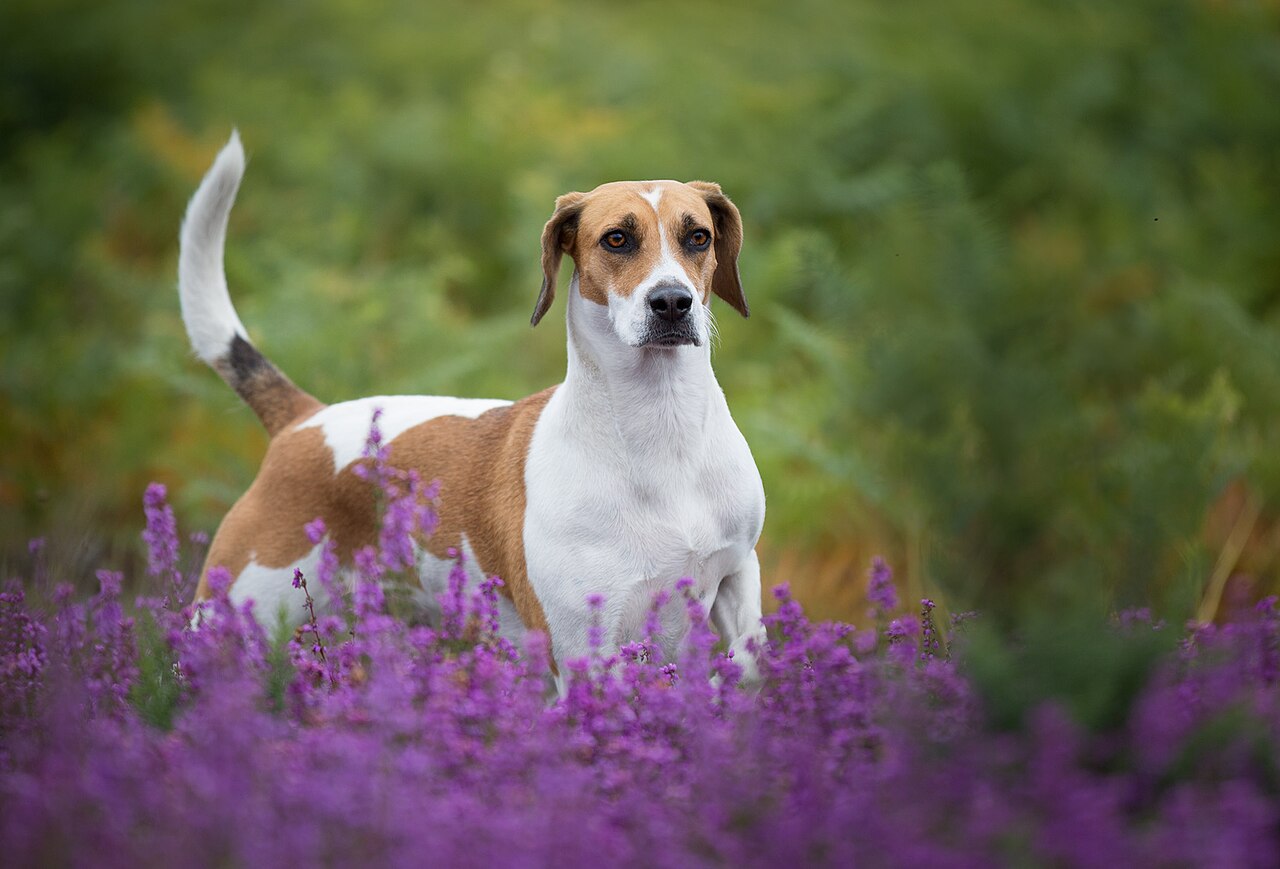
The Harrier is a gentle, hardworking dog that fits in well with active households, but it is not the ideal breed for a sedentary life or for someone who spends many hours away from home.
In favour .
- Cheerful, balanced, and very tolerant of people.
- Excellent with children and, by her herding instinct, sociable with other dogs.
- Short coat that barely needs maintenance.
- Robust, resistant and with a very good life expectancy (12 to 15 years).
- Intelligent and capable; enjoys exploring, tracking and working.
To be taken into account
- It needs vigorous daily exercise; bored it becomes destructive.
- Very strong tracking instinct: tends to follow smells and escape.
- Some birds bark and howl with a powerful voice.
- It is advisable to supervise with small pets other than dogs.
- It’s a rare breed; finding breeders can be expensive.
Character and temperament
If we had to summarize the Harrier in one word, it would be “cheerful”. It is a pack dog by nature, which translates into a sociable, cooperative and remarkably tolerant temperament with people. It rarely shows aggression; its default attitude is that of a friendly companion who likes to be part of a group, be it of humans, dogs or both at once.
That same herd inheritance explains their other side: The Harrier is an active, curious dog with a nose that commands everything else. He loves to explore, smell and follow trails, and when he catches an interesting scent he can disconnect from the world and start “working” on his own. It’s not stubbornness or malice, but pure instinct: For more than seven centuries, it’s been selected for precisely that.
At home, it is balanced and affectionate, away from the nervousness of some small breeds. But it is worth understanding that a happy Harrier is a tired Harrier: it needs physical and mental stimulation to bring out its best version. Without it, this sweet character can transform into hyperactivity and annoying behavior. It is an honest, unyielding dog, which returns more than the time you devote to it.
Coexistence: children, other pets, flat and loneliness
- With children: is one of its great virtues. The Harrier is patient, playful and resistant, which makes it an excellent companion for families with children.
- With other dogs: excellent. bred to live and hunt in packs, enjoys canine company and usually integrates smoothly. in fact, many Harriers are more balanced when they have a companion dog.
- With cats and small pets:‘s hunting instinct is high, so it is advisable to supervise him with animals other than dogs, unless he was raised with them as a puppy.
- On the floor: can adapt to a normal home and even a flat, but only if you cover its need for daily exercise.
- In the face of loneliness:‘s weakness is that as a good pack dog, he prefers company and is unwilling to spend long hours alone. Prolonged isolation favors boredom, howling and destructive behavior.
Education and training
The Harrier is intelligent and willing to cooperate, but its independence as a dog requires patience and perseverance from its owner. It is not a dog that obeys for the sake of obedience: it responds much better to positive reinforcement, food rewards and short, varied and fun sessions than to monotonous repetition or harsh methods, which only block it.
The great challenge is the called. When a Harrier catches a trail, its nose can do more than your voice, so recovery (returning when called) must be worked on from puppyhood and reinforced throughout life. Until you have a very solid call, it is prudent to release it only in fenced and safe areas; in open field, a long leash is your best ally.
early socialization is key: exposing it as a puppy to people, noises, environments and other animals builds the balanced adult that this breed can become, and given its tracking instinct, scent games and nose work are not a whim, but an educational tool: they channel its mind and prevent the boredom that is behind almost all of its behavioral problems.
Exercise and activity

This is the section that decides if the Harrier is your dog or not. It was bred to run and work for hours following hares, and that endurance is still intact. It needs daily and real exercise: long, vigorous walks, running, jogging by the bike or field days. A short walk around the block is not enough for it.
The good news is that it is an adaptable dog: with the right dose of activity, it relaxes perfectly at home and coexists well in a normal home. The bad news is that without that outlet, the Harrier tends to become hyperactive, gain excess weight and seek “entertainment” on its own, often in the form of debris. It is not a capricious dog: it simply has a motor that must be used.
Beyond physical expense, he appreciates mental stimulation. Canine sports that reward smell and endurance – tracking, mantrailing, canicross – come as rings on his finger and strengthen your bond. A Harrier that runs, sniffs and works is a calm and happy dog at home.
Care: fur and hygiene
In terms of maintenance, the Harrier is one of the most grateful breeds. Its hair is short, dense, and hard, and it only needs occasional brushing to remove the dead hair and distribute the natural fat that keeps the coat shiny.
Bathing should be punctual, only when it is really dirty, so as not to dry out the skin, but it is advisable to pay attention to their drooping ears: as they are poorly ventilated, they retain moisture and are more prone to infection, so they must be checked and cleaned regularly, especially after going out in the field or getting wet.
The rest is the basic hygiene of any dog: cutting his nails when necessary, brushing his teeth frequently to take care of his oral health, and checking his pads and skin after hikes.
Foodstuffs
The Harrier is an athlete, and its diet should be at the height of its activity. It needs a complete and quality food, with a good supply of protein to maintain its musculature and the energy it spends daily. The exact amount depends on its weight, age and, above all, the actual exercise it does: a working Harrier eats considerably more than a companion with moderate walks.
The critical point is the weight control. Like a good dog, it is gluttonous and tends to get fat when it does not burn what it eats, and overweight punishes its joints and its general health.
To reduce the risk of gastric torsion – something to keep in mind in deep-breasted dogs – it is wise to avoid strenuous exercise just before and after eating. And, as always, fresh water at your discretion and a gradual transition to any change of feed.
Health and life expectancy
The Harrier is a rustic and robust dog, with a life expectancy is around 12 to 15 years, an excellent figure for a medium-sized dog.
The most documented health problem in the breed is hypoplasia of the hip, a hereditary-based joint malformation that can lead to pain and osteoarthritis with age.
As with other dogs with droopy ears, it is advisable to keep an eye on the ear infections, and because of its deep chest it is not uncommon to know the signs of gastric torsion.
Physical appearance

The Harrier is a medium-sized, muscular and well-proportioned hound, with an unmistakable hunting dog air. The specimens measure between 48 and 53 cm to the cross and weigh approximately between 20 and 30 kg. It is somewhat longer than tall, with a firm, level dorsal line, strong bones and a structure designed for endurance and strength rather than pure speed.
The head has a broad skull and a strong, square snout, with rounded, dangling ears, attached to the head. The eyes, brown or hazel, convey a serene expression when the dog is relaxed and attentive when something catches its interest. The truffle is broad and black, and the bite should be on scissors. The tail is of medium length and carries it high, without twisting it over the back. The feet are compact and “cat-like”.
The coat is short, hard and attached to the body, and supports a a wide variety of colour combinations. The tricolor pattern – white, black and fire – is most associated with the breed, although specimens also appear in lemon and white tones or other blends.
Origin and history
The Harrier is a breed with centuries of history and, paradoxically, an uncertain origin. Sources offer versions that don’t quite match: Some argue that the first Harriers were crossed with Bloodhounds, the Talbot Hound and even the Basset Hound; others derive it from crosses of the English Foxhound with Fox Terrier and Greyhound; and a third considers it, simply, a reduced version of the English Foxhound. What is beyond doubt is its antiquity: This type of hound has been used since at least the middle of the 13th century.
His own name tells his story. “Harrier” is related to “harehound”, the hare hound, because the breed was developed primarily to hunt hares in packs, although it has also been employed in fox hunting. In size it is placed just between the Beagle and the English Foxhound, and for centuries it was a very popular working dog in England. In Ireland it became the most commonly used hound in hunting, with more than a hundred and a half packs scattered throughout the country.
The race lived through periods of glory and decline. It was among the first breeds recognized in the book of origins of the British Kennel Club in 1874, and the American Kennel Club recognized it in 1885 within the group of hounds (Hound Group). However, the two world wars and the dissolution of many private packs made it almost disappear from the field of hunting, to the point that the British Kennel Club withdrew its recognition in the early seventies.
It was the fans of France and the United States who kept the breed alive during those difficult decades. The recovery has been recent: The UK Kennel Club re-recognised the Harrier in January 2020, and it has since returned to exhibitions after more than a century of absence. Today, it is still a rare breed – estimated to number a few hundred in some countries – making it a real jewel among pack dogs.
Curiosities
- The earliest known description of the Harrier appears in the poem The Chace, written by the Englishman William Somervile in 1735.
- He has been humorously described as “a Beagle on steroids”, for resembling a large, muscular Beagle despite being more reminiscent of the English Foxhound.
- Its name comes from “harehound”, indicating what it was created for.
- It is a very rare breed, with only a few hundred left in some countries, making it one of the rarest hounds in the world.
- After decades away from the rings, she returned to UK exhibitions in 2020-2022, exhibiting for the first time in over a hundred years.
- In the United States it has been featured in prestigious competitions such as the Westminster Dog Show, where specimens of the breed have been awarded the “Best of Breed”.
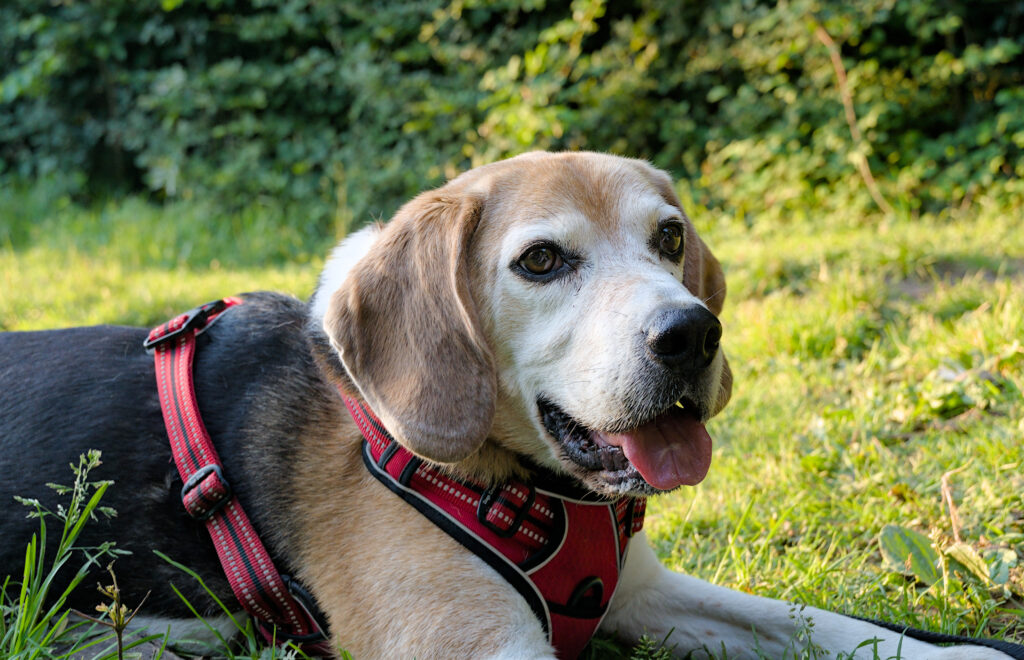
If you are attracted to the sociable nature and energy of hounds, there are other breeds that share their tracking instinct and sociability that are worth knowing. The Beagle is its smaller close relative and one of the most popular hounds in the world. The American Foxhound and the towering Bloodhound share with him the heritage of the pack and an extraordinary smell, while the Basset Hound offers that same hound temperament in a very different format. All of them are friendly-nose dogs, spiritual cousins of the Harrier.
Frequently Asked Questions about the Harrier
Is the Harrier a good family dog?
Yes, he’s cheerful, balanced, and very tolerant of people, and he excels especially as a companion to children, although he’s better suited to active families who can give him the daily exercise he needs.
How much exercise does a Harrier need?
He was raised to run and work for hours, so he requires vigorous exercise every day — long walks, running, or olfactory sports.
Does the Harrier bark or howl a lot?
Like good pack dogs, some dogs tend to “sing” or howl (the so-called baying) with a powerful voice, especially when bored or sensing an interesting trail.
Does the Harrier get along with other dogs and cats?
With other dogs, excellent: it is a pack dog and enjoys canine company. With cats and small pets, it is advisable to supervise it for its hunting instinct, unless it has been raised with them since puppyhood.
How long does a Harrier live?
Their life expectancy is around 12 to 15 years, a very good figure for a medium-sized dog.
Is it hard to train the Harrier?
It is intelligent and collaborative, but its independence as a dog requires patience. It responds very well to positive reinforcement. The biggest challenge is the call: when it follows a trail, its nose commands, so recovery must be trained from a puppy.
How does the Harrier differ from the Beagle and the Foxhound?
It’s a matter of size. The Harrier sits right in between: it’s bigger than the Beagle and slightly smaller than the English Foxhound, which it looks a lot like. Hence the popular description of “a steroided Beagle”.
Can the Harrier live on one floor?
It can adapt to a floor if you cover its need for daily exercise, as it is a dog that relaxes well at home when it is tired. Its downside is prolonged solitude: it prefers company and may get bored if it spends many hours alone.